


DNA vaccines will soon become the Generation 3 Covid vaccines. These are easy to design, cheap to manufacture and expected to be variant independent.
The problem with the DNA vaccines is because it's never been used on humans before as none of them went beyond the Phase II trials.
The core problem - Human cells don’t readily take in foreign DNA or mRNA. After injection, much of the vaccine would remain inert in the body and eventually break down, without triggering a good immune response.
But recently BioNTec, Moderna and CureVac overcame this problem by packaging the vaccine with lipid nanoparticles, (these are tiny fat droplets) which fuse with the cell membrane and help the vaccine get inside.
But sadly this approach does not work well with a DNA vaccine. DNA, is a large molecule, and has to penetrate not only through the cell’s outer layers but also through the cell’s nuclear membrane into the nucleus. Unlike an mRNA vaccine, which can function in parts of the cell outside the nucleus, a DNA vaccine can function only inside the nucleus.
Quite simply the standard delivery using an injection is ineffective.
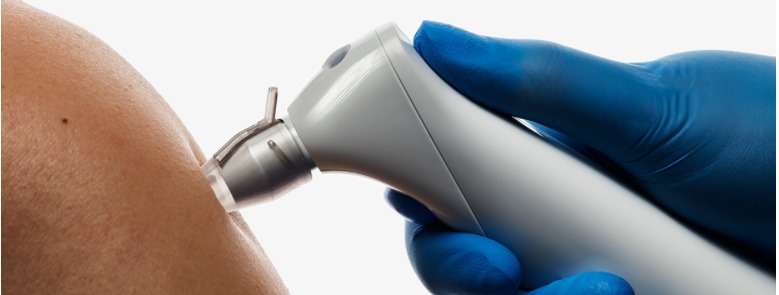
One method to overcome this limitation is by using "electroporation" which was found to be the most promising technique. Just a few days ago Inovio released their latest electroporation device, the Cellectra 3PSP, is handheld and battery operated. It can deliver about a hundred doses on a single charge and has a life-span of about 5,000 uses, due to battery limitations. Each use requires a disposable tip. As with more conventional vaccines, the injection site is the upper arm. Vaccination starts with an intradermal injection of the vaccine dose—a shot that’s only skin deep. Then, the tip of the Cellectra device is pressed against the skin, directly over the location of the shot. Electrodes about 3 millimeters in length administer a series of four square-wave electrical pulses that last 42 milliseconds each, at 0.2 amperes.
The pulses cause nearby cells to temporarily open channels through which the vaccine can enter. As soon as the electrical pulses finish, those channels close. “Now this DNA molecule is trapped inside the cells,” says Inovio.
Electroporation is generally 10 to 100 times as efficient at provoking an immune response as the same DNA vaccine given by a conventional needle injection alone.
Currently there are several DNA vaccines on trial and this device will certainly make a difference.
The problem with the DNA vaccines is because it's never been used on humans before as none of them went beyond the Phase II trials.
The core problem - Human cells don’t readily take in foreign DNA or mRNA. After injection, much of the vaccine would remain inert in the body and eventually break down, without triggering a good immune response.
But recently BioNTec, Moderna and CureVac overcame this problem by packaging the vaccine with lipid nanoparticles, (these are tiny fat droplets) which fuse with the cell membrane and help the vaccine get inside.
But sadly this approach does not work well with a DNA vaccine. DNA, is a large molecule, and has to penetrate not only through the cell’s outer layers but also through the cell’s nuclear membrane into the nucleus. Unlike an mRNA vaccine, which can function in parts of the cell outside the nucleus, a DNA vaccine can function only inside the nucleus.
Quite simply the standard delivery using an injection is ineffective.
One method to overcome this limitation is by using "electroporation" which was found to be the most promising technique. Just a few days ago Inovio released their latest electroporation device, the Cellectra 3PSP, is handheld and battery operated. It can deliver about a hundred doses on a single charge and has a life-span of about 5,000 uses, due to battery limitations. Each use requires a disposable tip. As with more conventional vaccines, the injection site is the upper arm. Vaccination starts with an intradermal injection of the vaccine dose—a shot that’s only skin deep. Then, the tip of the Cellectra device is pressed against the skin, directly over the location of the shot. Electrodes about 3 millimeters in length administer a series of four square-wave electrical pulses that last 42 milliseconds each, at 0.2 amperes.
The pulses cause nearby cells to temporarily open channels through which the vaccine can enter. As soon as the electrical pulses finish, those channels close. “Now this DNA molecule is trapped inside the cells,” says Inovio.
Electroporation is generally 10 to 100 times as efficient at provoking an immune response as the same DNA vaccine given by a conventional needle injection alone.
Currently there are several DNA vaccines on trial and this device will certainly make a difference.


