World Muslim population- 1996-1998

DJ.ROCKSTAR

Member
Jun 24, 2008
3,937
4
0
IM IN THE ROCKING WOLD
sri_lion said:
Oh! the so called "Dr."Zakir Naik :rolleyes: must be the stupidest doctor I've ever seen!!:lol:

Seriously... his points are so lame, and proven wrong already!!! :lol::lol:

HE IS A JOKE DUDE!!!! Maybe its good for those LAME Indians and Pakis... but not for those who with a correct mindset!! :lol::lol:
ahaa ballak baruwa kiyala kanthak pahath wenna ne :lol::lol::lol::lol::lol:
 

sri_lion

Member
Sep 14, 2006
12,908
102
0
Kuala Lumpur
daddyimmo said:
You've not read it properly..

Show me anywhere in the source where it's related! and come back to me! dont just say the words! I have read it twice and heard more of it before! it's only just a morale issue and not a religous issue!

did the number mazimized or the population there discreased?

dont just say what the the news does not say!

I think I've explained enough.. anybody with a right mind would see how killing people who belongs to other faiths will help in increasing their own followers!!

I'm SAD that you cannot see it and accept it!!!


daddyimmo said:
When say one thing you are asking another thing! then listen!

I didnt say that you're telling that they became muslims by force! (did I mean to you? NO!) they realised Islam is the true religion and became muslims!

Yeah.. well its always easy to outsource all your troubles, sins, behaviors to someone else (like a GOD) rather than taking ownership for what you do!! its easy isn't it?

Rather than try to make an issue out of something that does not exist, I suggest you answer some of the questions gone begging for answers!!! :rolleyes:

And life is so easy when you think every thing happens according to GOD!! :lol:

How did we come here? GOD
Who made the Universe? GOD
Chicken or Egg? GOD

And where's GOD? GOD knows!!!:rolleyes:

See how easy it is!!!
 

savi pabasara

Member
Aug 15, 2008
233
0
0
daddyimmo said:
You've not read it properly..

Show me anywhere in the source where it's related! and come back to me! dont just say the words! I have read it twice and heard more of it before! it's only just a morale issue and not a religous issue!

did the number mazimized or the population there discreased?

dont just say what the the news does not say!


When say one thing you are asking another thing! then listen!

I didnt say that you're telling that they became muslims by force! (did I mean to you? NO!) they realised Islam is the true religion and became muslims!

Yes friend, Now in many of countries muslim is spread not by force.. It happaned in fast... Now it happens only in few countries.. like napal and Bungladesh.... Now your main process of spreading is generating kids...

I say you again and again Muslim spread through the World not because of it is a good religion, but because of Muslim Moms and Dads are hitting the muslim population..
 

nadeeshaF

Member
Aug 17, 2008
533
1
0
DJ.ROCKSTAR said:
ahaa bt 1st u must read bro than u can knw it na :D

uh huh.

I'm asking for empirical scientific evidence for the existence of god. Whatever mentioned in the quran doesn't qualify in that category.

Do you believe everything you read?
 

sri_lion

Member
Sep 14, 2006
12,908
102
0
Kuala Lumpur
DJ.ROCKSTAR said:
ahaa ballak baruwa kiyala kanthak pahath wenna ne :lol::lol::lol::lol::lol:

Sri Lankan Muslims (most of them) run crying to Dr. Naik when someone question about Islam... :lol::lol:

Why you cannot answer? refer to Q'ran everything is there.. so I've told!!!

(Oh! BTW!!! I see you've shortened your siggy.. Thank you! :lol:)
 

savi pabasara

Member
Aug 15, 2008
233
0
0
This is for God...In Muslim and Jews..

Introduction

Some people falsely believe that it is impossible to prove the unexistence of anything, but they are wrong. It can, for example, be proved that there is no even prime number greater than two. Other people use to say that there is no way to prove if there is a god or not, or even that we cannot get any knowledge of god (agnosticism). My opinion as a strong atheist, is that we can in fact prove that god does not exist in the physical world. This document is my attempt to do so.
Definition of the word "god"

To prove the non-existence of god we first need to define the word "god". When christians talk about god they mean an almighty being. This, I think, is the only god that holds, since it is the only god that can be logically justified.
I think it makes most sense if god is female, because only women can give life. Something that even people in the Stone Age understood. Later when wars affected the cultural evolution, and men took control of society, god became male, but the female god still lives on in the expression "Mother earth". It should also be pointed out that an omnipotent god must be either androgyne or sexless. However, in most religions god is male so I will refer to god as 'he', 'him' etc.
Some people (Einstein for instance) believe in a god who is not a personal god, but a Spinozan kind of god. I claim that this god is not a god! To say that god is universe - by getting knowledge of the universe we get knowledge of god - is to redefine the meaning of the word god. This has nothing to do with the word god as it was defined by the "primitive" cultures which preceded our present civilization. He can be excluded with Occam's razor, and most important: Such a god does not hear prayers.
If god is not omnipotent there is nothing that prevents him from being a product of the universe. If that is the case, what makes god divine? Then god would only be an alien, a being of matter; probably containing flesh, blood and DNA like all life we know of. Everything god is able to do would be things that human beings also will be able to do, all his knowledge would be knowledge we will also achieve. In fact humans would be gods, which should lead to some strange kind of humanism!
Many people justify their faith with god as an explanation. What is the meaning of life? Where does time and space come from? Who created the physical constants? et cetera. Because we lack knowledge of these things - and maybe never will, since they are questions like "what is the color of a second?" or "how does sound taste?" - god is there as an explanation.
Let's say that god is the meaning of life, what then is the meaning of god? If god has a nature, who created that nature? If god created time and space, how can god exist without it? Since creation is an event in time, how could god create time? and who created god? To answer these questions god must be almighty, or else you can't explain them. In fact you can if you say god stands above time and space and so on (which he indeed does if he is almighty), but to be able to prevent god from being tied to future phenomena, you must give him the quality of omnipotence so he can stand above everything.
The qualities of an omnipotent god

If god is almighty there are several qualities he must have. They are as follows:
  • He must know everything. Everything that is, everything that has been and everything that will be. To be able to know everything that will be he must know every position and every momentum of every particle in cosmos (Laplace's "World Spirit").
  • He must be worth our worship. A being that is not worth worshipping is no god.
  • He must be able to do anything. If there are things that god can't do, he certainly is not omnipotent.
  • He must be above time. Something that even St. Augustine deduced. But not only that, god must stand above all possible dimensions.
  • He cannot be 'good' or 'evil' or, indeed, have any subjective characteristica. If god is all good, he cannot do evil things and cannot be almighty. Most people would object and say that good can do evil but chooses not to do it. Well, if god is all good he can't choose to do evil things, can he? The theodicé problem

    We also have the theodice problem, stated by David Hume:
    If the evil in the world is intended by god he is not good. If it violates his intentions he is not almighty. God can't be both almighty and good. There are many objections to this, but none that holds since god is ultimately responsible for the existence of evil. Besides, if only god can create he must have created evil. If somebody else (the devil) created evil, how can one know that god, and not Satan created the universe?
    For a good look at the Theodicé problem try The problem of natural evil
Reasons not to believe in god

Heisenberg's uncertainty principle

I have refuted this argument myself. See Refuted proofs for an explanation
The ontological evidence against gods

Neccesary a god is a being that is worth worshipping, so if there is no being worth worshipping there cannot be a god.
Not any of the existing religions can provide such a god. How do we know if there are no undiscovered beings worthy our submission? Well if there is a being that has either failed or not tried to communicate with us that being is not worth worshipping either, so the ontological evidence against god holds, even without complete knowledge of the world.
There is a test, based on the ontological evidence against god, that you can do to try the existence of god. Pray, and ask god to provide you with a clear proof for his existence within a week. After that week, if you have got a proof that god exists, send me the evidence. If not, there are only three reasons I can think of that are plausible: (1) God does not exist, (2) God does not want to or (3) God can't give you this evidence. Because of the ontological evidence, alternative (2) and (3) are not worth your worship and thus they equal alternative (1). So if you get no response there is no god.
The meaning of the word existence

What do we mean by existence? The very definition for existence is that a thing is said to exist if it relates in some way to some other thing. That is, things exist in relation to each other. For us, that means that something is part of our system ('The known world'). God is defined to be infinite, in which case it is not possible for there to be anything other than god because "infinite" is all-inclusive. But if there is nothing other than god then either god cannot be said to exist for the reason just explained, or god is the known world, in which case, by definition, god is not a god.
Occam's razor

Occam's razor was formulated by William of Occam (1285-1349) and says: "Non est ponenda pluralites sive necessitate" or in english: "Do not multiply entities unless necessarily". It is a principle for scientific labour which means that one should use a simple explanation with a few explanatory premises before a more complex one.
Let's say that everything must be created, and that was done by an omnipotent god. A god which stands above time, space, moral and existence, which is self containing and in it self has it's own cause. This entity can surely be replaced by the known world. The world stands above time, space, moral, existence, is self containing and in it has it's own meaning. Most theists agree that god has a nature. Then we must raise the question, who created god's nature? If we just accept that god has a nature and exists without a cause, why not say that the known world just is and that the laws of physics are what they are, without a cause?
God is not really an explanation, only a non-explanation. It is impossible to gain information from non-information so God as an explanation is a dead end. When we have said that the reason for something is that 'god did it that way' there is no way to understand it any further. We just shrug our shoulders and accept things as they are. To explain the unknown by god is only to explain how it happened, not why. If we are to investigate the world and build our views of life from the world, we cannot assume a god. Because adding god as an explanation leaves as many, if not more questions than it explains, god has to be removed with Occam's razor if we are serious in investigating the world.
Some things are impossible to do

There are things that are impossible to do. For example nobody can cover a two-dimensional surface with two-dimensional circles, without making them overlap. It is impossible to add the numbers two and two and get 666. You can not go back in time (without passing an infinite entropy barrier). The number of things that are impossible to do are almost infinite. If god were to be almighty he would be able to do them, but it's impossible to do so.
Some people say that he can only do things that are logically possible to do, but what is? Is it logically possible to walk on water? Is it logically possible to rise from the dead? Is it logically possible to stand above time, space and all other dimensions - and still exist? I'd say that everything which violates the laws of physics are logically impossible and thus omnipotence is logically impossible. Besides if omnipotence is a relative quality there is no way to tell omnipotence from non-omnipotence. For omnipotence to be a valid expression it must be absolute, but we have no objective criteria to measure omnipotence so the word itself is useless.
Omnipotence is impossible due to paradoxes

Another way to disprove the almighty god is that omnipotence leads to paradoxes. Can god make a rock that is too heavy for him to carry? Can god build a wall that even he can't tear down?
Also, if god knows everything, he knows what he will do in the "future" (in any dimension, not necessary the time dimension). He must have known that from the very start of his own existence. Thus god's actions are predestined. God is tied by faith, he has no free will. If god has no free will god is not omnipotent. Another way to put it is that to be able to make plans and decisions one must act over time. If god stands above time he can not do that and has no free will. Indeed, if god stands above all dimensions god is dimensionless - a singularity, nothing, void!
Besides there can exist no free wills at all if god is almighty. If you had a free will, god wouldn't know what you would do tomorrow and wouldn't be omnipotent.
The void creator

If everything must have been created, then god must have been created as well. If god is not created, then everything mustn't have a creator, so why should life or cosmos have one?
Besides this argument has another leap. If everything has a source and god is that source, then god must have existed without it before he created it. So if god created time and space, he must live outside of time and space. Thus he is non-existent. If all life must come from something and that is god, god is not alive and hence non-existent. If moral must come from god, god lacks moral. If logic comes from god, god is illogic. If nature comes from god, god is unnatural. If existence comes from god, god is non-existent. If god is the cause of everything, god is void
We would never notice god

This is not an evidence against god, but rather describes the lack of sense in praying to a god who stands above time.
If god stands above time and created time and space he can not be the first link in a time dependent chain of events. Rather he would affect every step in all chains, and we would only see god in the laws of physics (Davies, 1983, chapter 4). This god is an unnecessary entity to describe the world and should be removed with Occam's razor
If somebody would pray to god and god would listen, the laws would change to achieve the desired result. Thus the world would be different and the prayer would never have been said. Besides god would already (in an "above time" sense of view) know that you would pray, and already have changed the world. Prayers would be totally meaningless. We would already live in the best world possible, and any prayer would be to doubt the wisdom of god.
Even worse: For every prayer said, god has not acted, or else the prayer had been undone. This means that the more people have prayed, the more bad things in the world have persisted. Therefore, the more you pray, the more evil persist (provided god exists and stands above time).
A much better way to change the world is to do it yourself. Then you would know that it was you who made the world better. The effect of prayers are not scientific provable, whilst the effect of actions are. Instead of praying you should set to work at improving your situation. This is what humanism is about.
Nobody really believes in god

Schopenhauer once said something like:
"Man can do anything he wants, but he can not want whatever he wants."
My thesis is that people who claim to believe in god do not really do so. They just wish to believe in god. They somehow feel that their lives are meaningless without god, so they choose to close their eyes to evidence against the existence of god. The christian view is well expressed by Cardinal Ratzinger:
"Religious liberty can not justify freedom for divergence. This freedom does not aim at any freedom relative truth, but concerns the free descicion for a person to, according to his moral inclinations accept the truth." (The times, June 27 1990, p9) [Translated to Swedish in the Swedish version of (Baigenth, Leigh, 1991) and then translated back to english by me]
It's as clear as it can be! For a christian you accept the "truth" according to your moral, and then have to be strong in your faith to keep your believes. You decide a priori what to believe and then try to convince yourself and others that it is true. But theists don't really believe, because to believe something is to take it for true, and just like in Nazareth's song Sold my soul there is no sign of god in the world. When you have the evidence for and against something your sub-conscious works on it and makes a conclusion. The process can't be affected by your will, only delayed or suppressed, which will lead to psychoses, and those are far more common among (catholic) priests than any other group..
I have personal experience of this believing what you want to believe. When I was a child I believed in a lot of crazy things. I thought my stuffed animals were intelligent. I believed in Santa Claus. I thought there were monsters under my bed at night. I even believed in god after I heard some of the tales from the old testament. Then I became older and realized that these things weren't true. When I look back I don't understand how I could believe in them, it must have been that I wanted to do so. (Except for the monsters, which had to do with fear of the dark)
When many religious people are confronted with criticism of their religion they convert to atheism or agnosticism. Examples of people who became critical to the dogmas of christianity are Charles Darwin (Darwin, 1958), Dan Barker (Barker, 19??), Ernest Renan plus many former "Catholic modernists" in the 19th century such as Alfred Loisy and Antonio Fogazzaro (Baigenth, Leigh, 1991). The Catholic modernism evolved in the late 19th century and was banned in 1907 by the Vatican (Baigenth, Leigh, 1991). These people are to me clear evidence that an enlightened person will after considering the facts, reject christianity and other religions that contain deities.
Note: This is not the "Plead to authority" fallacy. I'm talking people here, who were trying to prove the existence of god and turned atheists. They did not want to do this, but had to after reading a lot of books and doing a lot of thinking on the subject.
Epilogue

I have tried to define the only god that can be philosophically justified and show some examples why this god cannot exist. After reading this document you may object and say that god is beyond human understanding and can't be defined in scientific terms. This is the view of agnosticism.
If god is so mysterious, how can we know anything about him? Through the Bible? How do we know that the Bible and not the Koran or the Vedha books, for example, are the words of god? (or the bible if you believe in any of the other two books). Considering the cruelties that have been made in the name of god, how do we know that not all religions are made by Satan?
If there is no way to know this but to trust people who claim they have had "divine experiences" there is no way to tell true from false prophets. One has to give up his free mind and follow the authority of a dictator. Remember also that it is the person making a positive claim who has to prove it.
"I wish to propose for the reader's favourable consideration a doctrine which may, I fear, appear wildly paradoxical and subversive. The doctrine in question is this: that it is undesirable to believe a proposition when there is no ground whatever for supposing it true." -- Bertrand Russell
"We shall not believe anything unless there is reasonable cause to believe that it is true" -- Ingemar Hedenius
 

DJ.ROCKSTAR

Member
Jun 24, 2008
3,937
4
0
IM IN THE ROCKING WOLD
What is Islam?


Among the blessings and favors that God has bestowed upon humanity is
that He endowed them with an innate ability to recognize and acknowledge His existence. He placed this awareness deep in their hearts as a natural disposition that has not changed since human beings were first created. Furthermore, He reinforced this natural disposition with the signs that he placed in Creation that testify to His existence. However, since it is not possible for human beings to have a detailed knowledge of God except through revelation from Himself, God sent His Messengers to teach the people about their Creator Who they must worship. These Messengers also brought with them the details of how to worship God, because such details cannot be known except by way of revelation. These two fundamentals were the most important things that the Messengers of all the divine revelations brought with them from God. On this basis, all the divine revelations have had the same lofty objectives, which are:
1. To affirm the Oneness of God - the praised and glorified Creator – in His essence and His attributes.
2. To affirm that God alone should be worshipped and that no other being should be worshipped along with Him or instead of Him.
3. To safeguard human welfare and oppose corruption and evil. Thus, everything that safeguards faith, life, reason, wealth and lineage are part of this human welfare that religion protects. On the other hand, anything that endangers these five universal needs is a form of corruption that religion opposes and prohibits.
4. To invite the people to the highest level of virtue, moral values, and noble customs.
The ultimate goal of every Divine Message has always been the same: to guide the people to God, to make them aware of Him, and to have them worship Him alone. Each Divine Message came to strengthen this meaning, and the following words were repeated on the tongues of all the Messengers: “Worship God, you have no god other than Him.” This message was conveyed to humanity by prophets and messengers which God sent to every nation. All of these messengers came with this same message, the message of Islam.
All the Divine Messages came to bring the life of the people into willing submission to God. For this reason, they all share the name of “Islam”, or “submission” derived from the same word as “Salam”, or “peace”, in Arabic. Islam, in this sense, was the religion of all the prophets, but why does one see different variations of the religion of God if they all emanated from the same source? The answer is twofold.
The first reason is that as a result of the passage of time, and due to the fact that previous religions were not under the Divine protection of God, they underwent much change and variation. As a result, we see that the fundamental truths which were brought by all messengers now differ from one religion to another, the most apparent being the strict tenet of the belief and worship of God and God alone.
The second reason for this variation is that God, in His infinite Wisdom and eternal Will, decreed that all the divine missions prior to the final message of Islam brought by Muhammad, may God praise him, be limited to a specific time frame. As a result, their laws and methodologies dealt with the specific conditions of the people whom they had been sent to address.
Humanity has passed through numerous periods of guidance, misguidance, integrity, and deviation, from the most primitive age to the heights of civilization. Divine guidance accompanied humanity through all of this, always providing the appropriate solutions and remedies.
This was the essence of the disparity that existed between the different religions. This disagreement never went beyond the particulars of the Divine Law. Each manifestation of the Law addressed the particular problems of the people it was meant for. However, the areas of agreement were significant and many, such as fundamentals of faith; the basic principles and objectives of the Divine Law, such as protecting faith, life, reason, wealth, and lineage and establishing justice in the land; and certain fundamental prohibitions, some of the most important of these being idolatry, fornication, murder, theft, and giving false witness. Moreover, they also agreed upon moral virtues like honesty, justice, charity, kindness, chastity, righteousness, and mercy. These principles as well as others are permanent and lasting; they are the essence of all the Divine Messages and bind them all together.
 

DJ.ROCKSTAR

Member
Jun 24, 2008
3,937
4
0
IM IN THE ROCKING WOLD
What is Islam?


The Origins of Islam


But where does the message of Muhammad, may God praise him, fit in with the previous messages revealed by God? A brief history of the prophets might clear this point.
The first human, Adam, followed Islam, in that he directed worship to God alone and none else and abided by His commandments. But through the passage of time and the dispersal of humanity throughout the earth, people strayed from this message and began directing worship to others instead of or along with God. Some took to worshipping the pious who passed away amongst them, while others took to worshipping spirits and forces of nature. It was then that God started to send messengers to humanity steering them back to the worship of God Alone, which accorded to their true nature, and warning them of the grave consequences of directing any type of worship to others besides Him.
The first of these messengers was Noah, who was sent to preach this message of Islam to his people, after they had started to direct worship to their pious forefathers along with God. Noah called his people to leave the worship of their idols, and ordered them to return to the worship of God Alone. Some of them followed the teachings of Noah, while the majority disbelieved in him. Those who followed Noah were followers of Islam, or Muslims, while those that did not, remained in their disbelief and were seized with a punishment for doing so.
After Noah, God sent messengers to every nation who had strayed from the Truth, to steer them back to it. This Truth was the same throughout time: to reject all objects of worship and to direct all worship without exception to God and none else, the Creator and Lord of all, and to abide by His commandments. But as we mentioned before, because each nation differed in regards to their way of life, language, and culture, specific messengers were sent to specific nations for a specific time period.
God sent messengers to all nations, and to the Kingdom of Babylon He sent Abraham – one of the earliest and greatest prophets – who called his people to reject the worship of the idols to which they were devoted. He called them to Islam, but they rejected him and even tried to kill him. God put Abraham through many tests, and he proved true to all of them. For his many sacrifices, God proclaimed that he would raise from amongst his progeny a great nation and choose prophets from amongst them. Whenever people from his progeny started to stray away from the Truth, which was to worship none but God alone and to obey His commandments, God sent them another messenger steering them back to it.
Consequently, we see that many prophets were sent amongst the progeny of Abraham, such as his two sons Isaac and Ishmael, along with Jacob (Israel), Joseph, David, Solomon, Moses, and of course, Jesus, to mention a few, may the Peace and Blessings of God be upon them all. Each prophet was sent to the Children of Israel (the Jews) when they went astray from the true religion of God, and it became obligatory upon them to follow the messenger which was sent to them and obey their commandments. All of the messengers came with the same message, to reject worship of all other beings except God Alone and to obey His commandments. Some disbelieved in the prophets, while others believed. Those that believed were followers of Islam, or Muslims.
From amongst the messengers was Muhammad, may the mercy and blessings of God be upon him, from the progeny of Ishmael, the son of Abraham, may God praise him, who was sent as a messenger in succession to Jesus. Muhammad, may the mercy and blessings of God be upon him, preached the same message of Islam as the previous prophets and messengers – to direct all worship to God Alone and none else and to obey His commandments – in which the followers of the previous prophets went astray.
So as we see, the Prophet Muhammad, may the mercy and blessings of God be upon him, was not the founder of a new religion, as many people mistakenly think, but he was sent as the Final Prophet of Islam. By revealing His final message to Muhammad, which is an eternal and universal message for all of mankind, God finally fulfilled the covenant that He made with Abraham.
Just as it was incumbent upon the those who were alive to follow the message of the last of the succession of prophets which was sent to them, it becomes incumbent upon all of humanity to follow the message of Muhammad. God promised that this message would remain unchanged and fit for all times and places. Suffice is it to say that the way of Islam is the same as the way of the prophet Abraham, because both the Bible and the Quran portray Abraham as a towering example of someone who submitted himself completely to God and directed worship to Him alone and none else, and without any intermediaries. Once this is realized, it should be clear that Islam has the most continuous and universal message of any religion, because all prophets and messengers were “Muslims”, i.e. those who submitted to God’s will, and they preached “Islam”, i.e. submission to the will of Almighty God by worshipping Him Alone and obeying His commandments.
So we see that those who call themselves Muslims today do not follow a new religion; rather they follow the religion and message of all prophets and messengers which were sent to humanity by God’s command, also known as Islam. The word “Islam” is an Arabic word which literally means “submission to God”, and Muslims are those who willfully submit to and actively obey God, living in accordance with His message.
 

tharinda07

Member
Mar 1, 2007
5,784
44
0
deviyancj0.jpg

deviyan2uq0.jpg

deviyan3mr8.jpg
 

DJ.ROCKSTAR

Member
Jun 24, 2008
3,937
4
0
IM IN THE ROCKING WOLD
savi pabasara said:
Can you prove that there is a god... You can't at all... It is a your belief only..... You are blind on god belief....
What is Islam?


The Essential

1) Belief in God

What_is_Islam_%28part_3_of_4%29_-_The_Essential_Beliefs_of_Islam_001.jpg
Islam upholds strict monotheism and belief in God forms the heart of their faith. Islam teaches belief in one God who neither gives birth nor was born Himself, and has no share in His caretaking of the world. He alone gives life, causes death, brings good, causes affliction, and provides sustenance for His creation. God in Islam is the sole Creator, Lord, Sustainer, Ruler, Judge, and Savior of the universe. He has no equal in His qualities and abilities, such as knowledge and power. All worship, veneration and homage is to be directed to God and none else. Any breach of these concepts negates the basis of Islam.
2) Belief in the Angels

Adherents to Islam must believe in the Unseen world as mentioned in the Quran. From this world are the angels’ emissaries of God, each assigned with a specific task. They have no free-will or ability to disobey; it is their very nature to be God's faithful servants. Angels are not to be taken as demigods or objects of praise or veneration; they are mere servants of God obeying His every command.
3) Belief in the Prophets and Messengers

Islam is a universal and inclusive religion. Muslims believe in the prophets, not just the Prophet Muhammad, may the blessing and mercy of God be upon him, but the Hebrew prophets, including Abraham and Moses, as well as the prophets of the New Testament, Jesus, and John the Baptist. Islam teaches God did not send prophets to Jews and Christians alone, rather He sent prophets to all nations in the world with one central message: worship God alone. Muslim must believe in all prophets sent by God mentioned in the Quran, without making any distinction between them. Muhammad was sent with the final message, and there is no prophet to come after him. His message is final and eternal, and through him God completed His Message to humanity.
4) Belief in the Sacred Texts

Muslims believe in certain books that God has sent down to humanity through His prophets. These books include the Books of Abraham, the Torah of Moses, the Psalms of David, and the Gospel of Jesus Christ. These books all had the same source (God), the same message, and all were revealed in truth. This does not mean that they have been preserved in truth. Muslims (and many other Jewish and Christian scholars and historians) find that the books in existence today are not the original scriptures, which in fact have been lost, changed, and/or translated over and over again, losing the original message.
As Christians view the New Testament to fulfill and complete the Old Testament, Muslims believe that the Prophet Muhammad received revelations from God through the angel Gabriel to correct human error that had entered into the scriptures and doctrine of Judaism, Christianity and all other religions. This revelation is the Quran, revealed in the Arabic language, and found today in its pristine form. It seeks to guide mankind in all walks of life; spiritual, temporal, individual and collective. It contains directions for the conduct of life, relates stories and parables, describes the attributes of God, and speaks of the best rules to govern social life. It has directions for everybody, every place, and for all time. Millions of people today have memorized the Quran, and all copies of the Quran found today and in the past are identical. God has promised that He will guard the Quran from change until the end of times, so that Guidance be clear to humanity and the message of all the prophets be available for those who seek it.
5) Belief in Life after Death

Muslims believe that a day will come when all of creation will perish and resurrected in order to be judged for their deeds: The Day of Judgment. On this day, all will gather in the presence of God and each individual will be questioned about their life in the world and how they lived it. Those who held correct beliefs about God and life, and followed their belief with righteous deeds will enter Paradise, even though they may pay for some of their sins in Hell if God out of His Infinite Justice chooses not to forgive them. As for those who fell into polytheism in its many faces, they will enter Hellfire, never to leave therefrom.
6) Belief in the Divine Decree

Islam asserts that God has full power and knowledge of all things, and that nothing happens except by His Will and with His full knowledge. What is known as divine decree, fate, or "destiny" is known in Arabic as al-Qadr. The destiny of every creature is already known to God.
This belief however does not contradict with the idea of man's free will to choose his course of action. God does not force us to do anything; we can choose whether to obey or disobey Him. Our choice is known to God before we even do it. We do not know what our destiny is; but God knows the fate of all things.
Therefore, we should have firm faith that whatever befalls us, it is according to God's will and with His full knowledge. There may be things that happen in this world that we do not understand, but we should trust that God has wisdom in all things.


nadeeshaF

Member
Aug 17, 2008
533
1
0
Lovely poetic words, but sadly they prove nothing.

I don't think anyone here asked for a lecture on Islam, all we ask is what is the proof for god? (and please don't talk of quran, since it does not qualify as evidence).
 

daddyimmo

Member
Jul 3, 2008
565
1
0
In Daddy Island
think I've explained enough.. anybody with a right mind would see how killing people who belongs to other faiths will help in increasing their own followers!!

I'm SAD that you cannot see it and accept it!!!

Thank you for wasting my time! Same to Tarinda07 too!

Yes friend, Now in many of countries muslim is spread not by force.. It happaned in fast... Now it happens only in few countries.. like napal and Bungladesh.... Now your main process of spreading is generating kids...

That’s all?

What about the conversion?
 
Last edited:

DJ.ROCKSTAR

Member
Jun 24, 2008
3,937
4
0
IM IN THE ROCKING WOLD
nadeeshaF said:
Lovely poetic words, but sadly they prove nothing.

I don't think anyone here asked for a lecture on Islam, all we ask is what is the proof for god? (and please don't talk of quran, since it does not qualify as evidence).
ah machanzz u jst read it ban than u will trust our religion :yes:
 

tharinda07

Member
Mar 1, 2007
5,784
44
0
A SINHALA BUDDHIST INTERPRETATION OF GOD


I am interested in the concept of God from an epistemological point of view. My epistemology includes ontology as well and what follows is an interpretation of monotheism from a Sinhala Buddhist point of view. Even if none of the other Sinhala Buddhists agree with the interpretation given here it could be called a Sinhala Buddhist interpretation for the simple reason that it is based on what I have acquired from the Sinhala Buddhist culture.

As this is only an interpretation it is not a criticism of any one of the monotheistic religions. I am not sure whether this interpretation has been given earlier by anybody else and I would not be surprised even if a non Sinhala Buddhist has thought about it. There have been and there will be many interpretations of God or readings of God as some of the trendy western intellectuals and their followers would say, just as much there are many explanations of Nibbana.

What or Who is God? What is Nibbana? What is meant by Anicca Dukka Anatta? Do we have "knowledge" about these? Are they concepts? Though there are some people who would like to say that Nibbana could be expressed in words, they cannot express Nibbana using other words. Neither they could give any instance where Buddha has expressed Nibbana in terms of other concepts. These people try to show to the "scientific" westerners that Nibbana is not "transcendental" and attempt to subordinate Buddhism to western phenomenology and its various derivatives. Nibbana, Anicca Dukka and Anatta are not concepts that could be expressed using other concepts. If that is the case then all that one has to do is to express them in terms of other concepts and we would be in a position to understand them the way we understand any other concept such as "paradigm" or "deconstruction". Nibbana, Anicca Dukka and Anatta cannot be grasped with the mind and as such they do not belong to the corpus of knowledge. Anicca is not impermanence or "A-nicca". We all know what impermanence is but that does not make us Arhats. If impermanence was Anicca we would have attained Nibbana long time ago.

Knowledge comes in the form of concepts, theories, narratives, folk lore, myths, feelings etc., and they are all associated with the mind. If not for the mind there is no knowledge and I believe (I cannot help referring to "Mage Lokaya", especially to the second reprint, though some are irritated by the mention of its name) that all knowledge is constructed by the mind due to the ignorance or "avidya" of "anicca dukka anatta". I should add that even the mind is a construction of the mind due to "avidya". The apparent circularity of this statement has been explained in an unrefereed article entitled "Sinhala Bauddha Manasa", without foot notes and references, published in the "Irida Divaina". As knowledge is constructed by the mind it is relative to the mind. Further as the mind is very often conditioned by the culture the knowledge is relative to the culture. Finally as the sense organs are associated with knowledge, it is relative to the former. Thus knowledge is constructed by the mind and it is relative to the sense organs, the mind and the culture. Professors of Philosophy or Physiology should not jump to the conclusion that this epistemology is nothing but solipsism where only the existence of one's mind is recognised. For the information and hence knowledge of these ladies and gentlemen I must also add there is no mind as such and as mentioned above in this epistemology the mind is also created due to avidya. However all these, including the mind, are relative truths and our knowledge consists of these relative truths. This is not an absolute statement on "knowledge" and knowledge, including that particular statement and everything I write, is due to "avidya" and is relative.

Now the question is whether there is "anything" (I would not call it knowledge) that is not relative. Is there "anything" that is "beyond the mind" or that cannot be constructed (grasped) by the mind. The ancient philosophers would have deliberated on this and it appears that they had come to the conclusion that there was "something" beyond the mind. This should not be confused with the things in themselves of Kant and his a-priori knowledge. All that the ancient philosophers, the Rishis or the Prophets could do was to say that there was "something" beyond the mind and leave it at that. There was no way of explaining this "something". The moment one tries to explain this "something" one would be compelled to use concepts that have been formulated or constructed to express relative knowledge and the "something" would degenerate to concepts or relative truths. However, all the relative truths arise (or are constructed) due to ignorance of the "something" and in a sense are created by the "something". The "something" that cannot be "known" is manifested as the world as in the case of "Shiva Nartana" or the knowledge created by the mind. The "something" is the "unmanifested" and the world, meaning the knowledge (of the world) is the manifested. I believe that this "something" is the God, Brahman, Allah or Yehovah as the case may be. The "unmanifested" "something", for the convenience of the ordinary man, has been finally animated like so many other objects such as the sun that became the Surya Divya (Sun God).

We do not know who the first monotheists were in the world. It could be the Philosophers who lived in the middle east, Persia or even Bharat. It is said that the ancient Jews were polytheists but became monotheists after coming into contact with the monotheistic ideas in Zoroastrianism, when they were in Babylonia. It could be that Zoroastrianism absorbed monotheism from Rishis in Bharat who had developed the concept of Brahman. What is interesting about the God, Brahman or Allah is their formlessness. Though it is said in the Old Testament that the God created the man in His image, it does not mean that the "God" has a physical "existence" or body similar to that of man. God, Allah or Brahman is "body less". It is true that in the Upanishads, Brahman is considered as both with a form and without it. This could be due to the fact that unlike in the case of Yehovah and Allah, Brahman is both the creator and the created. However, it was Shankaracharya who "formulated" a Nirgun Brahman without any "properties". The formlessness of the God, Yehovah and Allah has resulted in banning idol worshipping and making statues or drawing pictures of the "unmanifested" being forbidden. How could one formulate a concept of the "unmanifested". One could only give a name without formulating a concept and all that the ancients would say is that the "unmanifested" is present everywhere. The moment one tries to describe the "unmanifested" one gets into difficulties as something could be described only in terms of the manifested.

What is more interesting is the description of the creation of knowledge. In the Rig Veda as well as in the Genesis in the Old Testament it is said that in the beginning it was darkness and that the world was filled with water. Then gradually the world was created by the "unmanifested". Now how did the man come to "know" the world? In the Vedic religion it is due to Maya, which is described as "light", that was created by Brahman. Due to Maya the man is separated from the Brahman (strictly speaking, according to Advaitha Vedantha one cannot separate from Brahman as there is only Brahman.) and he "sees" the manifested. Thus the manifested is "known" due to Maya and we are in this sansaric journey due to Maya "creating" the "manifested". If not for maya we would be united with the "unmanifested". The "unmanifested" is thought to be the "ultimate reality".

According to the Old Testament, when Adam and Eve were in the garden of Eden the God asked them not to eat fruit from the tree that gives knowledge of what is good and bad. However, they were tempted by the snake and having eaten fruit from this particular tree they became aware that they were naked and were ashamed. Though the Old Testament refers to this particular tree as the tree that gives knowledge of good and bad, in general it could be said that it was the tree that gave knowledge. Adam and Eve before being ashamed were aware that they were naked after eating the forbidden fruit. It was just knowledge and not knowledge of good and bad. Though Adam and Eve would have known that there were trees and fruits and birds and other animals before they ate the forbidden fruit it could be said that, ignoring all the inconsistencies in the story, the eating of the forbidden fruit was the beginning of the "manifestation" of the world for them. Soon after, the "unmanifested" (God) sent Adam and Eve out of the Garden of Eden and put them in the "manifested" world to toil. The original sin is thus associated with knowledge and the "manifested" world and is not entirely different from the idea of Maya and toiling in sansara.

What is interesting is that it is the "manifestation" of a world from the "unmanifested" that makes us toil or suffer in the sansaric journey. The toiling and suffering would end when we unite with Brahman or go back to the paradise (heaven) when we would not be "manifesting" a world or knowledge. How does this differ from Sinhala Buddhism in particular or Theravada Buddhism in general. In Theravada Buddhism the "unmanifested" is not raised to the level of an absolute or ultimate "reality". Thus there is no need to "animate" the "unmanifested". The "manifested" is "created" due to "avidya" of anicca dukka anatta which are not concepts (if they are concepts then they belong to the manifested) just as much the "unmanifested" is not a concept. The "sathva" due to "avidya" suffer in the "sansaric journey" creating "sanskaras".

While in the monotheistic religions toiling or the sansaric journey is ended as a result of achieving a "higher" state of mind and thus uniting with the "unmanifested" or living in the heaven eternally, in Theravada Buddhism "one" attains Nibbana when "one" realises that there is no "one". "Anicca Dukka Anatta" has to be realised not by "somebody" but by "nobody". "One" gets the feeling or creates the knowledge of "oneself" due to avidya of "anicca dukka anatta". Having attained Nibbana there is nobody to live eternally or to be born again. It appears to me that "anicca dukka anatta" has been raised to the level of an "unmanifested" absolute in monotheism.


vidusara
 

DJ.ROCKSTAR

Member
Jun 24, 2008
3,937
4
0
IM IN THE ROCKING WOLD
The Quran on Seas and Rivers

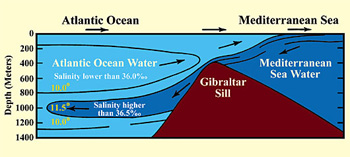
Modern Science has discovered that in the places where two different seas meet, there is a barrier between them. This barrier divides the two seas so that each sea has its own temperature, salinity, and density.[1] For example, Mediterranean sea water is warm, saline, and less dense, compared to Atlantic ocean water. When Mediterranean sea water enters the Atlantic over the Gibraltar sill, it moves several hundred kilometers into the Atlantic at a depth of about 1000 meters with its own warm, saline, and less dense characteristics. The Mediterranean water stabilizes at this depth[2] (see figure 1).
The_Quran_on_Seas_and_Rivers_002.jpg
Figure 1: The Mediterranean sea water as it enters the Atlantic over the Gibraltar sill with its own warm, saline, and less dense characteristics, because of the barrier that distinguishes between them. Temperatures are in degrees Celsius (C°). (Marine Geology, Kuenen, p. 43, with a slight enhancement.)

Although there are large waves, strong currents, and tides in these seas, they do not mix or transgress this barrier.
The Holy Quran mentioned that there is a barrier between two seas that meet and that they do not transgress. God has said:
“He has set free the two seas meeting together. There is a barrier between them. They do not transgress.” (Quran 55:19-20)
But when the Quran speaks about the divider between fresh and salt water, it mentions the existence of “a forbidding partition” with the barrier. God has said in the Quran:
“He is the one who has set free the two kinds of water, one sweet and palatable, and the other salty and bitter. And He has made between them a barrier and a forbidding partition.” (Quran 25:53)
One may ask, why did the Quran mention the partition when speaking about the divider between fresh and salt water, but did not mention it when speaking about the divider between the two seas?
Modern science has discovered that in estuaries, where fresh (sweet) and salt water meet, the situation is somewhat different from what is found in places where two seas meet. It has been discovered that what distinguishes fresh water from salt water in estuaries is a “pycnocline zone with a marked density discontinuity separating the two layers.”[3] This partition (zone of separation) has a different salinity from the fresh water and from the salt water4 (see figure 2).

The_Quran_on_Seas_and_Rivers_003.jpg
Figure 2: Longitudinal section showing salinity (parts per thousand ‰) in an estuary. We can see here the partition (zone of separation) between the fresh and the salt water. (Introductory Oceanography, Thurman, p. 301, with a slight enhancement.)

This information has been discovered only recently, using advanced equipment to measure temperature, salinity, density, oxygen dissolubility, etc. The human eye cannot see the difference between the two seas that meet, rather the two seas appear to us as one homogeneous sea. Likewise, the human eye cannot see the division of water in estuaries into the three kinds: fresh water, salt water, and the partition (zone of separation).
 

sri_lion

Member
Sep 14, 2006
12,908
102
0
Kuala Lumpur
daddyimmo said:
That’s all?

What about the conversion?

What do you mean "That's all"?

THAT'S NOT ALL!!!

Its nearly impossible at least in a Muslim country for a non-Muslim to marry a Muslim!

They enforce the strictest rules, the non-Muslim party MUST convert to Islam! If they dont... well... all privileges for that couple will be lost forever.. even citizenship!!!

And helpless people do it for the sake of love for their partner... and from there onwards their next generation's religion is Islam! In this case do they convert because they understand Islam? C'mon dude!!!

Islam does not give that freedom.. instead only making use of the situation to convert more people into Islam!!

So there goes another factor for the growth of Islam!!