Under Iran's strict Sharia law

Y2K

Member
Jun 11, 2007
11,007
165
0
In your heart
Under Iran's strict Sharia law
stoning.jpg

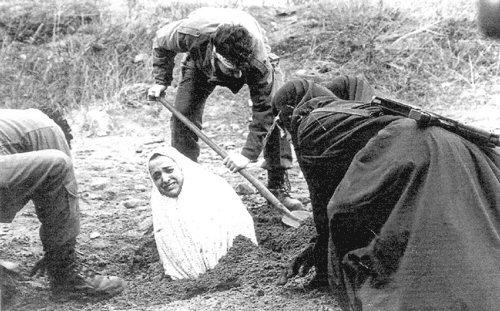
Photo: this poor frightened woman is buried up to her waist in preparation for her stoning to death.

Many Muslim countries enforce "Sharia laws" under which women deemed to be "immoral" are stoned to death, and widows guilty of being adulterous are buried alive.

Under Iran's brutal Islamic Sharia Laws, women usually get stoned for crimes against chastity. While men who even murder someone in a fit of rage in these cases, usually get only a few years in jail.

Under Iran's strict Sharia law, women sentenced to execution by stoning have their hands bound behind their back. They are wrapped from head to toe in sheets before being seated in a pit. The ditch is filled up to their breasts with dirt, and the soil is packed tightly before people assemble to execute the woman by pitching rocks at her head and upper body.

Contrast the above to what Jesus said about stoning and adultery:

According to the Gospel of John, the Jewish Priests (Pharisees), in an attempt to discredit Jesus, brought a woman charged with adultery before him. The Pharisees reminded Jesus that adultery was punishable by stoning under Law of Moses and challenged Jesus to judge the woman so that they might then accuse him of disobeying the law. Jesus thought for a moment and then replied, “He that is without sin among you, let him cast the first stone at her.” The people crowded around him were so touched by their own consciences that they departed. When Jesus found himself alone with the woman, he asked her who were her accusers. She replied, “No man, lord.” Jesus then said, “Neither do I condemn thee: go and sin no more.”
 

Y2K

Member
Jun 11, 2007
11,007
165
0
In your heart
This is a good prof that Jesus is against this baberic law which no longer be ethical now & this has proved that Jesus himself has all the authority to Judge & forgive sins

That is why I always telling you : Old Testament Brough God's Law & New Testament is all abt God's mercy
 

Y2K

Member
Jun 11, 2007
11,007
165
0
In your heart
What Does the Bible Say About the Old Testament Law?

The Law of Moses regulated almost every aspect of life in Old Testament times. But with the coming of Christ, God established a new covenant of faith and love with mankind. Christians are not required to follow the Old Testament rules about crimes and punishments, warfare, slavery, diet, circumcision, sacrifice, feast days, Sabbath observance, ritual cleanness, etc. However, the moral and ethical teachings of Jesus and His apostles call for even greater self-discipline than those of the Old Testament.

The Law of Moses

In Biblical times, the Law of Moses (also called Old Testament Law, Mosaic Law, or just The Law) regulated almost every aspect of Jewish life. The Ten Commandments and many other laws defined matters of morals, religious practice and government. It regulated the army, criminal justice, commerce, property rights, slavery, sexual relations, marriage and social interactions. It required circumcision for males, blood sacrifices, and Sabbath observance. It provided for the welfare of widows, orphans, the poor, foreigners and domestic animals. Ceremonial rules divided animals into "clean" and "unclean" categories. Clean animals could be eaten; unclean animals could not.

Teachings of Jesus
By the time of Jesus, the great moral principles God had given to Moses in the Ten Commandments had been turned into hundreds of ceremonial rules. People thought they were living holy lives if they just obeyed all those rules. But many people found enough "loopholes" to obey all the rules and still live wicked and greedy lives (Matthew 23:23-28).

Jesus said that was not at all what God had intended. Jesus did not abolish the moral and ethical laws that had been in effect from the time of Moses (Matthew 5:17-18, Luke 16:16-17). He affirmed and expanded upon those principles, but He said obedience must be from the heart (attitudes and intentions) rather than just technical observance of the letter of the law (Matthew 5:21-22, 27-28, 31-32, 33-34, 38-42, 43-44, etc.).

Jesus and His disciples did not observe the strict Jewish rules against doing any work on the Sabbath (Matthew 12:1-14, Mark 2:23-28, 3:1-6, Luke 6:1-11, 13:10-17, 14:1-6, John 5:1-18).

In contrast to the "clean" and "unclean rules," Jesus said no food can defile a person. It is bad attitudes and actions that can make a person unholy (Matthew 15:1-20, Mark 7:1-23).

Council of Jerusalem
The first Christians came from among the Jews, and they continued to observe the Law of Moses as well as their new Christian faith. But as more and more Gentiles (non-Jews) converted to Christianity, there were disputes about whether or not these Gentile Christians must observe the Law. Issues of circumcision and diet were especially troublesome.

In about the year 49 A.D., Peter, Paul, Barnabas, James and other Christian leaders met in Jerusalem to settle the issue (Acts 15:1-29). It was agreed that no conditions should be imposed on the Gentile converts except faith in Christ. However, the council directed the Gentile Christians abstain from certain things that were particularly offensive to their Jewish brethren - food sacrificed to idols, blood, meat of strangled animals and sexual immorality (Acts 15:29).

The New Covenant
With the coming of Christ, God has established a new covenant with mankind (Jeremiah 31:31-34, Luke 22:20, 1 Corinthians 11:25, Hebrews 8:8-13, 9:11-15). Jesus and His apostles gave us a radically new understanding of the true intent of the Old Testament Law; they brought a new era of the rule of love for all people and spiritual truth instead of rule by law (Luke 10:25-28, John 13:34-35, Ephesians 2:14-18).

However, God has not revoked His original covenant with Israel and the Jewish people (Luke 1:72, Acts 3:25, Romans 9:4-5, 11:26-29, Galatians 3:17). The New Covenant does not condemn the Jews, nor does it in any way justify persecution of Jews.

Conclusion
The teachings of Jesus, the Council of Jerusalem, and other New Testament teachings (John 1:16-17, Acts 13:39, Romans 2:25-29, 8:1-4, 1 Corinthians 9:19-21, Galatians 2:15-16, Ephesians 2:15) make it clear that Christians are not required to follow the Old Testament rules about crimes and punishments, warfare, slavery, diet, circumcision, sacrifice, feast days, Sabbath observance, ritual cleanness, etc.

Christians still look to the Old Testament scripture for moral and spiritual guidance (2 Timothy 3:16-17). But when there seems to be a conflict between Old Testament laws and New Testament principles, we must follow the New Testament because it represents the most recent and most perfect revelation from God (Hebrews 8:13, 2 Corinthians 3:1-18, Galatians 2:15-20).

However, freedom from the Old Testament Law is not a license for Christians to relax their moral standards. The moral and ethical teachings of Jesus and His apostles call for even greater self-discipline than those of the Old Testament (Matthew 5:21-22, 27-28, 31-32, 33-34, 38-42, 43-48, 7:1-5, 15:18-19, 25:37-40, Mark 7:21-23, 12:28-31, Luke 12:15, 1 Corinthians 13:1-13, Galatians 5:19-21, James 1:27, 2:15-16, 1 John 3:17-19).
 

ibnanv

Well-known member
  • Jun 27, 2009
    3,986
    257
    83
    What turned Anders Breivik into Norway's worst nightmare?


    Tony Paterson and Jerome Taylor investigate his fateful journey from impressionable boyhood to mass murder


    REUTERS
    The aftermath of Breivik's bomb in Oslo


    His face stares out from front pages on news stands all over Oslo and it wears an expression of triumph bordering on glee. Yet nearly a week after Norway's worst act of violence since the Second World War, the mass murderer Anders Breivik has assumed the proportions of an unspeakable monster. He is someone few people want to see, let alone mention by name.
    A yellow placard among a carpet of roses commemorating the dead outside the capital's Storting parliament reads: "Putting this man away for 21 years is not enough! We call on all politicians to make him pay dearly for what he has done. Somebody who took all these lives deserves to be put away forever." The placard is unsigned.
    Anders Behring Breivik, the 32-year-old one-time farmer who massacred 76, predominantly young, Norwegians in last Friday's Oslo bomb blast and subsequent Utoya island shooting, is not named on the placard. His name was not spoken either during a poignant rally attended by some 250,000 people in the centre of Oslo on Monday night to show sympathy with the families of the dead. Speakers referred to him only as "the perpetrator".


    Breivik is someone Norwegians would like to see forever banished. In response to demands that he be locked away for life, state prosecutors are considering charging him with crimes against humanity, rather than mere terrorism, an offence which carries a sentence of 30 years. Breivik's father's answer to his son's crimes are that "it would be better if he committed suicide" and he has refused ever to see him again.
    While Geir Lippestad, Breivik's lawyer who specialises in far-right crime, concludes that his client is probably "insane", the response of Jens Stoltenberg, Norway's suddenly massively popular Labour Party prime minister, to Breivik's murder spree has been unwavering defiance. "We are a small country," he declared in an emotional speech after the massacre. "But we are a proud people and we will stand by what we have. Our response is more democracy, more openness and more humanity."
    Six days after Norway's horrific shooting and bombing, the overriding impression is of a nation still so shell-shocked by what happened that it has gone into denial. Few, if anyone, have been prepared to acknowledge that Breivik is Norwegian. On paper at least, he is also a product of Norway's middle-class, consensus-bound society which champions the liberal values of tolerance advocated by Mr Stoltenberg. But to the utter shock of Norway, Breivik chose to bite the hand that fed him with a severity hitherto deemed inconceivable. What went wrong? Norway, it seems, is not yet ready to answer the question.
    As Mikal Hem, a political columnist for Norway's Dagbladet newspaper, told The Independent yesterday: "A lot of people don't want Breivik to be given any recognition at all. Norwegians are acutely aware that he wants attention and there is a sense that people will not give him what he wants."
    However he added: "But at some point we are going to have to ask ourselves some difficult questions about how this man evolved to be the person he became and if we don't ask these questions we will be doing something seriously wrong. Breivik, it has to be remembered, was a man given every advantage by Norway."
    A brief drive through the western Oslo district of Skøyen provides an impression of the kind of advantages Breivik was afforded. It is a suburb whose houses have big, green gardens. Unlike Oslo's run-down eastern immigrant quarter, western Skøyen is inhabited by Breivik's successful former schoolmates: doctors, lawyers and management consultants.
    Breivik went to school in the district, growing up in a modern housing estate popular with young professional parents. He returned there earlier this year to live with his ailing mother to save money and have "sufficient means and time", as he put it in his 1,516-page "manifesto", to prepare for the act of mass murder he referred to as his "mission".
    Next to the bell at house number 18 is a plaque bearing the words "A Breivik. Geofarm" which refers to the farmstead he bought and finally used to manufacture the devastating fertiliser bomb that last Friday exploded in Oslo's parliamentary district.
    He seems to have enjoyed a normal Norwegian childhood. "He was an alert but unremarkable boy at school," remembers a former classmate, who wished to be anonymous. "He was somebody who went along with the others. He wasn't an outsider and he didn't appear to have problems."
    After school, Breivik did a brief stint in the army, and then appears to have gone from one job to the next. He is believed to have started a computer company and earned enough money to live in a luxury apartment and sport a Breitling watch. However, other reports suggest that for years he worked in a lowly call centre and lived almost anonymously.
    He appears to have attracted attention as a 15-year-old when he joined a graffiti-spraying gang and subsequently clashed with an immigrant gang of Pakistani youths whose violence frightened him. When in the army, he joined the youth organisation of Norway's right-wing Progress Party and remained a member for 10 years before finally resigning because he felt the organisation was too much part of the establishment.
    Exactly what he lived on in the run- up to the massacre remains a mystery. But his bank details reveal that in 2007, a sum equivalent to €80,000 (£70,000) was added to his account, which would have enabled him to live without having to work.
    None of these details provide an explanation for Breivik's decision to gun down 68 youth members of the Norwegian Labour party on Utoya island, convinced their support for multicultural values was encouraging "Muslim world domination".
    However, his personal and sexual life may well provide criminal psychiatrists with evidence to explain his warped personality, his clinically obsessive character and even the motive for his acts. One clue is likely to be his ailing mother: she has not spoken or been interviewed since the massacre took place. But if the closing pages of Breivik's manifesto are credible then her ailment appears to stem from the final stages of an unspecified venereal disease which he claims she contracted several years ago and has since reduced her mental state "to that of a 10-year-old".
    Breivik appears never to have had a girlfriend worth mentioning. He was born in February 1979, the son of Jens Breivik, a career diplomat and Wenche Breivik, a nurse. Both were Norwegian Labour Party supporters. They divorced when Breivik was only one year old and he lived thereafter with his mother, who worked at Norway's embassies in Paris and London. He only maintained sporadic contact with his father and that came to an end when Breivik was 15.
    Neighbours described Wenche as elderly and frail, but added that she was a gregarious and welcoming woman who often chatted to strangers and was fascinated by foreigners. She remarried a Norwegian army major. But although apparently regarding his stepfather as a "good bloke", Breivik appears to have secretly detested him for being a product of permissive Norwegian attitudes to sex. He blames his stepfather for having infected his mother with venereal disease which was also passed on to one of his half-sisters.
    "My mother and my sister not only shamed me, but themselves and our family," Breivik writes in his bizarre manifesto confessions. "It is a family that was already destroyed as a result of the feminist/sexual revolution."
    He concludes that Norwegian liberalism and permissiveness allowed him "too much freedom" and had "to a certain extent made me feminine". Some analysts outside Norway have already started to advance the theory that Breivik had deep feelings of sexual inadequacy. They argue that he subconsciously sought compensation through gross acts of violence carried out with the help of an assortment of obviously "phallic" weapons such as the automatic rifles, shot-guns and special Glock automatic pistol with which he calmly gunned down teenaged Labour Party members as if they were rabbits.
    Breivik took nine years to work out his plans for mass murder. He is even reputed to have bought several bottles of French 1979 vintage wine which he opened each New Year and drank with his family to celebrate the approach of a mission, whose real purpose was never explained. Despite railing against his family's sexual immorality, he claims to have saved up €2,000 to spend on a "high-class" prostitute for the week before his massacre.
    When it came to the day, Breivik took innocent, tolerant Norway completely and horrifically by surprise. He hired a Volkswagen van which he had loaded with his fertiliser bomb, drove it to Oslo's parliament, parked it nearby and set the detonator on a timed switch which would cause the device to explode more than one hour later.
    He then hailed a silver-coloured taxi which drove him, by now dressed in a stolen police uniform, and his assortment of weapons to Utoya island where 600 adolescent members of the Norwegian Labour party were enjoying a summer camp for the nation's "most promising future politicians".
    The taxi driver recalled this week: "There was nothing suspicious about him at all. He seemed just like any easy-going cop. He told me he was just going to check the security on the island because of the bomb blast in Oslo that we were hearing about on the car radio."
    The taxi driver hailed the Utoya island ferry boat to come and pick Breivik up. The ferryman willingly obliged. Breivik, with an automatic rifle slung over his arm in a case, was also carrying a large black plastic suitcase full of his other weapons. The ferryman remembers lugging the case up the jetty. "I was a bit surprised how heavy it was," he said in an interview yesterday. Once off the jetty, Breivik unpacked his weapons and like a murderous Pied Piper, began summoning the band of happy campers to come towards him. "I have come to protect you," he insisted as he opened fire.
    In the end it was not Norway's immigrants or Muslims that Breivik chose to assassinate, but people who came from the same background as he did and whose parents were almost certainly Labour Party supporters like his own. But the fact was that by last Friday, Breivik felt not only that he no longer belonged to his own people, he had come to detest them with a virulence that was unprecedented.Is Norway's ostensibly tolerant social model partially to blame? Critics point out that in the aftermath of the humiliation inflicted on the country by the Nazi invasion and the imposition of a fascist puppet government during the Second World War, Norway has religiously adhered to an almost stifling form of consensus politics in which the main parties tend to agree on everything.
    The upshot is a generous welfare state, excellent schooling, high wages, high taxes and prices and considerable social uniformity. Immigration, which has hit the 20 per cent mark in Oslo and is largely confined to the city's eastern districts, may be high by Norwegian standards but is insignificant when compared to areas in Britain or other parts of continental Europe.
    Political commentators like Norway's Kjetil Kollsrud say that consensus politics conducted Norwegian-style have resulted in a form of extreme egalitarianism. "The fact is that in a system like this there is simply not a great deal of room for people who don't fit it," he told The Independent. Anders Breivik was clearly one of those who didn't.
     

    ibnanv

    Well-known member
  • Jun 27, 2009
    3,986
    257
    83
    Stone to death Bible says

    What the Bible says about stoning

    Everybody must get stoned

    For touching Mount Sinai Whosoever toucheth the mount shall be surely put to death. Exodus 19:13 For taking "accursed things" Achan ... took of the accursed thing. ... And all Israel stoned him with stones, and burned them with fire, after they had stoned them with stones. ... So the LORD turned from the fierceness of his anger. Joshua 7:1-26 For cursing or blaspheming And he that blasphemeth the name of the LORD, he shall surely be put to death, and all the congregation shall certainly stone him. Leviticus 24:16 For adultery (including urban rape victims who fail to scream loud enough) If a damsel that is a virgin be betrothed unto an husband, and a man find her in the city, and lie with her; Then ye shall bring them both out unto the gate of that city, and ye shall stone them with stones that they die; the damsel, because she cried not, being in the city. Deuteronomy 22:23-24 For animals (like an ox that gores a human) If an ox gore a man or a woman, that they die: then the ox shall be surely stoned. Exodus 21:28 For a woman who is not a virgin on her wedding night If any man take a wife, and go in unto her, and hate her ... and say, I took this woman, and when I came to her, I found her not a maid: Then shall the father of the damsel, and her mother, take and bring forth the tokens of the damsel's virginity unto the elders of the city in the gate: And the damsel's father shall say ... these are the tokens of my daughter's virginity. And they shall spread the cloth before the elders of the city. ... But if this thing be true, and the tokens of virginity be not found for the damsel: Then they shall bring out the damsel to the door of her father's house, and the men of her city shall stone her with stones that she die. Deuteronomy 22:13-21 For worshipping other gods If there be found among you ... that ... hath gone and served other gods, and worshipped them ... Then shalt thou ... tone them with stones, till they die. Deuteronomy 17:2-5 If thy brother, the son of thy mother, or thy son, or thy daughter, or the wife of thy bosom, or thy friend, which is as thine own soul, entice thee secretly, saying, Let us go and serve other gods, which thou hast not known, thou, nor thy fathers ... thou shalt stone him with stones, that he die. Deuteronomy 13:5-10 For disobeying parents If a man have a stubborn and rebellious son, which will not obey the voice of his father, or the voice of his mother ... Then shall his father and his mother lay hold on him, and bring him out unto the elders of his city ... And they shall say unto the elders of his city, This our son is stubborn and rebellious, he will not obey our voice; he is a glutton, and a drunkard. And all the men of his city shall stone him with stones, that he die. Deuteronomy 21:18-21 For witches and wizards A man also or woman that hath a familiar spirit, or that is a wizard, shall surely be put to death: they shall stone them with stones: their blood shall be upon them. Leviticus 20:27 For giving your children to Molech Whosoever ... giveth any of his seed unto Molech; he shall surely be put to death: the people of the land shall stone him with stones. Leviticus 20:2 For breaking the Sabbath They found a man that gathered sticks upon the sabbath day. ... And the LORD said unto Moses, The man shall be surely put to death: all the congregation shall stone him with stones.... And all the congregation brought him without the camp, and stoned him with stones, and he died; as the LORD commanded Moses. Numbers 15:32-56 For cursing the king Thou didst blaspheme God and the king. And then carry him out, and stone him, that he may die. 1 Kings 21:10
     

    Y2K

    Member
    Jun 11, 2007
    11,007
    165
    0
    In your heart
    What the Bible says about stoning

    Everybody must get stoned

    For touching Mount Sinai Whosoever toucheth the mount shall be surely put to death. Exodus 19:13 For taking "accursed things" Achan ... took of the accursed thing. ... And all Israel stoned him with stones, and burned them with fire, after they had stoned them with stones. ... So the LORD turned from the fierceness of his anger. Joshua 7:1-26 For cursing or blaspheming And he that blasphemeth the name of the LORD, he shall surely be put to death, and all the congregation shall certainly stone him. Leviticus 24:16 For adultery (including urban rape victims who fail to scream loud enough) If a damsel that is a virgin be betrothed unto an husband, and a man find her in the city, and lie with her; Then ye shall bring them both out unto the gate of that city, and ye shall stone them with stones that they die; the damsel, because she cried not, being in the city. Deuteronomy 22:23-24 For animals (like an ox that gores a human) If an ox gore a man or a woman, that they die: then the ox shall be surely stoned. Exodus 21:28 For a woman who is not a virgin on her wedding night If any man take a wife, and go in unto her, and hate her ... and say, I took this woman, and when I came to her, I found her not a maid: Then shall the father of the damsel, and her mother, take and bring forth the tokens of the damsel's virginity unto the elders of the city in the gate: And the damsel's father shall say ... these are the tokens of my daughter's virginity. And they shall spread the cloth before the elders of the city. ... But if this thing be true, and the tokens of virginity be not found for the damsel: Then they shall bring out the damsel to the door of her father's house, and the men of her city shall stone her with stones that she die. Deuteronomy 22:13-21 For worshipping other gods If there be found among you ... that ... hath gone and served other gods, and worshipped them ... Then shalt thou ... tone them with stones, till they die. Deuteronomy 17:2-5 If thy brother, the son of thy mother, or thy son, or thy daughter, or the wife of thy bosom, or thy friend, which is as thine own soul, entice thee secretly, saying, Let us go and serve other gods, which thou hast not known, thou, nor thy fathers ... thou shalt stone him with stones, that he die. Deuteronomy 13:5-10 For disobeying parents If a man have a stubborn and rebellious son, which will not obey the voice of his father, or the voice of his mother ... Then shall his father and his mother lay hold on him, and bring him out unto the elders of his city ... And they shall say unto the elders of his city, This our son is stubborn and rebellious, he will not obey our voice; he is a glutton, and a drunkard. And all the men of his city shall stone him with stones, that he die. Deuteronomy 21:18-21 For witches and wizards A man also or woman that hath a familiar spirit, or that is a wizard, shall surely be put to death: they shall stone them with stones: their blood shall be upon them. Leviticus 20:27 For giving your children to Molech Whosoever ... giveth any of his seed unto Molech; he shall surely be put to death: the people of the land shall stone him with stones. Leviticus 20:2 For breaking the Sabbath They found a man that gathered sticks upon the sabbath day. ... And the LORD said unto Moses, The man shall be surely put to death: all the congregation shall stone him with stones.... And all the congregation brought him without the camp, and stoned him with stones, and he died; as the LORD commanded Moses. Numbers 15:32-56 For cursing the king Thou didst blaspheme God and the king. And then carry him out, and stone him, that he may die. 1 Kings 21:10

    Allah's 1st revelation ? :rofl:
     

    Y2K

    Member
    Jun 11, 2007
    11,007
    165
    0
    In your heart
    What the Bible says about stoning

    Everybody must get stoned

    For touching Mount Sinai Whosoever toucheth the mount shall be surely put to death. Exodus 19:13 For taking "accursed things" Achan ... took of the accursed thing. ... And all Israel stoned him with stones, and burned them with fire, after they had stoned them with stones. ... So the LORD turned from the fierceness of his anger. Joshua 7:1-26 For cursing or blaspheming And he that blasphemeth the name of the LORD, he shall surely be put to death, and all the congregation shall certainly stone him. Leviticus 24:16 For adultery (including urban rape victims who fail to scream loud enough) If a damsel that is a virgin be betrothed unto an husband, and a man find her in the city, and lie with her; Then ye shall bring them both out unto the gate of that city, and ye shall stone them with stones that they die; the damsel, because she cried not, being in the city. Deuteronomy 22:23-24 For animals (like an ox that gores a human) If an ox gore a man or a woman, that they die: then the ox shall be surely stoned. Exodus 21:28 For a woman who is not a virgin on her wedding night If any man take a wife, and go in unto her, and hate her ... and say, I took this woman, and when I came to her, I found her not a maid: Then shall the father of the damsel, and her mother, take and bring forth the tokens of the damsel's virginity unto the elders of the city in the gate: And the damsel's father shall say ... these are the tokens of my daughter's virginity. And they shall spread the cloth before the elders of the city. ... But if this thing be true, and the tokens of virginity be not found for the damsel: Then they shall bring out the damsel to the door of her father's house, and the men of her city shall stone her with stones that she die. Deuteronomy 22:13-21 For worshipping other gods If there be found among you ... that ... hath gone and served other gods, and worshipped them ... Then shalt thou ... tone them with stones, till they die. Deuteronomy 17:2-5 If thy brother, the son of thy mother, or thy son, or thy daughter, or the wife of thy bosom, or thy friend, which is as thine own soul, entice thee secretly, saying, Let us go and serve other gods, which thou hast not known, thou, nor thy fathers ... thou shalt stone him with stones, that he die. Deuteronomy 13:5-10 For disobeying parents If a man have a stubborn and rebellious son, which will not obey the voice of his father, or the voice of his mother ... Then shall his father and his mother lay hold on him, and bring him out unto the elders of his city ... And they shall say unto the elders of his city, This our son is stubborn and rebellious, he will not obey our voice; he is a glutton, and a drunkard. And all the men of his city shall stone him with stones, that he die. Deuteronomy 21:18-21 For witches and wizards A man also or woman that hath a familiar spirit, or that is a wizard, shall surely be put to death: they shall stone them with stones: their blood shall be upon them. Leviticus 20:27 For giving your children to Molech Whosoever ... giveth any of his seed unto Molech; he shall surely be put to death: the people of the land shall stone him with stones. Leviticus 20:2 For breaking the Sabbath They found a man that gathered sticks upon the sabbath day. ... And the LORD said unto Moses, The man shall be surely put to death: all the congregation shall stone him with stones.... And all the congregation brought him without the camp, and stoned him with stones, and he died; as the LORD commanded Moses. Numbers 15:32-56 For cursing the king Thou didst blaspheme God and the king. And then carry him out, and stone him, that he may die. 1 Kings 21:10


    As a Good Muslim - Have you read the Gospel of Jesus?

    The Gospel of Jesus and Old Testament (Torah): "Guidance and Light"

    Surah 2:87 - And most certainly We gave Musa the Book and We sent apostles after him one after another; and We gave Isa, the son of Marium, clear arguments and strengthened him with the holy spirit, :baffled:

    මල හත්හිලව්වයි නේද? :baffled:

    දැන් සමහර මුස්ලිම් මල්ලිලා වියරු වැටිලා පරණ ගිවුසුමේ රෙප් cases, ගල්ගස මරන දඩුවම් පස්ස පැත්ත උඩ දාගෙන දැම්මානේ දැන් එවා අල්ලාත් පිලිගන්නවා ඒ පොත අල්ලාගෙ වචන බව දැන් ඉතින් කාලා වරෙන්කො !

    ඔවා කියපන කලු කොට කැත වින්නුන්ට :lol:

    you want more ?

    - Surah 3:48 - And He (Isa/Jesus) will teach him the Book and the wisdom and the Tavrat (Torah) and the Injeel (Christian Gospel).

    - Surah 3:50 - And a verifier of that which is before me of the Taurat (Torah) and that I may allow you part of that which has been forbidden you, and I have come to you with a sign from your Lord therefore be careful of (your duty to) Allah and obey me.

    - Surah 5:44 - "Surely We revealed the Taurat (Torah/Bible Old Testament) in which was guidance and light", with it the prophets who submitted themselves....

    කොල්ලො නුබ නුබේ ආගම හරියට දන්නෙවත් නතුව අනික් ආගම්වල දෙවල් කියවන්න ගිහින් ආනා ගන්න එපා තොපි ලග කුරාණයක් වත් ගෙදර නැද්ද නැතිනම් මට කියපන් මම ඉලෙක්ට්‍රොටික් කොපි එකක් දෙන්නම් , තියෙනවානම් හොදට මේ වාකය කියවලා බලපන් දැන් ඉතින් උබට බැ කිවපු එවා මකන්න නමුත් ඉදිරියටවත් පොඩ්ඩාක් තොගේ මොලේ පාවිච්චි කරපන් නිකන් කොපි පෙස් කරන්න කලින (මොලයක් නතිනම් මොලයක් දිය නොහැකි බව කරුනාවෙන් සලකන්න)