Sri Lanka's Network of Sufi Shrines
Although they are small establishments relative to Sri Lanka's major urban mosques, four sites can be readily identified as the island's most well-known Sufi-centred pilgrimage shrines. In addition to Daftar Jailani, there is the dargah of Faqir Muhiyadeen at Porvai (Godapitiya) near the southern town of Akuressa. In the nineteenth century, the saint revealed himself in a dream to two Muslim businessmen from Galle to be a mendicant avatar of Muhiyadeen Abdul Qadir Jilani. Like Daftar Jailani, the Porvai Dargah is situated in a Sinhalese majority area, and it had to be rebuilt (with help from the British colonial government) after suffering extensive damage in the Sinhalese-Muslim riots of 1915.
The southern coastal towns of Weligama and Matara, only 20 km away, are historic centres of Rifai Sufi allegiance, and the annual festival at Porvai features a strong Rifai presence, including ecstatic 'cutting and stabbing' (
vettukkuttu) performances by itinerant Bawas from the east coast and sometimes by lay Rifai Sufis as well. Because both Daftar Jailani and Porvai celebrate the death anniversary of the same saint, the two establishments have worked out a coordinated festival calendar that allows both festivals to take place within the same time frame.
The third major Sri Lankan Sufi pilgrimage shrine is the Beach Mosque (Katarkaraippalli) located at Kalmunaikkudy in Amparai District on the east coast of the island. This is an empty or virtual dargah—a 'branch office' as local people explained tome in English—of the sixteenth century saint Hazrat Seyid Abdul Qadir Shahul Hamid whose 'head office' tomb is located at Nagoor on the Tamilnadu coast near Nagappattinam.According to local sources, the Beach Mosque shrine was founded by an early nineteenth century South Indian Muslim trader from Kayalpattinam, Muhammad Tambi Lebbe, who was miraculously cured of leprosy at the beach when the Nagoor saint appeared in a vision and instructed him to drink a special mixture of lime juice and sea water.
Like similar 'branch office' dargahs in Singapore, Penang, and South India, the Beach Mosque celebrates the Nagoor saint's annual festival according to precisely the same ritual calendar, starting with a flag raising ceremony that coincides exactly with the flag raising at Nagoor. A unique feature, however, is the board of matriclan (
kuti) elders who administer the Beach Mosque in accordance with the matrilineal and matrilocal social system common to Muslims and Hindus in this region, of the island (McGilvray 1982, 1989, 1998). The Beach Mosque, too, is a major venue for the Bawas; in fact, it is the site of their annual general meeting presided over by the current head of the island-wide Bawa jamat, Dr Pakeer Jaufar, Ph.D. and Sar Kalifa, a Lecturer in Education at the Open University in Colombo.
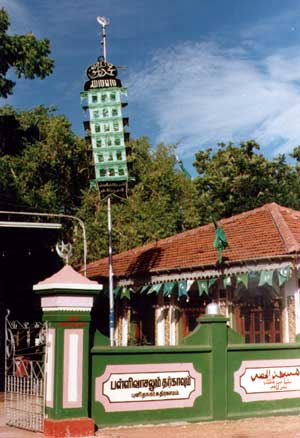
[SIZE=-1]Above:Kataragama Mosque & Shrine.
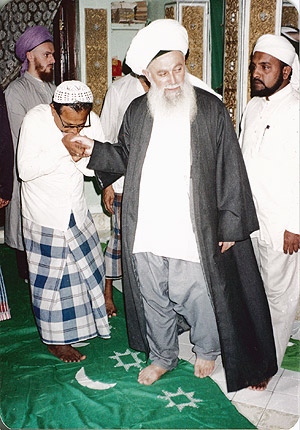
Below: Illustrious visitors to Kataragama include H.H. Sheikh Nazim Adil al-Haqqani of Cyprus and murids, seen here within Khidr Maqaam.[/SIZE]
A focus on the saints Muhiyadeen Abdul Qadir Jilani (Muhiyadeen Andavar) and Shahul Hamid (Nagoor Andavar) is deeply rooted in Sri Lankan popular Islam. The legends of Daftar Jailani say these two saints combined forces with the scriptural 'green' Prophet
17—the mysterious servant of Allah also known as Hayat Nabi, an advisor to Moses, who is believed to have a special connection with the world of nature and with the fountain of immortality—and the heroic figure,
Dhul Qarnayn (Two Horns), an Islamic transformation of Alexander the Great.
There is an annual celebration at Jailani in the month of Safar solely in honour of Khidr at which
niyattu,
18 a special form of milk-rice containing extra sugar and raisins, is cooked and distributed at the base of a Khidr flagpole on the eastern parapet overlooking the Kaltota plain and the forested hills to the east. People say that Jailani is the sort of wild location conducive to encountering Khidr, an event that is believed to have occurred when the Baghdad saint, and later the Nagoor saint, visited the site during their astral travels.
However, the Sri Lankan shrine that is most fully dedicated to Khidr is the fourth of the major Sufi sites in the island:
Kataragama. While ethnographic attention has focused upon the expanding island-wide Sinhalese and Tamil cult of Kataragama, a Sri Lankan name for the
Hindu god, Skanda or Murugan (Obeyesekere 1977, 1978), the Muslim enclave at the Kataragama pilgrimage centre located north of Tissamaharama has also steadily grown over the past century.
Muslim oral traditions identify the southeastern quarter of the island as the 'Khidr region' (Hassan 1968: 5). The present day
Khidr Taikkya at Kataragama has been steadily enlarged as the centerpiece of a Muslim compound containing the tombs of several north Indian or central Asian faqirs who resided at Kataragama to commune with Khidr.
19 One ecumenical Western devotee has even argued that Kataragama is actually
Khadir-gama; based on an alternative spelling of Khidr (Harrigan 1998: 109).
Another version of the Jailani legend contends that the Nagoor saint was invested with the cloak and title of
Qutbul Aktab at Kataragama (Hassan 1968:11). The Bawas make their seasonal appearance here as well, performing their penetrating zikr in the area in front of the tomb of the austere vegetarian saint known as Palkudi (milk-drinking) Bawa.
Religion and Politics at Jailani
Challenges from the Muslim community
A problem of litigious micro-politics is common to religious establishments throughout South Asia, and some of the Sri Lankan Sufi shrines discussed here have suffered their share of managerial conflicts, succession quarrels, and property disputes. A privately published
19 devotes nearly a third of its pages to recounting the mid-twentieth century succession battles and court cases that determined legal control of the shrine (Hassan 1968).
At Jailani, too, there was a lengthy lawsuit filed in 1922 to remove a usurping Indian mastan who had been charging pilgrims an entrance fee, and in the early 1970s the government filed a case against a faqir named Trinco Bawa for erecting a shelter at Jailani in defiance of the Antiquities Ordinance (Aboosally 2002).
Throughout the Twentieth Century it has been the members of one family, descendants of a leading Muslim physician who settled in Balangoda in the nineteenth century, who have been leaders in protecting and promoting the development of Jailani as a Sufi shrine.
In conversations with the current Chief Trustee, Mr M.L.M. Aboosally, a retired MP and former government minister, I learned that Jailani has been a target of criticism from Islamic reformist groups, such as the Tabliq, Jamat-i-Islami, and Towheed movements, who preach that Sufi mysticism devalues the fundamental Sharia requirements and that personal devotion to the saints amounts to shirk or idolatry.
However, on my visits to Jailani in 2001 and 2002, I observed no public opposition to the festival and no printed literature from Islamic fundamentalist groups. Mr Aboosally says he has dealt with them repeatedly in the past, however, pointing out that Muslims are free to stop attending Jailani whenever they wish. As long as pilgrims continue to come, he feels the shrine serves a religious need in the Sri Lankan Muslim community. Aboosally is a liberal-minded person, but there is little doubt that his stature as a highly successful retired politician, and as a member of one of Balangoda's leading Muslim families, has given him some needed leverage in this situation.
For their part, the Islamic reformists can discount Jailani as an exotic rural side-show, a place where Sufi devotionalism is performed far from the urban gaze. The contrast was stark when I stopped in Balangoda town to visit the Periya Bawa ziyaram, tomb of Seyed Mustafa Abdul Rahuman from Lakshadweep and his two local patrons, a small neglected masonry structure overshadowed by the vast modern extension of the Jumma Mosque located immediately adjacent.
On the walls of the new mosque were posted notices written in Tamil announcing meetings and sermons by visiting Islamic reformist speakers under the sponsorship of the Towheed movement. Inquiring about events at the Periya Bawa ziyaram, I learned that the annual kandoori for the local Balangoda saint has not been celebrated for several years because of opposition from a small but highly vocal fundamentalist faction.
Jailani and Buddhist Sacred Geography
It is not the fundamentalists, however, who have posed the most serious threat to the future of Jailani. It was pointed out earlier that Jailani is located in an overwhelmingly Sinhala Buddhist district and that the shrine itself is separated from the Muslim community in Balangoda by 22 km of serpentine road. Adam's Peak is revered by some Muslims, but it is much more sacred today to the Buddhists and the Hindus.
Jailani, however, is an exclusively Muslim shrine patronized by the small yet conspicuously prosperous community of Muslim traders and gem dealers in Balangoda, a town located deep in the hinterlands of
Dhamma Dipa, the island consecrated to preserving the Buddha's message. During the kandoori festival, Jailani is suddenly flooded with Muslims from all over the island who have no connection to the Balangoda region.
In the early 1970s, Jailani began to attract the attention of Sinhala chauvinists and politicized members of the Buddhist sangha as a seeming violation of the island's sacred geography, a religio-spatial error that might be rectified, they thought, with the help of the state Archaeology Department.
It is important to note that, while intermittent political friction and communal strife between Sri Lanka's Tamil Hindus and their Tamil-speaking Muslim neighbours in the Eastern Province has always been recognized as a significant and growing problem, especially in the context of the Eelam secessionist conflict, a more submerged but equally dangerous ethnic antagonism has long existed between the Sinhalese Buddhists and the Muslims. Entrenched memories of the traumatic 1915 Sinhalese-Muslim riots can account for much of the Twentieth Century Muslim political opportunism that Tamil nationalists have considered so disloyal to their Dravidian cultural mission.
Because two-thirds of Sri Lanka's Muslim minority live in Colombo and in the Sinhalese towns of the central and southwestern provinces, they are acutely aware of their vulnerability, a fact that has separated them from the more secure Muslim farmers of the eastern coastal districts (McGilvray 1998). Sudden outbreaks of violence against Muslims in Sinhalese towns like Mawanella in recent years have shown that these underlying ethnic embers can easily be fanned into flame.
One such potential flashpoint arose in 1971 during the SLFP government of Mrs Sirimavo Bandaranaike, herself a member of the powerful, aristocratic Ratwatte family from Balangoda. According to Mr Aboosally, who was the man on the spot, a Muslim petition that had been filed back in the 1940s to obtain permanent legal title to the property at Jailani was eventually denied by the government twenty years later, offering them only a permanent lease. Then, in the context of local political rivalries, a claim was put forward in the early 1970s that Jailani was actually an ancient Buddhist archaeological site requiring urgent government protection and preservation.
Abruptly, the Ministry of Cultural Affairs authorized the Archaeology Department to 'reconstruct' a small Buddhist dagoba at the summit of Curangam Malai directly above the cave where Muyihadeen Abdul Qadir Jilani is said to have meditated for twelve years, and a Buddhist reclamation of the site seemed imminent. By means of high-level counter-politics, construction of the Buddhist dagoba—using locally fired bricks and Kankesanturai cement from Jaffna—was stopped when the Jailani trustees obtained a cabinet order capping the Construction at a height of two feet.
The unfinished stupa remains on view today, protected by a low metal railing. The Archaeology Department nevertheless erected a permanent trilingual signboard near the Jailani mosque, also visible today, stating that the location, known as Kuragalawas the site of a Buddhist monastery dating to the second century BCE.
20
Archaeologically stalemated, the proponents of a Sinhala Buddhist take-over of the shrine, including an activist monk from Ratnapura and some members of the Ministry of Cultural Affairs, put together a high-level delegation and demanded to 'inspect' the Jailani site. According to Aboosally's account, the assembled crowd included 30-40 monks from Ratnapura along with their lay supporters, the Cultural Affairs Minister, the Commissioner of Archaeology, and the ruling party MP for Balangoda, Mrs Mallika Ratwatte.
With army personnel in position as well, the situation could have become violent if the Muslims had tried to defend their territory by force, but an ugly incident was averted by keeping most of the local Muslims away. On behalf of the Jailani mosque, Mr Aboosally strategically provided all the Buddhist monks with
dana (ritual presentation of food), and the only violence was a sharp verbal exchange between Mr Aboosally and Mrs Ratwatte.
Stairway from living rock leading into the Jailani sacred area
The conflict was finally resolved at the Prime Minister's level, when the Minister of Education (a Muslim) succeeded in persuading the rest of the cabinet to leave the trustees in possession of Jailani. The trustees, for their part, agreed to have the Jailani site gazetted under the Antiquities Ordinance. They also promised to strictly limit any future construction of buildings, and—to reassure the authorities that an expanding dargah-necropolis was not envisioned—they agreed to prohibit all further Muslim burials at the sacred site (Aboosally 2002 and personal interviews).
A Muslim Archaeological Ripost
Two years later, trustees of the shrine were gratified to learn that Trinco Bawa had been acquitted of flaunting the Antiquities Ordinance. However, these officially designated, governmentally-gazetted antiquities still do not include the Arabic inscriptions found on tombstones and rock faces at Jailani. "The Archaeological Department," observes Mr Aboosally, "appears to be only interested in Sinhala and Buddhist archaeology." (Aboosally 2002: 85)
However, the Muslims at Jailani have since learned something about the symbolic value of rock carving, or what we might call 'lithic politics'. In 1984, a wealthy Muslim donor from Chilaw made it possible for the trustees to hire a local mason to cut an impressive stairway from the living rock leading into the Jailani sacred area, much as the ancient Sinhala kings of Anuradhapura carved, steps from the rock at Mihintale to commemorate the conversion of the island to Buddhism.
These newly carved steps at Jailani, much more than the Islamic-style arch that frames them, speak the language of religious antiquity and sacred archaeology so popular in Sri Lanka today. They are obviously intended to vouchsafe the footsteps of future Muslim pilgrims to the shrine of Daftar Jailani