From Wikipedia
Sergey Prokudin-Gorsky
From Wikipedia, the free encyclopedia
Sergey Prokudin-Gorsky

Sergey Prokudin-Gorsky. Self-portrait on the
Korolistskali River, 1912 Born August 30, 1863
Funikova Gora,
Russian Empire Died September 27, 1944 (aged 81)
Paris,
France Resting place
Sainte-Geneviève-des-Bois Russian Cemetery Nationality Russian Known for Early techniques for taking
colour photographs Sergey Mikhaylovich Prokudin-Gorsky (
Russian:
 Серге́й Миха́йлович Проку́дин-Го́рский
 (
help·
info), August 30 [
O.S. August 18] 1863
Russian Empire – September 27, 1944) was a Russian
chemist and
photographer. He is best known for his pioneering work in
color photography of early 20th-century Russia.
[1]
Contents
Biography
Early life
Prokudin-Gorsky was born in the ancestral estate of
Funikova Gora, in what is now
Kirzhachsky District,
Vladimir Oblast. His parents were of the Russian
nobility, and the family had a long military history.
[2] They moved to
Saint Petersburg, where Prokudin-Gorsky enrolled in
Saint Petersburg State Institute of Technology to study chemistry under
Dmitri Mendeleev. He also studied music and painting at the
Imperial Academy of Arts. In 1889, he traveled to
Berlin to continue his studies in
photochemistry at the
Technical University of Berlin with
Adolf Miethe,
[3] who was working on color dyes and three-color photography.
[4]
Marriage and career in photography
In 1890, Prokudin-Gorsky married Anna Aleksandrovna Lavrova, and later the couple had two sons, Mikhail and Dmitri, and a daughter, Ekaterina.
[5] Anna was the daughter of the Russian industrialist Aleksandr Stepanovich Lavrov, an active member in the Imperial Russian Technical Society (IRTS).
[5] Prokudin-Gorsky subsequently became the director of the executive board of Lavrov's metal works near
Saint Petersburg and remained so until the
October Revolution. He also joined Russia's oldest photographic society, the photography section of the IRTS, presenting papers and lecturing on the science of photography.
[4] In 1901, he established a photography studio and laboratory in Saint Petersburg and further developed Miethe's methods on color photography. Throughout the years, his photographic work, publications and slide shows to other scientists and photographers in Russia, Germany and France earned him praise,
[5] and, in 1906, he was elected the president of the IRTS photography section and editor of Russia's main photography journal, the
Fotograf-Liubitel.
[4]
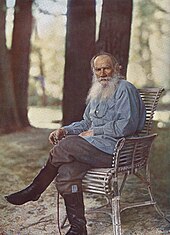
 Lithograph
 print of
Leo Tolstoy in front of Prokudin-Gorsky's camera in
Yasnaya Polyana, 1908
Perhaps Prokudin-Gorsky's best-known work from the time is the only color portrait of
Leo Tolstoy,
[6] which was then reproduced in various publications and printed for framing and on postcards.
[5][7] The fame from this photo and his earlier photos of Russia's nature and monuments earned him invitations to show his work to the
Grand Duke Michael Alexandrovich of Russia,
Empress Maria Feodorovna, and, eventually,
Tsar Nicholas II of Russia and his family in 1909.
[4] The Tsar enjoyed the demonstration, and, with his blessing, Prokudin-Gorsky got the permission and funding to document Russia in color.
[8] In the course of ten years, he was to make a collection of 10,000 photos.
[9] Prokudin-Gorsky considered the project his life's work and continued his photographic journeys through Russia until after the October Revolution.
[5] He was appointed to a new professorship under the new regime, but he left the country in August 1918.
[10] He still pursued scientific work in color photography, published papers in English photography journals and, together with his colleague S. O. Maksimovich, obtained patents in Germany, England, France and Italy.
[5]
Later life and death
In 1920, Prokudin-Gorsky remarried and had a daughter with his assistant Maria Fedorovna née Schedrimo. The family finally settled in
Paris in 1922, reuniting with his first wife and children.
[4] Prokudin-Gorsky set up a photo studio there together with his three adult children, naming it after his fourth child, Elka. In the 1930s, the elderly Prokudin-Gorsky continued with lectures showing his photographs of Russia to young Russians in France, but stopped commercial work and left the studio to his children, who named it Gorsky Frères. He died at Paris on September 27, 1944, and is buried in the
Sainte-Geneviève-des-Bois Russian Cemetery.
[5]
Photography technique
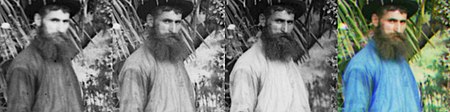
Crop from
Alleia Hamerops showing the red-, green- and blue-color channels as well as the composite image
Prokudin-Gorsky's own research yielded
patents for producing color film slides and for projecting color
motion pictures. His process used a camera that took a series of three
monochrome pictures in sequence, each through a different-colored
filter. By projecting all three monochrome pictures using correctly colored light, it was possible to reconstruct the original color scene. Any stray movement within the camera's field of view showed up in the prints as multiple "ghosted" images, since the red, green and blue images were taken of the subject at slightly different times.[
citation needed]
The exposure time of the frames is likely to have varied, even if the developed negatives were later on similar glass plates. In a letter to Leo Tolstoy requesting a photo session, Prokudin-Gorsky described each photo as taking one to three seconds, but, when recollecting his time with Tolstoy, he described a six-second exposure on a sunny day.
[7][11] Blaise Agüera y Arcas estimated the exposure of a 1909 photo taken in broad daylight to have had combined exposures of over a minute, using the movement of the moon as comparison.
[12]
Though color prints of the photos were difficult to make at the time and slide show lectures consumed much of the time he used to demonstrate his work, his studio worked in publishing prints of the photos in journals, books, postcards and large
photogravures.
[4] Many of the original prints from his publishing studio have survived to this day.
[13]
Documentary of the Russian Empire
Around 1905, Prokudin-Gorsky envisioned and formulated a plan to use the emerging technological advances that had been made in color photography to document the
Russian Empire systematically. Through such an ambitious project, his ultimate goal was to educate the schoolchildren of Russia with his "optical color projections" of the vast and diverse
history,
culture, and
modernization of the empire.
[14]
Outfitted with a specially equipped railroad-car
darkroom provided by
Tsar Nicholas II and in possession of two permits that granted him access to restricted areas and cooperation from the empire's bureaucracy, Prokudin-Gorsky documented the Russian Empire around 1909 through 1915. He conducted many illustrated lectures of his work. His photographs offer a vivid portrait of a lost world—the Russian Empire on the eve of
World War I and the coming
Russian Revolution. His subjects ranged from the medieval churches and monasteries of old Russia, to the railroads and factories of an emerging industrial power, to the daily life and work of Russia's diverse population.[
citation needed]
It has been estimated from Prokudin-Gorsky's personal inventory that before leaving Russia, he had about 3500 negatives.
[15] Upon leaving the country and exporting all his photographic material, about half of the photos were confiscated by Russian authorities for containing material that seemed to be strategically sensitive for war-time Russia.
[4] According to Prokudin-Gorsky's notes, the photos left behind were not of interest to the general public.
[15] Some of Prokudin-Gorsky's negatives were given away,
[16] and some he hid on his departure.
[17] Outside the Library of Congress collection, none has yet been found.
[15]
By Prokudin-Gorsky's death, the tsar and his family had long since been executed during the Russian Revolution, and Communist rule had been established over what was once the Russian Empire. The surviving boxes of photo albums and fragile glass plates the negatives were recorded on were finally stored in the basement of a Parisian apartment building, and the family was worried about them getting damaged. The United States
Library of Congress purchased the material from Prokudin-Gorsky's heirs in 1948 for $3500–$5000 on the initiative of a researcher inquiring into their whereabouts.
[15] The library counted 1902 negatives and 710 album prints without corresponding negatives in the collection.
[18]
Digital color rendering
Due to the difficulty in reproducing prints of sufficient quality from the negatives, only some hundred were used for exhibits, books and scholarly articles after the Library of Congress acquired them.
[4] The best-known is perhaps the 1980
coffee table book Photographs for the Tsar: The Pioneering Color Photography of Sergei Mikhailovich Prokudin-Gorskii Commissioned by Tsar Nicholas II,
[19] where the photos were combined from black-and-white prints of the negatives.
[20] It was only with the advent of
digital image processing that multiple images could be satisfactorily combined into one.
[21] The Library of Congress undertook a project in 2000 to make digital scans of all the photographic material received from Prokudin-Gorsky's heirs and contracted with the photographer Walter Frankhauser to combine the monochrome negatives into color images.
[22] He created 122 color renderings using a method he called digichromatography and commented that each image took him around six to seven hours to align, clean and color-correct.
[23] In 2001, the Library of Congress produced an exhibition from these,
The Empire That Was Russia: The Prokudin-Gorskii Photographic Record Recreated.
[24] The photographs have since been the subject of many other exhibitions in the area where Prokudin-Gorsky took his photos.
[25][26][27][28][29][30]
In 2004, the Library of Congress contracted with computer scientist
Blaise Agüera y Arcas to produce an automated color composite of each of the 1902 negatives from the high-resolution
digital images of the glass-plate negatives. He applied algorithms to compensate for the differences between the exposures and prepared color composites of all the negatives in the collection.
[12] As the library offers the high-resolution images of the negatives freely on the Internet, many others have since created their own color representations of the photos,
[31] and they have become a favourite testbed for computer scientists.
[32] A century after Prokudin-Gorsky explained his ambitions to the tsar, people all around the world are finally able to view his work, fulfilling his goal of showing everyone the glory of the Russian Empire.


 Серге́й Миха́йлович Проку́дин-Го́рский (help·info), August 30 [O.S. August 18] 1863 Russian Empire – September 27, 1944) was a Russian chemist and photographer. He is best known for his pioneering work in color photography of early 20th-century Russia.[1]


