The World’s 10 Largest Hydroelectric Dams

ShreddeR

Well-known member
  • Aug 21, 2014
    6,131
    1,419
    113
    Lurking behind you!
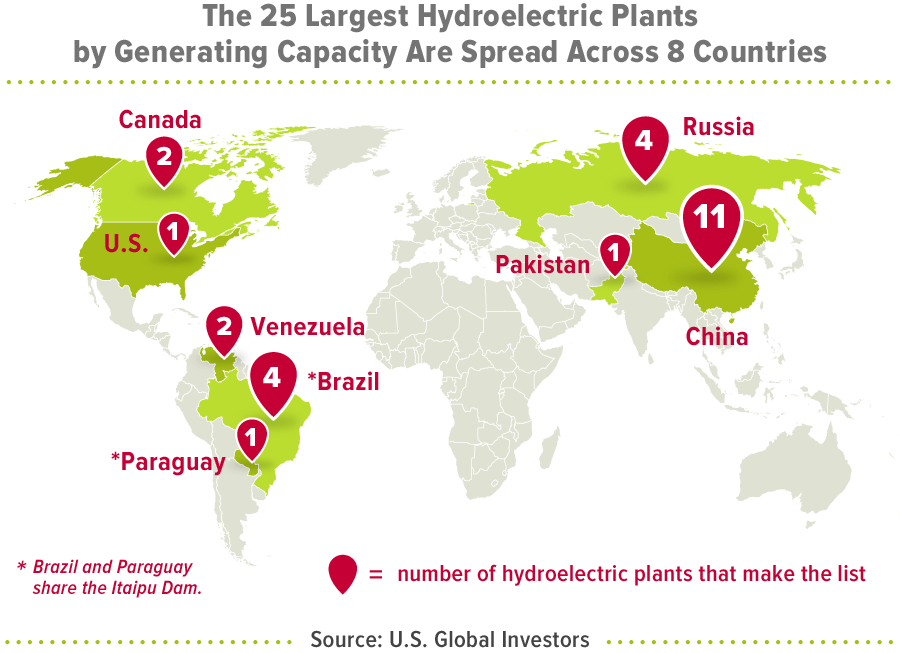
    ජල විදුලිය, පුනර්ජනනීය විදුලි උත්පාදනයේ ප්‍රමුඛ තැනක් උසුලනවා. ලොව විදුලි නිෂ්පාදනයෙන් එය 16% ක්. එවගේම 3.1% ක වර්ධන වේගයකුත් තියෙනවා. මෙහිදී චීනයට සුවිශේෂ තැනක් හිමි වෙනවා. ලොව විශාලතම ජල විදුලි බලාගාර 10න් 4ක් ඔවුන් සතුවෙනවා.සාපේක්ෂව වියදම් අඩුවීමත් හරිතාගාර වායුන් පිටවීම අවම වීමත්, ජල විදුලිය මේ තරම් භාවිතයට ප්‍රධානම හේතුන් වෙනවා.

    ලොව විශාලතම ජල විදුලි බලාගාර 10


    10. Robert-Bourassa
    La Grande, Canada


    This plant is part of Quebec’s James Bay Project and has a generating capacity of 5,616 MW. The dam is named after Premier of Quebec Robert Bourassa and was originally commissioned in 1981.

    robertbourassa-01.jpg


    spillway in action

    robert-bourassa-spillway-42.jpg


    9. Krasnoyarsk
    Yenisei River, Russia


    This dam originally came online in 1972 and has been operating ever since. It’s located in Southern Russia and has a generating capacity of 6,000 MW.

    stock-footage-krasnoyarsk-hydroelectric-power-station-dam-view-of-the-krasnoyarsk-dam-from-the-right-bank-of.jpg


    spillway in action

    GES.jpg


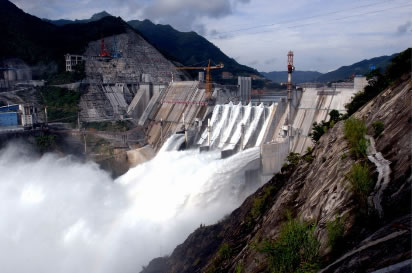
    8. Longtan Dam
    Hongshui River, China


    The Longtan Dam is the tallest of its type in the world and has a generating capacity of 6,426 MW. It’s relatively new, as it was only commissioned in 2007.
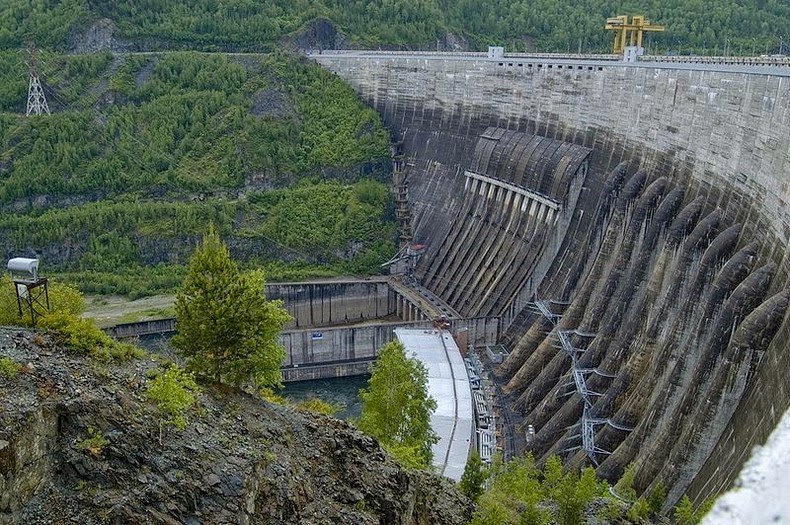
    Image.jpg


    spillway in action

    20103407023440.jpg


    7. Grand Coulee
    Columbia River, United States


    Washington State’s Grand Coulee dam is a classic. It’s been around since 1933 and remains one of the biggest in the world. It has a generating capacity of 6,809 MW and is currently undergoing major overhauls.

    image.adapt.990.high.1412629551965.jpg


    spillway in action

    Grand-Coulee-Dam-in-the-United-States.jpg


    6. Xiangjiaba
    Jinsha River, China


    This dam operates on a tributary of the Yangtze River and has a generating capacity of 6,400 MW. This dam is also very new, beginning operations in 2012.

    continued...​
     

    ShreddeR

    Well-known member
  • Aug 21, 2014
    6,131
    1,419
    113
    Lurking behind you!
    Continued

    5. Tucuruí
    Tocantins River, Brazil


    This dam was the first large-scale hydro power project in the Amazon rainforest. It was commissioned in 1984 and has a generating capacity of 8,370 MW.

    Tucurui-Dam.jpg


    spillway in action

    tucurui3.jpg


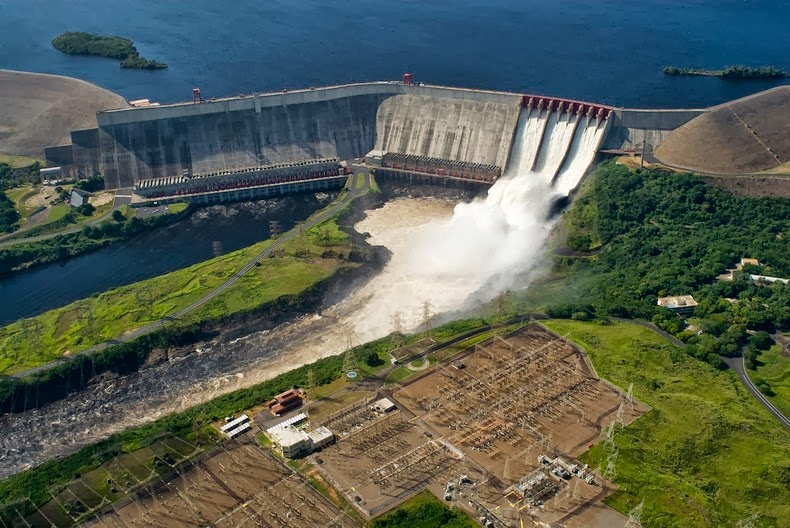
    4. Guri
    Caroní River, Venezuela


    The Guri Dam is huge. It is 7,426 meters long and 162 meters high. It’s also quite old, as it was commissioned in 1978. It currently has a generating capacity of 10,235 MW.

    guri-dam.jpg


    spillway in action

    guri-3%25255B6%25255D.jpg


    3. Xiluodu
    Jinsha River, China

    This dam has a generating capacity of 13,860 and also provides flood control for the region. It’s brand new, as it was only commissioned in 2013, and is operated by China Yangtze Power.

    After completed.

    4213xiluodu1.jpg


    2. Itaipu Dam
    Paraná River, Brazil/Paraguay


    This dam occasionally has a higher generating output than the number one spot. With 14 GW of installed capacity it’s quite impressive. It also straddles the line between two countries, making initial negotiations difficult.

    469372536-itaipu-reservoir-itaipu-dam-parana-river-alto-parana.jpg


    spillway in action

    78448-004-F6C7C18D.jpg


    1. Three Gorges Dam
    Yangtze River, China


    Here it is: the big one. With a massive generating capacity of 22.5 GW, the Three Gorges Dam is the biggest hydro dam in the world. China had begun dreaming up this dam in 1919, and in 2008, it came alive. It’s a beast of a hydro dam and is a marvel of modern engineering.

    Three-Gorge-Dam-on-the-Yangtze-River-500x335.jpg


    spillway in action

    three-gorges-dam-3.jpg


    තවත් මෙවන් ලිපියකින් හමුවෙමු.
    11.gif
     
    Last edited:

    ShreddeR

    Well-known member
  • Aug 21, 2014
    6,131
    1,419
    113
    Lurking behind you!
    Hydro power and Sri Lanka’s energy challenge

    ජල විදුලිය සහ ශ්‍රී ලංකාවට වර්තමානයේ ඇති අභියෝගය

    Water and energy are linked with an eternal bond. Many countries blessed with rivers and waterfalls have harnessed their inherent kinetic energy through hydro-electricity in fulfilling their energy needs. Sri Lanka is one such country. But the rising demand for electricity and the limited generation potential of existing hydro plants have reduced the relative contribution of hydro power in the country’s electricity generation.

    As a solution to this, Sri Lanka has taken a policy decision to move towards thermal and coal for electricity generation. However, this is leading to issues such as rising electricity prices and negative environmental externalities. The challenge for countries like Sri Lanka is to redefine the water-energy nexus to find sustainable solutions for the future.

    Rising electricity demand and debatable supply mix

    Sri Lanka faces an increasing demand for electricity. This has grown gradually over time where the increase in the average per capita electricity consumption from 2010 to 2012 was 14.6 percent. Approximately, 94 percent of households are provided with electricity and the government is determined to raise this to 100 percent. Further, the country provides grid electricity to about 80 percent of households, while around 3 percent of households use off-grid systems. At the moment, about 40 percent of electrical energy is used in households, 40 percent in manufacturing industry and the rest in the commercial sector.

    Since the commissioning of the first hydroelectric power plant in 1950 at Laxapana, hydropower has played a major role in power generation in Sri Lanka. In fact, the largest share of electricity generation came from major hydro development projects until the mid-1990s.

    Since then, electricity generation has been in a transition from a predominantly hydroelectric system to a mixed hydro-thermal system, presently dominated by oil. As shown in Figure 1, thermal power has currently become the major source of electricity generation – about 70.8 percent[ii]. Between 2000 and 2012, contributions from the major hydro plants have seen significant fluctuations – from a high 46 percent to a low 23 percent. Nevertheless, a significant portion of electricity demand continues to be met by conventional and non-conventional renewable energy sources which include mini-hydro. Therefore, even though the contribution is decreasing, hydro still plays a major role in Sri Lanka’s electricity generation mix.

    Hydro power potential: Limited or neglected?

    It is widely claimed that all available significant sources of hydro potential have been exhausted and the possibility of further expansion is rather limited. However, hydro power is the least-cost electricity source for many countries. Research done by the United States Geological Survey (USGS) shows that hydroelectricity systems have a life time of close to 100 years, produce clean and green energy, and help to stabilize the price effects of coal and oil power systems[iii].

    Hydro power generation potential has two major sources – conventional hydro power and non-conventional hydro power. Conventional hydro, also known as ‘major hydro’, refers to large hydro power generation facilities that have been in operation since the early periods of the energy industry in Sri Lanka. This includes power plants such as Laxapana, Norton and Maussakele, and stations established under the Mahaweli scheme like Randenigala, Victoria, and Kotmale. The major hydro schemes that are being newly developed include Upper Kotmale, Broadlands, Uma Oya and Monaragala. Today, it seems that whilst the demand for electricity is continuously increasing, the exploitable capacity of major hydropower is stagnating.

    On the other hand, non-conventional hydro is a term that refers to small scale, grid-connected hydro resources. In the past 15 years, there was a growth in non-conventional hydro, with capacity additions surpassing 180 MW of grid power, generating more than 4 percent of the total capacity. A considerable portion of small hydro potential remains to be explored. These have capacities varying from a few hundred kW to 40 MW. Some studies have estimated the total potential to be around 500MW[iv].

    Untitled-8(25).jpg


    The challenge: Generation mix and three questions to ask

    Overall, it seems Sri Lanka’s capacity for further expansion of hydroelectric potential – in both large and small developments – is limited. As such, Sri Lanka’s electricity generating system (currently dominated by oil-fired electricity generation) is likely to be led by coal-fired power plants in the future – being the cheapest alternative to oil-fired generation.

    The share of hydropower is estimated to reduce from 40.2 percent in 2007 to 19.5 percent by 2020, while coal-fired thermal generation is estimated to reach 70.9 percent by 2020[v]. Furthermore, there is ample evidence to suggest that Sri Lanka’s climate has already changed. Variability of both southwest monsoon and northeast monsoon rains and rains of convectional origin during inter-monsoon seasons has increased significantly in recent decades. These changes will have direct impacts on water availability for hydro power generation.

    Meanwhile, the dependency on coal may also increase electricity prices and negative environmental externalities. A recent study done by Harvard University reports that the life-cycle effects of coal, and the waste stream generated, is costing the U.S. public between a third to over half a trillion dollars annually[vi]. Moreover, many of these externalities are cumulative. When the environmental damages are accounted for, the price of a unit of electricity generated by a unit of coal is higher than any other renewable resource, especially hydro. Therefore, leaning towards coal as a long-term solution needs rethinking.

    Against this backdrop, it is essential to ask some basic questions –
    (1) Are there any management practices that can be employed to increase the efficiency in hydro power generation?;
    (2) What are new innovations that could boost the efficiency of hydro power generation?; and
    (3) How can the adverse impacts that climate change would have on generating power through hydro be addressed?.

    Policy options: Managing catchment areas, adopting new technology

    Even though it is widely believed that the major hydro systems have reached their potential, there could be ways to improve efficiency. Better management of ’catchment areas and upper catchment areas’ can be one option. A catchment area is the area drained by the water body or the reservoir, while an upper catchment area is just above that and is generally covered by forests. Deforestation in upper catchment areas causes heavy soil erosion and causes siltation in the catchment area.

    Better management of these areas could improve water storage of existing reservoirs, allowing more water to be available for power generation over a longer period of time. Today, deforestation and soil erosion has caused siltation in many of the major reservoirs, significantly reducing their water holding capacities. Therefore, it might be useful to protect these catchments areas, and manage them properly to ensure larger storages during rainy seasons.

    Many new innovations that are emerging can boost the performance of hydro power generation systems, for instance Pump Water Storage Power Plants (PWSPP). These systems allow the pumping of water from lower reservoirs to upper reservoirs using renewable energy such as solar power. These storage mechanisms have been reported to possess efficiency levels of around 85 percent[vii]. Some studies on implementing this in Sri Lanka are now underway. Potential capacity improvements have been assessed for sites such as Samanalawewa (Keriketi Oya), Maussakele (Adam’s peak falls), Randenigala (Halgran Oya), Kotmale (Maha Oya, Gurugal Oya, Kada Oya) and Upper Kotmale (Dambagatalawa, Agra Oya)[viii].

    Figure-1-Electricity-Generation-in-Sri-Lanka-by-Source-(%25)---2000-to-2012.jpg


    Climate change has created drastic changes to rainfall patterns. In the long run, wet zones will receive more rainfall while dry areas become drier. Rainfall will not be evenly distributed and rainfall intensities will be higher. Therefore, water collection and release plans, reservoir and dam maintenance and reconstruction plans need to be geared to tackle these changes. By doing so, it would be possible to avoid unfortunate situations where dams are closed for repairs during periods of ample rainfall.

    Finally, it can be argued that it is still too early for Sri Lanka to focus overwhelmingly on coal energy for the future. Even though hydro will not be sufficient to cater to the growing electricity demand in Sri Lanka, there is additional potential that can be explored. With focused research on better management practices and innovations, the contribution from hydro could well be more than the 19.5 percent by 2020 as currently predicted by energy planners.

    Source: Dailymirror 2014-03-25
     
    • Like
    Reactions: Local Disk (c:)
    Nov 28, 2014
    117
    3
    0
    Hello all newbies, how are you all. I am Prince Charming. Nice to meet all of you. I am an Artist. I love to meet new people as well as making new friends. I like to watch new Hollywood Movies as well as Bollywood Movies and want to know about them as more as possible. So if you really want to know my thinking about the World’s 10 Largest Hydroelectric Dams, then i will tell you about these names which i mention under here :

    1. Three Gorges Dam
    2. Itaipu Dam
    3. Xiluodu
    4. Guri
    5. Tucurui
    6. Grand Coulee
    7. Xiangjiaba
    8. Longtan Dam
    9. Sayano - Shushenskaya
    10. Krasnoyarsk


    That's it..................