


අයන්නේ සිට ඉලෙකට්රොනික්ස්.....
Georg Simon Ohm

Georg Simon Ohm was born in Erlangen, Bavaria, on March 16, 1787. His father was a master mechanic who determined that his son should obtain an education in science. Although Ohm became a teacher in a high school, he had aspirations to receive a university appointment. The only way that such an appointment could be realized would be if Ohm could produce important results through scientific research. Since the science of electricity was in its infancy, and because the electric cell had recently been invented by the Italian Conte Alessandro Volta, Ohm decided to study the behavior of current in resistive circuits. Because equipment was expensive and hard to come by, Ohm made much of his own, thanks, in large part, to his father’s training. Using this equipment, Ohm determined experimentally that the amount of current transmitted along a wire was directly proportional to its cross-sectional area and inversely proportional to its length. From these results, Ohm was able to define resistance and show that there was a simple relationship between voltage, resistance, and current. This result, now known as Ohm’s law, is probably the most fundamental relationship in circuit theory. However, when published in 1827, Ohm’s results were met with ridicule. As a result, not only did Ohm miss out on a university appointment, he was forced to resign from his high-school teaching position. While Ohm was living in poverty and shame, his work became known and appreciated outside Germany. In 1842, Ohm was appointed a member of the Royal Society. Finally, in 1849, he was appointed as a professor at the University of Munich, where he was at last recognized for his important contributions.
Ohm's Law
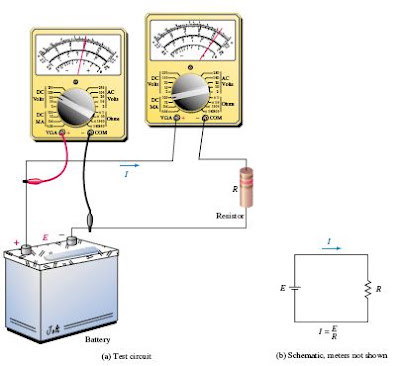
Ohm determined experimentally that current in a resistive circuit is directly proportional to its applied voltage and inversely proportional to its resistance.
I = V / R
V is the voltage in volt
R is the resistance in ohm
I is the current in ampere
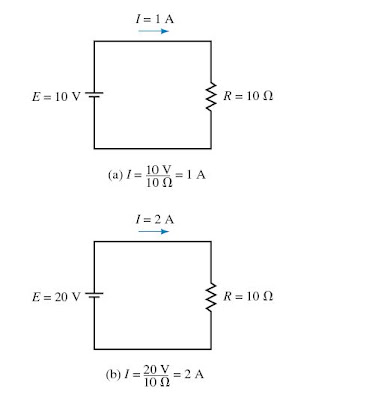
Its determine that that larger the applied voltage, larger the current, while larger the resistance, smaller the current.
Examples:
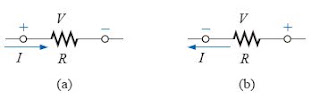
For an isolated resistive element, the polarity of the voltage drop is as shown in following figure (a) for the indicated current direction. A reversal in current will reverse the polarity as in figure (b). In general, the flow of charge is from a high (+) to a low (-) potential. Polarities as established by current direction will become increasingly important in the circuit analysis.
For More Details: Click Here
Georg Simon Ohm

Georg Simon Ohm was born in Erlangen, Bavaria, on March 16, 1787. His father was a master mechanic who determined that his son should obtain an education in science. Although Ohm became a teacher in a high school, he had aspirations to receive a university appointment. The only way that such an appointment could be realized would be if Ohm could produce important results through scientific research. Since the science of electricity was in its infancy, and because the electric cell had recently been invented by the Italian Conte Alessandro Volta, Ohm decided to study the behavior of current in resistive circuits. Because equipment was expensive and hard to come by, Ohm made much of his own, thanks, in large part, to his father’s training. Using this equipment, Ohm determined experimentally that the amount of current transmitted along a wire was directly proportional to its cross-sectional area and inversely proportional to its length. From these results, Ohm was able to define resistance and show that there was a simple relationship between voltage, resistance, and current. This result, now known as Ohm’s law, is probably the most fundamental relationship in circuit theory. However, when published in 1827, Ohm’s results were met with ridicule. As a result, not only did Ohm miss out on a university appointment, he was forced to resign from his high-school teaching position. While Ohm was living in poverty and shame, his work became known and appreciated outside Germany. In 1842, Ohm was appointed a member of the Royal Society. Finally, in 1849, he was appointed as a professor at the University of Munich, where he was at last recognized for his important contributions.
Ohm's Law

Ohm determined experimentally that current in a resistive circuit is directly proportional to its applied voltage and inversely proportional to its resistance.
I = V / R
V is the voltage in volt
R is the resistance in ohm
I is the current in ampere
Its determine that that larger the applied voltage, larger the current, while larger the resistance, smaller the current.
Examples:

For an isolated resistive element, the polarity of the voltage drop is as shown in following figure (a) for the indicated current direction. A reversal in current will reverse the polarity as in figure (b). In general, the flow of charge is from a high (+) to a low (-) potential. Polarities as established by current direction will become increasingly important in the circuit analysis.

For More Details: Click Here


