


The Sombrero galaxy likely merged with a relatively massive galaxy several billions of years ago. In a new study published in the Monthly Notices of the Royal Astronomical Society, astronomers analyzed wide-field deep images of the Sombrero galaxy’s outskirts obtained with a small amateur telescope with the purpose of detecting any tidal structures — such as stellar streams and tails — from the possible ancient merger.

The Sombrero galaxy is located approximately 28 million light-years away in the constellation of Virgo. Also known as Messier 104, M104 or NGC 4594, the galaxy was discovered on May 11, 1781, by the French astronomer Pierre Méchain. It has a diameter of approximately 49,000 light-years, about 3 times smaller than our Milky Way Galaxy.“The Sombrero galaxy shows characteristics of both of the dominant types of galaxies in the Universe, the spirals and the ellipticals,” said Dr. David Martínez-Delgado, an astronomer at the Instituto de Astrofísica de Andalucía – CSIC, and his colleagues.“It has spiral arms, and a very large bright central bulge, which makes it look like a hybrid of the two types.”
The recent discovery of extremely metal-rich stars in the halo of the Sombrero galaxy suggested that the galaxy had undergone a recent major merger with a relatively massive galaxy.“According to the latest cosmological models, large spiral galaxies such as the Milky Way grew by absorbing smaller galaxies, by a sort of galactic cannibalism,” the astronomers said.“Evidence for this is given by very large structures, the tidal stellar streams, which are observed around them, which are the remains of these satellite galaxies.”But the full histories of the majority of these cases are hard to study, because these flows of stars are very faint, and only the remains of the most recent mergers have been detected.”
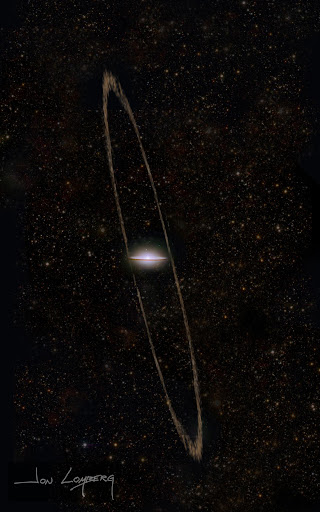
An artist’s impression of the tidal stream around the Sombrero galaxy. Image credit: Jon Lomberg / Stellar Tidal Stream Survey.
In the new study, the researchers observed the ring-like tidal structure in the inner halo region of the Sombrero galaxy.“It is remarkable that thanks to these advanced photometric techniques we have been able to do front line science with a Messier object using only an 18-cm-diameter telescope,” said co-author Dr. Javier Román, a postdoctoral researcher in the Instituto de Astrofísica de Andalucía – CSIC, the Instituto de Astrofísica de Canarias, and the Universidad de La Laguna.
The team’s result is in agreement with the hypothesis that the galaxy was created by a ‘wet major merger’ event more than 3.5 billion years ago that heated up the stellar population.“A ‘wet merger’ is a scenario in which a large elliptical galaxy is rejuvenated by large quantities of gas and dust from another massive galaxy, which went into the formation of the disk which we now observe,” they said.“In our search, we have been able to trace for the first time the complete tidal stream which surrounds the disk of the Sombrero galaxy and our theoretical simulations have let us reconstruct its formation in the last 3 billion years, by cannibalism of a satellite dwarf galaxy.”
Source: sci-news.com
The Sombrero galaxy is located approximately 28 million light-years away in the constellation of Virgo. Also known as Messier 104, M104 or NGC 4594, the galaxy was discovered on May 11, 1781, by the French astronomer Pierre Méchain. It has a diameter of approximately 49,000 light-years, about 3 times smaller than our Milky Way Galaxy.“The Sombrero galaxy shows characteristics of both of the dominant types of galaxies in the Universe, the spirals and the ellipticals,” said Dr. David Martínez-Delgado, an astronomer at the Instituto de Astrofísica de Andalucía – CSIC, and his colleagues.“It has spiral arms, and a very large bright central bulge, which makes it look like a hybrid of the two types.”
The recent discovery of extremely metal-rich stars in the halo of the Sombrero galaxy suggested that the galaxy had undergone a recent major merger with a relatively massive galaxy.“According to the latest cosmological models, large spiral galaxies such as the Milky Way grew by absorbing smaller galaxies, by a sort of galactic cannibalism,” the astronomers said.“Evidence for this is given by very large structures, the tidal stellar streams, which are observed around them, which are the remains of these satellite galaxies.”But the full histories of the majority of these cases are hard to study, because these flows of stars are very faint, and only the remains of the most recent mergers have been detected.”
An artist’s impression of the tidal stream around the Sombrero galaxy. Image credit: Jon Lomberg / Stellar Tidal Stream Survey.
In the new study, the researchers observed the ring-like tidal structure in the inner halo region of the Sombrero galaxy.“It is remarkable that thanks to these advanced photometric techniques we have been able to do front line science with a Messier object using only an 18-cm-diameter telescope,” said co-author Dr. Javier Román, a postdoctoral researcher in the Instituto de Astrofísica de Andalucía – CSIC, the Instituto de Astrofísica de Canarias, and the Universidad de La Laguna.
The team’s result is in agreement with the hypothesis that the galaxy was created by a ‘wet major merger’ event more than 3.5 billion years ago that heated up the stellar population.“A ‘wet merger’ is a scenario in which a large elliptical galaxy is rejuvenated by large quantities of gas and dust from another massive galaxy, which went into the formation of the disk which we now observe,” they said.“In our search, we have been able to trace for the first time the complete tidal stream which surrounds the disk of the Sombrero galaxy and our theoretical simulations have let us reconstruct its formation in the last 3 billion years, by cannibalism of a satellite dwarf galaxy.”
Source: sci-news.com


