Big Bang Theory and Sinhala Buddhist explanation about Big Bang Theory

tharinda07

Member
Mar 1, 2007
5,784
44
0
Observational evidence

The earliest and most direct kinds of observational evidence are the Hubble-type expansion seen in the redshifts of galaxies, the detailed measurements of the cosmic microwave background, and the abundance of light elements . These are sometimes called the three pillars of the big bang theory. Many other lines of evidence now support the picture, notably various properties of the large-scale structure of the cosmoshttp://en.wikipedia.org/wiki/Big_Bang#cite_note-35 which are predicted to occur due to gravitational growth of structure in the standard Big Bang theory.



tharinda07

Member
Mar 1, 2007
5,784
44
0
Hubble's law and the expansion of space


Observations of distant galaxies and quasars show that these objects are redshifted—the light emitted from them has been shifted to longer wavelengths. This can be seen by taking a frequency spectrum of an object and matching the spectroscopic pattern of emission lines or absorption lines corresponding to atoms of the chemical elements interacting with the light. These redshifts are uniformly isotropic, distributed evenly among the observed objects in all directions. If the redshift is interpreted as a Doppler shift, the recessional velocity of the object can be calculated. For some galaxies, it is possible to estimate distances via the cosmic distance ladder. When the recessional velocities are plotted against these distances, a linear relationship known as Hubble's law is observed:

b5852a53bf53791a627f96b71dbf58f7.png

where

v is the recessional velocity of the galaxy or other distant object
D is the comoving proper distance to the object and
H0 is Hubble's constant, measured to be 70.1 ± 1.3 km/s/Mpc by the WMAP probe.

Hubble's law has two possible explanations. Either we are at the center of an explosion of galaxies—which is untenable given the Copernican Principle—or the universe is uniformly expanding everywhere. This universal expansion was predicted from general relativity by Alexander Friedman in 1922 and Georges Lemaître in 1927, well before Hubble made his 1929 analysis and observations, and it remains the cornerstone of the Big Bang theory as developed by Friedmann, Lemaître, Robertson and Walker.

The theory requires the relation v = HD to hold at all times, where D is the proper distance, v = dD / dt, and v, H, and D all vary as the universe expands (hence we write H0 to denote the present-day Hubble "constant"). For distances much smaller than the size of the observable universe, the Hubble redshift can be thought of as the Doppler shift corresponding to the recession velocity v. However, the redshift is not a true Doppler shift, but rather the result of the expansion of the universe between the time the light was emitted and the time that it was detected.

That space is undergoing metric expansion is shown by direct observational evidence of the Cosmological Principle and the Copernican Principle, which together with Hubble's law have no other explanation. Astronomical redshifts are extremely isotropic and homogenous, supporting the Cosmological Principle that the universe looks the same in all directions, along with much other evidence. If the redshifts were the result of an explosion from a center distant from us, they would not be so similar in different directions.

Measurements of the effects of the cosmic microwave background radiation on the dynamics of distant astrophysical systems in 2000 proved the Copernican Principle, that the Earth is not in a central position, on a cosmological scale. Radiation from the Big Bang was demonstrably warmer at earlier times throughout the universe. Uniform cooling of the cosmic microwave background over billions of years is explainable only if the universe is experiencing a metric expansion, and excludes the possibility that we are near the unique center of an explosion.


tharinda07

Member
Mar 1, 2007
5,784
44
0
Cosmic microwave background radiation​


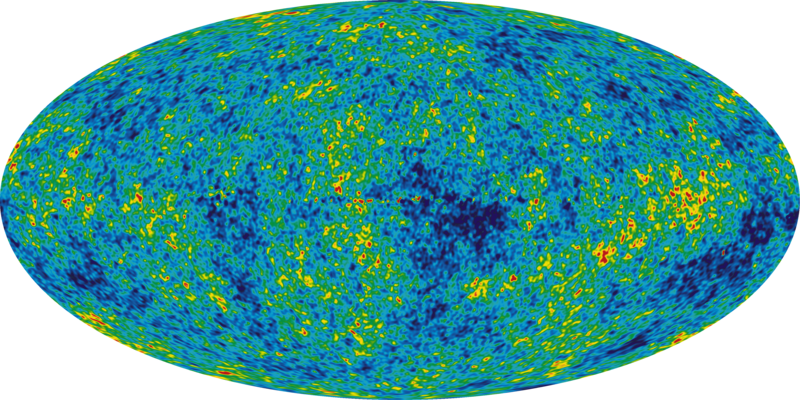
800px-WMAP_2008.png


WMAP image of the cosmic microwave background radiation


During the first few days of the universe, the universe was in full thermal equilibrium, with photons being continually emitted and absorbed, giving the radiation a blackbody spectrum. As the universe expanded, it cooled to a temperature at which photons could no longer be created or destroyed. The temperature was still high enough for electrons and nuclei to remain unbound, however, and photons were constantly "reflected" from these free electrons through a process called Thomson scattering. Because of this repeated scattering, the early universe was opaque to light.

When the temperature fell to a few thousand Kelvin, electrons and nuclei began to combine to form atoms, a process known as recombination. Since photons scatter infrequently from neutral atoms, radiation decoupled from matter when nearly all the electrons had recombined, at the epoch of last scattering, 379,000 years after the Big Bang. These photons make up the CMB that is observed today, and the observed pattern of fluctuations in the CMB is a direct picture of the universe at this early epoch. The energy of photons was subsequently redshifted by the expansion of the universe, which preserved the blackbody spectrum but caused its temperature to fall, meaning that the photons now fall into the microwave region of the electromagnetic spectrum. The radiation is thought to be observable at every point in the universe, and comes from all directions with (almost) the same intensity.

In 1964, Arno Penzias and Robert Wilson accidentally discovered the cosmic background radiation while conducting diagnostic observations using a new microwave receiver owned by Bell Laboratories. Their discovery provided substantial confirmation of the general CMB predictions—the radiation was found to be isotropic and consistent with a blackbody spectrum of about 3 K—and it pitched the balance of opinion in favor of the Big Bang hypothesis. Penzias and Wilson were awarded a Nobel Prize for their discovery.

In 1989, NASA launched the Cosmic Background Explorer satellite (COBE), and the initial findings, released in 1990, were consistent with the Big Bang's predictions regarding the CMB. COBE found a residual temperature of 2.726 K and in 1992 detected for the first time the fluctuations (anisotropies) in the CMB, at a level of about one part in 105.John C. Mather and George Smoot were awarded Nobels for their leadership in this work. During the following decade, CMB anisotropies were further investigated by a large number of ground-based and balloon experiments. In 2000–2001, several experiments, most notably BOOMERanG, found the universe to be almost spatially flat by measuring the typical angular size (the size on the sky) of the anisotropies.
In early 2003, the first results of the Wilkinson Microwave Anisotropy satellite (WMAP) were released, yielding what were at the time the most accurate values for some of the cosmological parameters. This satellite also disproved several specific cosmic inflation models, but the results were consistent with the inflation theory in general, it confirms too that a sea of cosmic neutrinos permeates the universe, a clear evidence that the first stars took more than a half-billion years to create a cosmic fog. Another satellite like it will be launched within the next few years, the Planck Surveyor, which will provide even more accurate measurements of the CMB anisotropies. Many other ground- and balloon-based experiments are also currently running; see Cosmic microwave background experiments.

The background radiation is exceptionally smooth, which presented a problem in that conventional expansion would mean that photons coming from opposite directions in the sky were coming from regions that had never been in contact with each other. The leading explanation for this far reaching equilibrium is that the universe had a brief period of rapid exponential expansion, called inflation. This would have the effect of driving apart regions that had been in equilibrium, so that all the observable universe was from the same equilibrated region.
 
Last edited:

tharinda07

Member
Mar 1, 2007
5,784
44
0
Abundance of primordial elements


Using the Big Bang model it is possible to calculate the concentration of helium-4, helium-3, deuterium and lithium-7 in the universe as ratios to the amount of ordinary hydrogen, H. All the abundances depend on a single parameter, the ratio of photons to baryons, which itself can be calculated independently from the detailed structure of CMB fluctuations. The ratios predicted (by mass, not by number) are about 0.25 for 4He/H, about 10−3 for ²H/H, about 10−4 for ³He/H and about 10−9 for 7Li/H.

The measured abundances all agree at least roughly with those predicted from a single value of the baryon-to-photon ratio. The agreement is excellent for deuterium, close but formally discrepant for 4He, and a factor of two off for 7Li; in the latter two cases there are substantial systematic uncertainties. Nonetheless, the general consistency with abundances predicted by BBN is strong evidence for the Big Bang, as the theory is the only known explanation for the relative abundances of light elements, and it is virtually impossible to "tune" the Big Bang to produce much more or less than 20–30% helium. Indeed there is no obvious reason outside of the Big Bang that, for example, the young universe (i.e., before star formation, as determined by studying matter supposedly free of stellar nucleosynthesis products) should have more helium than deuterium or more deuterium than He, and in constant ratios, too.


Scarface

Well-known member
  • Dec 8, 2008
    1,711
    471
    83
    morphine base
    Zeus said:


    Yes ayiye mata mehema hitenava api balun patalayak aragena eke langin langin tith tiyala adinava vage.
    Etakota balun patalaya hama pattenma adimin prasaranaya karana kota e tith ekinekin athvevi prasaranaya venava
    So one mark had correspodent spot b4
    Ehemada:confused:


    According to Modern Cosmology, the Universe has no "center" or an "edge". So, hence, no "surrounding stuff".

    Sort of imagine it this way:
    Imagine the universe as a balloon that's inflating. If an ant stood at Point A, and another ant stood at Point B, as the balloon inflates, the distance between then increases, hence, you have a "universe expansion".

    If you say that you are on the inside of the balloon, and you are going to run OUTWARDS, to get to the edge, that still doesn't work, because this balloon is inflating faster than you can move. Technically to speak, Universe expansion is not limited by "c". So even if you travel at "c", you cannot reach the edge.

    The expansion distance can be seen by:
    An element of flat Friedmann-Lemaitre-Roberts
    on-Walker metric (where we'll assume a homogeneous expanding universe) as
    ds^2 = -dt^2 + a(t)(dx^2+dy^2+dz^2)

    where this is an exact solution to GR (YAY to anyone else here who loves solving differentials, lol).

    Hence, we can say that the distance is the integral of:
    a(t) sqrt[dx^2+dy^2+dz^2], where t is a constant. ( a(t) can be taken out of the integral, also).

    So, distance at time t is a(t)K; K being a constant. Now, if we give Universe A a velocity, V is basically ds/dt, or in this case, [da(t)/dt]K -> aK = v. Assuming we are a 3rd observer inbetween these two galaxies moving away from us, then their distance away from us is the same, if the distance from one of them is a(t)K, then the distance between the two of them is 2a(t)K.
    That makes the expansion speed 2aK

    (so if universe A was moving away at 0.55c, and so was Universe B, then the Universe expansion rate is 0.55c x 2 = 1.1c)

    **I read this up just recently, though I admit I don't know too much about GR. But I do know differentials.
     

    tharinda07

    Member
    Mar 1, 2007
    5,784
    44
    0
    Galactic evolution and distribution


    Detailed observations of the morphology and distribution of galaxies and quasarsgalaxy clusters and superclusters. Populations of stars have been aging and evolving, so that distant galaxies (which are observed as they were in the early universe) appear very different from nearby galaxies (observed in a more recent state). Moreover, galaxies that formed relatively recently appear markedly different from galaxies formed at similar distances but shortly after the Big Bang. These observations are strong arguments against the steady-state model. Observations of star formation, galaxy and quasar distributions and larger structures agree well with Big Bang simulations of the formation of structure in the universe and are helping to complete details of the theory
    provide strong evidence for the Big Bang. A combination of observations and theory suggest that the first quasars and galaxies formed about a billion years after the Big Bang, and since then larger structures have been forming, such as
     

    tharinda07

    Member
    Mar 1, 2007
    5,784
    44
    0
    2MASS_LSS_chart-NEW_Nasa.jpg

    This panoramic view of the entire near-infrared sky reveals the distribution of galaxies beyond the Milky Way. The galaxies are color coded by redshift.​
     

    Zeus

    Well-known member
  • Sep 14, 2007
    20,327
    1,957
    113
    Kalutara
    Thanx tarinda ayiya
    MA me dan devenipara articles tiak kiyavanna yanne
    And dnt 4get v have to discuss about Buddists xplanation too
    :D
     

    Zeus

    Well-known member
  • Sep 14, 2007
    20,327
    1,957
    113
    Kalutara
    Scarface said:


    ds^2 = -dt^2 + a(t)(dx^2+dy^2+dz^2)


    a(t) sqrt[dx^2+dy^2+dz^2], where t is a constant. ( a(t) can be taken out of the integral, also).

    Thnx a lot pal u gave me a clear pic xcept these lines above
    thnx agin pal hope u'll be wi us in this thred :D
     

    tharinda07

    Member
    Mar 1, 2007
    5,784
    44
    0
    Zeus said:
    Thanx tarinda ayiya
    MA me dan devenipara articles tiak kiyavanna yanne
    And dnt 4get v have to discuss about Buddists xplanation too
    :D
    kk thaama big bang eaka wisthara karala iwara naene
     

    tharinda07

    Member
    Mar 1, 2007
    5,784
    44
    0
    Other lines of evidence


    After some controversy, the age of universe as estimated from the Hubble expansion and the CMB is now in good agreement with (i.e., slightly larger than) the ages of the oldest stars, both as measured by applying the theory of stellar evolution to globular clusters and through radiometric dating of individual Population II stars.
    The prediction that the CMB temperature was higher in the past has been experimentally supported by observations of temperature-sensitive emission lines in gas clouds at high redshift. This prediction also implies that the amplitude of the Sunyaev-Zel'dovich effect in clusters of galaxies does not depend directly on redshift; this seems to be roughly true, but unfortunately the amplitude does depend on cluster properties which do change substantially over cosmic time, so a precise test is impossible.


    tharinda07

    Member
    Mar 1, 2007
    5,784
    44
    0
    Features, issues and problems

    While very few researchers now doubt the Big Bang occurred, the scientific community was once divided between supporters of the Big Bang and those of alternative cosmological models. Throughout the historical development of the subject, problems with the Big Bang theory were posed in the context of a scientific controversy regarding which model could best describe the cosmological observations (see the history section above). With the overwhelming consensus in the community today supporting the Big Bang model, many of these problems are remembered as being mainly of historical interest; the solutions to them have been obtained either through modifications to the theory or as the result of better observations. Other issues, such as the cuspy halo problem and the dwarf galaxy problem of cold dark matter, are not considered to be fatal as it is anticipated that they can be solved through further refinements of the theory.
    The core ideas of the Big Bang—the expansion, the early hot state, the formation of helium, the formation of galaxies—are derived from many independent observations including abundance of light elements, the cosmic microwave background, large scale structure and Type Ia supernovae, and can hardly be doubted as important and real features of our universe.
    Precise modern models of the Big Bang appeal to various exotic physical phenomena that have not been observed in terrestrial laboratory experiments or incorporated into the Standard Model of particle physics. Of these features, dark energy and dark matter are considered the most secure, while inflation and baryogenesis remain speculative: they provide satisfying explanations for important features of the early universe, but could be replaced by alternative ideas without affecting the rest of the theory.http://en.wikipedia.org/wiki/Big_Bang#cite_note-41 Explanations for such phenomena remain at the frontiers of inquiry in physics.


    Zeus

    Well-known member
  • Sep 14, 2007
    20,327
    1,957
    113
    Kalutara
    tharinda07 said:
    kk thaama big bang eaka wisthara karala iwara naene

    Ayi oya tama mainly describe karala ivara nadda??
    Ok ehenam tava post karanna im waiting
    MAn me devenipara oyage articles tika hemin sare kiyavagena yanava
    Mulika adahasa tibbama athi :D
     

    tharinda07

    Member
    Mar 1, 2007
    5,784
    44
    0
    Zeus said:
    Ayi oya tama mainly describe karala ivara nadda??
    Ok ehenam tava post karanna im waiting
    MAn me devenipara oyage articles tika hemin sare kiyavagena yanava
    Mulika adahasa tibbama athi :D
    hamootama theerena widihata explain karala iwarai
    thawa post wagayak thiyenawa ewa thika ookoma mama dan daannam oya kiyawala iwara nisa:)
     

    tharinda07

    Member
    Mar 1, 2007
    5,784
    44
    0
    Horizon problem

    The horizon problem results from the premise that information cannot travel faster than light. In a universe of finite age, this sets a limit—the particle horizon—on the separation of any two regions of space that are in causal contact.http://en.wikipedia.org/wiki/Big_Bang#cite_note-kolb_c8-42 The observed isotropy of the CMB is problematic in this regard: if the universe had been dominated by radiation or matter at all times up to the epoch of last scattering, the particle horizon at that time would correspond to about 2 degrees on the sky. There would then be no mechanism to cause these regions to have the same temperature.
    A resolution to this apparent inconsistency is offered by inflationary theory in which a homogeneous and isotropic scalar energy field dominates the universe at some very early period (before baryogenesis). During inflation, the universe undergoes exponential expansion, and the particle horizon expands much more rapidly than previously assumed, so that regions presently on opposite sides of the observable universe are well inside each other's particle horizon. The observed isotropy of the CMB then follows from the fact that this larger region was in causal contact before the beginning of inflation.
    Heisenberg's uncertainty principle predicts that during the inflationary phase there would be quantum thermal fluctuations, which would be magnified to cosmic scale. These fluctuations serve as the seeds of all current structure in the universe. Inflation predicts that the primordial fluctuations are nearly scale invariant and Gaussian, which has been accurately confirmed by measurements of the CMB
     

    tharinda07

    Member
    Mar 1, 2007
    5,784
    44
    0
    Flatness/oldness problem


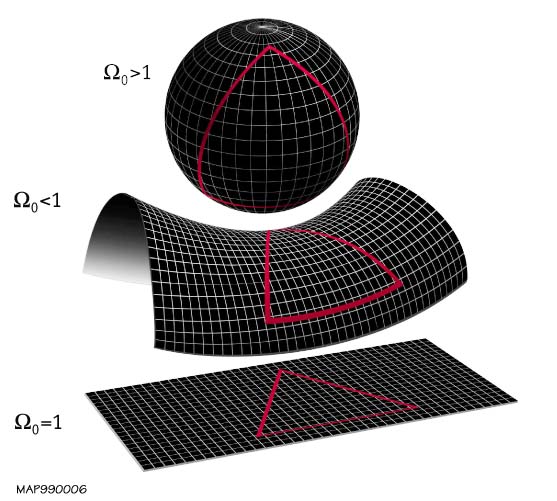
    The flatness problem (also known as the oldness problem) is an observational problem associated with a Friedmann-Lemaître-Robertson-Walker metric.http://en.wikipedia.org/wiki/Big_Bang#cite_note-kolb_c8-42 The universe may have positive, negative or zero spatial curvature depending on its total energy density. Curvature is negative if its density is less than the critical density, positive if greater, and zero at the critical density, in which case space is said to be flat. The problem is that any small departure from the critical density grows with time, and yet the universe today remains very close to flat.http://en.wikipedia.org/wiki/Big_Bang#cite_note-43 Given that a natural timescale for departure from flatness might be the Planck time, 10−43Heat Death nor a Big Crunch after billions of years requires some explanation. For instance, even at the relatively late age of a few minutes (the time of nucleosynthesis), the universe must have been within one part in 1014 of the critical density, or it would not exist as it does today.http://en.wikipedia.org/wiki/Big_Bang#cite_note-44seconds, the fact that the universe has reached neither a
    A resolution to this problem is offered by inflationary theory. During the inflationary period, spacetime expanded to such an extent that its curvature would have been smoothed out. Thus, it is believed that inflation drove the universe to a very nearly spatially flat state, with almost exactly the critical density.
     

    tharinda07

    Member
    Mar 1, 2007
    5,784
    44
    0
    End_of_universe.jpg


    The overall geometry of the universe is determined by whether the Omega cosmological parameter is less than, equal to or greater than 1. From top to bottom: a closed universe with positive curvature, a hyperbolic universe with negative curvature and a flat universe with zero curvature.
     

    tharinda07

    Member
    Mar 1, 2007
    5,784
    44
    0
    Magnetic monopoles


    The magnetic monopole objection was raised in the late 1970s. Grand unification theories predicted topological defects in space that would manifest as magnetic monopoles. These objects would be produced efficiently in the hot early universe, resulting in a density much higher than is consistent with observations, given that searches have never found any monopoles. This problem is also resolved by cosmic inflation, which removes all point defects from the observable universe in the same way that it drives the geometry to flatness.http://en.wikipedia.org/wiki/Big_Bang#cite_note-kolb_c8-42
    A resolution to the horizon, flatness, and magnetic monopole problems alternative to cosmic inflation is offered by the Weyl curvature hypothesis.http://en.wikipedia.org/wiki/Big_Bang#cite_note-45http://en.wikipedia.org/wiki/Big_Bang#cite_note-46
     

    tharinda07

    Member
    Mar 1, 2007
    5,784
    44
    0
    Baryon asymmetry

    It is not yet understood why the universe has more matter than antimatter.http://en.wikipedia.org/wiki/Big_Bang#cite_note-kolb_c6-25 It is generally assumed that when the universe was young and very hot, it was in statistical equilibrium and contained equal numbers of baryons and anti-baryons. However, observations suggest that the universe, including its most distant parts, is made almost entirely of matter. An unknown process called "baryogenesis" created the asymmetry. For baryogenesis to occur, the Sakharov conditions must be satisfied. These require that baryon number is not conserved, that C-symmetry and CP-symmetry are violated and that the universe depart from thermodynamic equilibrium.http://en.wikipedia.org/wiki/Big_Bang#cite_note-sakharov-47 All these conditions occur in the Standard Model, but the effect is not strong enough to explain the present baryon asymmetry
     

    Zeus

    Well-known member
  • Sep 14, 2007
    20,327
    1,957
    113
    Kalutara
    tharinda07 said:
    hamootama theerena widihata explain karala iwarai
    thawa post wagayak thiyenawa ewa thika ookoma mama dan daannam oya kiyawala iwara nisa:)

    Ela ela
    keep it up man :)