Big Bang Theory and Sinhala Buddhist explanation about Big Bang Theory

tharinda07

Member
Mar 1, 2007
5,784
44
0
Globular cluster age

In the mid-1990s, observations of globular clusters appeared to be inconsistent with the Big Bang. Computer simulations that matched the observations of the stellarstellar winds, indicated a much younger age for globular clusters.http://en.wikipedia.org/wiki/Big_Bang#cite_note-48There still remain some questions as to how accurately the ages of the clusters are measured, but it is clear that these objects are some of the oldest in the universe.
populations of globular clusters suggested that they were about 15 billion years old, which conflicted with the 13.7-billion-year age of the universe. This issue was generally resolved in the late 1990s when new computer simulations, which included the effects of mass loss due to
 

tharinda07

Member
Mar 1, 2007
5,784
44
0
Dark matter

During the 1970s and 1980s, various observations showed that there is not sufficient visible matter in the universe to account for the apparent strength of gravitational forces within and between galaxies. This led to the idea that up to 90% of the matter in the universe is dark matter that does not emit light or interact with normal baryonic matter. In addition, the assumption that the universe is mostly normal matter led to predictions that were strongly inconsistent with observations. In particular, the universe today is far more lumpy and contains far less deuteriumgalaxy cluster velocity dispersions, large-scale structure distributions, gravitational lensing studies, and X-ray measurements of galaxy clusters.http://en.wikipedia.org/wiki/Big_Bang#cite_note-49 than can be accounted for without dark matter. While dark matter was initially controversial, it is now indicated by numerous observations: the anisotropies in the CMB,
The evidence for dark matter comes from its gravitational influence on other matter, and no dark matter particles have been observed in laboratories. Many particle physics candidates for dark matter have been proposed, and several projects to detect them directly are underway.http://en.wikipedia.org/wiki/Big_Bang#cite_note-pdg-50


tharinda07

Member
Mar 1, 2007
5,784
44
0
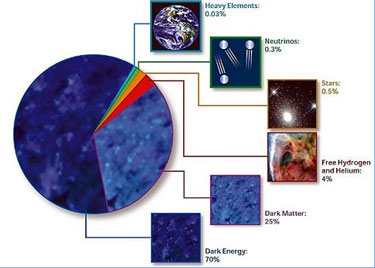
Cosmological_composition.jpg


A pie chart indicating the proportional composition of different energy-density components of the universe, according to the best ΛCDM model fits. Roughly ninety-five percent is in the exotic forms of dark matter and dark energy
 

tharinda07

Member
Mar 1, 2007
5,784
44
0
Dark energy

Measurements of the redshiftmagnitude relation for type Ia supernovae have revealed that the expansion of the universe has been accelerating since the universe was about half its present age. To explain this acceleration, general relativity requires that much of the energy in the universe consists of a component with large negative pressure, dubbed "dark energy". Dark energy is indicated by several other lines of evidence. Measurements of the cosmic microwave backgroundcritical density of mass/energy. But the mass density of the universe can be measured from its gravitational clustering, and is found to have only about 30% of the critical density.http://en.wikipedia.org/wiki/Big_Bang#cite_note-peebles-8gravitational lenses, and the other using the characteristic pattern of the large-scale structure as a cosmic ruler. indicate that the universe is very nearly spatially flat, and therefore according to general relativity the universe must have almost exactly the Since dark energy does not cluster in the usual way it is the best explanation for the "missing" energy density. Dark energy is also required by two geometrical measures of the overall curvature of the universe, one using the frequency of
Negative pressure is a property of vacuum energy, but the exact nature of dark energy remains one of the great mysteries of the Big Bang. Possible candidates include a cosmological constant and quintessence. Results from the WMAP team in 2008, which combined data from the CMB and other sources, indicate that the universe today is 72% dark energy, 23% dark matter, 4.6% regular matter and less than 1% neutrinos.http://en.wikipedia.org/wiki/Big_Bang#cite_note-wmap5year-22 The energy density in matter decreases with the expansion of the universe, but the dark energy density remains constant (or nearly so) as the universe expands. Therefore matter made up a larger fraction of the total energy of the universe in the past than it does today, but its fractional contribution will fall in the far future as dark energy becomes even more dominant.
In the ΛCDM, the best current model of the Big Bang, dark energy is explained by the presence of a cosmological constant in the general theory of relativity. However, the size of the constant that properly explains dark energy is surprisingly small relative to naive estimates based on ideas about quantum gravity. Distinguishing between the cosmological constant and other explanations of dark energy is an active area of current research.


tharinda07

Member
Mar 1, 2007
5,784
44
0
The future according to the Big Bang theory


Before observations of dark energy, cosmologists considered two scenarios for the future of the universe. If the mass density of the universe were greater than the critical density, then the universe would reach a maximum size and then begin to collapse. It would become denser and hotter again, ending with a state that was similar to that in which it started—a Big Crunch.http://en.wikipedia.org/wiki/Big_Bang#cite_note-kolb_c3-34Alternatively, if the density in the universe were equal to or below the critical density, the expansion would slow down, but never stop. Star formation would cease as all the interstellar gas in each galaxy is consumed; stars would burn out leaving white dwarfs, neutron stars, and black holes. Very gradually, collisions between these would result in mass accumulating into larger and larger black holes. The average temperature of the universe would asymptotically approach absolute zero—a Big Freeze. Moreover, if the proton were unstable, then baryonic matter would disappear, leaving only radiation and black holes. Eventually, black holes would evaporate by emitting Hawking radiation. The entropy of the universe would increase to the point where no organized form of energy could be extracted from it, a scenario known as heat death.

Modern observations of accelerated expansion imply that more and more of the currently visible universe will pass beyond our event horizon and out of contact with us. The eventual result is not known. The ΛCDM model of the universe contains dark energy in the form of a cosmological constant. This theory suggests that only gravitationally bound systems, such as galaxies, would remain together, and they too would be subject to heat death, as the universe expands and cools. Other explanations of dark energy—so-called phantom energy theories—suggest that ultimately galaxy clusters, stars, planets, atoms, nuclei and matter itself will be torn apart by the ever-increasing expansion in a so-called Big Rip.http://en.wikipedia.org/wiki/Big_Bang#cite_note-51
 

tharinda07

Member
Mar 1, 2007
5,784
44
0
Speculative physics beyond the Big Bang


While the Big Bang model is well established in cosmology, it is likely to be refined in the future. Little is known about the earliest moments of the universe's history. The Penrose-Hawking singularity theorems require the existence of a singularity at the beginning of cosmic time. However, these theorems assume that general relativity is correct, but general relativity must break down before the universe reaches the Planck temperature, and a correct treatment of quantum gravity may avoid the singularity.http://en.wikipedia.org/wiki/Big_Bang#cite_note-52
There may also be parts of the universe well beyond what can be observed in principle. If inflation occurred this is likely, for exponential expansion would push large regions of space beyond our observable horizon.
Some proposals, each of which entails untested hypotheses, are:
Proposals in the last two categories see the Big Bang as an event in a much larger and older universe, or multiverse, and not the literal beginning.


tharinda07

Member
Mar 1, 2007
5,784
44
0
A graphical representation of the expansion of the universe with the inflationary epoch represented as the dramatic expansion of the metric seen on the left.
Image from WMAP press release, 2006.


CMB_Timeline75.jpg
 

tharinda07

Member
Mar 1, 2007
5,784
44
0
Religious interpretations

The Big Bang is a scientific theory, and as such stands or falls by its agreement with observations. But as a theory which addresses, or at least seems to address, the origins of reality, it has always been entangled with theological and philosophical implications. In the 1920s and '30s almost every major cosmologist preferred an eternal universe, and several complained that the beginning of time implied by the Big Bang imported religious concepts into physics; this objection was later repeated by supporters of the steady state theory.http://en.wikipedia.org/wiki/Big_Bang#cite_note-60This perception was enhanced by the fact that Georges Lemaître, who put the theory forth, was a Roman Catholic priest.


Zeus

Well-known member
  • Sep 14, 2007
    20,327
    1,957
    113
    Kalutara
    TArinda ayiye Eisntine ge theory ekata anuva Universe eke either expanding or contraction kiyanne ayi????
    Is there any reason for that??
     

    uocanu

    Member
    Aug 11, 2006
    5,346
    106
    0
    In Lions Land
    Originally Posted by RajNOX
    big bang theory is TRUE! one day they would realize that Darwins theory is WONG too..
    Macho hodata Sciense study kaloth ubatath therei science kiyanne mokakda kiyala.......
    oya kisima theori ekak 100% correct wenne ne banzzzz
     

    uocanu

    Member
    Aug 11, 2006
    5,346
    106
    0
    In Lions Land
    Zeus said:
    TArinda ayiye Eisntine ge theory ekata anuva Universe eke either expanding or contraction kiyanne ayi????
    Is there any reason for that??

    As i knw for exsistanse of the universe it mus be expanding or contraction
    it cnt b in same size according to these theoris


    Zeus

    Well-known member
  • Sep 14, 2007
    20,327
    1,957
    113
    Kalutara
    tharinda07 said:

    solar system all seem to be flat and fall in line with one another. For instance why isn't mars above us, and why is it that all the planets seem to be spaced out and lined up.


    this is for u zues

    YEp ayie but there exceptions
    Do u know the path of the pluto is compltely differ that all others neda??
    Cz of this paradox it colses to the sun than anyone else neda??
    Am i wrng????
     

    Zeus

    Well-known member
  • Sep 14, 2007
    20,327
    1,957
    113
    Kalutara
    uocanu said:
    As i knw for exsistanse of the universe it mus be expanding or contraction
    it cnt b in same size according to these theoris


    YEs all i have to ask is
    Y??
    Y is that happeneing??

    CAn u xplain it simply???
     

    uocanu

    Member
    Aug 11, 2006
    5,346
    106
    0
    In Lions Land
    Zeus said:
    YEs all i have to ask is
    Y??
    Y is that happeneing??

    CAn u xplain it simply???
    When Einstein developed the theory of relativity, his calculations showed that the universe had to be either contracting or expanding- at the time he took this to mean his calculations were incorrect, and added the "cosmological constant" to his calculations in order to make up for a static universe- his initial findings were proven to be correct after the deployment of the Hubble telescope and subsequent findings showed that the universe is, indeed, expanding!
     

    Zeus

    Well-known member
  • Sep 14, 2007
    20,327
    1,957
    113
    Kalutara
    uocanu said:
    When Einstein developed the theory of relativity, his calculations showed that the universe had to be either contracting or expanding- at the time he took this to mean his calculations were incorrect, and added the "cosmological constant" to his calculations in order to make up for a static universe- his initial findings were proven to be correct after the deployment of the Hubble telescope and subsequent findings showed that the universe is, indeed, expanding!

    :)
    OKez bro thanx machan