


MASTER OF JEET KUNE DOE
JUN FAN(BRUCE LEE)......


Date of Birth
27 November 1940, San Francisco, California, USA
Date of Death
20 July 1973, Hong Kong (cerebral edema)
Birth Name
Lee Jun Fan
Height
5' 7½" (1.71 m)
Biography...
The greatest icon of martial arts cinema, and a key figure of modern popular culture. Had it not been for the amazing Bruce Lee and his incredible movies in the early 1970s, it's arguable whether or not the martial arts film genre would have ever penetrated and influenced mainstream western cinema & audiences the way it has over the past three decades.
The influence of Asian martial arts cinema can be seen today in so many other film genres including comedies, action, drama, science fiction, horror and animation.....and they all have their roots in the phenomenon that was Bruce Lee
Bruce Lee was born "Lee Juan Fan" in November 1940 in San Francisco, the son of Lee Hoi Chuen, a singer with the Cantonese Opera. Approximately, one year later the family returned to Kowloon in Hong Kong and at the age of 5, a young Bruce begins appearing in children's roles in minor films including The Birth of Mankind (1946) and Fu gui fu yun (1948). At the age of 12, Bruce commenced attending La Salle College, and was later beaten up by a street gang, which inspired him to take up martial arts training under the tuition of "Sifu Yip Man" who schooled Bruce in wing chun kung fu for a period of approximately five years (this was the only formalized martial arts training ever undertaken by Lee). The talented & athletic Bruce also took up cha-cha dancing, and at the age of 18 won a major dance championship in Hong Kong.
However, his temper and quick fists saw him fall foul of the HK police on numerous occasions, and his parents suggested that he head off to the United States. Lee landed in San Francisco's Chinatown in 1959 and worked in a relative's restaurant, however he eventually made his way to Seattle, Washington where he enrolled at university to study philosophy, and found the time to practice his beloved kung fu techniques. In 1963, Lee met Linda Emery (later his wife) and in addition he opened his first kung fu school at 4750 University Way. During the early half of the 1960s, Lee became associated with many key martial arts identities in the USA including kenpo karate expert Ed Parker and tae kwon do master Jhoon Rhee. He made guest appearances at notable martial arts events including the Long Beach Nationals. Through one of these tournaments, Bruce met Hollywood hair stylist Jay Sebring who introduced him to TV producer William Dozier. Based on the runaway success of "Batman", Dozier was keen to bring the cartoon character of "The Green Hornet" to TV and was on the lookout for an Oriental actor to play the Green Hornet's sidekick, "Kato". Around this time, Bruce also opened a second kung fu school in Oakland, California and relocated to Oakland to be closer to Hollywood.
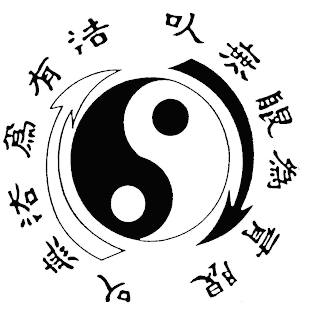
Bruce's screen test was successful, and "The Green Hornet" starring Van Williams went to air in early 1966 to mixed success. However, the show was surprisingly terminated after only one season (30 episodes), but by this time he was receiving more fan mail than the show's star. He then opened a third branch of his kung fu school in Los Angeles, and began providing personalized martial arts training to film stars including Steve McQueen and James Coburn. In addition, he refined his prior knowledge of wing chun, plus incorporating aspects of other fighting styles such as traditional boxing and okinawan karate. He also developed his own unique style "Jeet Kune Do" (Way of the Intercepting Fist). Another film opportunity then comes his way, as he landed the small role of a stand over man named "Winslow Wong" intimidating private eye James Garner in Marlowe (1969). Wong paid a visit to Garner and proceeded to demolish the investigator's office with his fists and feet, finishing off with a spectacular high kick that shattered the light fitting. With this further exposure of his talents, Bruce then scored several guest appearances as a martial arts instructor to blind private eye James Franciscus on the TV series "Longstreet" (1971).
With his minor success in Hollywood and money in his pockets, Bruce returned for a visit to Hong Kong and was approached by film producer Raymond Chow who had recently started "Golden Harvest" productions. Chow was keen to utilize Lee's strong popularity amongst young Chinese fans, and offered him the lead role in _Tang sha da xiong (1971)_ ( aka "Fists of Fury", aka "The Big Boss"). The film was directed by Wei Lo, shot in Thailand, on a very low budget and in terrible living conditions for cast and crew. However when it opened in Hong Kong, the film was an enormous hit! Young Chinese flocked in their thousands to see this ground breaking film starring a tough, athletic Chinese hero who dispensed justice with his fists and feet. Chow knew he had struck box office gold with Lee, and quickly assembled another script entitled Fist of Fury (1972) (aka "The Chinese Connection", aka "Fist of Fury"). The second film (with a slightly improved budget) was again directed by Wei Lo and was set in Shanghai in the year 1900, with Lee returning to his school to find his beloved master has been poisoned by the local Japanese karate school. Once again, he uncovered the evil doers and set about seeking revenge on those responsible for murdering his teacher. The film featured several superb fight sequences, and at the film's conclusion, Lee refuses to surrender to the Japanese law and seemingly leaps to his death in a hail of police bullets!
Once more, Hong Kong streets were jammed back with thousands of fervent Chinese movie fans who could not get enough of the fearless Bruce Lee, and his second film went on to break the box office records set by the first! Lee then set up his own production company, Concord Productions, and set about guiding his film career personally by writing, directing and acting in his next film, _Meng long guojiang (1972)_ (aka "Way of the Dragon", aka "Return of The Dragon"). A bigger budget, meant better locations and opponents, with the new film set in Rome, Italy and additionally starring hapkido expert Ing-Sik Whang, karate legend Robert Wall and seven times US karate champion Chuck Norris. Bruce played a seemingly simple country boy sent to assist at a cousin's restaurant in Rome, and finds his cousins are being bullied by local thugs for protection.
By now, Lee's remarkable success in the Orient had come to the attention of Hollywood film executives and a script was hastily written pitching him as a secret agent penetrating an island fortress. Warner Bros. financed the film, and also insisted on B-movie tough guy John Saxon co-starring alongside Lee to give the film more Western appeal. The film culminated with another show stopping fight sequence between Lee and the key villain, Han, in a maze of mirrors. Shooting was completed in and around Hong Kong in early 1973 and in the subsequent weeks, Bruce was involved in completing over dubs and looping for the final cut. Various reports from friends and co-workers cite how he was not feeling well during this period, and on July 20th 1973 he lay down at the apartment of actress Betty Ting Pei after taking a headache tablet, and was later unable to be revived. A doctor was called, and he was then taken to hospital by ambulance and pronounced dead that evening. The official finding was death was due to a cerebral edema, caused by a reaction to the headache tablet. In other words, death by misadventure.
Chinese movie fans were absolutely shattered that their virile idol, had passed away at such a young age, and nearly 30,000 fans filed past his coffin in Hong Kong. A second, much smaller ceremony was held in Seattle, Washington and Bruce was laid to rest at Lake View Cemetary in Seattle with pall bearers including Steve McQueen, James Coburn and Dan Inosanto. Enter the Dragon (1973) was later released in the mainland United States, and was a huge hit with American audiences, which then prompted National General films to actively distribute his three prior movies to US theaters...each of them was a box office smash. Bruce Lee was an international film star after he had died!
Fans worldwide were still hungry for more Bruce Lee films, and thus remaining footage (completed before his death) of Lee fighting several opponents including Dan Inosanto, Hugh O'Brian and Kareem Abdul-Jabbar was crafted into another film titled The Game of Death (1978). The film used a look alike actor and shadowy camera work to be substituted for the real Lee in numerous scenes. The film is a poor addition to the line up, and is only saved by the final twenty minutes and the footage of the real Bruce Lee battling his way up the tower. Amazingly, this same shoddy process was used to create Game of Death II (1981) (aka "Game of Death II"), with more look alike and stunt doubles interwoven with a few brief minutes of footage of the real Bruce Lee.
Tragically, his son Brandon Lee, an actor and martial artist like his father, was killed in a freak accident on the set of The Crow (1994).
Bruce Lee was not only an amazing athlete and martial artist, but he possessed genuine superstar charisma and through a handful of films he left behind an indelible impression on the tapestry of modern cinema.
Personal Quotes
1.Absorb what is useful, Discard what is not, Add what is uniquely your own.
2.Knowing is not enough; we must apply. Willing is not enough; we must do.
3.Simplicity is the last step of art.
4.A teacher is never a giver of truth - he is a guide, a pointer to the truth that each student must find for himself. A good teacher is merely a catalyst.
5.When an opportunity in a fight presents itself, "I" don't hit, "it" hits all by itself.
6.Empty your mind. Become formless and shapeless like water. When water is poured into a cup, it becomes the cup. When water is poured into a teapot, it becomes the teapot. Be water, my friend.
7.To know oneself is to study oneself in action with another person. If you want to understand the truth in martial arts, to see any opponent clearly, you must throw away the notion of styles or schools, prejudices, likes and dislikes, and so forth. Then, your mind will cease all conflict and come to rest. In this silence, you will see totally and freshly.
8.I fear not the man who has practiced 10,000 kicks once, but I fear the man who has practiced one kick 10,000 times.
9.The key to immortality is first living a life worth remembering.
10.Don't think, feel! It is like a finger pointing away to the moon. Don't concentrate on the finger or you will miss all that heavenly glory.
11.A quick temper will make a fool of you soon enough.
12.I don't believe in different ways of fighting now. I mean, unless human beings have 3 arms and 3 legs, then we will have a different way of fighting. But basically we all have two arms and two legs so that is why I believe there should be only one way of fighting and that is no way.
13.If you always put limits on what you can do, physical or anything else, it'll spread over into the rest of your life. It'll spread over into your work, into your mortality, into your entire being. There are no limits. There are plateaus, but you must not stay there, you must go beyond them. If it kills you, it kills you.
14.There's no challenge in breaking a board. Boards don't hit back.
15.Ever since I was a child I have had this instinctive urge for expansion and growth. To me, the function and duty of a quality human being is the sincere and honest development of one's potential.
16.Love is like a friendship caught on fire. In the beginning a flame, very pretty, often hot and fierce, but still only light and flickering. As love grows older, our hearts mature and our love becomes as coals, deep-burning and unquenchable.
17.Notice that the stiffest tree is most easily cracked, while the bamboo or willow survives by bending with the wind.
18.Martial art is ultimately an athletic expression of the dynamic human body. More important yet, is the person who is expressing his own soul.
19.I have always been a martial artist by choice, an actor by profession, but above all, am actualising myself to be an artist of life.
20.A goal is not always meant to be reached; it often serves simply as something to aim at.
21.The martial arts are ultimately self-knowledge. A punch or a kick is not to knock the hell out of the guy in front, but to knock the hell out of your ego, your fear, or your hang-ups.
22.First of all, the word superstar really turns me off -- and I'll tell you why. The word "star" man, it's an illusion. it's something what the public calls you. You should look upon oneself as an actor, man. I mean you would be very pleased if somebody said (punches his fist into his open hand) "man, you are a super actor!" it is much better than, you know, superstar.
23.I'm not in this world to live up to your expectations and you're not in this world to live up to mine.
JUN FAN(BRUCE LEE)......


Date of Birth
27 November 1940, San Francisco, California, USA
Date of Death
20 July 1973, Hong Kong (cerebral edema)
Birth Name
Lee Jun Fan
Height
5' 7½" (1.71 m)
Biography...
The greatest icon of martial arts cinema, and a key figure of modern popular culture. Had it not been for the amazing Bruce Lee and his incredible movies in the early 1970s, it's arguable whether or not the martial arts film genre would have ever penetrated and influenced mainstream western cinema & audiences the way it has over the past three decades.
The influence of Asian martial arts cinema can be seen today in so many other film genres including comedies, action, drama, science fiction, horror and animation.....and they all have their roots in the phenomenon that was Bruce Lee
Bruce Lee was born "Lee Juan Fan" in November 1940 in San Francisco, the son of Lee Hoi Chuen, a singer with the Cantonese Opera. Approximately, one year later the family returned to Kowloon in Hong Kong and at the age of 5, a young Bruce begins appearing in children's roles in minor films including The Birth of Mankind (1946) and Fu gui fu yun (1948). At the age of 12, Bruce commenced attending La Salle College, and was later beaten up by a street gang, which inspired him to take up martial arts training under the tuition of "Sifu Yip Man" who schooled Bruce in wing chun kung fu for a period of approximately five years (this was the only formalized martial arts training ever undertaken by Lee). The talented & athletic Bruce also took up cha-cha dancing, and at the age of 18 won a major dance championship in Hong Kong.
However, his temper and quick fists saw him fall foul of the HK police on numerous occasions, and his parents suggested that he head off to the United States. Lee landed in San Francisco's Chinatown in 1959 and worked in a relative's restaurant, however he eventually made his way to Seattle, Washington where he enrolled at university to study philosophy, and found the time to practice his beloved kung fu techniques. In 1963, Lee met Linda Emery (later his wife) and in addition he opened his first kung fu school at 4750 University Way. During the early half of the 1960s, Lee became associated with many key martial arts identities in the USA including kenpo karate expert Ed Parker and tae kwon do master Jhoon Rhee. He made guest appearances at notable martial arts events including the Long Beach Nationals. Through one of these tournaments, Bruce met Hollywood hair stylist Jay Sebring who introduced him to TV producer William Dozier. Based on the runaway success of "Batman", Dozier was keen to bring the cartoon character of "The Green Hornet" to TV and was on the lookout for an Oriental actor to play the Green Hornet's sidekick, "Kato". Around this time, Bruce also opened a second kung fu school in Oakland, California and relocated to Oakland to be closer to Hollywood.
Bruce's screen test was successful, and "The Green Hornet" starring Van Williams went to air in early 1966 to mixed success. However, the show was surprisingly terminated after only one season (30 episodes), but by this time he was receiving more fan mail than the show's star. He then opened a third branch of his kung fu school in Los Angeles, and began providing personalized martial arts training to film stars including Steve McQueen and James Coburn. In addition, he refined his prior knowledge of wing chun, plus incorporating aspects of other fighting styles such as traditional boxing and okinawan karate. He also developed his own unique style "Jeet Kune Do" (Way of the Intercepting Fist). Another film opportunity then comes his way, as he landed the small role of a stand over man named "Winslow Wong" intimidating private eye James Garner in Marlowe (1969). Wong paid a visit to Garner and proceeded to demolish the investigator's office with his fists and feet, finishing off with a spectacular high kick that shattered the light fitting. With this further exposure of his talents, Bruce then scored several guest appearances as a martial arts instructor to blind private eye James Franciscus on the TV series "Longstreet" (1971).
With his minor success in Hollywood and money in his pockets, Bruce returned for a visit to Hong Kong and was approached by film producer Raymond Chow who had recently started "Golden Harvest" productions. Chow was keen to utilize Lee's strong popularity amongst young Chinese fans, and offered him the lead role in _Tang sha da xiong (1971)_ ( aka "Fists of Fury", aka "The Big Boss"). The film was directed by Wei Lo, shot in Thailand, on a very low budget and in terrible living conditions for cast and crew. However when it opened in Hong Kong, the film was an enormous hit! Young Chinese flocked in their thousands to see this ground breaking film starring a tough, athletic Chinese hero who dispensed justice with his fists and feet. Chow knew he had struck box office gold with Lee, and quickly assembled another script entitled Fist of Fury (1972) (aka "The Chinese Connection", aka "Fist of Fury"). The second film (with a slightly improved budget) was again directed by Wei Lo and was set in Shanghai in the year 1900, with Lee returning to his school to find his beloved master has been poisoned by the local Japanese karate school. Once again, he uncovered the evil doers and set about seeking revenge on those responsible for murdering his teacher. The film featured several superb fight sequences, and at the film's conclusion, Lee refuses to surrender to the Japanese law and seemingly leaps to his death in a hail of police bullets!
Once more, Hong Kong streets were jammed back with thousands of fervent Chinese movie fans who could not get enough of the fearless Bruce Lee, and his second film went on to break the box office records set by the first! Lee then set up his own production company, Concord Productions, and set about guiding his film career personally by writing, directing and acting in his next film, _Meng long guojiang (1972)_ (aka "Way of the Dragon", aka "Return of The Dragon"). A bigger budget, meant better locations and opponents, with the new film set in Rome, Italy and additionally starring hapkido expert Ing-Sik Whang, karate legend Robert Wall and seven times US karate champion Chuck Norris. Bruce played a seemingly simple country boy sent to assist at a cousin's restaurant in Rome, and finds his cousins are being bullied by local thugs for protection.
By now, Lee's remarkable success in the Orient had come to the attention of Hollywood film executives and a script was hastily written pitching him as a secret agent penetrating an island fortress. Warner Bros. financed the film, and also insisted on B-movie tough guy John Saxon co-starring alongside Lee to give the film more Western appeal. The film culminated with another show stopping fight sequence between Lee and the key villain, Han, in a maze of mirrors. Shooting was completed in and around Hong Kong in early 1973 and in the subsequent weeks, Bruce was involved in completing over dubs and looping for the final cut. Various reports from friends and co-workers cite how he was not feeling well during this period, and on July 20th 1973 he lay down at the apartment of actress Betty Ting Pei after taking a headache tablet, and was later unable to be revived. A doctor was called, and he was then taken to hospital by ambulance and pronounced dead that evening. The official finding was death was due to a cerebral edema, caused by a reaction to the headache tablet. In other words, death by misadventure.
Chinese movie fans were absolutely shattered that their virile idol, had passed away at such a young age, and nearly 30,000 fans filed past his coffin in Hong Kong. A second, much smaller ceremony was held in Seattle, Washington and Bruce was laid to rest at Lake View Cemetary in Seattle with pall bearers including Steve McQueen, James Coburn and Dan Inosanto. Enter the Dragon (1973) was later released in the mainland United States, and was a huge hit with American audiences, which then prompted National General films to actively distribute his three prior movies to US theaters...each of them was a box office smash. Bruce Lee was an international film star after he had died!
Fans worldwide were still hungry for more Bruce Lee films, and thus remaining footage (completed before his death) of Lee fighting several opponents including Dan Inosanto, Hugh O'Brian and Kareem Abdul-Jabbar was crafted into another film titled The Game of Death (1978). The film used a look alike actor and shadowy camera work to be substituted for the real Lee in numerous scenes. The film is a poor addition to the line up, and is only saved by the final twenty minutes and the footage of the real Bruce Lee battling his way up the tower. Amazingly, this same shoddy process was used to create Game of Death II (1981) (aka "Game of Death II"), with more look alike and stunt doubles interwoven with a few brief minutes of footage of the real Bruce Lee.
Tragically, his son Brandon Lee, an actor and martial artist like his father, was killed in a freak accident on the set of The Crow (1994).
Bruce Lee was not only an amazing athlete and martial artist, but he possessed genuine superstar charisma and through a handful of films he left behind an indelible impression on the tapestry of modern cinema.
Personal Quotes
1.Absorb what is useful, Discard what is not, Add what is uniquely your own.
2.Knowing is not enough; we must apply. Willing is not enough; we must do.
3.Simplicity is the last step of art.
4.A teacher is never a giver of truth - he is a guide, a pointer to the truth that each student must find for himself. A good teacher is merely a catalyst.
5.When an opportunity in a fight presents itself, "I" don't hit, "it" hits all by itself.
6.Empty your mind. Become formless and shapeless like water. When water is poured into a cup, it becomes the cup. When water is poured into a teapot, it becomes the teapot. Be water, my friend.
7.To know oneself is to study oneself in action with another person. If you want to understand the truth in martial arts, to see any opponent clearly, you must throw away the notion of styles or schools, prejudices, likes and dislikes, and so forth. Then, your mind will cease all conflict and come to rest. In this silence, you will see totally and freshly.
8.I fear not the man who has practiced 10,000 kicks once, but I fear the man who has practiced one kick 10,000 times.
9.The key to immortality is first living a life worth remembering.
10.Don't think, feel! It is like a finger pointing away to the moon. Don't concentrate on the finger or you will miss all that heavenly glory.
11.A quick temper will make a fool of you soon enough.
12.I don't believe in different ways of fighting now. I mean, unless human beings have 3 arms and 3 legs, then we will have a different way of fighting. But basically we all have two arms and two legs so that is why I believe there should be only one way of fighting and that is no way.
13.If you always put limits on what you can do, physical or anything else, it'll spread over into the rest of your life. It'll spread over into your work, into your mortality, into your entire being. There are no limits. There are plateaus, but you must not stay there, you must go beyond them. If it kills you, it kills you.
14.There's no challenge in breaking a board. Boards don't hit back.
15.Ever since I was a child I have had this instinctive urge for expansion and growth. To me, the function and duty of a quality human being is the sincere and honest development of one's potential.
16.Love is like a friendship caught on fire. In the beginning a flame, very pretty, often hot and fierce, but still only light and flickering. As love grows older, our hearts mature and our love becomes as coals, deep-burning and unquenchable.
17.Notice that the stiffest tree is most easily cracked, while the bamboo or willow survives by bending with the wind.
18.Martial art is ultimately an athletic expression of the dynamic human body. More important yet, is the person who is expressing his own soul.
19.I have always been a martial artist by choice, an actor by profession, but above all, am actualising myself to be an artist of life.
20.A goal is not always meant to be reached; it often serves simply as something to aim at.
21.The martial arts are ultimately self-knowledge. A punch or a kick is not to knock the hell out of the guy in front, but to knock the hell out of your ego, your fear, or your hang-ups.
22.First of all, the word superstar really turns me off -- and I'll tell you why. The word "star" man, it's an illusion. it's something what the public calls you. You should look upon oneself as an actor, man. I mean you would be very pleased if somebody said (punches his fist into his open hand) "man, you are a super actor!" it is much better than, you know, superstar.
23.I'm not in this world to live up to your expectations and you're not in this world to live up to mine.


