
Latest ads
-
 Peppa Pig Family Plush Toy Set – 5 Characters
- anil1961
- Updated:
-
Express VPN PC - 1 Year Rs. 600.00
- Sanathbh
- Updated:
-
Capcut Pro 7 Days Team Plan - Rs. 3️⃣0️⃣0️⃣
- Sanathbh
- Updated:
-
 Singapore V2ray VPN for Tunneling
- hu KANNA
- Updated:
-
Web hosting for your business
- avishka777
- Updated:
You are using an out of date browser. It may not display this or other websites correctly.
You should upgrade or use an alternative browser.
You should upgrade or use an alternative browser.


Here's a little limerick, sent in by Gregory Bond.
"A mosquito was heard to complain
that a chemist had poisoned his brain.
The cause of his sorrow
was paradichloro-
Diphenyltrichloroethane!
And another little ditty, sent in by Garry Heather from Sony.
"Ernie was a chemist,
now Ernie is no more.
For what he thought was H2O, was H2SO4."
Here's a ditty that was taught to Jerry Goodenough by his Chemistry teacher.
Poor Jimmy, finding life a bore,
Drank some H2SO4.
Jimmy's father, an MD,
Gave him CaCO3.
Now he's neutralised, it's true,
But he's full of CO2. [The last line to be interrupted by a burping sound!]
"A mosquito was heard to complain
that a chemist had poisoned his brain.
The cause of his sorrow
was paradichloro-
Diphenyltrichloroethane!
And another little ditty, sent in by Garry Heather from Sony.
"Ernie was a chemist,
now Ernie is no more.
For what he thought was H2O, was H2SO4."
Here's a ditty that was taught to Jerry Goodenough by his Chemistry teacher.
Poor Jimmy, finding life a bore,
Drank some H2SO4.
Jimmy's father, an MD,
Gave him CaCO3.
Now he's neutralised, it's true,
But he's full of CO2. [The last line to be interrupted by a burping sound!]

Last edited:


+C and +2H makes the whole difference...
Any way both Methanol and Ethanol makes the same thing at last..

Thanks Bro...
Any way both Methanol and Ethanol makes the same thing at last..

Thanks Bro...

+C and +2H makes the whole difference...
Any way both Methanol and Ethanol makes the same thing at last..
Thanks Bro...


so by that logic, if you drink both ethanol and methanol, both you and others will dance ?Do u know fun in chemistry?
If u drink Ethanol (alcohol)..
U wil dance for others!
If u drink methonol(poison) others wil dance for u!
so by that logic, if you drink both ethanol and methanol, both you and others will dance ?

so by that logic, if you drink both ethanol and methanol, both you and others will dance ?

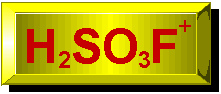
Magic Acid
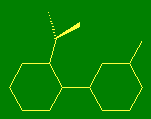
Bicyclohexyl
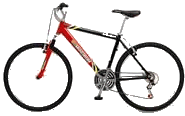
This molecule not only has a name that sounds like a bicycle, ironically it even looks like one too. In fact, the bicyclohexyl compound with isopropyl and methyl sidechains (2-isopropyl-3'-methylbicyclohexyl, shown in the diagram) looks even more like a bicycle. There is also tricyclene, but unfortunately its structure looks nothing like a tricycle.
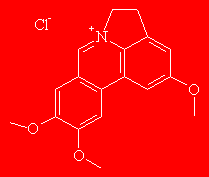
Tortuosine
This molecule is an alkaloid extracted from the plant Amaryllidaceae, but I bet it was extracted very sloooowwwllly. In fact, this naturally occurring organic compound and the following one (assoanine) had plant-derived names that were so compelling that Lee Flippin designed and executed total syntheses of them just for the fun of it.
NanoPutian Molecules
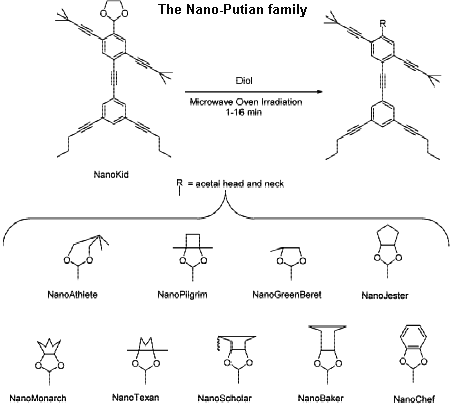
today's award for the 'How did they possibly get a grant to do that?' paper, goes to the J. Org. Chem. article by Chanteau and Tour from Rice University in Texas. It concerns making anthropomorphic molecules - i.e. molecules that look like humans...but why anyone would want to do this I don't know... They have been named NanoPutians, after the little men from Lilliput in the book 'Gulliver's Travels'. They come in many forms - the basic building block is the NanoKid (shown right), and from this other variants can be made, such as NanoAthlete and NanoBaker.
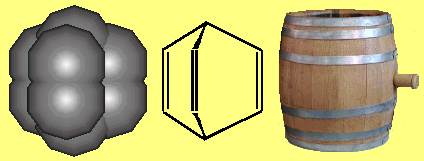
Barrelene
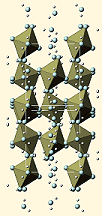
Studtite and Metastudtite
Studtite isn't the glue which keeps tongue-studs into place, nor is it the secret formula for Hollywood male actors. It's actually a uranium mineral containing peroxide of formula (UO2)O2·4(H2O) formed by the radioactive decay of nuclear fuel or uranium ores. It occurs as white yellow needle-like crystals, and as a mineral it was named for Franz Edward Studt, a English prospector and geologist who was working in the Belgian Congo.
Bicyclohexyl
This molecule not only has a name that sounds like a bicycle, ironically it even looks like one too. In fact, the bicyclohexyl compound with isopropyl and methyl sidechains (2-isopropyl-3'-methylbicyclohexyl, shown in the diagram) looks even more like a bicycle. There is also tricyclene, but unfortunately its structure looks nothing like a tricycle.
Tortuosine
This molecule is an alkaloid extracted from the plant Amaryllidaceae, but I bet it was extracted very sloooowwwllly. In fact, this naturally occurring organic compound and the following one (assoanine) had plant-derived names that were so compelling that Lee Flippin designed and executed total syntheses of them just for the fun of it.
NanoPutian Molecules
today's award for the 'How did they possibly get a grant to do that?' paper, goes to the J. Org. Chem. article by Chanteau and Tour from Rice University in Texas. It concerns making anthropomorphic molecules - i.e. molecules that look like humans...but why anyone would want to do this I don't know... They have been named NanoPutians, after the little men from Lilliput in the book 'Gulliver's Travels'. They come in many forms - the basic building block is the NanoKid (shown right), and from this other variants can be made, such as NanoAthlete and NanoBaker.
Barrelene
Studtite and Metastudtite
Studtite isn't the glue which keeps tongue-studs into place, nor is it the secret formula for Hollywood male actors. It's actually a uranium mineral containing peroxide of formula (UO2)O2·4(H2O) formed by the radioactive decay of nuclear fuel or uranium ores. It occurs as white yellow needle-like crystals, and as a mineral it was named for Franz Edward Studt, a English prospector and geologist who was working in the Belgian Congo.
Last edited:
18 ++ 
Eric Kaufman from North Carolina State University sent me this reference to a ruthenium compound known short-hand as Ru(Tris)BiPy-on-a-stick (pronounced Rew-Tris-Bip-e on a stick). The picture from the paper must be one of the most suggestive molecular pictures in any Chemistry Journal. [Ref: S.H. Toma, et al, Inorg. Chem. 43 (2004) 3521.]
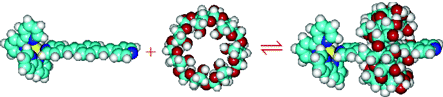
(Prathi wartha rasayanika prathikkriyawak)
Eric Kaufman from North Carolina State University sent me this reference to a ruthenium compound known short-hand as Ru(Tris)BiPy-on-a-stick (pronounced Rew-Tris-Bip-e on a stick). The picture from the paper must be one of the most suggestive molecular pictures in any Chemistry Journal. [Ref: S.H. Toma, et al, Inorg. Chem. 43 (2004) 3521.]
(Prathi wartha rasayanika prathikkriyawak)
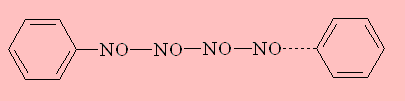
Rob Towart found an article from the Canadian Medical Assoc. Journal 93 (1965) about a hypothetical new contraceptive drug shown left. The authors named it 'armpitin', since 'its effectiveness was most pronounced when applied to the female axillary regions.' Readers can quickly identify the mode of operation, being associated with the numerous NO groups in the molecule. In fact, the number of NO groups can be modified from one to infinity. The authos state that the contraceptive effect is directly proportional to the number of NO groups in the molecule, with each NO corresponding to one day's contraceptive effect.

Here's a limerick sent to me by Ian Livingstone.
There was a young chemist from Ryde,
Who drank a foul poison and died.
It was ortho-hydroxy-
para-methoxy-
tri-nitro benzaldehyde!
(A/L Chemistry)
Rob Towart found an article from the Canadian Medical Assoc. Journal 93 (1965) about a hypothetical new contraceptive drug shown left. The authors named it 'armpitin', since 'its effectiveness was most pronounced when applied to the female axillary regions.' Readers can quickly identify the mode of operation, being associated with the numerous NO groups in the molecule. In fact, the number of NO groups can be modified from one to infinity. The authos state that the contraceptive effect is directly proportional to the number of NO groups in the molecule, with each NO corresponding to one day's contraceptive effect.
18 ++
Eric Kaufman from North Carolina State University sent me this reference to a ruthenium compound known short-hand as Ru(Tris)BiPy-on-a-stick (pronounced Rew-Tris-Bip-e on a stick). The picture from the paper must be one of the most suggestive molecular pictures in any Chemistry Journal. [Ref: S.H. Toma, et al, Inorg. Chem. 43 (2004) 3521.]
(Prathi wartha rasayanika prathikkriyawak)
Magic Acid
Bicyclohexyl
This molecule not only has a name that sounds like a bicycle, ironically it even looks like one too. In fact, the bicyclohexyl compound with isopropyl and methyl sidechains (2-isopropyl-3'-methylbicyclohexyl, shown in the diagram) looks even more like a bicycle. There is also tricyclene, but unfortunately its structure looks nothing like a tricycle.
Tortuosine
This molecule is an alkaloid extracted from the plant Amaryllidaceae, but I bet it was extracted very sloooowwwllly. In fact, this naturally occurring organic compound and the following one (assoanine) had plant-derived names that were so compelling that Lee Flippin designed and executed total syntheses of them just for the fun of it.
NanoPutian Molecules
today's award for the 'How did they possibly get a grant to do that?' paper, goes to the J. Org. Chem. article by Chanteau and Tour from Rice University in Texas. It concerns making anthropomorphic molecules - i.e. molecules that look like humans...but why anyone would want to do this I don't know... They have been named NanoPutians, after the little men from Lilliput in the book 'Gulliver's Travels'. They come in many forms - the basic building block is the NanoKid (shown right), and from this other variants can be made, such as NanoAthlete and NanoBaker.
Barrelene
Studtite and Metastudtite
Studtite isn't the glue which keeps tongue-studs into place, nor is it the secret formula for Hollywood male actors. It's actually a uranium mineral containing peroxide of formula (UO2)O2·4(H2O) formed by the radioactive decay of nuclear fuel or uranium ores. It occurs as white yellow needle-like crystals, and as a mineral it was named for Franz Edward Studt, a English prospector and geologist who was working in the Belgian Congo.


"Anode an explanation of this, but before I could torque to her, she was in her coat of rust and out the door. Being true to the Kopp's Rule, I was quick to follow; but when she got into her Monochromatic-8, I knew I was infra tough chase. Fortunately her engine started Fehling just beyond the city limits and I caught her."
<Phy Chemistry>
<Phy Chemistry>
Similar threads

- Replies
- 41
- Views
- 2K


- Replies
- 0
- Views
- 664
- Replies
- 5
- Views
- 415
