


Hasta Siempre (Hasta siempre, comandante) is a 1965 song by Cuban composer Carlos Puebla. The song's lyrics are a reply to Che Guevara's Farewell Letter when he left Cuba.
The lyrics recount key moments of the Cuban Revolution, glorifying Che Guevara and his role as a revolutionary commandant. The song became iconic after Guevara's death, and many left-leaning artists did their own cover versions of the song afterwards. The title is a part of Guevara's saying "Hasta la Victoria Siempre" or "Until Victory Always" Hasta Siempre in this song means "Forever" Meaning we will always follow and remember Che Guevara

Date of birth: June 14, 1928
Place of birth: Rosario, Argentina
Date of death: October 9, 1967 (aged 39)
Place of death: La Higuera, Bolivia
Major organizations: 26th of July Movement, United Party of the
Cuban Socialist Revolution, National Liberation Army (Bolivia)
Motorcycle journey

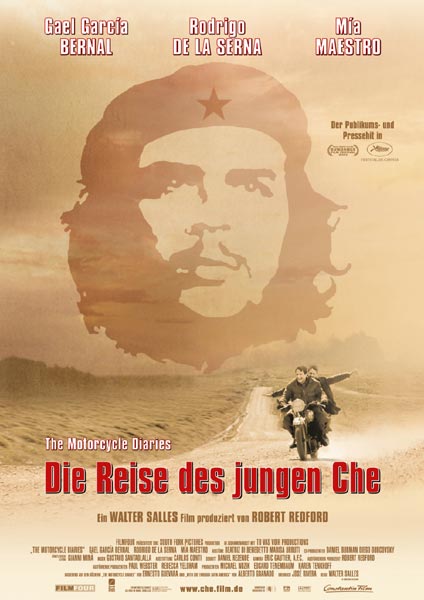
In 1948, Guevara entered the University of Buenos Aires to study medicine. But in 1951, he took a year off from studies to embark on a trip traversing South America by motorcycle with his friend Alberto Granado, with the final goal of spending a few weeks volunteering at the San Pablo Leper colony in Peru, on the banks of the Amazon River. On the way to Machu Picchu high in the Andes, he was struck by the crushing poverty of the remote rural areas, where peasant farmers worked small plots of land owned by wealthy landlords. Later on his journey, Guevara was especially impressed by the camaraderie among those living in a Leper Colony, stating "The highest forms of human solidarity and loyalty arise among such lonely and desperate people."Guevara used notes taken during this trip to write an account entitled The Motorcycle Diaries, which later became a New York Times best-seller, and was adapted into a 2004 award-winning film of the same name.
By trip's end, he came to view Latin America not as collection of separate nations, but as a single entity requiring a continent-wide liberation strategy. His conception of a borderless, united Hispanic America sharing a common 'Latino' heritage was a theme that prominently recurred during his later revolutionary activities. Upon returning to Argentina, he completed his studies and received his medical degree in June 1953, making him officially "Dr. Ernesto Guevara".[34] Guevara later remarked that through his travels of Latin America, he came in "close contact with poverty, hunger and disease" along with the "inability to treat a child because of lack of money" and "stupefaction provoked by the continual hunger and punishment" that leads a father to "accept the loss of a son as an unimportant accident". It was these experiences which Guevara cites as convincing him that in order to "help these people", he needed to leave the realm of medicine, and consider the political arena of armed struggle.
THIS IS THE MOVIE BASED ON HIS JOURNAL--
http://rapidshare.com/files/110318573/The_Motorcycle_Diaries.part1.rar
http://rapidshare.com/files/110328325/The_Motorcycle_Diaries.part2.rar
http://rapidshare.com/files/110338748/The_Motorcycle_Diaries.part3.rar
http://rapidshare.com/files/110348846/The_Motorcycle_Diaries.part4.rar
http://rapidshare.com/files/110358321/The_Motorcycle_Diaries.part5.rar
http://rapidshare.com/files/110367715/The_Motorcycle_Diaries.part6.rar
http://rapidshare.com/files/110379056/The_Motorcycle_Diaries.part7.rar
http://rapidshare.com/files/110382712/The_Motorcycle_Diaries.part8.rar
Cuban Revolution
The first step in Castro's revolutionary plan was an assault on Cuba from Mexico via the Granma, an old, leaky cabin cruiser. They set out for Cuba on November 25, 1956. Attacked by Batista's military soon after landing, many of the 82 men were either killed in the attack or executed upon capture; only 22 found each other afterwards. Guevara wrote that it was during this bloody confrontation that he laid down his medical supplies and picked up a box of ammunition dropped by a fleeing comrade, finalizing his symbolic transition from physician to combatant.
Only a small band of revolutionaries survived to re-group as a bedraggled fighting force deep in the Sierra Maestra mountains, where they received support from the urban guerrilla network of Frank País, the 26th of July Movement, and local campesinos. With the group withdrawn to the Sierra, the world wondered whether Castro was alive or dead until early 1957 when the interview by Herbert Matthews appeared in The New York Times. The article presented a lasting, almost mythical image for Castro and the guerrillas. Guevara was not present for the interview, but in the coming months he began to realize the importance of the media in their struggle. Meanwhile, as supplies and morale grew low, and with an allergy to mosquito bites which resulted in agonizing walnut-sized cysts on his body,Guevara considered these "the most painful days of the war."
As the war continued, Guevara became an integral part of the rebel army and "convinced Castro with competence, diplomacy and patience." Guevara set up factories to make grenades, built ovens to bake bread, taught new recruits about tactics, and organized schools to teach illiterate campesinos to read and write. Moreover, Guevara established health clinics, workshops to teach military tactics, and a newspaper to disseminate information. The man who three years later would be dubbed by Time Magazine: "Castro's brain", at this point was promoted by Fidel Castro to Comandante (commander) of a second army column.
THIS MOVIE BASED ON HIS CUBAN REVOLUTION--
Che: Part One (2008)

http://www.mediafire.com/?nmdmgkzzjnh
http://www.mediafire.com/?e3wnmmifyx4
http://www.mediafire.com/?m3jdmzxzdjq
Bolivia, Capture and execution

At Castro's behest, a parcel of montane dry forest in the remote Ñancahuazú region had been purchased by native Bolivian Communists for Guevara to use as a training area and base camp.
Félix Rodríguez, a Cuban exile turned CIA Special Activities Division operative, advised Bolivian troops during the hunt for Guevara in Bolivia. On October 7, an informant apprised the Bolivian Special Forces of the location of Guevara's guerrilla encampment in the Yuro ravine. They encircled the area, and Guevara was wounded and taken prisoner while leading a detachment with Simeón Cuba Sarabia. Che biographer Jon Lee Anderson reports Bolivian Sergeant Bernardino Huanca's account: that a twice wounded Guevara, his gun rendered useless, shouted "Do not shoot! I am Che Guevara and worth more to you alive than dead."
Guevara was tied up and taken to a dilapidated mud schoolhouse in the nearby village of La Higuera on the night of October 7. For the next day and a half Guevara refused to be interrogated by Bolivian officers and would only speak quietly to Bolivian soldiers. One of those Bolivian soldiers, helicopter pilot Jaime Nino de Guzman, describes Che as looking "dreadful". According to De Guzman, Guevara was shot through the right calf, his hair was matted with dirt, his clothes were shredded, and his feet were covered in rough leather sheaths. Despite his haggard appearance, he recounts that "Che held his head high, looked everyone straight in the eyes and asked only for something to smoke." De Guzman states that he "took pity" and gave him a small bag of tobacco for his pipe, with Guevara then smiling and thanking him. Later on the night of October 8, Guevara, despite having his hands tied, kicked Bolivian Officer Espinosa into the wall, after the officer entered the schoolhouse in order to snatch Guevara's pipe from his mouth as a souvenir. In another instance of defiance, Guevara spat in the face of Bolivian Rear Admiral Urgateche shortly before his execution.
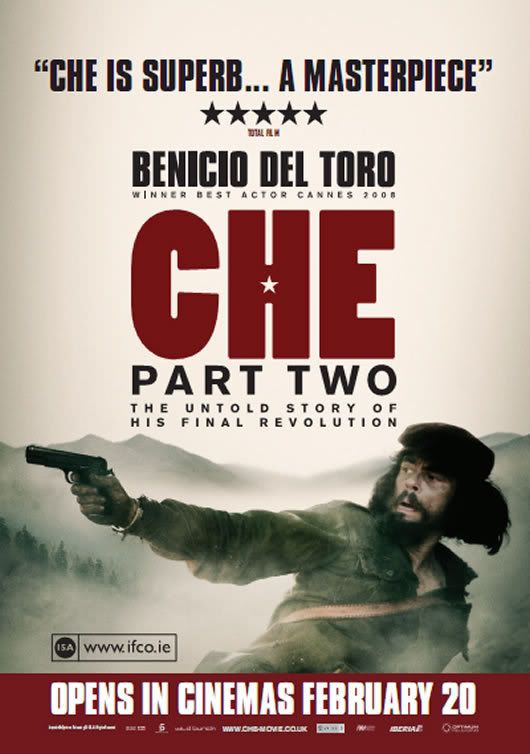
THIS IS THE MOVIE OF HIS LAST DAYS---
Che: Part Two (2008)
http://www.mediafire.com/?xwiwiwlbnmk
http://www.mediafire.com/?mmnvwm5acyk
http://www.mediafire.com/?ymimxmjcmhy
The lyrics recount key moments of the Cuban Revolution, glorifying Che Guevara and his role as a revolutionary commandant. The song became iconic after Guevara's death, and many left-leaning artists did their own cover versions of the song afterwards. The title is a part of Guevara's saying "Hasta la Victoria Siempre" or "Until Victory Always" Hasta Siempre in this song means "Forever" Meaning we will always follow and remember Che Guevara

Date of birth: June 14, 1928
Place of birth: Rosario, Argentina
Date of death: October 9, 1967 (aged 39)
Place of death: La Higuera, Bolivia
Major organizations: 26th of July Movement, United Party of the
Cuban Socialist Revolution, National Liberation Army (Bolivia)
Motorcycle journey

In 1948, Guevara entered the University of Buenos Aires to study medicine. But in 1951, he took a year off from studies to embark on a trip traversing South America by motorcycle with his friend Alberto Granado, with the final goal of spending a few weeks volunteering at the San Pablo Leper colony in Peru, on the banks of the Amazon River. On the way to Machu Picchu high in the Andes, he was struck by the crushing poverty of the remote rural areas, where peasant farmers worked small plots of land owned by wealthy landlords. Later on his journey, Guevara was especially impressed by the camaraderie among those living in a Leper Colony, stating "The highest forms of human solidarity and loyalty arise among such lonely and desperate people."Guevara used notes taken during this trip to write an account entitled The Motorcycle Diaries, which later became a New York Times best-seller, and was adapted into a 2004 award-winning film of the same name.
By trip's end, he came to view Latin America not as collection of separate nations, but as a single entity requiring a continent-wide liberation strategy. His conception of a borderless, united Hispanic America sharing a common 'Latino' heritage was a theme that prominently recurred during his later revolutionary activities. Upon returning to Argentina, he completed his studies and received his medical degree in June 1953, making him officially "Dr. Ernesto Guevara".[34] Guevara later remarked that through his travels of Latin America, he came in "close contact with poverty, hunger and disease" along with the "inability to treat a child because of lack of money" and "stupefaction provoked by the continual hunger and punishment" that leads a father to "accept the loss of a son as an unimportant accident". It was these experiences which Guevara cites as convincing him that in order to "help these people", he needed to leave the realm of medicine, and consider the political arena of armed struggle.
THIS IS THE MOVIE BASED ON HIS JOURNAL--
http://rapidshare.com/files/110318573/The_Motorcycle_Diaries.part1.rar
http://rapidshare.com/files/110328325/The_Motorcycle_Diaries.part2.rar
http://rapidshare.com/files/110338748/The_Motorcycle_Diaries.part3.rar
http://rapidshare.com/files/110348846/The_Motorcycle_Diaries.part4.rar
http://rapidshare.com/files/110358321/The_Motorcycle_Diaries.part5.rar
http://rapidshare.com/files/110367715/The_Motorcycle_Diaries.part6.rar
http://rapidshare.com/files/110379056/The_Motorcycle_Diaries.part7.rar
http://rapidshare.com/files/110382712/The_Motorcycle_Diaries.part8.rar
Cuban Revolution
The first step in Castro's revolutionary plan was an assault on Cuba from Mexico via the Granma, an old, leaky cabin cruiser. They set out for Cuba on November 25, 1956. Attacked by Batista's military soon after landing, many of the 82 men were either killed in the attack or executed upon capture; only 22 found each other afterwards. Guevara wrote that it was during this bloody confrontation that he laid down his medical supplies and picked up a box of ammunition dropped by a fleeing comrade, finalizing his symbolic transition from physician to combatant.
Only a small band of revolutionaries survived to re-group as a bedraggled fighting force deep in the Sierra Maestra mountains, where they received support from the urban guerrilla network of Frank País, the 26th of July Movement, and local campesinos. With the group withdrawn to the Sierra, the world wondered whether Castro was alive or dead until early 1957 when the interview by Herbert Matthews appeared in The New York Times. The article presented a lasting, almost mythical image for Castro and the guerrillas. Guevara was not present for the interview, but in the coming months he began to realize the importance of the media in their struggle. Meanwhile, as supplies and morale grew low, and with an allergy to mosquito bites which resulted in agonizing walnut-sized cysts on his body,Guevara considered these "the most painful days of the war."
As the war continued, Guevara became an integral part of the rebel army and "convinced Castro with competence, diplomacy and patience." Guevara set up factories to make grenades, built ovens to bake bread, taught new recruits about tactics, and organized schools to teach illiterate campesinos to read and write. Moreover, Guevara established health clinics, workshops to teach military tactics, and a newspaper to disseminate information. The man who three years later would be dubbed by Time Magazine: "Castro's brain", at this point was promoted by Fidel Castro to Comandante (commander) of a second army column.
THIS MOVIE BASED ON HIS CUBAN REVOLUTION--
Che: Part One (2008)

http://www.mediafire.com/?nmdmgkzzjnh
http://www.mediafire.com/?e3wnmmifyx4
http://www.mediafire.com/?m3jdmzxzdjq
Bolivia, Capture and execution

At Castro's behest, a parcel of montane dry forest in the remote Ñancahuazú region had been purchased by native Bolivian Communists for Guevara to use as a training area and base camp.
Félix Rodríguez, a Cuban exile turned CIA Special Activities Division operative, advised Bolivian troops during the hunt for Guevara in Bolivia. On October 7, an informant apprised the Bolivian Special Forces of the location of Guevara's guerrilla encampment in the Yuro ravine. They encircled the area, and Guevara was wounded and taken prisoner while leading a detachment with Simeón Cuba Sarabia. Che biographer Jon Lee Anderson reports Bolivian Sergeant Bernardino Huanca's account: that a twice wounded Guevara, his gun rendered useless, shouted "Do not shoot! I am Che Guevara and worth more to you alive than dead."
Guevara was tied up and taken to a dilapidated mud schoolhouse in the nearby village of La Higuera on the night of October 7. For the next day and a half Guevara refused to be interrogated by Bolivian officers and would only speak quietly to Bolivian soldiers. One of those Bolivian soldiers, helicopter pilot Jaime Nino de Guzman, describes Che as looking "dreadful". According to De Guzman, Guevara was shot through the right calf, his hair was matted with dirt, his clothes were shredded, and his feet were covered in rough leather sheaths. Despite his haggard appearance, he recounts that "Che held his head high, looked everyone straight in the eyes and asked only for something to smoke." De Guzman states that he "took pity" and gave him a small bag of tobacco for his pipe, with Guevara then smiling and thanking him. Later on the night of October 8, Guevara, despite having his hands tied, kicked Bolivian Officer Espinosa into the wall, after the officer entered the schoolhouse in order to snatch Guevara's pipe from his mouth as a souvenir. In another instance of defiance, Guevara spat in the face of Bolivian Rear Admiral Urgateche shortly before his execution.
THIS IS THE MOVIE OF HIS LAST DAYS---
Che: Part Two (2008)
http://www.mediafire.com/?xwiwiwlbnmk
http://www.mediafire.com/?mmnvwm5acyk
http://www.mediafire.com/?ymimxmjcmhy
~~!! Don't You Think That I Deserve The Reps !!~~


