History of Microsoft Windows

Mal Baba

Well-known member
  • Apr 26, 2009
    106,270
    5,599
    113
    Blob Storage
    www.37innovate.com
    History of Microsoft Windows


    250px-Windows_1.0_logo.svg.png


    Windows1.0

    Windows 1.0 is a 16-bit graphical operating environment that was released on November 20, 1985[1]. It was Microsoft's first attempt to implement a multi-taskinggraphical user interface-based operating environment on the PC platform. Windows 1.0 was the first version of Windows launched. It was succeeded by Windows 2.0.

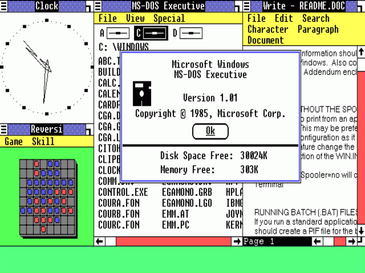
    Screen Shot of Windows 1.01
    Windows1.0.png


    Windows_1.0.jpg


    The boxart of Windows 1.0, the first version Microsoft released to the public. The same boxart was used in other versions,
    such as 1.01.


    Mal Baba

    Well-known member
  • Apr 26, 2009
    106,270
    5,599
    113
    Blob Storage
    www.37innovate.com
    Windows 2.0

    Windows 2.0

    Windows 2.0 is a 16-bit Microsoft Windows graphical user interface-based operating environment that was released in November 1987 and superseded Windows 1.0. With Windows 2.1x in 1988, Windows 2.0 was supplemented by Windows/286 and Windows/386. Windows 2.0, Windows/286 and Windows/386 were superseded by Windows 3.0 in May 1990, but supported by Microsoft for fourteen years, until 31 December 2001.

    Application support

    The first Windows versions of Microsoft Word and Microsoft Excel ran on Windows 2.0. Third-party developer support for Windows increased substantially with this version (some shipped the Windows Runtime software with their applications, for customers who had not purchased the full version of Windows). However, most developers still maintained DOS versions of their applications, as Windows users were still a distinct minority of their market.
    Applications shipping with Windows 2.0:

    1. CALC.EXE
    2. CALENDAR.EXE
    3. CARDFILE.EXE
    4. CLIPBRD.EXE
    5. CLOCK.EXE
    6. CONTROL.EXE
    7. CVTPAINT.EXE
    8. MSDOS.EXE
    9. MSDOSD.EXE
    10. NOTEPAD.EXE
    11. PAINT.EXE
    12. REVERSI.EXE
    13. TERMINAL.EXE
    14. WRITE.EXE

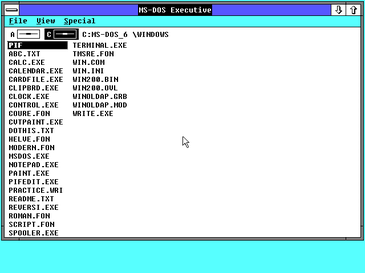
    Screenshot of Microsoft's Windows 2.0 operating environment.
    Windows_2.0.png


    Mal Baba

    Well-known member
  • Apr 26, 2009
    106,270
    5,599
    113
    Blob Storage
    www.37innovate.com
    Windows 2.1x

    Windows 2.1x


    Windows 2.1x is a family of Microsoft Windows graphical user interface-based operating environments.
    Less than a year after the release of Windows 2.0, Windows/286 2.10 and Windows/386 2.10 were released on 27 May 1988. These versions can take advantage of the specific features of the Intel 80286 and Intel 80386 processors.

    Screenshot of Windows 2.1


    Windows_2.1.png


    Mal Baba

    Well-known member
  • Apr 26, 2009
    106,270
    5,599
    113
    Blob Storage
    www.37innovate.com
    Windows 3.0

    Windows 3.0

    Windows 3.0 is the third major release of Microsoft Windows, and was released on 22 May 1990. It became the first widely successful version of Windows and a rival to Apple Macintosh and the Commodore Amiga on the GUI front. It was followed by Windows 3.1.

    Windows 3.0 logo
    200px-Windows_3.0_logo.svg.png


    Screenshot of Windows 3.0


    Windows_3.0_workspace.png


    Mal Baba

    Well-known member
  • Apr 26, 2009
    106,270
    5,599
    113
    Blob Storage
    www.37innovate.com
    Windows 3.1x

    Windows 3.1x

    Windows 3.1x is a series of 16-bit operating systems produced by Microsoft for use on personal computers. The series began with Windows 3.1, which was first sold during March 1992 as a successor to Windows 3.0. Further editions were released between 1992 and 1994 until the series was superseded by Windows 95.

    Screenshot of Windows 3.11

    Windows_3.11_workspace.png


    Windows 3.1 start up screen

    Windows_3.1_start.png


    Windows 3.1 showing some of the personalisation options available.


    Windows_3.1.png


    Mal Baba

    Well-known member
  • Apr 26, 2009
    106,270
    5,599
    113
    Blob Storage
    www.37innovate.com
    Windows NT

    Windows NT

    Windows NT logo
    276px-Windows_NT_logo.svg.png


    Windows NT is a family of operating systems produced by Microsoft, the first version of which was released in July 1993. It was originally designed to be a powerful high-level-language-based, processor-independent, multiprocessing, multiuser operating system with features comparable to Unix. It was intended to complement consumer versions of Windows that were based on MS-DOS. NT was the first fully 32-bit version of Windows, whereas its consumer-oriented counterparts, Windows 3.1x and Windows 9x, were 16-bit/32-bit hybrids. Windows 2000, Windows XP, Windows Server 2003, Windows Vista, Windows Home Server, Windows Server 2008 and Windows 7 are based on Windows NT, although they are not branded as Windows NT.
    Although various Microsoft publications, including a 1998 question-and-answer session with Bill Gates, reveal that the letters 'NT' were expanded to 'New Technology for marketing purposes, they originally stood for "N-Ten," the codename of the Intel i860 XR processor for which NT was initially developed. However, they no longer carry any specific meaning.
     

    Mal Baba

    Well-known member
  • Apr 26, 2009
    106,270
    5,599
    113
    Blob Storage
    www.37innovate.com
    Windows NT 3.1

    Windows NT 3.1

    This is a logo for Windows NT 3.1.

    221px-Windows_NT_3.1_logo.svg.png

    Windows NT 3.1 is the first release of Microsoft's Windows NT line of server and business desktop operating systems, and was released to manufacturing on 27 July 1993. The version number was chosen to match the one of Windows 3.1, the then-latest operating environment from Microsoft, on account of the similar visual appearance of the user interface. Two editions of NT 3.1 were made available, Windows NT 3.1 and Windows NT Advanced Server. It was succeeded by Windows NT 3.5 in September 1994.
    It could run on Intel x86, DEC Alpha, and MIPS R4000 CPUs.

    Screenshot of Windows NT 3.1


    Windows_NT_3.1.png


    Mal Baba

    Well-known member
  • Apr 26, 2009
    106,270
    5,599
    113
    Blob Storage
    www.37innovate.com
    Windows 95

    Windows 95

    Windows 95 logo
    276px-Windows_95_logo.svg.png

    Windows 95 is a consumer-oriented graphical user interface-based operating system. It was released on August 24, 1995 by Microsoft[2], and was a significant progression from the company's previous Windows products. During development it was referred to as Windows 4.0 or by the internal codename Chicago.
    Windows 95 was intended to integrate Microsoft's formerly separate MS-DOS and Windows products, however it is still considered an operating environment that sits over the DOS operating system. It features significant improvements over its predecessor, Windows 3.1, most notably in the graphical user interface (GUI) and in its simplified "plug-n-play" features. There were also major changes made at lower levels of the operating system, such as moving from a 16-bit subsystem to a 32-bit subsystem.
    In the marketplace, Windows 95 was a major success, and within a year or two of its release had become the most successful operating system ever produced. It also had the effect of driving other major players in the DOS-compatible operating system market out of business, something which would later be used in court against Microsoft. Some three years after introduction, Windows 95 was succeeded by Windows 98.

    Screenshot of Windows 95


    Am_windows95_desktop.png


    Mal Baba

    Well-known member
  • Apr 26, 2009
    106,270
    5,599
    113
    Blob Storage
    www.37innovate.com
    Windows NT 4.0

    Windows NT 4.0

    Windows NT 4.0 is a preemptive,graphical and business-oriented operating system designed to work with either uniprocessor or symmetric multi-processorMicrosoft's Windows NT line of operating systems and was released to manufacturing on 31 July 1996 . It is a 32-bitWindows system available in both workstation and server editions with a graphical environment similar to that of Windows 95. The "NT" designation in the product's title initially stood for "New Technology" according to Microsoft's then-CEO Bill Gates, but now no longer has any specific meaning. Windows NT 4.0 was succeeded by Windows 2000 in February 2000. Windows NT 4.0 is classified as a hybrid kernel operating system. computers. It was the next release of

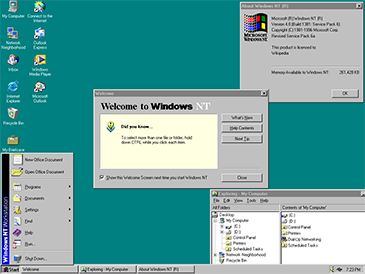
    Screenshot of Windows NT 4.0

    Windows_NT_4.0.png


    Microsoft released Windows NT 4.0, which features the new Windows 95 interface on top of the Windows NT kernel (a patch was available for developers to make NT 3.51 use the new UI, but it was quite buggy).

    Windows NT 4.0 came in four versions:

    • Windows NT 4.0 Workstation
    • Windows NT 4.0 Server
    • Windows NT 4.0 Server, Enterprise Edition (includes support for 8-way SMP and clustering)
    • Windows NT 4.0 Terminal Server


    Mal Baba

    Well-known member
  • Apr 26, 2009
    106,270
    5,599
    113
    Blob Storage
    www.37innovate.com
    Windows 98

    Windows 98

    Windows 98 logo

    276px-Windows_98_logo.svg.png


    Windows 98 (codenamed Memphis) is a graphical operating system by Microsoft. It is the second major release in the Windows 9x line of operating systems. It was released to manufacturing on May 15, 1998 and to retail on June 25, 1998. Windows 98 is the successor to Windows 95. Like its predecessor, it is a hybrid 16-bit/32-bit Ms-DOS based boot loader. Windows 98 was succeeded by Windows Me on September 14, 2000. Microsoft support for Windows 98 ended on July 11, 2006. monolithic product with an

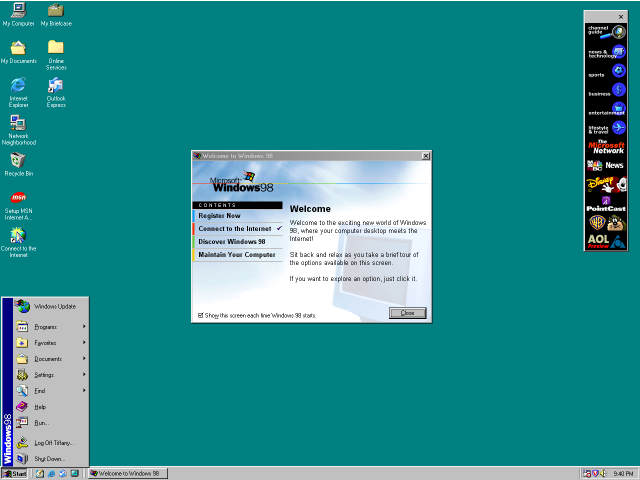
    Screenshot of Windows 98


    Windows98.png


    Mal Baba

    Well-known member
  • Apr 26, 2009
    106,270
    5,599
    113
    Blob Storage
    www.37innovate.com
    Windows 2000

    Windows 2000

    Windows 2000 logo

    Windows_2000_logo.png

    Windows 2000 is a line of operating systems produced by Microsoft for use on personal computers, business desktops, laptops, and servers. Released on 17 February 2000,it was the successor to Windows NT 4.0, and is the final release of Microsoft Windows to display the "Windows NT" designation. It was succeeded by Windows XP for desktop systems in October 2001 and Windows Server 2003Windows Me was released only a few months after Windows 2000 and one year before Windows XP, but Windows Me was not intended to be, nor did it serve as the successor to Windows 2000. Windows Me is designed for home use, while Windows 2000 is designed for business. for servers in April 2003.
    Four editions of Windows 2000 were released: Professional, Server, Advanced Server, and Datacenter Server.Additionally, Microsoft sold Windows 2000 Advanced Server Limited Edition and Windows 2000 Datacenter Server Limited Edition, which were released in 2001 and run on 64-bit Intel Itaniummicroprocessors. While each edition of Windows 2000 was targeted to a different market, they share a core set of features, including many system utilities such as the Microsoft Management Console and standard system administration applications.
    Support for people with disabilities has been improved over Windows NT 4.0 with a number of new assistive technologies, and Microsoft increased support for different languages and locale information.
    All versions of the operating system support the Windows NT file system, NTFS the Encrypting File System, as well as basic and dynamic disk storage. The Windows 2000 Server family has additional features, including the ability to provide Active Directory services (a hierarchical framework of resources), Distributed File SystemUnattended installations rely on the use of answer files to fill in installation information, and can be performed through a bootable CD using Microsoft Systems Management Server, by the System Preparation Tool. 3.0, (a file system that supports sharing of files) and fault-redundant storage volumes. Windows 2000 can be installed through either a manual or unattended installation.
    Microsoft marketed Windows 2000 as the most secure Windows version ever,but it became the target of a number of high-profile virus attacks such as Code Red and Nimda. Over ten years after its release, it continued to receive patches for security vulnerabilities nearly every month until reaching the end of its lifecycle on 13 July 2010.

    Screenshot of Windows 2000 Professional


    800px-Win2000.png

    Windows 2000 was available in six editions:

    • Windows 2000 Professional
    • Windows 2000 Server
    • Windows 2000 Advanced Server
    • Windows 2000 Datacenter Server
    • Windows 2000 Advanced Server Limited Edition
    • Windows 2000 Datacenter Server Limited Edition