
Latest ads
-
Colombo Hard Disk For Sale
- mazza
- Updated:
-
 land for sale
- justasking
- Updated:
-
 AMD AM 5 Ryzen setup
- prabodhamadusanka
- Updated:
-
 Gampaha ACER OKW223 Wired RGB Keyboard
- chint
- Updated:
-
 Gampaha FANTECH R1 V2 RACING WHEEL
- chint
- Updated:
History of Microsoft Windows
- Thread starter Mal Baba
- Start date
You are using an out of date browser. It may not display this or other websites correctly.
You should upgrade or use an alternative browser.
You should upgrade or use an alternative browser.

Windows Me
Windows Me
Microsoft Windows Millenium Edition Logo

Windows Millennium Edition, or Windows Me (pronounced as an abbreviation, /ˌɛm ˈiː/ em-ee), is a graphical operating system released on September 14, 2000 by Microsoft. Support for Windows Me ended on July 11, 2006.
Windows Me was the successor to Windows 98 and, just like Windows 98, was targeted specifically at home PC users.It included Internet Explorer 5.5, Windows Media Player 7, and the new Windows Movie Maker software, which provided basic video editing and was designed to be easy for home users. Microsoft also updated the graphical user interface and the shell features and Windows Explorer in Windows Me with some of those first introduced in Windows 2000, which had been released as a business oriented operating system seven months earlier. Windows Me could be upgraded to Internet Explorer 6 SP1, but not to SP2 (SV1) or Internet Explorer 7, and Windows Media Player 9 Series. Microsoft .NET Framework up to and including version 2.0 is supported, however versions 2.0 SP1, 3.x, and greater are not. Office XP was the last version of Microsoft Office to be compatible with Windows 9x.
Windows Me is a continuation of the Windows 9x model, but with access to real mode MS-DOS restricted in order to speed up system boot time. This was one of the most publicized changes in Windows Me, because applications that needed real mode DOS to run, such as older disk utilities, did not run under Windows Me.
Compared with other releases of Windows, Windows Me had a short shelf-life of just over a year; it was soon replaced by the Windows NT-based Windows XP, which was launched on October 25, 2001.
Screenshot of Windows Me

Microsoft Windows Millenium Edition Logo

Windows Millennium Edition, or Windows Me (pronounced as an abbreviation, /ˌɛm ˈiː/ em-ee), is a graphical operating system released on September 14, 2000 by Microsoft. Support for Windows Me ended on July 11, 2006.
Windows Me was the successor to Windows 98 and, just like Windows 98, was targeted specifically at home PC users.It included Internet Explorer 5.5, Windows Media Player 7, and the new Windows Movie Maker software, which provided basic video editing and was designed to be easy for home users. Microsoft also updated the graphical user interface and the shell features and Windows Explorer in Windows Me with some of those first introduced in Windows 2000, which had been released as a business oriented operating system seven months earlier. Windows Me could be upgraded to Internet Explorer 6 SP1, but not to SP2 (SV1) or Internet Explorer 7, and Windows Media Player 9 Series. Microsoft .NET Framework up to and including version 2.0 is supported, however versions 2.0 SP1, 3.x, and greater are not. Office XP was the last version of Microsoft Office to be compatible with Windows 9x.
Windows Me is a continuation of the Windows 9x model, but with access to real mode MS-DOS restricted in order to speed up system boot time. This was one of the most publicized changes in Windows Me, because applications that needed real mode DOS to run, such as older disk utilities, did not run under Windows Me.
Compared with other releases of Windows, Windows Me had a short shelf-life of just over a year; it was soon replaced by the Windows NT-based Windows XP, which was launched on October 25, 2001.
Screenshot of Windows Me


Windows XP
Windows XP
Microsoft Windows XP Logo

Windows XP is an operating system produced by Microsoft for use on personal computers, including home and business desktops, laptops, and media centers. It was first released in August 2001, and is currently one of the most popular versions of Windows. The name "XP" is short for "eXPerience."
Windows XP is the successor to both Windows 2000 and Windows Me, and is the first consumer-oriented operating system produced by Microsoft to be built on the Windows NT kernel and architecture. Windows XP was released for retail sale on October 25, 2001, and over 400 million copies were in use in January 2006, according to an estimate in that month by an IDC analyst. It was succeeded by Windows Vista, which was released to volume license customers on November 8, 2006, and worldwide to the general public on January 30, 2007. Direct OEM and retail sales of Windows XP ceased on June 30, 2008. Microsoft continued to sell XP through their System Builders (smaller OEMs who sell assembled computers) program until January 31, 2009.[5][6] XP may continue to be available as these sources run through their inventory or by purchasing Windows 7 Ultimate, Windows 7 Pro, Windows Vista Ultimate or Windows Vista Business, and then downgrading
to Windows XP.
The most common editions of the operating system are Windows XP Home Edition, which is targeted at home users, and Windows XP Professional, which offers additional features such as support for Windows Server domains and two physical processors, and is targeted at power users, business and enterprise clients. Windows XP Media Center Edition has additional multimedia features enhancing the ability to record and watch TV shows, view DVD movies, and listen to music. Windows XP Tablet PC Edition is designed to run stylus applications built using the Tablet PC platform.
Windows XP was eventually released for two additional architectures, Windows XP 64-bit Edition for IA-64 (Itanium) processors and Windows XP Professional x64 Edition for x86-64. There is also Windows XP Embedded, a component version of the Windows XP Professional, and editions for specific markets such as Windows XP Starter Edition. By mid 2009, a manufacturer revealed the first Windows XP powered cellular telephone.
The NT-based versions of Windows, which are programmed in C, C++, and assembly, are known for their improved stability and efficiency over the 9x versions of Microsoft Windows. Windows XP presents a significantly redesigned graphical user interface, a change Microsoft promoted as more user-friendly than previous versions of Windows. A new software management facility called Side-by-Side Assembly was introduced to ameliorate the "DLL hell" that plagues 9x versions of Windows. It is also the first version of Windows to use product activation to combat illegal copying, a restriction that did not sit well with some users and privacy advocates. Windows XP has also been criticized by some users for security vulnerabilities, tight integration of applications such as Internet Explorer 6 and Windows Media Player, and for aspects of its default user interface. Later versions with Service Pack 2, Service Pack 3, and Internet Explorer 8 addressed some of these concerns.
During development, the project was codenamed "Whistler", after Whistler, British Columbia, as many Microsoft employees skied at the Whistler-Blackcomb ski resort.
As of the end of June 2010, Windows XP is the most widely used operating system in the world with a 54.6% market share, having peaked at 76.1% in January 2007.
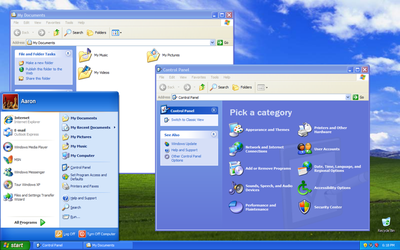
Screenshot of Windows XP
Microsoft Windows XP Logo

Windows XP is an operating system produced by Microsoft for use on personal computers, including home and business desktops, laptops, and media centers. It was first released in August 2001, and is currently one of the most popular versions of Windows. The name "XP" is short for "eXPerience."
Windows XP is the successor to both Windows 2000 and Windows Me, and is the first consumer-oriented operating system produced by Microsoft to be built on the Windows NT kernel and architecture. Windows XP was released for retail sale on October 25, 2001, and over 400 million copies were in use in January 2006, according to an estimate in that month by an IDC analyst. It was succeeded by Windows Vista, which was released to volume license customers on November 8, 2006, and worldwide to the general public on January 30, 2007. Direct OEM and retail sales of Windows XP ceased on June 30, 2008. Microsoft continued to sell XP through their System Builders (smaller OEMs who sell assembled computers) program until January 31, 2009.[5][6] XP may continue to be available as these sources run through their inventory or by purchasing Windows 7 Ultimate, Windows 7 Pro, Windows Vista Ultimate or Windows Vista Business, and then downgrading
to Windows XP.
The most common editions of the operating system are Windows XP Home Edition, which is targeted at home users, and Windows XP Professional, which offers additional features such as support for Windows Server domains and two physical processors, and is targeted at power users, business and enterprise clients. Windows XP Media Center Edition has additional multimedia features enhancing the ability to record and watch TV shows, view DVD movies, and listen to music. Windows XP Tablet PC Edition is designed to run stylus applications built using the Tablet PC platform.
Windows XP was eventually released for two additional architectures, Windows XP 64-bit Edition for IA-64 (Itanium) processors and Windows XP Professional x64 Edition for x86-64. There is also Windows XP Embedded, a component version of the Windows XP Professional, and editions for specific markets such as Windows XP Starter Edition. By mid 2009, a manufacturer revealed the first Windows XP powered cellular telephone.
The NT-based versions of Windows, which are programmed in C, C++, and assembly, are known for their improved stability and efficiency over the 9x versions of Microsoft Windows. Windows XP presents a significantly redesigned graphical user interface, a change Microsoft promoted as more user-friendly than previous versions of Windows. A new software management facility called Side-by-Side Assembly was introduced to ameliorate the "DLL hell" that plagues 9x versions of Windows. It is also the first version of Windows to use product activation to combat illegal copying, a restriction that did not sit well with some users and privacy advocates. Windows XP has also been criticized by some users for security vulnerabilities, tight integration of applications such as Internet Explorer 6 and Windows Media Player, and for aspects of its default user interface. Later versions with Service Pack 2, Service Pack 3, and Internet Explorer 8 addressed some of these concerns.
During development, the project was codenamed "Whistler", after Whistler, British Columbia, as many Microsoft employees skied at the Whistler-Blackcomb ski resort.
As of the end of June 2010, Windows XP is the most widely used operating system in the world with a 54.6% market share, having peaked at 76.1% in January 2007.
Screenshot of Windows XP
Windows XP Editions
- Windows XP Media Center Edition
Windows XP Media Center Edition (MCE) is a version of the Windows XPoperating system designed to serve as a home-entertainment hub. The last version, Windows XP Media Center Edition 2005, was released on October 12, 2004.
A Screen Shot of Windows XP Media Center Edition 2005

Versions
There are six versions of Windows XP Media Center Edition, all based on Windows XP Professional with all features enabled except Active Directory in Windows XP Media Center Edition 2005 (see "Features removed in the last release" below) and Terminal Services in the original release.
Windows XP Media Center Edition
(codename "eHome", Jan 2002) was the first showing and based directly on Windows XP Professional. This was only available from Tier 1 computer manufacturers (HP, Dell, Sony, Zitech, et al).
Windows XP Media Center Edition 2003
("Freestyle", Oct 2002) added a number of features, including FM radio tuning.
Windows XP Media Center Edition 2004
("Harmony", Nov 2003). Windows XP Service Pack 2 upgrades earlier versions of MCE to this one.
Windows XP Media Center Edition 2005
("Symphony", Nov 2004) is the first edition of MCE available to non-Tier 1 system builders. Among other things it includes support for Media Center Extenders, and CD/DVD-Video burning support.
Windows XP Media Center Edition 2006
("Emerald", Aug 2005) is a service pack- like update of MCE 2005 (Symphony) and was a recommended download designed to be installed on top of existing Symphony.
A Screen Shot of Windows XP Media Center Edition 2005

Versions
There are six versions of Windows XP Media Center Edition, all based on Windows XP Professional with all features enabled except Active Directory in Windows XP Media Center Edition 2005 (see "Features removed in the last release" below) and Terminal Services in the original release.
Windows XP Media Center Edition
(codename "eHome", Jan 2002) was the first showing and based directly on Windows XP Professional. This was only available from Tier 1 computer manufacturers (HP, Dell, Sony, Zitech, et al).
Windows XP Media Center Edition 2003
("Freestyle", Oct 2002) added a number of features, including FM radio tuning.
Windows XP Media Center Edition 2004
("Harmony", Nov 2003). Windows XP Service Pack 2 upgrades earlier versions of MCE to this one.
Windows XP Media Center Edition 2005
("Symphony", Nov 2004) is the first edition of MCE available to non-Tier 1 system builders. Among other things it includes support for Media Center Extenders, and CD/DVD-Video burning support.
Windows XP Media Center Edition 2006
("Emerald", Aug 2005) is a service pack- like update of MCE 2005 (Symphony) and was a recommended download designed to be installed on top of existing Symphony.
- Windows XP Tablet PC Edition
Windows XP Tablet PC Edition Logo

Windows XP Tablet PC Edition is an edition of Windows XP intended for specially-designed notebook/laptop computers called tablet PCs. Windows XP Tablet PC Edition is compatible with a pen-sensitive screen, supporting handwritten notes and portrait-oriented screens. A retail version cannot be purchased separately from a tablet PC, but is available to Microsoft Developers Network (MSDN) subscribers. Unlike Windows XP Media Center Edition which is not available in a retail or volume license form, a volume license version is also available.

Windows XP Tablet PC Edition is an edition of Windows XP intended for specially-designed notebook/laptop computers called tablet PCs. Windows XP Tablet PC Edition is compatible with a pen-sensitive screen, supporting handwritten notes and portrait-oriented screens. A retail version cannot be purchased separately from a tablet PC, but is available to Microsoft Developers Network (MSDN) subscribers. Unlike Windows XP Media Center Edition which is not available in a retail or volume license form, a volume license version is also available.
Windows Server 2003
Windows Server 2003
Windows Server 2003 logo

Windows Server 2003 (also referred to as Win2K3) is a server operating systemMicrosoft, introduced on 24 April 2003. An updated version, Windows Server 2003 R2, was released to manufacturing on 6 December 2005. Its successor, Windows Server 2008, was released on 4 February 2008. produced by
According to Microsoft, Windows Server 2003 is more scalable and delivers better performance than its predecessor, Windows 2000.
Screenshot of Windows Server 2003 Enterprise Edition

Windows Server 2003 is available in six editions
Windows Server 2003 logo

Windows Server 2003 (also referred to as Win2K3) is a server operating systemMicrosoft, introduced on 24 April 2003. An updated version, Windows Server 2003 R2, was released to manufacturing on 6 December 2005. Its successor, Windows Server 2008, was released on 4 February 2008. produced by
According to Microsoft, Windows Server 2003 is more scalable and delivers better performance than its predecessor, Windows 2000.
Screenshot of Windows Server 2003 Enterprise Edition

Windows Server 2003 is available in six editions
- Web Edition (32-bit)
- Standard Edition (32 and 64-bit)
- Enterprise Edition (32 and 64-bit)
- Datacenter Edition (32 and 64-bit)
- Small Business Server (32-bit)
- Storage Server (OEM channel only)
Windows Home Server
Windows Home Server
Windows Home Server logo

Windows Home Server, code-named Quattro, is a home server operating systemMicrosoft. Announced on 7 January 2007, at the Consumer Electronics ShowBill Gates, Windows Home Server is intended to be a solution for homes with multiple connected PCs to offer file sharing, automated backups, and remote access.Windows Server 2003 Service Pack 2. from by It is based on
Windows Home Server was released to manufacturing on 16 July 2007 and officially released on 7 November 2007. Power Pack 1 for Windows Home Server was released 20 July 2008, Power Pack 2 was released 24 March 2009, and Power Pack 3 was released 24 November 2009 . The next version of Windows Home Server, Windows Home Server V2 is expected to be released sometime in 2010.
Screenshot of the Windows Home Server Desktop

Windows Home Server logo

Windows Home Server, code-named Quattro, is a home server operating systemMicrosoft. Announced on 7 January 2007, at the Consumer Electronics ShowBill Gates, Windows Home Server is intended to be a solution for homes with multiple connected PCs to offer file sharing, automated backups, and remote access.Windows Server 2003 Service Pack 2. from by It is based on
Windows Home Server was released to manufacturing on 16 July 2007 and officially released on 7 November 2007. Power Pack 1 for Windows Home Server was released 20 July 2008, Power Pack 2 was released 24 March 2009, and Power Pack 3 was released 24 November 2009 . The next version of Windows Home Server, Windows Home Server V2 is expected to be released sometime in 2010.
Screenshot of the Windows Home Server Desktop


Windows Vista
Windows Vista
Windows Vista logo

Windows Vista is an operating system expressed in several variations developed by Microsoft for use on personal computers, including home and business desktops, laptops, tablet PCs, and media center PCs. Prior to its announcement on July 22, 2005, Windows Vista was known by its codename "Longhorn." Development was completed on November 8, 2006; over the following three months it was released in stages to computer hardware and software manufacturers, business customers, and retail channels. On January 30, 2007, it was released worldwide, and was made available for purchase and download from Microsoft's website. The release of Windows Vista came more than five years after the introduction of its predecessor, Windows XP, the longest time span between successive releases of Microsoft Windows desktop operating systems. It was succeeded by Windows 7 which was released to manufacturing on July 22, 2009, and for the general public on October 22, 2009.
Windows Vista contains many changes and new features, including an updated graphical user interface and visual style dubbed Aero, a redesigned search function, multimedia tools including Windows DVD Maker, and redesigned networking, audio, print, and display sub-systems. Vista aims to increase the level of communication between machines on a home network, using peer-to-peerfiles and media between computers and devices. Windows Vista includes version 3.0 of the .NET Framework, allowing software developers to write applications without traditional Windows APIs. technology to simplify sharing
Microsoft's primary stated objective with Windows Vista has been to improve the state of security in the Windows operating system. One common criticism of Windows XP and its predecessors is their commonly exploited security vulnerabilities and overall susceptibility to malware, viruses and buffer overflows. In light of this, Microsoft chairman Bill Gates announced in early 2002 a company-wide "Trustworthy Computing initiative" which aims to incorporate security work into every aspect of software development at the company. Microsoft stated that it prioritized improving the security of Windows XP and Windows Server 2003 above finishing Windows Vista, thus delaying its completion.
While these new features and security improvements have garnered positive reviews, Vista has also been the target of much criticism and negative press. Criticism of Windows Vista has targeted its high system requirements, its more restrictive licensing terms, the inclusion of a number of new digital rights managementUser Account Control. As a result of these and other issues, Windows Vista had seen initial adoption and satisfaction rates lower than Windows XP.
However, with an estimated 330 million Internet users as of January 2009, it had been announced that Vista usage had surpassed Microsoft’s pre-launch two-year-out expectations of achieving 200 million users. At the release of Windows 7 (October 2009), Windows Vista (with approximately 400 million Internet users) was the second most widely used operating system on the Internet with an approximately 18.6% market share, the most widely used being Windows XP with an approximately 63.3% market share. As of the end of May 2010, Windows Vista's market share estimates range from 15.26% to 26.04%. technologies aimed at restricting the copying of protected digital media, lack of compatibility with some pre-Vista hardware and software, and the number of authorization prompts for .
Screenshot of Windows Vista Ultimate

Windows Vista logo

Windows Vista is an operating system expressed in several variations developed by Microsoft for use on personal computers, including home and business desktops, laptops, tablet PCs, and media center PCs. Prior to its announcement on July 22, 2005, Windows Vista was known by its codename "Longhorn." Development was completed on November 8, 2006; over the following three months it was released in stages to computer hardware and software manufacturers, business customers, and retail channels. On January 30, 2007, it was released worldwide, and was made available for purchase and download from Microsoft's website. The release of Windows Vista came more than five years after the introduction of its predecessor, Windows XP, the longest time span between successive releases of Microsoft Windows desktop operating systems. It was succeeded by Windows 7 which was released to manufacturing on July 22, 2009, and for the general public on October 22, 2009.
Windows Vista contains many changes and new features, including an updated graphical user interface and visual style dubbed Aero, a redesigned search function, multimedia tools including Windows DVD Maker, and redesigned networking, audio, print, and display sub-systems. Vista aims to increase the level of communication between machines on a home network, using peer-to-peerfiles and media between computers and devices. Windows Vista includes version 3.0 of the .NET Framework, allowing software developers to write applications without traditional Windows APIs. technology to simplify sharing
Microsoft's primary stated objective with Windows Vista has been to improve the state of security in the Windows operating system. One common criticism of Windows XP and its predecessors is their commonly exploited security vulnerabilities and overall susceptibility to malware, viruses and buffer overflows. In light of this, Microsoft chairman Bill Gates announced in early 2002 a company-wide "Trustworthy Computing initiative" which aims to incorporate security work into every aspect of software development at the company. Microsoft stated that it prioritized improving the security of Windows XP and Windows Server 2003 above finishing Windows Vista, thus delaying its completion.
While these new features and security improvements have garnered positive reviews, Vista has also been the target of much criticism and negative press. Criticism of Windows Vista has targeted its high system requirements, its more restrictive licensing terms, the inclusion of a number of new digital rights managementUser Account Control. As a result of these and other issues, Windows Vista had seen initial adoption and satisfaction rates lower than Windows XP.
However, with an estimated 330 million Internet users as of January 2009, it had been announced that Vista usage had surpassed Microsoft’s pre-launch two-year-out expectations of achieving 200 million users. At the release of Windows 7 (October 2009), Windows Vista (with approximately 400 million Internet users) was the second most widely used operating system on the Internet with an approximately 18.6% market share, the most widely used being Windows XP with an approximately 63.3% market share. As of the end of May 2010, Windows Vista's market share estimates range from 15.26% to 26.04%. technologies aimed at restricting the copying of protected digital media, lack of compatibility with some pre-Vista hardware and software, and the number of authorization prompts for .
Screenshot of Windows Vista Ultimate

Windows Aero
Windows Aero
Aero Logo

Windows Aero is the graphical user interface and the default theme in most editions of Windows Vista and Windows 7, operating systems released by Microsoft. It is also available in Windows Server 2008, but is not enabled by default. Its name is a backronym for Authentic, Energetic, Reflective and Open. Intended to be a cleaner, more powerful, more efficient and more aesthetically pleasing user interface than the previously used theme (Luna), it includes new translucency, live thumbnails, live icons, animations and eye candy. Aero also encompasses a set of user interface design guidelines for Microsoft Windows.
The "glass"-like window borders, a distinctive feature of Windows Aero.

Aero Logo

Windows Aero is the graphical user interface and the default theme in most editions of Windows Vista and Windows 7, operating systems released by Microsoft. It is also available in Windows Server 2008, but is not enabled by default. Its name is a backronym for Authentic, Energetic, Reflective and Open. Intended to be a cleaner, more powerful, more efficient and more aesthetically pleasing user interface than the previously used theme (Luna), it includes new translucency, live thumbnails, live icons, animations and eye candy. Aero also encompasses a set of user interface design guidelines for Microsoft Windows.
The "glass"-like window borders, a distinctive feature of Windows Aero.

Windows Server 2008
Windows Server 2008
Windows Server 2008 logo

Windows Server 2008 is one of Microsoft Windows' server line of operating systems. Released to manufacturing on February 4, 2008, and officially released on February 27, 2008, it is the successor to Windows Server 2003, released nearly five years earlier. A second release, named Windows Server 2008 R2, was released to manufacturing on July 22, 2009.Like Windows Vista and Windows 7, Windows Server 2008 is built on Windows NT 6.x.
Screenshot of Windows Server 2008

Windows Server 2008 ships in ten editions
Windows Server 2008 logo

Windows Server 2008 is one of Microsoft Windows' server line of operating systems. Released to manufacturing on February 4, 2008, and officially released on February 27, 2008, it is the successor to Windows Server 2003, released nearly five years earlier. A second release, named Windows Server 2008 R2, was released to manufacturing on July 22, 2009.Like Windows Vista and Windows 7, Windows Server 2008 is built on Windows NT 6.x.
Screenshot of Windows Server 2008

Windows Server 2008 ships in ten editions
- Windows Server 2008 Standard Edition (32-bit and 64-bit)
- Windows Server 2008 Enterprise Edition (32-bit and 64-bit)
- Windows Server 2008 Datacenter Edition (32-bit and 64-bit)
- Windows HPC Server 2008
- Windows Web Server 2008 (32-bit and 64-bit)
- Windows Storage Server 2008 (32-bit and 64-bit)
- Windows Small Business Server 2008 (64-bit only)
- Windows Essential Business Server 2008 (32-bit and 64-bit)
- Windows Server 2008 for Itanium-based Systems
- Windows Server 2008 Foundation Server
Windows 7
Windows 7
Windows 7 logo

Windows 7 is a version of Microsoft Windows, a series of operating systemsMicrosoft for use on personal computers, including home and business desktops, laptops, netbooks, tablet PCs, and media center PCs. Windows 7 was released to manufacturing on July 22, 2009, and reached general retail availability on October 22, 2009, less than three years after the release of its predecessor, Windows Vista. Windows 7's server counterpart, Windows Server 2008 R2, was released at the same time. Windows 7 will be succeeded by Windows 8, which has no release date as of yet. produced by
Unlike its predecessor, Windows Vista, which introduced a large number of new features, Windows 7 was intended to be a more focused, incremental upgrade to the Windows line, with the goal of being compatible with applications and hardware with which Windows Vista is already compatible.Presentations given by Microsoft in 2008 focused on multi-touch support, a redesigned Windows Shell with a new taskbar, referred to as the Superbar, a home networking system called HomeGroup,Windows Calendar, Windows Mail, Windows Movie Maker, and Windows Photo Gallery, are not included in Windows 7; most are instead offered separately at no charge as part of the Windows Live Essentials suite and performance improvements. Some standard applications that have been included with prior releases of Microsoft Windows, including
Screenshot of Windows 7 Ultimate

The Windows 7 Task Bar.

Windows 7 logo

Windows 7 is a version of Microsoft Windows, a series of operating systemsMicrosoft for use on personal computers, including home and business desktops, laptops, netbooks, tablet PCs, and media center PCs. Windows 7 was released to manufacturing on July 22, 2009, and reached general retail availability on October 22, 2009, less than three years after the release of its predecessor, Windows Vista. Windows 7's server counterpart, Windows Server 2008 R2, was released at the same time. Windows 7 will be succeeded by Windows 8, which has no release date as of yet. produced by
Unlike its predecessor, Windows Vista, which introduced a large number of new features, Windows 7 was intended to be a more focused, incremental upgrade to the Windows line, with the goal of being compatible with applications and hardware with which Windows Vista is already compatible.Presentations given by Microsoft in 2008 focused on multi-touch support, a redesigned Windows Shell with a new taskbar, referred to as the Superbar, a home networking system called HomeGroup,Windows Calendar, Windows Mail, Windows Movie Maker, and Windows Photo Gallery, are not included in Windows 7; most are instead offered separately at no charge as part of the Windows Live Essentials suite and performance improvements. Some standard applications that have been included with prior releases of Microsoft Windows, including
Screenshot of Windows 7 Ultimate

The Windows 7 Task Bar.

Windows 8
Windows 8

A roadmap timeline slide shown by Microsoft at the 2009 Professional Developers Conference shows that a product code named "Windows 8" is scheduled to be released sometime around 2012. Development and other aspects of Windows 8 have not been detailed in public, although job listings have mentioned improved functionality for file access in branch offices.
A recently-departed Microsoft employee's blog has revealed a rough version of Microsoft's roadmap for key software, including Windows 8. According to the information, Microsoft aims for Windows 8 support to start on July 1, 2011. Support for Windows Server 2012 starts on July 2, 2012.A Microsoft KB article confirmed that Windows 8 is the next version of Windows.
The article has now been changed to remove references to Windows 8.
A recently leaked document from Microsoft seems to indicate that Windows 8 might feature a faster startup, an App Store, integrated web applications, improved digital media support (including AVC HD and 3D video), faster resumes from low-power states, and USB 3.0 and Bluetooth 3.0 support.

A roadmap timeline slide shown by Microsoft at the 2009 Professional Developers Conference shows that a product code named "Windows 8" is scheduled to be released sometime around 2012. Development and other aspects of Windows 8 have not been detailed in public, although job listings have mentioned improved functionality for file access in branch offices.
A recently-departed Microsoft employee's blog has revealed a rough version of Microsoft's roadmap for key software, including Windows 8. According to the information, Microsoft aims for Windows 8 support to start on July 1, 2011. Support for Windows Server 2012 starts on July 2, 2012.A Microsoft KB article confirmed that Windows 8 is the next version of Windows.
The article has now been changed to remove references to Windows 8.
A recently leaked document from Microsoft seems to indicate that Windows 8 might feature a faster startup, an App Store, integrated web applications, improved digital media support (including AVC HD and 3D video), faster resumes from low-power states, and USB 3.0 and Bluetooth 3.0 support.
Do You Like My  Thread Add Your Comments
And Your Reps
Thanks
Thread Add Your Comments And Your Reps
Thanks


Thanks Nangiyagr8 Post aiya..
Thanks for sharing info with us..
Similar threads

- Replies
- 0
- Views
- 299
- Replies
- 11
- Views
- 396

- Replies
- 12
- Views
- 319

- Replies
- 0
- Views
- 121
