By W A Wijewardena – Former Deputy Governor CBSL
The Central Bank has issued its Annual Report for 2022 in two volumes, the first on the state of the economy and the second on its operations. The members of the public normally focus on the first volume since it is a rich source of the current and emerging economic situation. A scanty attention is paid to volume number two which brings out the financial position of the Bank. However, it is the volume which should be read and debated by the public because it gives clues about the stability of the Central Bank.
Thumping losses in CB in 2022
According to the financial results released, the Central Bank has made a thumping loss of Rs. 374 billion in 2022 as against a profit of Rs. 158 billion made in 2021. This is by calculating profits or losses in terms of the international accounting standards which the bank is following as its accounting and auditing template. These standards require the Central Bank to recognise the losses arising from the revaluation of foreign assets and liabilities due to exchange rate depreciation as a loss of income in the current year. But the normal central bank account systems require the bank to transfer such losses to a special account called the International Reserve Revaluation Account or IRRA and separate them from the distributable profits or losses. This is how the profit calculation should be made as prescribed in the Monetary Law Act or MLA.
But when this practice is followed by taking out the current revaluation losses amounting to some Rs. 610 billion, the loss of Rs. 374 billion in terms of the International Accounting Standards is converted to a profit of Rs. 235 billion that can be distributed by the bank it wishes to do so. However, as a prudential measure, the bank has decided not to make any profit transfer to the Government out of its financial operations in 2022.
Current CB management is not responsible for the losses
It should be noted that the present management of the Central Bank is not responsible for this malaise. In fact, it is a victim of the imprudent operations conducted by the Central Bank management in the past. Two of such imprudent measures included losing foreign reserves from around $ 7.6 billion at end 2019 to near zero level by March 2022 to keep the exchange rate at an artificial level of Rs. 200 per dollar and increasing the bank’s foreign liabilities to a level of $ 6 billion by that date. Hence, when the assets and liabilities were reassessed by using a collapsed exchange rate of Rs. 363 per US dollar, it resulted in a thumping loss of Rs. 610 billion as reported. This was much more than the generation of rupee profits by the bank during 2022 by lending to the Government at high interest rates of about 30%.
CB’s goal should not be making profits, but it should not make losses either
Profit making is not the goal of a central bank because it can make profits, unlike other entities in an economy, by printing money at its discretion and acquiring assets. If it prints more money, it can make a bigger quantum of profits. But those profits are made at the expense of those who hold on to the money it prints. When the money supply is more than the needs of the economy to conduct its economic transactions, the excess money creating an unwarranted total demand, known as the aggregate demand, for goods and services will lead to an increase in the general price level, on one side, and the depreciation of the exchange rate, on the other. When the general price level increases continuously over a period, it is called inflation.
Both inflation and the exchange rate depreciation will reduce the real value of the money held by people. For instance, if one goes by the underestimated Colombo Consumers’ Price Index, or CCPI, which is used as the country’s official measure of cost of living, a rupee earned in January 2021 is now worth only about 50 cents. Similarly, a person who has earned an income of Rs. 200 in January 2021 would have been able to command a basket of goods worth of one US dollar. The same one hundred rupees can command only a basket worth of 55 US cents in December 2022. Hence, the public is hit twice by the unnecessary money increases by a central bank, though it makes profits for it, leading to inflation and currency depreciation. This is not the goal of a central bank and therefore, it is not expected to make profits at the risk of generating inflation and currency depreciation.
Losses not tolerated in CBs
But a central bank is not expected to make losses either. Those losses will reduce its capital base and when the capital falls to a critically low level of making its monetary obligations in the form of currency it has issued and demand deposits it is holding more than the capital, it is reduced to a venture with a negative net worth. In the case of a private business, a venture with a negative net worth is not a ‘going concern’ meaning it cannot do its business, and, hence, should be compulsorily wound up. A central bank cannot be wound up like that and, therefore, should be given new capital by the taxpayers. This is a situation that should be avoided.
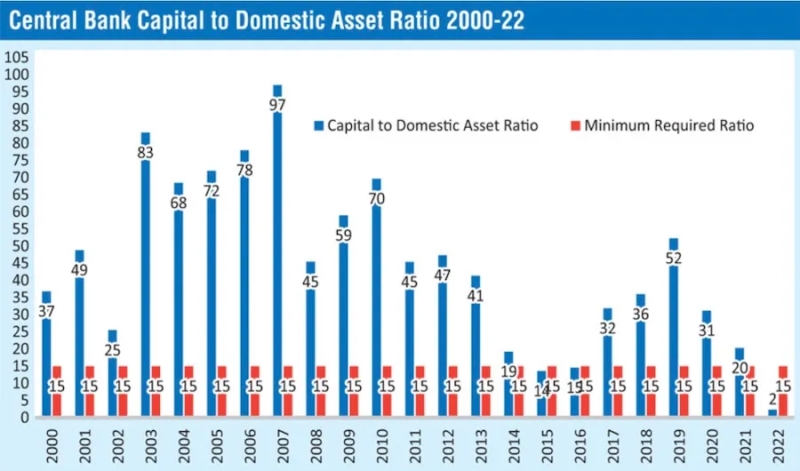
When the Central Bank continued to make losses in 2013, 2014, and 2015 causing a depletion of its capital base, I warned the Central Bank in this series that it should take action to reverse the trend to avoid the state of a negative net worth in the Bank. In the subsequent years, the Bank was able to reverse the trend and avoid the obvious pitfall.
CBs can make profits in forex operations
However, there is no objection to a central bank making modest profits in its foreign exchange operations after ensuring the safety of its foreign investments. This is because the foreign exchange operations are done by a central bank as the agent of the government by managing the nation’s foreign reserves. What is earned through these operations is earned from the rest of the world and has no implications for the domestic aggregate demand and consequential inflation and currency depreciation. Since foreign reserves are there to meet a foreign currency shortfall and avoid payment difficulties, it is not expected to take high risks by engaging in speculative types of investment.
In the past, there have been occasions where the Central Bank has violated this golden principle. As a result, in the new central bank bill, it has been stipulated that the central bank should conduct its foreign exchange operations ‘having regard to safety, liquidity, and return in that order of priority’. Therefore, even in the case of foreign exchange operations, the priority is not making profits but ensuring safety first, and liquidity second. Hence, the central bank should look at the return in investments only after the first two have been satisfied.
Capital ratios are a protective measure in CBs
Unlike currency boards where every currency note issued should be backed by an equal value of foreign reserves, central banks are not required to maintain such a reserve backing. Hence, capital becomes important for central banks. To force central banks to maintain adequate capital funds relative to the assets they create, the laws governing them have provided for maintaining proper capital ratios. For instance, the Monetary Law Act which governs the present central bank has required the Monetary Board of the Central Bank to build up capital funds equal to at least 15% of its domestic assets defined as the difference between the total assets and foreign assets.
The Central Bank has issued its Annual Report for 2022 in two volumes, the first on the state of the economy and the second on its operations. The members of the public normally focus on the first volume since it is a rich source of the current and emerging economic situation. A scanty attention is paid to volume number two which brings out the financial position of the Bank. However, it is the volume which should be read and debated by the public because it gives clues about the stability of the Central Bank.
Thumping losses in CB in 2022
According to the financial results released, the Central Bank has made a thumping loss of Rs. 374 billion in 2022 as against a profit of Rs. 158 billion made in 2021. This is by calculating profits or losses in terms of the international accounting standards which the bank is following as its accounting and auditing template. These standards require the Central Bank to recognise the losses arising from the revaluation of foreign assets and liabilities due to exchange rate depreciation as a loss of income in the current year. But the normal central bank account systems require the bank to transfer such losses to a special account called the International Reserve Revaluation Account or IRRA and separate them from the distributable profits or losses. This is how the profit calculation should be made as prescribed in the Monetary Law Act or MLA.
But when this practice is followed by taking out the current revaluation losses amounting to some Rs. 610 billion, the loss of Rs. 374 billion in terms of the International Accounting Standards is converted to a profit of Rs. 235 billion that can be distributed by the bank it wishes to do so. However, as a prudential measure, the bank has decided not to make any profit transfer to the Government out of its financial operations in 2022.
Current CB management is not responsible for the losses
It should be noted that the present management of the Central Bank is not responsible for this malaise. In fact, it is a victim of the imprudent operations conducted by the Central Bank management in the past. Two of such imprudent measures included losing foreign reserves from around $ 7.6 billion at end 2019 to near zero level by March 2022 to keep the exchange rate at an artificial level of Rs. 200 per dollar and increasing the bank’s foreign liabilities to a level of $ 6 billion by that date. Hence, when the assets and liabilities were reassessed by using a collapsed exchange rate of Rs. 363 per US dollar, it resulted in a thumping loss of Rs. 610 billion as reported. This was much more than the generation of rupee profits by the bank during 2022 by lending to the Government at high interest rates of about 30%.
CB’s goal should not be making profits, but it should not make losses either
Profit making is not the goal of a central bank because it can make profits, unlike other entities in an economy, by printing money at its discretion and acquiring assets. If it prints more money, it can make a bigger quantum of profits. But those profits are made at the expense of those who hold on to the money it prints. When the money supply is more than the needs of the economy to conduct its economic transactions, the excess money creating an unwarranted total demand, known as the aggregate demand, for goods and services will lead to an increase in the general price level, on one side, and the depreciation of the exchange rate, on the other. When the general price level increases continuously over a period, it is called inflation.
Both inflation and the exchange rate depreciation will reduce the real value of the money held by people. For instance, if one goes by the underestimated Colombo Consumers’ Price Index, or CCPI, which is used as the country’s official measure of cost of living, a rupee earned in January 2021 is now worth only about 50 cents. Similarly, a person who has earned an income of Rs. 200 in January 2021 would have been able to command a basket of goods worth of one US dollar. The same one hundred rupees can command only a basket worth of 55 US cents in December 2022. Hence, the public is hit twice by the unnecessary money increases by a central bank, though it makes profits for it, leading to inflation and currency depreciation. This is not the goal of a central bank and therefore, it is not expected to make profits at the risk of generating inflation and currency depreciation.
Losses not tolerated in CBs
But a central bank is not expected to make losses either. Those losses will reduce its capital base and when the capital falls to a critically low level of making its monetary obligations in the form of currency it has issued and demand deposits it is holding more than the capital, it is reduced to a venture with a negative net worth. In the case of a private business, a venture with a negative net worth is not a ‘going concern’ meaning it cannot do its business, and, hence, should be compulsorily wound up. A central bank cannot be wound up like that and, therefore, should be given new capital by the taxpayers. This is a situation that should be avoided.
When the Central Bank continued to make losses in 2013, 2014, and 2015 causing a depletion of its capital base, I warned the Central Bank in this series that it should take action to reverse the trend to avoid the state of a negative net worth in the Bank. In the subsequent years, the Bank was able to reverse the trend and avoid the obvious pitfall.
CBs can make profits in forex operations
However, there is no objection to a central bank making modest profits in its foreign exchange operations after ensuring the safety of its foreign investments. This is because the foreign exchange operations are done by a central bank as the agent of the government by managing the nation’s foreign reserves. What is earned through these operations is earned from the rest of the world and has no implications for the domestic aggregate demand and consequential inflation and currency depreciation. Since foreign reserves are there to meet a foreign currency shortfall and avoid payment difficulties, it is not expected to take high risks by engaging in speculative types of investment.
In the past, there have been occasions where the Central Bank has violated this golden principle. As a result, in the new central bank bill, it has been stipulated that the central bank should conduct its foreign exchange operations ‘having regard to safety, liquidity, and return in that order of priority’. Therefore, even in the case of foreign exchange operations, the priority is not making profits but ensuring safety first, and liquidity second. Hence, the central bank should look at the return in investments only after the first two have been satisfied.
Capital ratios are a protective measure in CBs
Unlike currency boards where every currency note issued should be backed by an equal value of foreign reserves, central banks are not required to maintain such a reserve backing. Hence, capital becomes important for central banks. To force central banks to maintain adequate capital funds relative to the assets they create, the laws governing them have provided for maintaining proper capital ratios. For instance, the Monetary Law Act which governs the present central bank has required the Monetary Board of the Central Bank to build up capital funds equal to at least 15% of its domestic assets defined as the difference between the total assets and foreign assets.