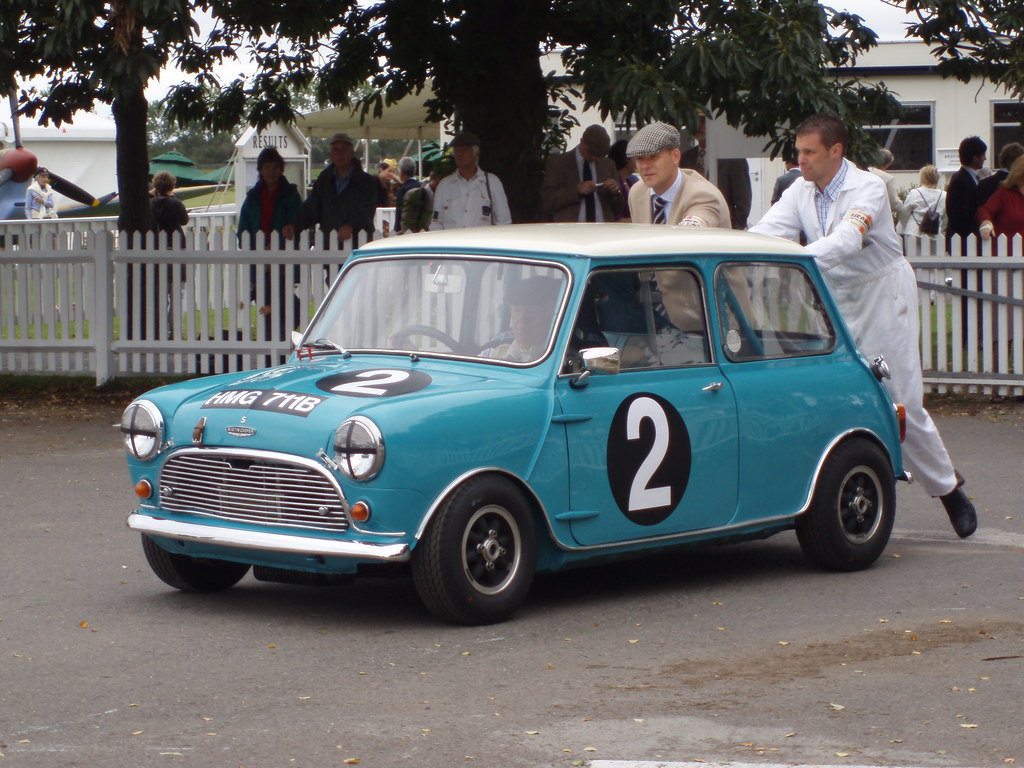
The Mini is a small car that was produced by the British Motor Corporation (BMC) and its successors from 1959 until 2000. The original is considered an icon of the 1960s, and its space-saving front-wheel-drive layout (that allowed 80% of the area of the car's floorpan to be used for passengers and luggage) influenced a generation of car-makers. The vehicle is in some ways considered the British equivalent to its German contemporary, the Volkswagen Beetle, which enjoyed similar popularity in North America. In 1999 the Mini was voted the second most influential car of the 20th Century, behind the Ford Model T.
This distinctive two-door car was designed for BMC by Sir Alec Issigonis. It was manufactured at the Longbridge and Cowley plants in England, the Victoria Park / Zetland British Motor Corporation (Australia) factory in Sydney, Australia, and later also in Spain (Authi), Belgium, Chile, Italy (Innocenti), Portugal, South Africa, Uruguay, Venezuela and Yugoslavia. The Mini Mark I had three major UK updates: the Mark II, the Clubman and the Mark III. Within these was a series of variations including an estate car, a pickup truck, a van and the Mini Moke—a jeep-like buggy. The Mini Cooper and Cooper "S" were sportier versions that were successful as rally cars, winning the Monte Carlo Rally four times from 1964 through to 1967, although in 1966 the Mini was disqualified after the finish, along with six other British entrants, which included the first four cars to finish, under a questionable ruling that the cars had used an illegal combination of headlamps and spotlights. Initially Minis were marketed under the Austin and Morris names, as the Austin Seven and Morris Mini Minor, until Mini became a marque in its own right in 1969. The Mini was again marketed under the Austin name in the 1980s.

Design and development

Designed as project ADO15 (Austin Drawing Office project number 15), the Mini came about because of a fuel shortage caused by the 1956 Suez Crisis. Petrol was once again rationed in the UK, sales of large cars slumped, the market for German Bubble cars boomed. Leonard Lord, the somewhat autocratic head of BMC, reportedly decreed: 'God damn these b****y awful Bubble Cars. We must drive them off the road by designing a proper miniature car'. He laid down some basic design requirements: the car should be contained within a box that measured 10 × 4 × 4 ft (3 × 1.2 × 1.2 m); and the passenger accommodation should occupy 6 ft (1.8 m) of the 10 ft (3 m) length; and the engine, for reasons of cost, should be an existing unit. Issigonis, who had been working for Alvis, had been recruited back to BMC in 1955 and, with his skills in designing small cars, was a natural for the task. The team that designed the Mini was remarkably small: as well as Issigonis, there was Jack Daniels (who had worked with him on the Morris Minor), Chris Kingham (who had been with him at Alvis), two engineering students and four draughtsmen. Together, by October 1957, they had designed and built the original prototype, which was affectionately named "The Orange Box" because of its colour.
The ADO15 used a conventional BMC A-Series four-cylinder water-cooled engine, but departed from tradition by mounting it transversely, with the engine-oil-lubricated, four-speed transmission in the sump, and by employing front-wheel drive. Almost all small front-wheel-drive cars developed since have used a similar configuration, except with the transmission usually separately enclosed rather than using the engine oil. The radiator was mounted at the left side of the car so that the engine-mounted fan could be retained, but with reversed pitch so that it blew air into the natural low pressure area under the front wing. This location saved precious vehicle length, but had the disadvantage of feeding the radiator with air that had been heated by passing over the engine. It also exposed the entire ignition system to the direct ingress of rainwater through the grille.
Mark I Mini: 1959–1967

The production version of the Mini was demonstrated to the press in April 1959, and by August several thousand cars had been produced ready for the first sales.
The name Mini did not appear by itself immediately—the first model's names were chosen by chief designer David Holland and were marketed under two of BMC's brand names, Austin and Morris. The name Austin Seven (sometimes written as SE7EN in early publicity material) recalled the popular small Austin 7 of the 1920s and 1930s. The other name used until 1967 in the United Kingdom (and in Commonwealth countries such as Australia), Morris Mini-Minor, seems to have been a play on words. The Morris Minor was a well known and successful car, with the word minor being Latin for "smaller"; so an abbreviation of the Latin word for "smallest"—minimus—was used for the new even smaller car. It was originally going to be called the Austin Newmarket.
Until 1962, the cars appeared as the Austin 850 and Morris 850 in North America and France, and in Denmark as the Austin Partner (until 1964) and Morris Mascot (until 1981). The name Mini was first used domestically by BMC for Austin's version in 1961, when the Austin Seven was rebranded as the Austin Mini, somewhat to the surprise of the Sharps Commercials car company (later known as Bond Cars Ltd) who had been using the name Minicar for their three-wheeled vehicles since 1949. However, legal action was somehow averted,[16] and BMC used the name Mini thereafter.
In 1964, the suspension of the cars was replaced by another Moulton design, the hydrolastic system. The new suspension gave a softer ride but it also increased weight and production cost and, in the minds of many enthusiasts, spoiled the handling characteristics for which the Mini was so famous. In 1971, the original rubber suspension reappeared and was retained for the remaining life of the Mini.
Slow at the outset, Mark I sales strengthened across most of the model lines in the 1960s, and production totalled 1,190,000. Sold at almost below cost, the basic Mini made very little money for its owners. However, it still did make a small profit. Ford once took a Mini away and completely dismantled it, possibly to see if they could offer an alternative. It was their opinion though, that they could not sell it at BMC's price. Ford determined that the BMC must have been losing around 30 pounds per car. BMC insisted that the way company overheads were shared out, the Mini always made money. Larger profits came from the popular De Luxe models and from optional extras such as seat belts, door mirrors, a heater and a radio, which would be considered necessities on modern cars, as well as the various "Cooper" and "Cooper S" models, to be discussed later.
The Mini etched its place into popular culture in the 1960s with well-publicised purchases by film and music stars.
Mark II Mini: 1967–1973

The Mark II Mini featured a redesigned grille which remained with the car from that point on. Also, a larger rear window and numerous cosmetic changes were introduced. 429,000 Mark II Minis were made.
A bewildering variety of Mini types were made in Pamplona, Spain, by the Authi company from 1968 onwards, mostly under the Morris name.
The Mini was arguably the star of the 1969 film The Italian Job, which features a car chase in which a gang of thieves drive three Minis down staircases, through storm drains, over buildings and finally into the back of a moving bus. This film was remade in 2003 using the new MINI.
Mini Cooper and Cooper S: 1961–2000

Issigonis' friend John Cooper, owner of the Cooper Car Company and designer and builder of Formula One and rally cars, saw the potential of the Mini for competition. Issigonis was initially reluctant to see the Mini in the role of a performance car, but after John Cooper appealed to BMC management, the two men collaborated to create the Mini Cooper, a nimble, economical and inexpensive car. The Austin Mini Cooper and Morris Mini Cooper debuted in 1961.
The original 848 cc engine from the Morris Mini-Minor was given a longer stroke to increase capacity to 997 cc, boosting power from 34 bhp to 55 bhp (25 to 41 kW). The car featured a racing-tuned engine, twin SU carburettors, a closer-ratio gearbox and front disc brakes, uncommon at the time in a small car. One thousand units of this version were commissioned by management, intended for and designed to meet the homologation rules of Group 2 rally racing. The 997 cc engine was replaced by a shorter stroke 998 cc unit in 1964.
A more powerful Mini Cooper, dubbed the "S", was developed in tandem and released in 1963. Featuring a 1071 cc engine with a 70.61 mm bore and nitrided steel crankshaft and strengthened bottom end to allow further tuning; and larger servo-assisted disc brakes, 4,030 Cooper S cars were produced and sold until the model was updated in August 1964. Cooper also produced two S models specifically for circuit racing in the under 1000cc and under 1300cc classes respectively, rated at 970 cc and a 1275 cc, both with the 70.61mm bore and both of which were also offered to the public. The smaller-engine model was not well received, and only 963 had been built when the model was discontinued in 1965. The 1275 cc Cooper S models continued in production until 1971.
Mini Clubman and 1275GT: 1969–1980

In 1969, under the ownership of British Leyland, the Mini was given a facelift by stylist Roy Haynes, who had previously worked for Ford. The restyled version was called the Mini Clubman, and has a squarer frontal look, using the same indicator/sidelight assembly as the Austin Maxi. The Mini Clubman was intended to replace the upmarket Riley and Wolseley versions. A new model, dubbed the 1275GT, was slated as the replacement for the 998 cc Mini Cooper (the 1275 cc Mini Cooper S continued alongside the 1275GT for two years until 1971). The Clubman Estate took over where the Countryman and Traveller left off.
Production of the Clubman and 1275GT got off to a slow start because the cars incorporated "lots of production changes" including the relocation of tooling from the manufacturer's Cowley plant to the Longbridge plant: very few cars were handed over to customers before the early months of 1970.
Early domestic market Clubmans were still delivered on cross-ply tyres despite the fact that by 1970 radials had become the norm for the car's mainstream competitors.By 1973 new Minis were, by default, being shipped with radial tyres, though cross-plies could be specified by special order, giving British buyers a price saving of £8.
The 1275GT is often incorrectly described as the "Mini Clubman 1275GT". The official name was always just the "Mini 1275GT", and it was a separate, distinct model from the Clubman (albeit, it shared the same frontal treatment as the Mini Clubman, and was launched at the same time).
In 1971, the 1275 cc Mini Cooper S was discontinued in the UK, leaving the Mini 1275GT as the only sporting Mini on sale for the rest of the decade. Innocenti in Italy, however, continued making their own version of the Mini Cooper for some time. While the UK built 1275GT was not nearly as quick as a 1275 Mini Cooper S, it was cheaper to buy, run, and insure. It was the first Mini to be equipped with a tachometer. It also featured a standard-fit close-ratio gearbox. Performance of the 1275GT was lively for the time, achieving 0–60 mph (97 km/h) in 12.9 seconds, and the excellent midrange torque offered a 30–50 mph (48–80 km/h) time in top gear of only nine seconds. The bluff front, however, meant that the model struggled to reach 90 mph (140 km/h). The 1275 cc A-series engine could be cheaply and easily tuned, though the cheap purchase price and prominent "sidewinder" door stripes meant that this model developed a reputation as something of a "boy-racer special" during the 1970s and into the 1980s.
The Mini Clubman and 1275GT were responsible for two motoring "firsts": they were the first vehicles to use a flexi printed-circuit board behind the dash instruments (universal nowadays, but technically advanced for 1969). Secondly, the 1275GT was the first vehicle to be offered with run-flat tyres; from 1974 this model could be ordered with optional Dunlop Denovo tyres on 12-inch (300 mm) diameter rims. In the event of a puncture, the Dunlop Denovo tyre would not burst and quickly deflate, but could continue to be used safely at speeds of up to 50 mph (80 km/h). This was a useful safety feature, although the increased road noise and relatively poor grip of this tyre meant that many 1275GT buyers ignored this option.
Throughout the 1970s, British Leyland continued to produce the classic 1959 "round-front" design, alongside the newer Clubman and 1275GT models. The long-nose Clubman and 1275GT offered better crash safety, were better equipped, and had vastly better under-bonnet access, but they were more expensive and aerodynamically inferior to the original 1959 design. The Mini Clubman and 1275GT were replaced in 1980 by the new hatchback Austin Metro, while production of the original "round-front" mini design continued for another 20 years. At the end of Clubman and 1275GT production, 275,583 Clubman saloons, 197,606 Clubman Estates and 110,673 1275GTs had been made.
Mark III and onwards: 1970–2000
The Mark III Mini had a modified bodyshell with enough alterations to see the factory code change from ADO15 to ADO20 (which it shared with the Clubman). The most obvious changes were larger doors with concealed hinges. Customer demand led to the sliding windows being replaced with winding windows—although some Australian-manufactured Mark I Minis had adopted this feature in 1965 (with opening quarterlight windows). The suspension reverted from Hydrolastic to rubber cones as a cost-saving measure. (The 1275 GT and Clubman would retain the hydrolastic system until June 1971 when they, too, switched to the rubber cone suspension of the original Minis.)
Production at the Cowley plant was ended, and the simple name Mini completely replaced the separate Austin and Morris brands.
In the late 1970s, Innocenti introduced the Innocenti 90 and 120, Bertone-designed hatchbacks based on the Mini platform. Bertone also created a Mini Cooper equivalent, christened the Innocenti De Tomaso, that sported a 1275 cc engine similar to the MG Metro engine but with a 11 stud head, a special inlet manifold and used the "A" clutch instead of the "Verto" type. The most important feature was the utilization of homokinetic shafts, avoiding the rubber couplings.
By this stage, the Mini was still hugely popular in Britain, but it was looking increasingly outdated in the face of newer and more practical rivals including the Ford Fiesta, Vauxhall Chevette, Chrysler Sunbeam, Volkswagen Polo and Peugeot 104. Since the late 1960s, plans had been in place for a newer and more practical supermini to replace it, though the Mini was still the only car of this size built by British Leyland for the home market.
Reports of the Mini's imminent demise surfaced again in 1980 with the launch of the Austin Mini-Metro (badging with the word mini in all lowercase). In New Zealand in 1981, the Mini starred in a road trip movie directed by Geoff Murphy called Goodbye Pork Pie. The Mini was beginning to fall out of favour in many export markets, with the South African, Australian, and New Zealand markets all stopping production around this time.
Although the Mini continued after the Metro's launch, production volumes were reduced as British Leyland and successor combine Rover Group concentrated on the Metro as its key supermini. Indeed, 1981 was the Mini's last year in the top ten of Britain's top selling cars, as it came ninth and the Metro was fifth.
* Mark III (introduced in November 1969) had wind up windows with internal door hinges except for the van and pickup models. The boot lid lost the original hinged number plate and its recess shape and a large rear colour coded lamp was fitted in its place, along with larger rear side windows.

* Mark IV (introduced in 1976) had a front rubber mounted subframe with single tower bolts and the rear frame had some larger bushes introduced. Twin stalk indicators were introduced with larger foot pedals. From 1977 onwards, the rear indicator lamps had the reverse lights incorporated in them.

* Mark V (from 1984): all cars had 8.4-inch (210 mm) brake discs and plastic wheel arches (mini special arches) but retained the same Mark IV body shell shape.

* Mark VI (from 1990): the engine mounting points were moved forward to take 1275 cc power units, and includes the HIF carb version, plus the single point fuel injected car which came out in 1991. The 998 cc power units were discontinued. Internal bonnet release were fitted from 1992.

* Mark VII was the final twin point injection with front mounted radiator.
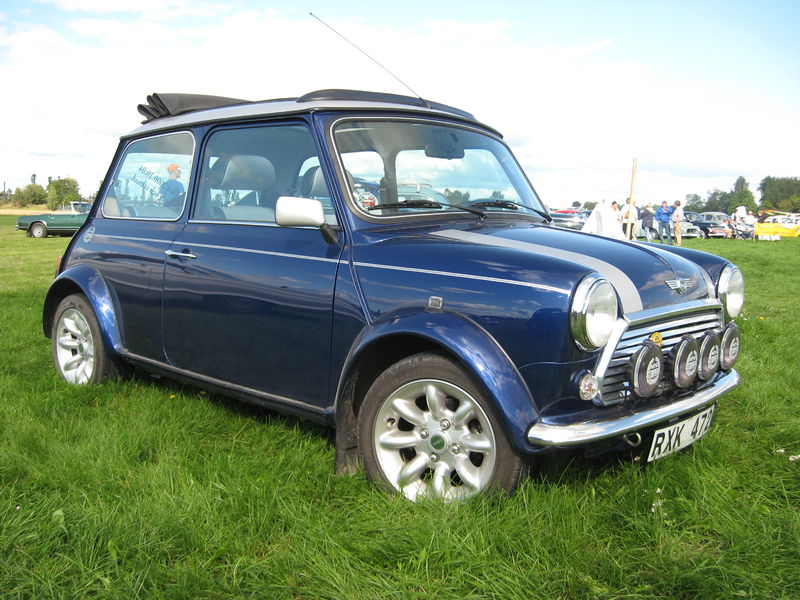
New MINI
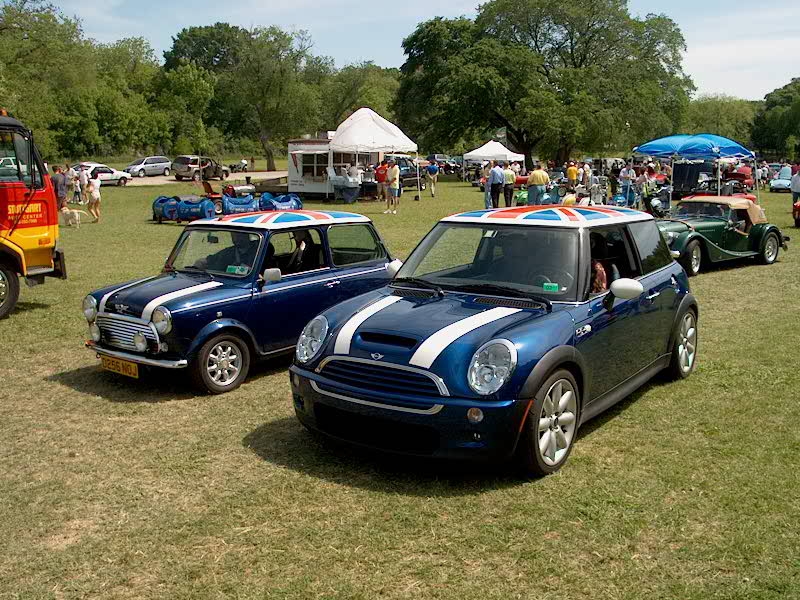
When production of the classic Mini ceased in 2000, BMW (the new owner of the brand) announced the successor to the Mini—which is variously called the "BMW MINI" or the "New MINI". The brand name for the new car is MINI (written in capital letters).

The new MINI is larger than the classic Mini. It is around 55 centimetres (22 in) longer, 30 centimetres (12 in) wider, weighing 1,050 kg (2,315 lb) rather than 650 kg (1,433 lb). It is now classified as compact car rather than supermini car.[citation needed]
On 3 April 2007, the one millionth MINI rolled out of the Oxford Plant after six years of production, just one month longer than it took the classic Mini to reach the same total in March 1965.