


Modern Assault Rifles
M16A1

M16A1 with heavy barrel

M16A1 with 40mm M203 grenade launcher attached
The M16 is still a general-issue rifle with the US Armed forces. It is also widely used by the US Law Enforcement agencies, either in military form (for example, the LAPD had some M16s, retired from Army), or in "civilian" semi-automatic only form. The AR-15 style rifles are made in the USA by at least dozen large companies, such as Armalite, Bushmaster, Colt, FN Manufacturing, Hesse, Les Baer, Olympic, Wilson Combat, and by number of smaller companies, many of which do assembly their rifles from components made by some other major manufacturers. M16-type rifles also manufactured outside of the USA, most notably in the Canada, by Diemaco Co. China also makes some AR-15 type rifles at NORINCO state factories. M16 rifles are used by many foreign military groups, most notably the British SAS, who preferred the M16 over the infamous L85A1 rifle, and by many others.
At the present time almost all initial flaws of the M16 are bugged out, and it is considered among the best assault rifles in the world. While its reliability in the harsh conditions cannot match reliability of its main rival, the Kalashnikov AK-47 and AK-74, it is still a quite reliable rifle, especially when well maintained. It is also comfortable to fire and quite accurate.
Caliber : 5.56x45mm (.223 Remington), M193
Action : gas operated, rotating bolt
Weight, empty / loaded w. 30 rounds : 2.89 kg / 3.6 kg
Magazine capacity : 20 or 30 rounds standard
Maximum effective range : 460 meters
Kalashnikov AK-74(Russia)

AK-74 5.45mm assault rifle

AK-74M with GP-30 40mm grenade launcher installed
The idea of the reduced caliber ammunition for military shoulder arms was played with for a very long time. Each time the technology leaped forward, the standard calibers were reduced - from the 0.45 - 0.50 inch (11.4 - 12.7mm) of the mid-1800 to the .30 of the mid-1900s. The idea of further reduction of the caliber down to 6.5 - 5.6 mm (.240 - .220 inch) was also considered in many countries since the beginning of the XX century, but it was not until the 1960s when the idea of the low impulse, small-caliber, high velocity round came up to something real. When US Army adopted the M16 rifle in the mid-1960s, everybody else eyed Americans with interest. And as soon as the idea of small caliber rifle was found worthwhile, the total rearming began.
Soviet army started the development of its own small-caliber ammunition in the early 1960s. After some years of development, a new round was created. This round featured a bottlenecked, tapered case 39mm long made of steel, loaded with slim, relatively long bullet with nominal caliber of 5.45mm (actual bullet diameter is 5.62 mm). The bullet featured a combined steel and lead core with the hollow nose, muzzle velocity from the 415mm barrel was about 900 m/s. It must be noted that the new 5.45mm ammunition featured a new case of smaller diameter (compared to 7.62x39 M43 cartridges); this allowed for lighter round and also solved the problem of loading of the 7.62mm ammunition into the 5.45mm weapon by mistake (which otherwwise might result in a catastrophical failure of the weapon).
As soon as the new ammunition was available and accepted by the Soviet Military, it was decided to develop a new family of small arms around this cartridge, and an official requirements for new family of small arms were issued to all development organizations in 1966. Trials of new weapons commenced in 1968, and it must be note that most rifles, submitted for trials, were of highly advanced designs, as the main goal of the new weapon was to significantly improve hits probability (compared to 7.62mm AKM rifles). Most weapons were build using so called "balanced action", in which additional mass is added to the action to counter-recoil synchronously with the bolt group, to minimize its effect on the gun stability. About the only weapon of the more or less conventional design was the entry by Kalashnikov team - this was more or less the old AKM rifle, adapted for new 5.45mm ammunition.
Caliber : 5.45x39 mm
Action : Gas operated, rotating bolt with 2 lugs
Weight, empty : 3.07 kg
Magazine capacity : 30 rounds standard
FN F2000 assault rifle (Belgium)

FN F2000 assault rifle, in standard configuration, with telescope sight

FN F2000 assault rifle, with telescope sight and 40mm FN EGLM grenade launcher
During the late 1980s and early 1990s famous Belgian company FN Herstal began the search for its next entry into the assault rifle world. The aim this time was to produce a modern, modular weapon, and this ultimately resulted in the FN F2000 rifle, which was first displayed in public in 2001. The F2000 offers all of the most popular features of the modern assault rifle, such as a compact bullpup layout, completely ambidextrous handling, and a modular design with plenty of options and add-ons already available, which allow the rifle to be “tailored” for any particular mission or tactical situation. For example, for peacekeeping operations F2000 could be fitted with less-lethal M303 underbarrel module, which fires tear gas or marker projectiles using pre-compressed air. On the other hand, the F2000 could be fitted with various 40 mm FN EGLM grenade launchers and a proprietary computerized fire control system, instead of the standard low-magnification optical sights. So far FN F2000 rifle found only few buyers, including Armed forces of Slovenia and Belgian Special operations forces. Nevertheless, it is one of most promising assault rifles on the market.
Quite recently FN also introduced a civilian version of F2000, known as FS2000. It has a somewhat longer barrel and is limited to semi-automatic fire. Otherwise it is the same excellent weapon, with great ergonomics and 100% ambidexterity.
Caliber : 5.56x45 mm NATO
Action : Gas operated, rotating bolt
Weight : 3.6 kg empty, in standart configuration;
4.6 kg with 40mm grenade launcher
Magazine capacity: 30 rounds (any NATO / STANAG type magazines)
FN SCAR (Belgium)

FN SCAR-L / Mk.16 rifle prototype (1s generation, late 2004), left side view

FN SCAR-L / Mk.16 rifle, 2nd generation prototype, with FN EGLM 40mm grenade launcher attached
The US Special Operations Command (US SOCOM) issued a solicitation for the procurement of SOF Combat Assault Rifles (SCAR) on October 15th, 2003. This solicitation requested a new combat rifle, specially tailored for the current and proposed future needs of the US Special Forces, which are somewhat different from latest generic US Army requirements, which are being fulfilled by the newest Heckler-Koch XM8 assault rifle. The key difference in basic requirements between XM8 and SCAR is that, while XM8 is a single-caliber weapon system, tailored for 5.56x45mm NATO ammunition, the SCAR should be available in various different calibers. Initial SOF requirements included two basic versions of SCAR system - the SCAR Light (SCAR-L), available in 5.56mm NATO, and the SCAR heavy (SCAR-H), which should be initially available in significantly more powerful 7.62x51 NATO chambering, and should be easily adaptable in the field to other chamberings. These other chamberings initially include the well-spread 7.62x39 M43 ammunition of the Soviet / Russian origins, and probably some others (like the proposed 6.8x43 Remington SPC cartridge, especially developed for US Special Forces). The key idea of SCAR rifle system is that it will provide the Special Forces operators with wide variety of options, from short-barreled 5.56mm SCAR-L CQC variation, tailored for urban close combat, and up to long range 7.62x51 SCAR-H Sniper variant, as well as 7.62x39 SCAR-H, which will accept "battlefield pickup" AK-47/AKM magazines with 7.62 M43 ammunition, available during the operations behind the enemy lines. Both SCAR-L and SCAR-H shall be initially available in three versions, Standard (S), Close Quarters Combat (CQC) and Sniper Variant (SV; now it is dubbed Long Barrel - LB). All these variants, regardless the caliber and exact configuration, will provide the operator with the same controls layout, same handling and maintenance procedures, and same optional equipment, such as sights, scopes, and other current and future attachments.
Caliber :5.56x45 NATO 7.62x51 NATO basic
Weight :3.5 kg empty 3.86 kg empty
Magazine capacity :30 rounds standard 20 rounds (7.62x51 NATO)
30 rounds (7.62x39 M43)
GIAT FAMAS assault rifle (France)

FAMAS F1 (original version). Note original straight FAMAS magazine that holds 25 rounds

FAMAS rifle stripped into major components
FAMAS stands for Fusil d'Assaut de la Manufacture d'Armes de St-Etienne (Assault Rifle by St-Etienne Arms Factory - a member of the French govt. owned GIAT Industries concern). Development of this rifle began in 1967, under the leadership of the Paul Tellie, a French arms designer. This new rifle was intended to replace in service the MAS Mle.49/56 semi-automatic rifles, MAT-49 submachine guns and some MAC Mle.1929 light machine guns. First FAMAS prototype had been built in 1971. French military began to test this rifle in 1972-73, but, in the meantime, France adopted a Swiss-designed SIG SG-540 5.56mm assault rifle as an intermediate solution. FAMAS rifle was adopted by the French in 1978 and since then became a standard French Army shoulder fired small arm, known among the French soldiers as "Le Clairon" (the bulge). According to the Janes Infantry Weapons 2000, the total number of FAMAS F1 rifles built is estimated at 400 000, and the production of the F1 variant is now completed. It is still used by the French army, and was exported in small numbers to some countries like the Senegal or United Arab Emirates. Since then, the GIAT Industries developed an improved version of the F1, known as the G1. This rifle featured an enlarged trigger guard, that covered a whole hand, and a slightly improved plastic handguards. G1 was an intermediate design, and was consequently replaced by the latest production model, the FAMAS G2, which appeared circa 1994. This rifle has the G1-style enlarged trigger guard but can accept only STANAG type (M16-compatible) magazines. It was adopted and purchased by the French Navy in the 1995, with the French Army soon following the suit, and also offered for export. At the present time the slightly upgraded FAMAS G2 rifle is used as a platform for the future FELIN system (a French counterpart to the US "Land Warrior" programme), which incorporates a various electronic sights and sensors, connected to the soldier carried equipment, like the helmet mounted displays, ballistic and tactical computers etc. GIAT also now offers some variations of the basic FAMAS G2 rifle, such as "Submachine gun" with shortened receiver and barrel of 320 mm long, "Commando" with the standard receiver and the 405 mm barrel, and the "Sniper", with longer and heavier 620 mm barrel and an integral scope mount instead of the carrying handle.
Caliber : 5.56mm NATO (.223rem)
Action : Delayed blowback
Weight : 3.61 kg with empty magazine 3.8 kg with
empty magazine
Magazine capacity : 25 rounds (proprietary) 30 rounds (STANAG)
Effective range : 300 meters 450 meters
XM8 Lightweight Assault Rifle (USA)

XM8 rifle in basic infantry configuration, as displayed in January, 2004, at the ShotShow-04 in USA

XM8 rifle in Compact (SMG / PDW) configuration, with shortened barrel.
The development of the XM8 Lightweight Assault Rifle was initiated by US Army in the 2002, when contract was issued to the Alliant Techsystems Co of USA to study possibilities of development of kinetic energy part of the XM29 OICW weapon into separate lightweight assault rifle, which could, in the case of success, replace the aging M16A2 rifles and M4A1 carbines in US military service. XM8 is being developed by the Heckler-Koch USA, a subsidiary of famous German Heckler-Koch company. According to the present plans, the XM8 should enter full production circa 2005, if not earlier, several years before the XM29 OICW. The XM8 (M8 after its official adoption) should become a standard next generation US forces assault rifle. It will fire all standard 5.56mm NATO ammunition, and, to further decrease the load on the future infantrymen, a new type of 5.56mm ammunition is now being developed. This new ammunition will have composite cases, with brass bases and polymer walls, which will reduce weight of the complete ammunition, while maintaining compatibility with all 5.56mm NATO weapons. Along with 20% weight reduction in the XM8 (compared to the current issue M4A1 carbine), this will be a welcome move for any infantryman, already overloaded by protective, communications and other battle equipment.
Caliber : 5.56x45 mm NATO
Action : Gas operated, rotating bolt
Weight : 2.659 kg empty in basic configuration
Magazine capacity: 30 rounds (STANAG) or 100-rounds double
drum in Automatic Rifle/SAW role
Bushmaster ACR (USA)
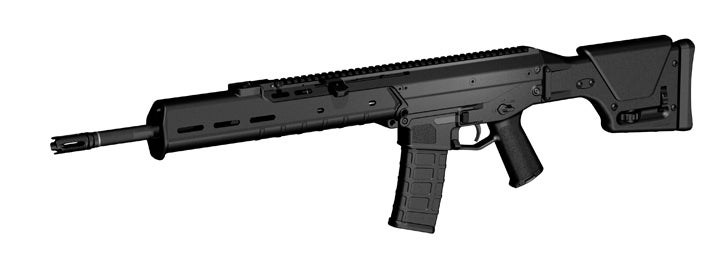

The Bushmaster Adaptive Combat Rifle (ACR) is the production name for an updated version of the Masada Adaptive Combat Weapon System. In late January 2008, Bushmaster entered into a licensing agreement with Magpul whereby Bushmaster would take over production, future development and sales of the Masada. It is a patent pending self-loading rifle platform designed by Magpul Industries of Erie, Colorado. The rifle was initially developed over a period of four months, completely independent of government funding. Prototypes were displayed at the 2007 SHOT Show in Orlando, Florida. Originally scheduled for release in the second quarter of 2008, Bushmaster announced on May 16, 2008, that the consumer release would be delayed until Q1 2009, due to a focus on military projects. On November 18, 2008, Bushmaster released a statement saying, "The ACR is being redesigned to be a superior offering to compete for the next generation US Army infantry carbine and subcompact weapon requirement and will be available to select customers in 2009." The ACR was one of the weapons displayed to U.S. Army officials during an invitation-only Industry Day on November 13, 2008. The goal of the Industry Day was to review current carbine technology prior to writing formal requirements for a future replacement for the M4 Carbine.
Cartridge :5.56x45mm NATO, 6.8 mm Remington SPC,
7.62x39mm M43
Action :Gas-operated, rotating bolt
Effective range :300-600 m (328-656 yd), depending
on configuration
Magazine capacity : Feed system 30-round detachable box (5.56
variant) magazine, staggered-column
magazine (STANAG compatible)
M16A1

M16A1 with heavy barrel

M16A1 with 40mm M203 grenade launcher attached
The M16 is still a general-issue rifle with the US Armed forces. It is also widely used by the US Law Enforcement agencies, either in military form (for example, the LAPD had some M16s, retired from Army), or in "civilian" semi-automatic only form. The AR-15 style rifles are made in the USA by at least dozen large companies, such as Armalite, Bushmaster, Colt, FN Manufacturing, Hesse, Les Baer, Olympic, Wilson Combat, and by number of smaller companies, many of which do assembly their rifles from components made by some other major manufacturers. M16-type rifles also manufactured outside of the USA, most notably in the Canada, by Diemaco Co. China also makes some AR-15 type rifles at NORINCO state factories. M16 rifles are used by many foreign military groups, most notably the British SAS, who preferred the M16 over the infamous L85A1 rifle, and by many others.
At the present time almost all initial flaws of the M16 are bugged out, and it is considered among the best assault rifles in the world. While its reliability in the harsh conditions cannot match reliability of its main rival, the Kalashnikov AK-47 and AK-74, it is still a quite reliable rifle, especially when well maintained. It is also comfortable to fire and quite accurate.
Caliber : 5.56x45mm (.223 Remington), M193
Action : gas operated, rotating bolt
Weight, empty / loaded w. 30 rounds : 2.89 kg / 3.6 kg
Magazine capacity : 20 or 30 rounds standard
Maximum effective range : 460 meters
Kalashnikov AK-74(Russia)

AK-74 5.45mm assault rifle

AK-74M with GP-30 40mm grenade launcher installed
The idea of the reduced caliber ammunition for military shoulder arms was played with for a very long time. Each time the technology leaped forward, the standard calibers were reduced - from the 0.45 - 0.50 inch (11.4 - 12.7mm) of the mid-1800 to the .30 of the mid-1900s. The idea of further reduction of the caliber down to 6.5 - 5.6 mm (.240 - .220 inch) was also considered in many countries since the beginning of the XX century, but it was not until the 1960s when the idea of the low impulse, small-caliber, high velocity round came up to something real. When US Army adopted the M16 rifle in the mid-1960s, everybody else eyed Americans with interest. And as soon as the idea of small caliber rifle was found worthwhile, the total rearming began.
Soviet army started the development of its own small-caliber ammunition in the early 1960s. After some years of development, a new round was created. This round featured a bottlenecked, tapered case 39mm long made of steel, loaded with slim, relatively long bullet with nominal caliber of 5.45mm (actual bullet diameter is 5.62 mm). The bullet featured a combined steel and lead core with the hollow nose, muzzle velocity from the 415mm barrel was about 900 m/s. It must be noted that the new 5.45mm ammunition featured a new case of smaller diameter (compared to 7.62x39 M43 cartridges); this allowed for lighter round and also solved the problem of loading of the 7.62mm ammunition into the 5.45mm weapon by mistake (which otherwwise might result in a catastrophical failure of the weapon).
As soon as the new ammunition was available and accepted by the Soviet Military, it was decided to develop a new family of small arms around this cartridge, and an official requirements for new family of small arms were issued to all development organizations in 1966. Trials of new weapons commenced in 1968, and it must be note that most rifles, submitted for trials, were of highly advanced designs, as the main goal of the new weapon was to significantly improve hits probability (compared to 7.62mm AKM rifles). Most weapons were build using so called "balanced action", in which additional mass is added to the action to counter-recoil synchronously with the bolt group, to minimize its effect on the gun stability. About the only weapon of the more or less conventional design was the entry by Kalashnikov team - this was more or less the old AKM rifle, adapted for new 5.45mm ammunition.
Caliber : 5.45x39 mm
Action : Gas operated, rotating bolt with 2 lugs
Weight, empty : 3.07 kg
Magazine capacity : 30 rounds standard
FN F2000 assault rifle (Belgium)

FN F2000 assault rifle, in standard configuration, with telescope sight

FN F2000 assault rifle, with telescope sight and 40mm FN EGLM grenade launcher
During the late 1980s and early 1990s famous Belgian company FN Herstal began the search for its next entry into the assault rifle world. The aim this time was to produce a modern, modular weapon, and this ultimately resulted in the FN F2000 rifle, which was first displayed in public in 2001. The F2000 offers all of the most popular features of the modern assault rifle, such as a compact bullpup layout, completely ambidextrous handling, and a modular design with plenty of options and add-ons already available, which allow the rifle to be “tailored” for any particular mission or tactical situation. For example, for peacekeeping operations F2000 could be fitted with less-lethal M303 underbarrel module, which fires tear gas or marker projectiles using pre-compressed air. On the other hand, the F2000 could be fitted with various 40 mm FN EGLM grenade launchers and a proprietary computerized fire control system, instead of the standard low-magnification optical sights. So far FN F2000 rifle found only few buyers, including Armed forces of Slovenia and Belgian Special operations forces. Nevertheless, it is one of most promising assault rifles on the market.
Quite recently FN also introduced a civilian version of F2000, known as FS2000. It has a somewhat longer barrel and is limited to semi-automatic fire. Otherwise it is the same excellent weapon, with great ergonomics and 100% ambidexterity.
Caliber : 5.56x45 mm NATO
Action : Gas operated, rotating bolt
Weight : 3.6 kg empty, in standart configuration;
4.6 kg with 40mm grenade launcher
Magazine capacity: 30 rounds (any NATO / STANAG type magazines)
FN SCAR (Belgium)

FN SCAR-L / Mk.16 rifle prototype (1s generation, late 2004), left side view

FN SCAR-L / Mk.16 rifle, 2nd generation prototype, with FN EGLM 40mm grenade launcher attached
The US Special Operations Command (US SOCOM) issued a solicitation for the procurement of SOF Combat Assault Rifles (SCAR) on October 15th, 2003. This solicitation requested a new combat rifle, specially tailored for the current and proposed future needs of the US Special Forces, which are somewhat different from latest generic US Army requirements, which are being fulfilled by the newest Heckler-Koch XM8 assault rifle. The key difference in basic requirements between XM8 and SCAR is that, while XM8 is a single-caliber weapon system, tailored for 5.56x45mm NATO ammunition, the SCAR should be available in various different calibers. Initial SOF requirements included two basic versions of SCAR system - the SCAR Light (SCAR-L), available in 5.56mm NATO, and the SCAR heavy (SCAR-H), which should be initially available in significantly more powerful 7.62x51 NATO chambering, and should be easily adaptable in the field to other chamberings. These other chamberings initially include the well-spread 7.62x39 M43 ammunition of the Soviet / Russian origins, and probably some others (like the proposed 6.8x43 Remington SPC cartridge, especially developed for US Special Forces). The key idea of SCAR rifle system is that it will provide the Special Forces operators with wide variety of options, from short-barreled 5.56mm SCAR-L CQC variation, tailored for urban close combat, and up to long range 7.62x51 SCAR-H Sniper variant, as well as 7.62x39 SCAR-H, which will accept "battlefield pickup" AK-47/AKM magazines with 7.62 M43 ammunition, available during the operations behind the enemy lines. Both SCAR-L and SCAR-H shall be initially available in three versions, Standard (S), Close Quarters Combat (CQC) and Sniper Variant (SV; now it is dubbed Long Barrel - LB). All these variants, regardless the caliber and exact configuration, will provide the operator with the same controls layout, same handling and maintenance procedures, and same optional equipment, such as sights, scopes, and other current and future attachments.
Caliber :5.56x45 NATO 7.62x51 NATO basic
Weight :3.5 kg empty 3.86 kg empty
Magazine capacity :30 rounds standard 20 rounds (7.62x51 NATO)
30 rounds (7.62x39 M43)
GIAT FAMAS assault rifle (France)

FAMAS F1 (original version). Note original straight FAMAS magazine that holds 25 rounds

FAMAS rifle stripped into major components
FAMAS stands for Fusil d'Assaut de la Manufacture d'Armes de St-Etienne (Assault Rifle by St-Etienne Arms Factory - a member of the French govt. owned GIAT Industries concern). Development of this rifle began in 1967, under the leadership of the Paul Tellie, a French arms designer. This new rifle was intended to replace in service the MAS Mle.49/56 semi-automatic rifles, MAT-49 submachine guns and some MAC Mle.1929 light machine guns. First FAMAS prototype had been built in 1971. French military began to test this rifle in 1972-73, but, in the meantime, France adopted a Swiss-designed SIG SG-540 5.56mm assault rifle as an intermediate solution. FAMAS rifle was adopted by the French in 1978 and since then became a standard French Army shoulder fired small arm, known among the French soldiers as "Le Clairon" (the bulge). According to the Janes Infantry Weapons 2000, the total number of FAMAS F1 rifles built is estimated at 400 000, and the production of the F1 variant is now completed. It is still used by the French army, and was exported in small numbers to some countries like the Senegal or United Arab Emirates. Since then, the GIAT Industries developed an improved version of the F1, known as the G1. This rifle featured an enlarged trigger guard, that covered a whole hand, and a slightly improved plastic handguards. G1 was an intermediate design, and was consequently replaced by the latest production model, the FAMAS G2, which appeared circa 1994. This rifle has the G1-style enlarged trigger guard but can accept only STANAG type (M16-compatible) magazines. It was adopted and purchased by the French Navy in the 1995, with the French Army soon following the suit, and also offered for export. At the present time the slightly upgraded FAMAS G2 rifle is used as a platform for the future FELIN system (a French counterpart to the US "Land Warrior" programme), which incorporates a various electronic sights and sensors, connected to the soldier carried equipment, like the helmet mounted displays, ballistic and tactical computers etc. GIAT also now offers some variations of the basic FAMAS G2 rifle, such as "Submachine gun" with shortened receiver and barrel of 320 mm long, "Commando" with the standard receiver and the 405 mm barrel, and the "Sniper", with longer and heavier 620 mm barrel and an integral scope mount instead of the carrying handle.
Caliber : 5.56mm NATO (.223rem)
Action : Delayed blowback
Weight : 3.61 kg with empty magazine 3.8 kg with
empty magazine
Magazine capacity : 25 rounds (proprietary) 30 rounds (STANAG)
Effective range : 300 meters 450 meters
XM8 Lightweight Assault Rifle (USA)

XM8 rifle in basic infantry configuration, as displayed in January, 2004, at the ShotShow-04 in USA

XM8 rifle in Compact (SMG / PDW) configuration, with shortened barrel.
The development of the XM8 Lightweight Assault Rifle was initiated by US Army in the 2002, when contract was issued to the Alliant Techsystems Co of USA to study possibilities of development of kinetic energy part of the XM29 OICW weapon into separate lightweight assault rifle, which could, in the case of success, replace the aging M16A2 rifles and M4A1 carbines in US military service. XM8 is being developed by the Heckler-Koch USA, a subsidiary of famous German Heckler-Koch company. According to the present plans, the XM8 should enter full production circa 2005, if not earlier, several years before the XM29 OICW. The XM8 (M8 after its official adoption) should become a standard next generation US forces assault rifle. It will fire all standard 5.56mm NATO ammunition, and, to further decrease the load on the future infantrymen, a new type of 5.56mm ammunition is now being developed. This new ammunition will have composite cases, with brass bases and polymer walls, which will reduce weight of the complete ammunition, while maintaining compatibility with all 5.56mm NATO weapons. Along with 20% weight reduction in the XM8 (compared to the current issue M4A1 carbine), this will be a welcome move for any infantryman, already overloaded by protective, communications and other battle equipment.
Caliber : 5.56x45 mm NATO
Action : Gas operated, rotating bolt
Weight : 2.659 kg empty in basic configuration
Magazine capacity: 30 rounds (STANAG) or 100-rounds double
drum in Automatic Rifle/SAW role
Bushmaster ACR (USA)
The Bushmaster Adaptive Combat Rifle (ACR) is the production name for an updated version of the Masada Adaptive Combat Weapon System. In late January 2008, Bushmaster entered into a licensing agreement with Magpul whereby Bushmaster would take over production, future development and sales of the Masada. It is a patent pending self-loading rifle platform designed by Magpul Industries of Erie, Colorado. The rifle was initially developed over a period of four months, completely independent of government funding. Prototypes were displayed at the 2007 SHOT Show in Orlando, Florida. Originally scheduled for release in the second quarter of 2008, Bushmaster announced on May 16, 2008, that the consumer release would be delayed until Q1 2009, due to a focus on military projects. On November 18, 2008, Bushmaster released a statement saying, "The ACR is being redesigned to be a superior offering to compete for the next generation US Army infantry carbine and subcompact weapon requirement and will be available to select customers in 2009." The ACR was one of the weapons displayed to U.S. Army officials during an invitation-only Industry Day on November 13, 2008. The goal of the Industry Day was to review current carbine technology prior to writing formal requirements for a future replacement for the M4 Carbine.
Cartridge :5.56x45mm NATO, 6.8 mm Remington SPC,
7.62x39mm M43
Action :Gas-operated, rotating bolt
Effective range :300-600 m (328-656 yd), depending
on configuration
Magazine capacity : Feed system 30-round detachable box (5.56
variant) magazine, staggered-column
magazine (STANAG compatible)


