


Nvidia is officially announcing its RTX 40-series GPUs today. After months of rumors and some recent teasing from Nvidia, the RTX 4090 and RTX 4080 are now both official. The RTX 4090 arrives on October 12th priced at $1,599, with the RTX 4080 priced starting at $899 and available in November. Both are powered by Nvidia’s next-gen Ada Lovelace architecture.
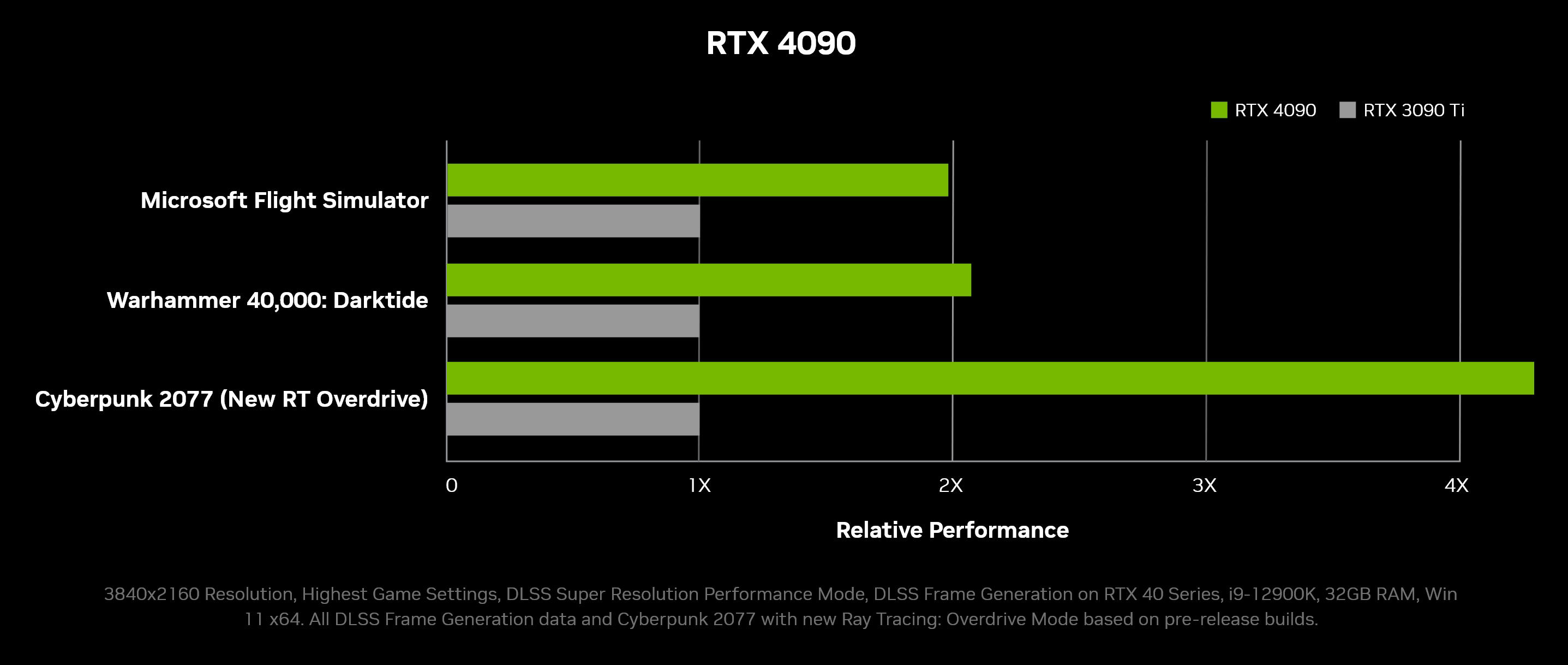
The RTX 4090 is the top-end card for the Lovelace generation. It will ship with a massive 24GB of GDDR6X memory. Nvidia claims it’s 2–4x faster than the RTX 3090 Ti, and it will consume the same amount of power as that previous generation card. Nvidia recommends a power supply of at least 850 watts based on a PC with a Ryzen 5900X processor.
Inside the giant RTX 4090, there are 16,384 CUDA Cores, a base clock of 2.23GHz that boosts up to 2.52GHz, 1,321 Tensor-TFLOPs, 191 RT-TFLOPs, and 83 Shader-TFLOPs.

Nvidia is actually offering the RTX 4080 in two models, one with 12GB of GDDR6X memory and another with 16GB of GDDR6X memory, and Nvidia claims it’s 2–4x faster than the existing RTX 3080 Ti. The 12GB model will start at $899 and include 7,680 CUDA Cores, 7,680 CUDA Cores, a 2.31GHz base clock that boosts up to 2.61GHz, 639 Tensor-TFLOPs, 92 RT-TFLOPs, and 40 Shader-TFLOPs.
The 16GB model of the RTX 4080 isn’t just a bump to memory, though. Priced starting at $1,199, it’s more powerful, with 9,728 CUDA Cores, a base clock of 2.21GHz that boosts up to 2.51GHz, 780 Tensor-TFLOPs, 113 RT-TFLOPs, and 49 Shader-TFLOPs of power. The 12GB RTX 4080 model will require a 700-watt power supply, with the 16GB model needing at least 750 watts. Both RTX 4080 models will launch in November.
More
Nvidia Announcement
DLSS 3
Huang also announced NVIDIA DLSS 3 — the next revolution in the company’s Deep Learning Super Sampling neural-graphics technology for games and creative apps. The AI-powered technology can generate entire frames for massively faster game play. It can overcome CPU performance limitations in games by allowing the GPU to generate entire frames independently.
The technology is coming to the world’s most popular game engines, such as Unity and Unreal Engine, and has received support from many of the world’s leading game developers, with more than 35 games and apps coming soon.
Additionally, the RTX 40 Series GPUs feature a range of new technological innovations, including:
- Streaming multiprocessors with up to 83 teraflops of shader power — 2x over the previous generation.
- Third-generation RT Cores with up to 191 effective ray-tracing teraflops — 2.8x over the previous generation.
- Fourth-generation Tensor Cores with up to 1.32 Tensor petaflops — 5x over the previous generation using FP8 acceleration.
- Shader Execution Reordering (SER) that improves execution efficiency by rescheduling shading workloads on the fly to better utilize the GPU’s resources. As significant an innovation as out-of-order execution was for CPUs, SER improves ray-tracing performance up to 3x and in-game frame rates by up to 25%.
- Ada Optical Flow Accelerator with 2x faster performance allows DLSS 3 to predict movement in a scene, enabling the neural network to boost frame rates while maintaining image quality.
- Architectural improvements tightly coupled with custom TSMC 4N process technology results in an up to 2x leap in power efficiency.
- Dual NVIDIA Encoders (NVENC) cut export times by up to half and feature AV1 support. The NVENC AV1 encode is being adopted by OBS, Blackmagic Design DaVinci Resolve, Discord and more.



Last edited:


