


Owath Wadada........!

----------------------------------
---------------------------------
---------------------------------
--------------------------------
Real ........................
--------------------------------
----------------------------
-------------------------------
[FONT=Verdana, Arial]Mil Mi-26[/FONT][FONT=Verdana, Arial]
[SIZE=+2]1977[/SIZE][/FONT]
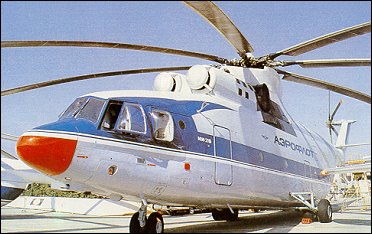
[FONT=Verdana, Arial][SIZE=-1] The Mi-26, which was seen in public for the first time at the 1981 Paris Air Show, is the result of a specification issued at the beginning of the seventies for a transport helicopter whose empty weight, without fuel, was not to exceed half the maximum take-off weight. It first flew on 14 December 1977 and has two very powerful turbine engines driving a big eight-blade rotor, and a large cargo hold 3.20m wide, 3.15m high and 15m deep with two winches on overhead rails, each capable of lifting 2.5 tonnes. Access to the hold is through a hydraulically-actuated rear loading ramp. The maximum payload is 5000kg or 70-100 passengers. The helicopter has a crew of four, with room for an additional handler, and has a full range of navigational electronics and an automatic hover system. [/SIZE][/FONT]
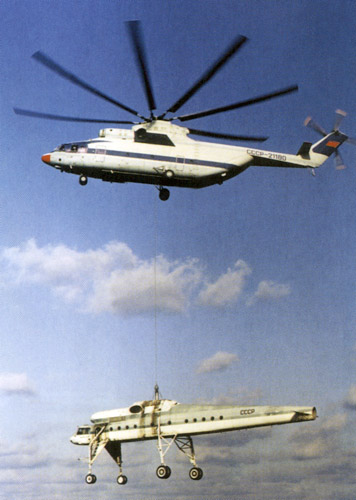
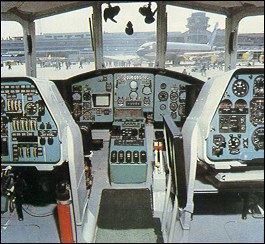 [FONT=Verdana, Arial][SIZE=-1] Except for the V-12 prototypes that preceded it, the Mil Mi-26 'Halo' is the heaviest helicopter to have flown to date. Designed to provide Aeroflot with a heavylift helicopter to assist in the exploitation of undeveloped regions, this aircraft began life in the early 1970s, as soon as it became clear that the V-12 was not going to fulfil this role. It required the costly and time-consuming design and development of a completely new rotor and transmission system, which was precisely why the Mil bureau had arrived at the configuration of the V-12. As a result the design, development and testing of a suitable dynamic system, plus the need to meet an official requirement that the aircraft's empty weight should be only half that of its maximum take-off weight, meant that it was not until 14 December 1977 that the V-26 prototype achieved its first hovering flight. Of similar overall configuration to the Mil Mi-6 heavylift helicopter, and with a fuselage of similar dimensions, the Mi-26 has a smaller-diameter (but eight-bladed) main rotor and powerplant of almost double the output, enabling it to carry 66% more payload than the Mi-6. This was demonstrated effectively on 3 February 1982 when, as just one of a string of new records established by the Mi-26, this new helicopter lifted a total mass (helicopter plus pay-load) of 56768.8kg to a height of 2000m. [/SIZE][/FONT]
[FONT=Verdana, Arial][SIZE=-1] Development of the 'Halo' was completed in 1983 and the type was in civil and military service by 1985, since when about 70 have been built. The production model carries a crew of five, and up to 85 combat-equipped troops, or two airborne infantry combat vehicles. A new version is reported to be under development to replace the 'Hook' in the command support role, with uprated engines, composite rotor blades and maximum payload increased to 22000kg. [/SIZE][/FONT]
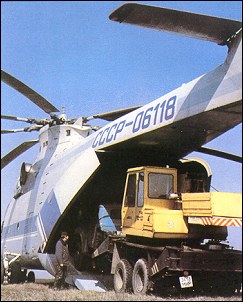 [FONT=Verdana, Arial][SIZE=-1]By far largest helicopter ever built, this was unusual extrapolation of Mi-6 a decade later to match greater fixed-wing airlift of An-22 and Il-76. To avoid immense task of developing new set of rotors, reduction gears and transmission, decision taken to double up Mi-6 dynamics and use two sets of Mi-6 engines, gearboxes and lifting rotors side-by-side, left rotor being mirror image, with small overlap. Rotor rpm reduced to 112; gearboxes linked by transverse shafting. Axes inclined forwards 4°30'. Engine/rotor groups carried on wings of light-alloy stressed-skin construction with 8° dihedral, sharp inverse taper and set at incidence 7° root 14° tip. Braced at root and tip to main landing gears with torque reacted by horizontal bracing to rear fuselage. Inner/outer trailing-edge flaps fixed in outer wings and two external tanks; optional ferry tanks in cabin. Fixed twin-wheel landing gear with main tyres 1750 x 730mm, pneumatic brakes, and steerable nose tyres 1200 x 450mm. Large stressed-skin fuselage with crew door each side, three sliding side doors and full-section rear clamshell doors and ramp with left/right twin-wheel ventral bumpers. Aeroplane tail with fin, tabbed rudder, dihedralled tailplane with tabbed elevators, and endplate fins mounted vertically but toed inwards. Flight deck for pilot (left) with engineer behind and co-pilot (right) with elec-syst operator behind. Upper flight deck for nav with radio operator behind. Hydraulic flight control with emergency manual reversion. Autopilot with three-axis autostab; mapping radar under nose. AI-8 turbine APU for ground power and engine start. Main cabin 28.15m long, 4.4m square. Overhead gantry crane with four 1t hoists. Tip-up seats along sides (50 to 120). [/SIZE][/FONT]
[FONT=Verdana, Arial][SIZE=-1]First hover 1967 terminated by impact with ground causing severe damage; cause coincidence of primary airframe aeroelastic freq with natural freq of control system, causing uncontrollable vertical oscillations. Second (21142, now at Monino) flown by V.P.Koloshchyenko Aug 1969 to 2255m with payload of 40204.5kg; NII tests completed and demos at Paris, but abandoned because Mi-26 far superiour. ASCC name "Homer". [/SIZE][/FONT]
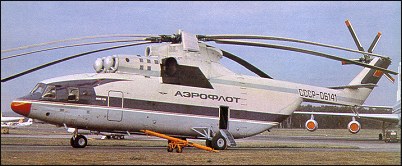 [FONT=Verdana, Arial][SIZE=-1]TYPE: Heavy-lift helicopter. [/SIZE][/FONT]
[FONT=Verdana, Arial][SIZE=-1]PROGRAMME: Development started early 1970s (initially as Mi-6M); aim was payload capability 1.5 to 2 times greater than that of any previous production helicopter; first prototype flew 14 December 1977; first production aircraft rolled out October 1980; one of several prototype or preproduction Mi-26s (SSSR-06141) displayed at 1981 Paris Air Show; in-field evaluation, probably with military development squadron, began early 1982; fully operational 1983; export deliveries started (to India) June 1986; production continues at low rate, with manufacture and marketing by Rostvertol. [/SIZE][/FONT]
[FONT=Verdana, Arial][SIZE=-1]CURRENT VERSIONS: [/SIZE][/FONT]
[FONT=Verdana, Arial][SIZE=-1]Mi-26 (Izdelie 90): Basic military transport.
Detailed description applies to basic Mi-26, except where indicated. [/SIZE][/FONT]
[FONT=Verdana, Arial][SIZE=-1]Mi-26A: Modified military Mi-26, tested in 1985, with PNK-90 integrated flight/nav systems for automatic approach and descent to critical decision point, and other tasks. Not adopted. [/SIZE][/FONT]
[FONT=Verdana, Arial][SIZE=-1]Mi-26T: Basic civil transport (Izdelie 209), generally as military Mi-26. Production begun in 1985. Variants include Geological Survey Mi-26 towing seismic gear, with tractive force of 10,000kg or more, at 180 to 200km/h at 55 to 100m for up to 3 hours. The mockup of an Mi-26 two-crew flight deck was shown al the 1997 Moscow Air Show and was again displayed at Farnborough 2002, when Rostvertol said decision to install new avionics on helicopter dependent upon outcome of discussions undertaken at Farnborough; if go-ahead is given, new designation Mi-26T2 will apply. New avionics suite will include PNK-26M flight-navigation system, incorporating five colour MFDs, two data input panels and a digital computer, plus GPS receiver and digital map and weather radar; increased automation will eliminate need for navigator/communications operator and flight engineer, although loadmaster will be retained. Military version will be adapted for night operations, using OVN-1 Skosok NVGs and GOES-321 gyrostabilised observation turret, containing a FLIR sensor and a laser range-finder. No designation has been announced for military versions. [/SIZE][/FONT]
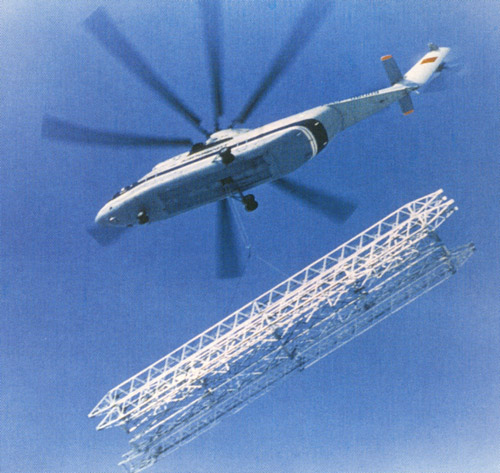
[FONT=Verdana, Arial][SIZE=-1]Mi-26TS (sertifitsywvannyi: certified): Mi-26T (Izdelie 219), but prepared for certification and marketed (in West as Mi-26TC) from 1996. Preproduction version, with gondola (port, front), positioned a 16,000kg TV tower, 30m long, in Rostov-on-Don in 1996. One delivered to Samsung Aerospace Industries in South Korea on 13 Septernher 1997; supplied with Twin Bambi Bucket fire-suppressant system and fulfils dual transport/ firefighting roles. This version is subject of upgrade proposal involving installation of new avionics suite and other improvements that will reduce crew numbers from five to three and offer benefits in area of operational effectiveness; if implemented, is expected to result in improved helicopter becoming available in about 2006. [/SIZE][/FONT]
[FONT=Verdana, Arial][SIZE=-1]Mi-26MS: Medical evacuation version of Mi-26T, typically with intensive care section for four casualties and two medics, surgical section for one casualty and three medics, pre-operating section for two casualties and two medics, ambulance section for five stretcher patients, three seated casualties and two attendants; laboratory; and amenities section with lavatory, washing facilities, food storage and recreation unit. Civil version in use by MChS Rossii (Ministry of Emergency Situations). Alternative medical versions available, with modular box-laboratories or fully equipped medical centres that can be inserted into the hold for anything from ambulance to field hospital use. As field ambulance can accommodate up to 60 stretcher patients; or seven patients in intensive care, 32 patients on stretchers and seven attendants; or 47 patients and eight attendants in other configurations, which can include 12 bunks in four tiers forward, or patent Rostvertol box laboratory behind the first row of bunks, with 16 bunks behind. [/SIZE][/FONT]
[FONT=Verdana, Arial][SIZE=-1]The box includes an operating table, diagnostic equipment, anaesthetic and breathing equipment and other systems. Another configuration includes a larger theatre box by Heinkel Medizin Systeme and 12 stretchers behind, and the helicopter can be fitted with an X-ray laboratory or form the central element of a deployable air-portable field hospital. [/SIZE][/FONT]
[FONT=Verdana, Arial][SIZE=-1]Mi-26NEF-M: ASW version with search radar in undernose faired radome, extra cabin heat exchangers and towed MAD housing mounted on ramp. [/SIZE][/FONT]
[FONT=Verdana, Arial][SIZE=-1]Mi-26P: Transport for 63 passeugers, basically four abreast in airline-type seating, with centre aisle; lavatory, galley and cloakroom aft of flight deck. [/SIZE][/FONT]
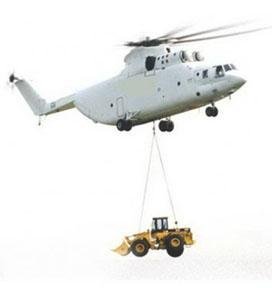
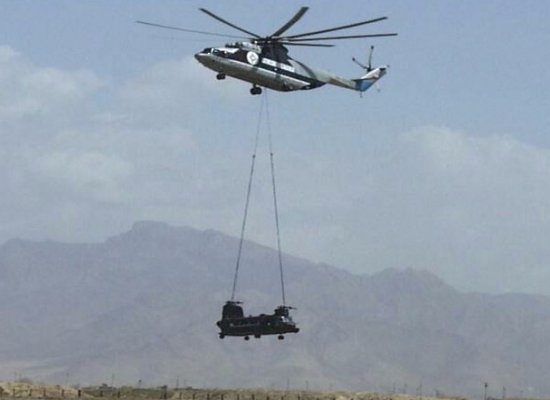
[FONT=Verdana, Arial][SIZE=-1]Mi-26PK: Flying crane (kran) derivative of Mi-26P with operator's gondola on fuselage side, next to cabin door on port side. First produced in 1997. [/SIZE][/FONT]
[FONT=Verdana, Arial][SIZE=-1]Mi-26PP: Reported ECM version. First noted 1986; current status unknown. [/SIZE][/FONT]
[FONT=Verdana, Arial][SIZE=-1]Mi-26S: Hastily developed version for disaster relief tasks following explosion at Chernobyl nuclear facility; equipped with deactivating liquid tank and underbelly spraying apparatus. [/SIZE][/FONT]
[FONT=Verdana, Arial][SIZE=-1]Mi-26TM: Flying crane, with gondola for pilot/sling supervisor under fuselage aft of nosewheels or under rear-loading ramp. First produced in 1992. [/SIZE][/FONT]
[FONT=Verdana, Arial][SIZE=-1]Mi-26TP: Firefighting (pozharnyi) version that appeared in 1994, with internal tanks able to dispense up to 15,000 litres fire retardant from one or two vents, or 17,260 litres of water from an underslung VSU-15 bucket, or from two linked EP-8000 containers. Can fill tanks on the ground using pumps with 3,000 litres/min throughput. Prototype RA-06183 operated by Rostvertol. One delivered to Moscow Fire Brigade on 19 August 1999. [/SIZE][/FONT]
[FONT=Verdana, Arial][SIZE=-1]Mi-26TZ: Tanker version that emerged in 1998, with 14,040 litres of T2, TS1 or R2 aviation fuel or DL, DZ or DA diesel oil fuel and 1,040 litres lubricants (in 52 jerry cans), dispensed through four 60m hoses for aircraft, or 10 20m hoses for ground vehicles. Conversion to/from Mi-26T takes 1 hour 25 minutes for each operation. [/SIZE][/FONT]
[FONT=Verdana, Arial][SIZE=-1]Mi-26M: Upgrade under development; all-GFRP main rotor blades of new aerodynamic configuration, new ZMKB Progress D-127 turboshafts (each 10,700kW), and modified integrated flight/nav system with EFIS. Transmission rating unchanged, but full payload capability maintained under 'hot and high' conditions, OEI safety improved, hovering and service ceilings increased, and greater maximum payload (22,000 kg) for crane operations. [/SIZE][/FONT]
[FONT=Verdana, Arial][SIZE=-1]Two prototypes of a command support version of the Mi-26 are reported to have been built in 1988, with designation [/SIZE][/FONT][FONT=Verdana, Arial][SIZE=-1]
[/SIZE][/FONT]

----------------------------------
---------------------------------
---------------------------------
--------------------------------
Real ........................
--------------------------------
----------------------------
-------------------------------
[FONT=Verdana, Arial]Mil Mi-26[/FONT][FONT=Verdana, Arial]
[SIZE=+2]1977[/SIZE][/FONT]

[FONT=Verdana, Arial][SIZE=-1] The Mi-26, which was seen in public for the first time at the 1981 Paris Air Show, is the result of a specification issued at the beginning of the seventies for a transport helicopter whose empty weight, without fuel, was not to exceed half the maximum take-off weight. It first flew on 14 December 1977 and has two very powerful turbine engines driving a big eight-blade rotor, and a large cargo hold 3.20m wide, 3.15m high and 15m deep with two winches on overhead rails, each capable of lifting 2.5 tonnes. Access to the hold is through a hydraulically-actuated rear loading ramp. The maximum payload is 5000kg or 70-100 passengers. The helicopter has a crew of four, with room for an additional handler, and has a full range of navigational electronics and an automatic hover system. [/SIZE][/FONT]
[FONT=Verdana, Arial][SIZE=-1][SIZE=-2]G.Apostolo "The Illustrated Encyclopedia of Helicopters", 1984[/SIZE] [/SIZE][/FONT]
[FONT=Verdana, Arial][SIZE=-1] Development of the 'Halo' was completed in 1983 and the type was in civil and military service by 1985, since when about 70 have been built. The production model carries a crew of five, and up to 85 combat-equipped troops, or two airborne infantry combat vehicles. A new version is reported to be under development to replace the 'Hook' in the command support role, with uprated engines, composite rotor blades and maximum payload increased to 22000kg. [/SIZE][/FONT]
[FONT=Verdana, Arial][SIZE=-1][SIZE=-2]D.Donald "The Complete Encyclopedia of World Aircraft", 1997[/SIZE] [/SIZE][/FONT]
[FONT=Verdana, Arial][SIZE=-1]First hover 1967 terminated by impact with ground causing severe damage; cause coincidence of primary airframe aeroelastic freq with natural freq of control system, causing uncontrollable vertical oscillations. Second (21142, now at Monino) flown by V.P.Koloshchyenko Aug 1969 to 2255m with payload of 40204.5kg; NII tests completed and demos at Paris, but abandoned because Mi-26 far superiour. ASCC name "Homer". [/SIZE][/FONT]
[FONT=Verdana, Arial][SIZE=-1][SIZE=-2]G.Apostolo "The Illustrated Encyclopedia of Helicopters", 1984[/SIZE] [/SIZE][/FONT]
[FONT=Verdana, Arial][SIZE=-1]PROGRAMME: Development started early 1970s (initially as Mi-6M); aim was payload capability 1.5 to 2 times greater than that of any previous production helicopter; first prototype flew 14 December 1977; first production aircraft rolled out October 1980; one of several prototype or preproduction Mi-26s (SSSR-06141) displayed at 1981 Paris Air Show; in-field evaluation, probably with military development squadron, began early 1982; fully operational 1983; export deliveries started (to India) June 1986; production continues at low rate, with manufacture and marketing by Rostvertol. [/SIZE][/FONT]
[FONT=Verdana, Arial][SIZE=-1]CURRENT VERSIONS: [/SIZE][/FONT]
[FONT=Verdana, Arial][SIZE=-1]Mi-26 (Izdelie 90): Basic military transport.
Detailed description applies to basic Mi-26, except where indicated. [/SIZE][/FONT]
[FONT=Verdana, Arial][SIZE=-1]Mi-26A: Modified military Mi-26, tested in 1985, with PNK-90 integrated flight/nav systems for automatic approach and descent to critical decision point, and other tasks. Not adopted. [/SIZE][/FONT]
[FONT=Verdana, Arial][SIZE=-1]Mi-26T: Basic civil transport (Izdelie 209), generally as military Mi-26. Production begun in 1985. Variants include Geological Survey Mi-26 towing seismic gear, with tractive force of 10,000kg or more, at 180 to 200km/h at 55 to 100m for up to 3 hours. The mockup of an Mi-26 two-crew flight deck was shown al the 1997 Moscow Air Show and was again displayed at Farnborough 2002, when Rostvertol said decision to install new avionics on helicopter dependent upon outcome of discussions undertaken at Farnborough; if go-ahead is given, new designation Mi-26T2 will apply. New avionics suite will include PNK-26M flight-navigation system, incorporating five colour MFDs, two data input panels and a digital computer, plus GPS receiver and digital map and weather radar; increased automation will eliminate need for navigator/communications operator and flight engineer, although loadmaster will be retained. Military version will be adapted for night operations, using OVN-1 Skosok NVGs and GOES-321 gyrostabilised observation turret, containing a FLIR sensor and a laser range-finder. No designation has been announced for military versions. [/SIZE][/FONT]
[FONT=Verdana, Arial][SIZE=-1]Mi-26TS (sertifitsywvannyi: certified): Mi-26T (Izdelie 219), but prepared for certification and marketed (in West as Mi-26TC) from 1996. Preproduction version, with gondola (port, front), positioned a 16,000kg TV tower, 30m long, in Rostov-on-Don in 1996. One delivered to Samsung Aerospace Industries in South Korea on 13 Septernher 1997; supplied with Twin Bambi Bucket fire-suppressant system and fulfils dual transport/ firefighting roles. This version is subject of upgrade proposal involving installation of new avionics suite and other improvements that will reduce crew numbers from five to three and offer benefits in area of operational effectiveness; if implemented, is expected to result in improved helicopter becoming available in about 2006. [/SIZE][/FONT]
[FONT=Verdana, Arial][SIZE=-1]Mi-26MS: Medical evacuation version of Mi-26T, typically with intensive care section for four casualties and two medics, surgical section for one casualty and three medics, pre-operating section for two casualties and two medics, ambulance section for five stretcher patients, three seated casualties and two attendants; laboratory; and amenities section with lavatory, washing facilities, food storage and recreation unit. Civil version in use by MChS Rossii (Ministry of Emergency Situations). Alternative medical versions available, with modular box-laboratories or fully equipped medical centres that can be inserted into the hold for anything from ambulance to field hospital use. As field ambulance can accommodate up to 60 stretcher patients; or seven patients in intensive care, 32 patients on stretchers and seven attendants; or 47 patients and eight attendants in other configurations, which can include 12 bunks in four tiers forward, or patent Rostvertol box laboratory behind the first row of bunks, with 16 bunks behind. [/SIZE][/FONT]
[FONT=Verdana, Arial][SIZE=-1]The box includes an operating table, diagnostic equipment, anaesthetic and breathing equipment and other systems. Another configuration includes a larger theatre box by Heinkel Medizin Systeme and 12 stretchers behind, and the helicopter can be fitted with an X-ray laboratory or form the central element of a deployable air-portable field hospital. [/SIZE][/FONT]
[FONT=Verdana, Arial][SIZE=-1]Mi-26NEF-M: ASW version with search radar in undernose faired radome, extra cabin heat exchangers and towed MAD housing mounted on ramp. [/SIZE][/FONT]
[FONT=Verdana, Arial][SIZE=-1]Mi-26P: Transport for 63 passeugers, basically four abreast in airline-type seating, with centre aisle; lavatory, galley and cloakroom aft of flight deck. [/SIZE][/FONT]
[FONT=Verdana, Arial][SIZE=-1]Mi-26PK: Flying crane (kran) derivative of Mi-26P with operator's gondola on fuselage side, next to cabin door on port side. First produced in 1997. [/SIZE][/FONT]
[FONT=Verdana, Arial][SIZE=-1]Mi-26PP: Reported ECM version. First noted 1986; current status unknown. [/SIZE][/FONT]
[FONT=Verdana, Arial][SIZE=-1]Mi-26S: Hastily developed version for disaster relief tasks following explosion at Chernobyl nuclear facility; equipped with deactivating liquid tank and underbelly spraying apparatus. [/SIZE][/FONT]
[FONT=Verdana, Arial][SIZE=-1]Mi-26TM: Flying crane, with gondola for pilot/sling supervisor under fuselage aft of nosewheels or under rear-loading ramp. First produced in 1992. [/SIZE][/FONT]
[FONT=Verdana, Arial][SIZE=-1]Mi-26TP: Firefighting (pozharnyi) version that appeared in 1994, with internal tanks able to dispense up to 15,000 litres fire retardant from one or two vents, or 17,260 litres of water from an underslung VSU-15 bucket, or from two linked EP-8000 containers. Can fill tanks on the ground using pumps with 3,000 litres/min throughput. Prototype RA-06183 operated by Rostvertol. One delivered to Moscow Fire Brigade on 19 August 1999. [/SIZE][/FONT]
[FONT=Verdana, Arial][SIZE=-1]Mi-26TZ: Tanker version that emerged in 1998, with 14,040 litres of T2, TS1 or R2 aviation fuel or DL, DZ or DA diesel oil fuel and 1,040 litres lubricants (in 52 jerry cans), dispensed through four 60m hoses for aircraft, or 10 20m hoses for ground vehicles. Conversion to/from Mi-26T takes 1 hour 25 minutes for each operation. [/SIZE][/FONT]
[FONT=Verdana, Arial][SIZE=-1]Mi-26M: Upgrade under development; all-GFRP main rotor blades of new aerodynamic configuration, new ZMKB Progress D-127 turboshafts (each 10,700kW), and modified integrated flight/nav system with EFIS. Transmission rating unchanged, but full payload capability maintained under 'hot and high' conditions, OEI safety improved, hovering and service ceilings increased, and greater maximum payload (22,000 kg) for crane operations. [/SIZE][/FONT]
[FONT=Verdana, Arial][SIZE=-1]Two prototypes of a command support version of the Mi-26 are reported to have been built in 1988, with designation [/SIZE][/FONT][FONT=Verdana, Arial][SIZE=-1]
[/SIZE][/FONT]


