


NASA's website contains a wealth of amazing photographs. Here is a collection of some of my favorites from NASA's Image of the Day Gallery which can be found on the NASA website.

Ring of Fire -- This image from the Solar Dynamics Observatory's Atmospheric Imaging Assembly (AIA) shows in great detail a solar prominence taken from a March 30, 2010 eruption. The twisting motion of the material is the most noticeable feature. Launched on Feb. 11, 2010, SDO is the most advanced spacecraft ever designed to study the sun. During its five-year mission, it will examine the sun's magnetic field and also provide a better understanding of the role the sun plays in Earth's atmospheric chemistry and climate. SDO will provide images with clarity 10 times better than high-definition television and will return more comprehensive science data faster than any other solar observing spacecraft. NASA/SDO/AIA

Experience Hubble's Universe in 3-D -- This image depicts a vast canyon of dust and gas in the Orion Nebula from a 3-D computer model based on observations by NASA's Hubble Space Telescope and created by science visualization specialists at the Space Telescope Science Institute (STScI) in Baltimore, Md. A 3-D visualization of this model takes viewers on an amazing four-minute voyage through the 15-light-year-wide canyon. The model takes viewers through an exhilarating ride through the Orion Nebula, a vast star-making factory 1,500 light-years away. This virtual space journey isn't the latest video game but one of several groundbreaking astronomy visualizations created by specialists at STScI, the science operations center for NASA's Hubble Space Telescope. The cinematic space odysseys are part of the new Imax film Hubble 3D. While Hubble pictures of celestial objects are awe-inspiring, they are flat 2-D photographs. For this film, those 2-D images have been converted into 3-D environments, giving the audience the impression they are space travelers taking a tour of Hubble's most popular targets. NASA, G. Bacon, L. Frattare, Z. Levay, and F. Summers (STScI/AURA)

The Birth of Stars -- This new Hubble photo is but a small portion of one of the largest seen star-birth regions in the galaxy, the Carina Nebula. Towers of cool hydrogen laced with dust rise from the wall of the nebula. Reminiscent of Hubble's classic image of the Eagle Nebula dubbed the 'Pillars of Creation' this image is even more striking in appearance. Captured here are the top of a three-light-year-tall pillar of gas and the dust that is being eaten away by the brilliant light from nearby bright stars. The pillar is also being pushed apart from within, as infant stars buried inside it fire off jets of gas that can be seen streaming from towering peaks like arrows sailing through the air. NASA, ESA, and M. Livio and the Hubble 20th Anniversary Team (STScI)

M51 Hubble Remix -- The 51st entry in Charles Messier's famous catalog is perhaps the original spiral nebula--a large galaxy with a well defined spiral structure also cataloged as NGC 5194. Over 60,000 light-years across, M51's spiral arms and dust lanes clearly sweep in front of its companion galaxy, NGC 5195. Image data from the Hubble's Advanced Camera for Surveys was reprocessed to produce this alternative portrait of the well-known interacting galaxy pair. The processing sharpened details and enhanced color and contrast in otherwise faint areas, bringing out dust lanes and extended streams that cross the small companion, along with features in the surroundings and core of M51 itself. The pair are about 31 million light-years distant. Not far on the sky from the handle of the Big Dipper, they officially lie within the boundaries of the small constellation Canes Venatici. NASA, Hubble Heritage Team, (STScI/AURA), ESA, S. Beckwith (STScI). Additional Processing: Robert Gendler

Assembly Line of Stars -- The constellation Vulpecula is a veritable entire assembly line of newborn stars. The diffuse glow reveals the widespread cold reservoir of raw material that our Milky Way galaxy has in stock for building stars. Large-scale turbulence from the giant colliding galactic flows causes this material to condense into the web of filaments seen in this image. As the stellar material becomes colder and denser, gravitational forces take over and fragment these filaments into chains of stellar embryos that can finally collapse to form baby stars. These scientific results from the European Space Agency's Herschel infrared space observatory are revealing previously hidden details of star formation. New images show thousands of distant galaxies furiously building stars and beautiful star-forming clouds draped across the Milky Way. Presented on May 6, 2010, during a major scientific symposium held at ESA, the results challenge old ideas of star birth, and open new roads for future research. NASA / ESA/Hi-GAL Consortium

The Crab Nebula -- The Crab Nebula, the result of a supernova noted by Earth-bound chroniclers in 1054 A.D., is filled with mysterious filaments that are are not only tremendously complex, but appear to have less mass than expelled in the original supernova and a higher speed than expected from a free explosion. The Crab Nebula spans about 10 light-years. In the nebula's very center lies a pulsar: a neutron star as massive as the Sun but with only the size of a small town. The Crab Pulsar rotates about 30 times each second. NASA, ESA, J. Hester, A. Loll (ASU)

Stellar Nursery in the Rosette Nebula -- This image from the European Space Agency's Herschel Space Observatory shows the cloud associated with the Rosette Nebula, a stellar nursery about 5,000 light-years from Earth in the Monoceros, or Unicorn, constellation. Herschel collects the infraredstars, which will grow up to 10 times the mass of our sun. The small spots near the center of the image are lower mass stellar embryos. The Rosette Nebula itself, and its massive cluster of stars,NASA / ESA/PACS & SPIRE Consortium/HOBYS Key Programme Consortia light given out by dust. The bright smudges are dusty cocoons containing massive embryonic is located to the right of the picture.

Trio of Galaxies Mixes It Up -- Though they are the largest and most widely scattered objects in the universe, galaxies do collide. The Hubble Space Telescope has photographed many pairs of galaxies colliding. Like snowflakes, no two examples look exactly alike. This is one of the most arresting galaxy smash-up images to date. At first glance, it looks as if a smaller galaxy has been caught in a tug-of-war between a Sumo-wrestler pair of elliptical galaxies. The hapless, mangled galaxy may have once looked more like our Milky Way, a pinwheel-shaped galaxy. Now that it's caught in a cosmic blender, its dust lanes are being stretched and warped by the tug of gravity. Unlike the elliptical galaxies, the spiral is rich in dust and gas for the formation of new stars. It is the fate of the spiral galaxy to be pulled like taffy and then swallowed by the pair of elliptical galaxies, which will trigger a firestorm of new stellar creation. NASA, ESA and R. Sharples (University of Durham)

Menkhib and the California Nebula -- NASA's Wide-field Infrared Survey Explorer, or WISE, features one of the bright stars in the constellation Perseus, named Menkhib (at upper left near the red dust cloud), surrounded by the large star-forming California Nebula, running diagonally through the image. Menkhib is one of the hottest stars visible in the night sky; its surface temperature is about 37,000 Kelvin (about 66,000 degrees Fahrenheit, or more than six times hotter than the sun). Because of its high temperature, it appears blue-white to the human eye. It has about 40 times the mass of our sun and gives off 330,000 times the amount of light. Menkhib is a runaway star, and the fast stellar wind it blows is piling up in front of it to create a shock wave. This shock wave is heating up dust, which WISE sees as the red cloud in the upper left of the image. NASA/JPL-Caltech/UCLA

The Wizard Nebula -- This image of the open star cluster NGC 7380, also known as the Wizard Nebula, is a mosaic of images from the WISE mission spanning an area on the sky of about 5 times the size of the full moon. NGC 7380 is located in the constellation Cepheus about 7,000 light-years from Earth within the Milky Way Galaxy. The star cluster is embedded in a nebula, which spans some 110 light-years. The stars of NGC 7380 have emerged from this star-forming region in the last 5 million years or so, making it a relatively young cluster. WISE, the Wide-field Infraredinfrared light, picking up the glow of hundreds of millions of objects and producing millions of images. The mission is designed to uncover objects never seen before, including the coolest stars, the universe's most luminous galaxies and some of the darkest near-Earth asteroids and comets. NASA/JPL-Caltech/UCLA Survey Explorer mission, scans the entire sky in

Winds of Change -- This is a composite image of NGC 1068, one of the nearest and brightest galaxies containing a rapidly growing supermassive black hole. The X-ray images and spectra obtained using Chandra's High Energy Transmission Grating Spectrometer show that a strong wind is being driven away from the center of NGC 1068 at a rate of about a million miles per hour. This wind is likely generated as surrounding gas is accelerated and heated as it swirls toward the black hole. A portion of the gas is pulled into the black hole, but some of it is blown away. High energy X-rays produced by the gas near the black hole heat the ouflowing gas, causing it to glow at lower X-ray energies. X-ray data from the Chandra X-ray Observatory are shown in red, optical data from the Hubble Space Telescope in green and radio data from the Very Large Array in blue. The spiral structure of NGC 1068 is shown by the X-ray and optical data, and a jet powered by the central supermassive black hole is shown by the radio data. NGC 1068 is located about 50 million light years from Earth and contains a supermassive black hole about twice as massive as the one in the middle of the Milky Way Galaxy. X-ray (NASA/CXC/ MIT/C.Canizares, D.Evans et al), Optical (NASA/STScI), Radio (NSF/ NRAO/VLA)

A Mosaic of Cassiopeia -- This mosaic of images from the Wide-Field Infrared Survey Explore, or WISE, in the constellation of Cassiopeia contains a large star-forming nebula within the Milky Way Galaxy, called IC 1805 or the Heart Nebula, a portion of which is seen at the right of the image. IC 1805 is more than 6,000 light-years from Earth. Also visible in this image are two nearby galaxies, Maffei 1 and Maffei 2. In visible light these galaxies are hidden by dust in IC 1805 and were unknown until 1968 when Paolo Maffei found them using infrared observations. Both galaxies contain billions of stars and are located some 10 million light-years away. Maffei 1 is a lenticular galaxy, which has a disk-like structure and a central bulge but no spiral structure or appreciable dust content. Maffei 2 is a spiral galaxy that also has a disk shape, but with a bar-like central bulge and two prominent dusty spiral arms. NASA/JPL-Caltech/UCLA
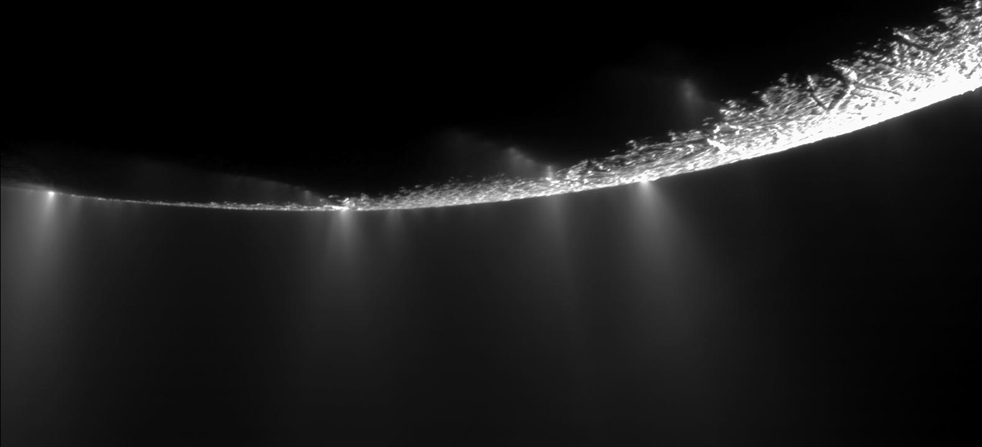
Bursting at the Seams -- Dramatic plumes, both large and small, spray water ice out from many locations along the famed 'tiger stripes' near the south pole of Saturn's moon Enceladus. The tiger stripes are fissures that spray icy particles, water vapor and organic compounds. This mosaic was created from two high-resolution images that were captured by the narrow-angle camera when NASA's Cassini spacecraft flew past Enceladus and through the jets on Nov. 21, 2009. Imaging the jets over time will allow Cassini scientists to study the consistency of their activity. NASA/JPL/Space Science Institute

Earth's Moon -- During its mission, the Galileo spacecraft returned a number of images of Earth's only natural satellite. Galileo surveyed the moon on Dec. 7, 1992, on its way to explore the Jupiter system in 1995-1997. This color mosaic was assembled from 18 images taken by Galileo's imaging system through a green filter. On the upperleft is the dark, lava-filled Mare Imbrium, Mare Serenitatis (middle left), Mare Tranquillitatis (lower left), and Mare Crisium, the dark circular feature toward the bottom of the mosaic. Also visible in this view are the dark lava plains of the Marginis and Smythii Basins at the lower right. The Humboldtianum Basin, a 400-mile impact structure partly filled with dark volcanic deposits, is seen at the center of the image. NASA/JPL/USGS

Stately Saturn -- Saturn, stately and resplendent in this natural color view, dwarfs its icy moon Rhea. Rhea (949 miles in diameter) orbits beyond the rings on the right of the image. The moon Tethys is not shown here, but its shadow is visible on the planet on the left of the image. This view looks toward the northern, sunlit side of the rings from just above the ringplane. Images taken using red, green and blue spectral filters were combined to create this natural color view. The images were obtained with the Cassini spacecraft wide-angle camera on Nov. 4, 2009, at a distance of approximately 808,000 miles from Saturn. NASA/JPL/Space Science Institute

Ring of Fire -- This image from the Solar Dynamics Observatory's Atmospheric Imaging Assembly (AIA) shows in great detail a solar prominence taken from a March 30, 2010 eruption. The twisting motion of the material is the most noticeable feature. Launched on Feb. 11, 2010, SDO is the most advanced spacecraft ever designed to study the sun. During its five-year mission, it will examine the sun's magnetic field and also provide a better understanding of the role the sun plays in Earth's atmospheric chemistry and climate. SDO will provide images with clarity 10 times better than high-definition television and will return more comprehensive science data faster than any other solar observing spacecraft. NASA/SDO/AIA

Experience Hubble's Universe in 3-D -- This image depicts a vast canyon of dust and gas in the Orion Nebula from a 3-D computer model based on observations by NASA's Hubble Space Telescope and created by science visualization specialists at the Space Telescope Science Institute (STScI) in Baltimore, Md. A 3-D visualization of this model takes viewers on an amazing four-minute voyage through the 15-light-year-wide canyon. The model takes viewers through an exhilarating ride through the Orion Nebula, a vast star-making factory 1,500 light-years away. This virtual space journey isn't the latest video game but one of several groundbreaking astronomy visualizations created by specialists at STScI, the science operations center for NASA's Hubble Space Telescope. The cinematic space odysseys are part of the new Imax film Hubble 3D. While Hubble pictures of celestial objects are awe-inspiring, they are flat 2-D photographs. For this film, those 2-D images have been converted into 3-D environments, giving the audience the impression they are space travelers taking a tour of Hubble's most popular targets. NASA, G. Bacon, L. Frattare, Z. Levay, and F. Summers (STScI/AURA)

The Birth of Stars -- This new Hubble photo is but a small portion of one of the largest seen star-birth regions in the galaxy, the Carina Nebula. Towers of cool hydrogen laced with dust rise from the wall of the nebula. Reminiscent of Hubble's classic image of the Eagle Nebula dubbed the 'Pillars of Creation' this image is even more striking in appearance. Captured here are the top of a three-light-year-tall pillar of gas and the dust that is being eaten away by the brilliant light from nearby bright stars. The pillar is also being pushed apart from within, as infant stars buried inside it fire off jets of gas that can be seen streaming from towering peaks like arrows sailing through the air. NASA, ESA, and M. Livio and the Hubble 20th Anniversary Team (STScI)

M51 Hubble Remix -- The 51st entry in Charles Messier's famous catalog is perhaps the original spiral nebula--a large galaxy with a well defined spiral structure also cataloged as NGC 5194. Over 60,000 light-years across, M51's spiral arms and dust lanes clearly sweep in front of its companion galaxy, NGC 5195. Image data from the Hubble's Advanced Camera for Surveys was reprocessed to produce this alternative portrait of the well-known interacting galaxy pair. The processing sharpened details and enhanced color and contrast in otherwise faint areas, bringing out dust lanes and extended streams that cross the small companion, along with features in the surroundings and core of M51 itself. The pair are about 31 million light-years distant. Not far on the sky from the handle of the Big Dipper, they officially lie within the boundaries of the small constellation Canes Venatici. NASA, Hubble Heritage Team, (STScI/AURA), ESA, S. Beckwith (STScI). Additional Processing: Robert Gendler

Assembly Line of Stars -- The constellation Vulpecula is a veritable entire assembly line of newborn stars. The diffuse glow reveals the widespread cold reservoir of raw material that our Milky Way galaxy has in stock for building stars. Large-scale turbulence from the giant colliding galactic flows causes this material to condense into the web of filaments seen in this image. As the stellar material becomes colder and denser, gravitational forces take over and fragment these filaments into chains of stellar embryos that can finally collapse to form baby stars. These scientific results from the European Space Agency's Herschel infrared space observatory are revealing previously hidden details of star formation. New images show thousands of distant galaxies furiously building stars and beautiful star-forming clouds draped across the Milky Way. Presented on May 6, 2010, during a major scientific symposium held at ESA, the results challenge old ideas of star birth, and open new roads for future research. NASA / ESA/Hi-GAL Consortium

The Crab Nebula -- The Crab Nebula, the result of a supernova noted by Earth-bound chroniclers in 1054 A.D., is filled with mysterious filaments that are are not only tremendously complex, but appear to have less mass than expelled in the original supernova and a higher speed than expected from a free explosion. The Crab Nebula spans about 10 light-years. In the nebula's very center lies a pulsar: a neutron star as massive as the Sun but with only the size of a small town. The Crab Pulsar rotates about 30 times each second. NASA, ESA, J. Hester, A. Loll (ASU)

Stellar Nursery in the Rosette Nebula -- This image from the European Space Agency's Herschel Space Observatory shows the cloud associated with the Rosette Nebula, a stellar nursery about 5,000 light-years from Earth in the Monoceros, or Unicorn, constellation. Herschel collects the infraredstars, which will grow up to 10 times the mass of our sun. The small spots near the center of the image are lower mass stellar embryos. The Rosette Nebula itself, and its massive cluster of stars,NASA / ESA/PACS & SPIRE Consortium/HOBYS Key Programme Consortia light given out by dust. The bright smudges are dusty cocoons containing massive embryonic is located to the right of the picture.

Trio of Galaxies Mixes It Up -- Though they are the largest and most widely scattered objects in the universe, galaxies do collide. The Hubble Space Telescope has photographed many pairs of galaxies colliding. Like snowflakes, no two examples look exactly alike. This is one of the most arresting galaxy smash-up images to date. At first glance, it looks as if a smaller galaxy has been caught in a tug-of-war between a Sumo-wrestler pair of elliptical galaxies. The hapless, mangled galaxy may have once looked more like our Milky Way, a pinwheel-shaped galaxy. Now that it's caught in a cosmic blender, its dust lanes are being stretched and warped by the tug of gravity. Unlike the elliptical galaxies, the spiral is rich in dust and gas for the formation of new stars. It is the fate of the spiral galaxy to be pulled like taffy and then swallowed by the pair of elliptical galaxies, which will trigger a firestorm of new stellar creation. NASA, ESA and R. Sharples (University of Durham)

Menkhib and the California Nebula -- NASA's Wide-field Infrared Survey Explorer, or WISE, features one of the bright stars in the constellation Perseus, named Menkhib (at upper left near the red dust cloud), surrounded by the large star-forming California Nebula, running diagonally through the image. Menkhib is one of the hottest stars visible in the night sky; its surface temperature is about 37,000 Kelvin (about 66,000 degrees Fahrenheit, or more than six times hotter than the sun). Because of its high temperature, it appears blue-white to the human eye. It has about 40 times the mass of our sun and gives off 330,000 times the amount of light. Menkhib is a runaway star, and the fast stellar wind it blows is piling up in front of it to create a shock wave. This shock wave is heating up dust, which WISE sees as the red cloud in the upper left of the image. NASA/JPL-Caltech/UCLA

The Wizard Nebula -- This image of the open star cluster NGC 7380, also known as the Wizard Nebula, is a mosaic of images from the WISE mission spanning an area on the sky of about 5 times the size of the full moon. NGC 7380 is located in the constellation Cepheus about 7,000 light-years from Earth within the Milky Way Galaxy. The star cluster is embedded in a nebula, which spans some 110 light-years. The stars of NGC 7380 have emerged from this star-forming region in the last 5 million years or so, making it a relatively young cluster. WISE, the Wide-field Infraredinfrared light, picking up the glow of hundreds of millions of objects and producing millions of images. The mission is designed to uncover objects never seen before, including the coolest stars, the universe's most luminous galaxies and some of the darkest near-Earth asteroids and comets. NASA/JPL-Caltech/UCLA Survey Explorer mission, scans the entire sky in

Winds of Change -- This is a composite image of NGC 1068, one of the nearest and brightest galaxies containing a rapidly growing supermassive black hole. The X-ray images and spectra obtained using Chandra's High Energy Transmission Grating Spectrometer show that a strong wind is being driven away from the center of NGC 1068 at a rate of about a million miles per hour. This wind is likely generated as surrounding gas is accelerated and heated as it swirls toward the black hole. A portion of the gas is pulled into the black hole, but some of it is blown away. High energy X-rays produced by the gas near the black hole heat the ouflowing gas, causing it to glow at lower X-ray energies. X-ray data from the Chandra X-ray Observatory are shown in red, optical data from the Hubble Space Telescope in green and radio data from the Very Large Array in blue. The spiral structure of NGC 1068 is shown by the X-ray and optical data, and a jet powered by the central supermassive black hole is shown by the radio data. NGC 1068 is located about 50 million light years from Earth and contains a supermassive black hole about twice as massive as the one in the middle of the Milky Way Galaxy. X-ray (NASA/CXC/ MIT/C.Canizares, D.Evans et al), Optical (NASA/STScI), Radio (NSF/ NRAO/VLA)

A Mosaic of Cassiopeia -- This mosaic of images from the Wide-Field Infrared Survey Explore, or WISE, in the constellation of Cassiopeia contains a large star-forming nebula within the Milky Way Galaxy, called IC 1805 or the Heart Nebula, a portion of which is seen at the right of the image. IC 1805 is more than 6,000 light-years from Earth. Also visible in this image are two nearby galaxies, Maffei 1 and Maffei 2. In visible light these galaxies are hidden by dust in IC 1805 and were unknown until 1968 when Paolo Maffei found them using infrared observations. Both galaxies contain billions of stars and are located some 10 million light-years away. Maffei 1 is a lenticular galaxy, which has a disk-like structure and a central bulge but no spiral structure or appreciable dust content. Maffei 2 is a spiral galaxy that also has a disk shape, but with a bar-like central bulge and two prominent dusty spiral arms. NASA/JPL-Caltech/UCLA
Bursting at the Seams -- Dramatic plumes, both large and small, spray water ice out from many locations along the famed 'tiger stripes' near the south pole of Saturn's moon Enceladus. The tiger stripes are fissures that spray icy particles, water vapor and organic compounds. This mosaic was created from two high-resolution images that were captured by the narrow-angle camera when NASA's Cassini spacecraft flew past Enceladus and through the jets on Nov. 21, 2009. Imaging the jets over time will allow Cassini scientists to study the consistency of their activity. NASA/JPL/Space Science Institute

Earth's Moon -- During its mission, the Galileo spacecraft returned a number of images of Earth's only natural satellite. Galileo surveyed the moon on Dec. 7, 1992, on its way to explore the Jupiter system in 1995-1997. This color mosaic was assembled from 18 images taken by Galileo's imaging system through a green filter. On the upperleft is the dark, lava-filled Mare Imbrium, Mare Serenitatis (middle left), Mare Tranquillitatis (lower left), and Mare Crisium, the dark circular feature toward the bottom of the mosaic. Also visible in this view are the dark lava plains of the Marginis and Smythii Basins at the lower right. The Humboldtianum Basin, a 400-mile impact structure partly filled with dark volcanic deposits, is seen at the center of the image. NASA/JPL/USGS

Stately Saturn -- Saturn, stately and resplendent in this natural color view, dwarfs its icy moon Rhea. Rhea (949 miles in diameter) orbits beyond the rings on the right of the image. The moon Tethys is not shown here, but its shadow is visible on the planet on the left of the image. This view looks toward the northern, sunlit side of the rings from just above the ringplane. Images taken using red, green and blue spectral filters were combined to create this natural color view. The images were obtained with the Cassini spacecraft wide-angle camera on Nov. 4, 2009, at a distance of approximately 808,000 miles from Saturn. NASA/JPL/Space Science Institute
Last edited:


