

Latest ads
-
 RHCSA, RHCE, AWS, Docker, Kubernetes Training
- Sanjeewani95
- Updated:
-
 🛡️ Kaspersky Antivirus – 1 Year / 1 Device | Rs. 2,300 | Only 9 Left
- KSPathirana
- Updated:
-
Professional CCTV Installation Service
- Techguy231
- Updated:
-
I'll research & write an article - Rs. 2000 onwards
- Blogerwiki
- Updated:
-
 House Plan
- lenura
- Updated:
You are using an out of date browser. It may not display this or other websites correctly.
You should upgrade or use an alternative browser.
You should upgrade or use an alternative browser.
The Complete Works of William Shakespeare
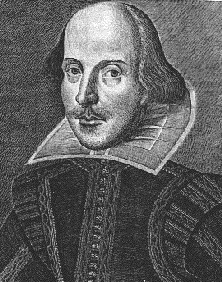
Welcome to the Web's first edition of the Complete Works of William Shakespeare. This site has offered Shakespeare's plays and poetry to the Internet community since 1993.
Announcement: The restoration of the site following a disk failure has been delayed. The text of the plays is available now. The poetry and other services, including the search engine and forums, will return shortly. (Nov. 13, 2000)
For other Shakespeare resources, visit the Mr. William Shakespeare and the Internet Web site.
The original electronic source for this server is the Complete Moby(tm) Shakespeare, which is freely available online. The HTML versions of the plays provided here are placed in the public domain.
The original electronic source for this server is the Complete Moby(tm) Shakespeare, which is freely available online. The HTML versions of the plays provided here are placed in the public domain.
Comedy
All's Well That Ends Well
As You Like It
The Comedy of Errors
Cymbeline
Love's Labours Lost
Measure for Measure
The Merry Wives of Windsor
The Merchant of Venice
A Midsummer Night's Dream
Much Ado About Nothing
Pericles, Prince of Tyre
Taming of the Shrew
The Tempest
Troilus and Cressida
Twelfth Night
Two Gentlemen of Verona
Winter's Tale
All's Well That Ends Well
As You Like It
The Comedy of Errors
Cymbeline
Love's Labours Lost
Measure for Measure
The Merry Wives of Windsor
The Merchant of Venice
A Midsummer Night's Dream
Much Ado About Nothing
Pericles, Prince of Tyre
Taming of the Shrew
The Tempest
Troilus and Cressida
Twelfth Night
Two Gentlemen of Verona
Winter's Tale
history
Henry IV, part 1
Henry IV, part 2
Henry V
Henry VI, part 1
Henry VI, part 2
Henry VI, part 3
Henry VIII
King John
Richard II
Richard III
Henry IV, part 1
Henry IV, part 2
Henry V
Henry VI, part 1
Henry VI, part 2
Henry VI, part 3
Henry VIII
King John
Richard II
Richard III
Tragedy
Antony and Cleopatra
Coriolanus
Hamlet
Julius Caesar
King Lear
Macbeth
Othello
Romeo and Juliet
Timon of Athens
Titus Andronicus
Antony and Cleopatra
Coriolanus
Hamlet
Julius Caesar
King Lear
Macbeth
Othello
Romeo and Juliet
Timon of Athens
Titus Andronicus
poetry
The Sonnets
A Lover's Complaint
The Rape of Lucrece
Venus and Adonis
Funeral Elegy by W.S.
The Sonnets
A Lover's Complaint
The Rape of Lucrece
Venus and Adonis
Funeral Elegy by W.S.
SCENE I. Orchard of Oliver's house.
Enter ORLANDO and ADAM
ORLANDO As I remember, Adam, it was upon this fashion
bequeathed me by will but poor a thousand crowns,
and, as thou sayest, charged my brother, on his
blessing, to breed me well: and there begins my
sadness. My brother Jaques he keeps at school, and
report speaks goldenly of his profit: for my part,
he keeps me rustically at home, or, to speak more
properly, stays me here at home unkept; for call you
that keeping for a gentleman of my birth, that
differs not from the stalling of an ox? His horses
are bred better; for, besides that they are fair
with their feeding, they are taught their manage,
and to that end riders dearly hired: but I, his
brother, gain nothing under him but growth; for the
which his animals on his dunghills are as much
bound to him as I. Besides this nothing that he so
plentifully gives me, the something that nature gave
me his countenance seems to take from me: he lets
me feed with his hinds, bars me the place of a
brother, and, as much as in him lies, mines my
gentility with my education. This is it, Adam, that
grieves me; and the spirit of my father, which I
think is within me, begins to mutiny against this
servitude: I will no longer endure it, though yet I
know no wise remedy how to avoid it.
ADAM bequeathed me by will but poor a thousand crowns,
and, as thou sayest, charged my brother, on his
blessing, to breed me well: and there begins my
sadness. My brother Jaques he keeps at school, and
report speaks goldenly of his profit: for my part,
he keeps me rustically at home, or, to speak more
properly, stays me here at home unkept; for call you
that keeping for a gentleman of my birth, that
differs not from the stalling of an ox? His horses
are bred better; for, besides that they are fair
with their feeding, they are taught their manage,
and to that end riders dearly hired: but I, his
brother, gain nothing under him but growth; for the
which his animals on his dunghills are as much
bound to him as I. Besides this nothing that he so
plentifully gives me, the something that nature gave
me his countenance seems to take from me: he lets
me feed with his hinds, bars me the place of a
brother, and, as much as in him lies, mines my
gentility with my education. This is it, Adam, that
grieves me; and the spirit of my father, which I
think is within me, begins to mutiny against this
servitude: I will no longer endure it, though yet I
know no wise remedy how to avoid it.
Yonder comes my master, your brother.
ORLANDO
Go apart, Adam, and thou shalt hear how he will
shake me up.
Enter OLIVER
OLIVER shake me up.
Enter OLIVER
Now, sir! what make you here?
ORLANDO
Nothing: I am not taught to make any thing.
OLIVER
What mar you then, sir?
ORLANDO
Marry, sir, I am helping you to mar that which God
made, a poor unworthy brother of yours, with idleness.
OLIVER made, a poor unworthy brother of yours, with idleness.
Marry, sir, be better employed, and be naught awhile.
ORLANDO
Shall I keep your hogs and eat husks with them?
What prodigal portion have I spent, that I should
come to such penury?
OLIVER What prodigal portion have I spent, that I should
come to such penury?
Know you where your are, sir?
ORLANDO
O, sir, very well; here in your orchard.
OLIVER
Know you before whom, sir?
ORLANDO
Ay, better than him I am before knows me. I know
you are my eldest brother; and, in the gentle
condition of blood, you should so know me. The
courtesy of nations allows you my better, in that
you are the first-born; but the same tradition
takes not away my blood, were there twenty brothers
betwixt us: I have as much of my father in me as
you; albeit, I confess, your coming before me is
nearer to his reverence.
OLIVER you are my eldest brother; and, in the gentle
condition of blood, you should so know me. The
courtesy of nations allows you my better, in that
you are the first-born; but the same tradition
takes not away my blood, were there twenty brothers
betwixt us: I have as much of my father in me as
you; albeit, I confess, your coming before me is
nearer to his reverence.
What, boy!
ORLANDO
Come, come, elder brother, you are too young in this.
OLIVER
Wilt thou lay hands on me, villain?
ORLANDO
I am no villain; I am the youngest son of Sir
Rowland de Boys; he was my father, and he is thrice
a villain that says such a father begot villains.
Wert thou not my brother, I would not take this hand
from thy throat till this other had pulled out thy
tongue for saying so: thou hast railed on thyself.
ADAM Rowland de Boys; he was my father, and he is thrice
a villain that says such a father begot villains.
Wert thou not my brother, I would not take this hand
from thy throat till this other had pulled out thy
tongue for saying so: thou hast railed on thyself.
Sweet masters, be patient: for your father's
remembrance, be at accord.
OLIVER remembrance, be at accord.
Let me go, I say.
ORLANDO
I will not, till I please: you shall hear me. My
father charged you in his will to give me good
education: you have trained me like a peasant,
obscuring and hiding from me all gentleman-like
qualities. The spirit of my father grows strong in
me, and I will no longer endure it: therefore allow
me such exercises as may become a gentleman, or
give me the poor allottery my father left me by
testament; with that I will go buy my fortunes.
OLIVER father charged you in his will to give me good
education: you have trained me like a peasant,
obscuring and hiding from me all gentleman-like
qualities. The spirit of my father grows strong in
me, and I will no longer endure it: therefore allow
me such exercises as may become a gentleman, or
give me the poor allottery my father left me by
testament; with that I will go buy my fortunes.
And what wilt thou do? beg, when that is spent?
Well, sir, get you in: I will not long be troubled
with you; you shall have some part of your will: I
pray you, leave me.
ORLANDO Well, sir, get you in: I will not long be troubled
with you; you shall have some part of your will: I
pray you, leave me.
I will no further offend you than becomes me for my good.
OLIVER
Get you with him, you old dog.
ADAM
Is 'old dog' my reward? Most true, I have lost my
teeth in your service. God be with my old master!
he would not have spoke such a word.
Exeunt ORLANDO and ADAM
OLIVER teeth in your service. God be with my old master!
he would not have spoke such a word.
Exeunt ORLANDO and ADAM
Is it even so? begin you to grow upon me? I will
physic your rankness, and yet give no thousand
crowns neither. Holla, Dennis!
Enter DENNIS
DENNIS physic your rankness, and yet give no thousand
crowns neither. Holla, Dennis!
Enter DENNIS
Calls your worship?
OLIVER
Was not Charles, the duke's wrestler, here to speak with me?
DENNIS
So please you, he is here at the door and importunes
access to you.
OLIVER access to you.
Call him in.
Exit DENNIS
'Twill be a good way; and to-morrow the wrestling is.
Enter CHARLES
CHARLES Exit DENNIS
'Twill be a good way; and to-morrow the wrestling is.
Enter CHARLES
Good morrow to your worship.
OLIVER
Good Monsieur Charles, what's the new news at the
new court?
CHARLES new court?
There's no news at the court, sir, but the old news:
that is, the old duke is banished by his younger
brother the new duke; and three or four loving lords
have put themselves into voluntary exile with him,
whose lands and revenues enrich the new duke;
therefore he gives them good leave to wander.
OLIVER that is, the old duke is banished by his younger
brother the new duke; and three or four loving lords
have put themselves into voluntary exile with him,
whose lands and revenues enrich the new duke;
therefore he gives them good leave to wander.
Can you tell if Rosalind, the duke's daughter, be
banished with her father?
CHARLES banished with her father?
O, no; for the duke's daughter, her cousin, so loves
her, being ever from their cradles bred together,
that she would have followed her exile, or have died
to stay behind her. She is at the court, and no
less beloved of her uncle than his own daughter; and
never two ladies loved as they do.
OLIVER her, being ever from their cradles bred together,
that she would have followed her exile, or have died
to stay behind her. She is at the court, and no
less beloved of her uncle than his own daughter; and
never two ladies loved as they do.
Where will the old duke live?
CHARLES
They say he is already in the forest of Arden, and
a many merry men with him; and there they live like
the old Robin Hood of England: they say many young
gentlemen flock to him every day, and fleet the time
carelessly, as they did in the golden world.
OLIVER a many merry men with him; and there they live like
the old Robin Hood of England: they say many young
gentlemen flock to him every day, and fleet the time
carelessly, as they did in the golden world.
What, you wrestle to-morrow before the new duke?
CHARLES
Marry, do I, sir; and I came to acquaint you with a
matter. I am given, sir, secretly to understand
that your younger brother Orlando hath a disposition
to come in disguised against me to try a fall.
To-morrow, sir, I wrestle for my credit; and he that
escapes me without some broken limb shall acquit him
well. Your brother is but young and tender; and,
for your love, I would be loath to foil him, as I
must, for my own honour, if he come in: therefore,
out of my love to you, I came hither to acquaint you
withal, that either you might stay him from his
intendment or brook such disgrace well as he shall
run into, in that it is a thing of his own search
and altogether against my will.
OLIVER matter. I am given, sir, secretly to understand
that your younger brother Orlando hath a disposition
to come in disguised against me to try a fall.
To-morrow, sir, I wrestle for my credit; and he that
escapes me without some broken limb shall acquit him
well. Your brother is but young and tender; and,
for your love, I would be loath to foil him, as I
must, for my own honour, if he come in: therefore,
out of my love to you, I came hither to acquaint you
withal, that either you might stay him from his
intendment or brook such disgrace well as he shall
run into, in that it is a thing of his own search
and altogether against my will.
Charles, I thank thee for thy love to me, which
thou shalt find I will most kindly requite. I had
myself notice of my brother's purpose herein and
have by underhand means laboured to dissuade him from
it, but he is resolute. I'll tell thee, Charles:
it is the stubbornest young fellow of France, full
of ambition, an envious emulator of every man's
good parts, a secret and villanous contriver against
me his natural brother: therefore use thy
discretion; I had as lief thou didst break his neck
as his finger. And thou wert best look to't; for if
thou dost him any slight disgrace or if he do not
mightily grace himself on thee, he will practise
against thee by poison, entrap thee by some
treacherous device and never leave thee till he
hath ta'en thy life by some indirect means or other;
for, I assure thee, and almost with tears I speak
it, there is not one so young and so villanous this
day living. I speak but brotherly of him; but
should I anatomize him to thee as he is, I must
blush and weep and thou must look pale and wonder.
CHARLES thou shalt find I will most kindly requite. I had
myself notice of my brother's purpose herein and
have by underhand means laboured to dissuade him from
it, but he is resolute. I'll tell thee, Charles:
it is the stubbornest young fellow of France, full
of ambition, an envious emulator of every man's
good parts, a secret and villanous contriver against
me his natural brother: therefore use thy
discretion; I had as lief thou didst break his neck
as his finger. And thou wert best look to't; for if
thou dost him any slight disgrace or if he do not
mightily grace himself on thee, he will practise
against thee by poison, entrap thee by some
treacherous device and never leave thee till he
hath ta'en thy life by some indirect means or other;
for, I assure thee, and almost with tears I speak
it, there is not one so young and so villanous this
day living. I speak but brotherly of him; but
should I anatomize him to thee as he is, I must
blush and weep and thou must look pale and wonder.
I am heartily glad I came hither to you. If he come
to-morrow, I'll give him his payment: if ever he go
alone again, I'll never wrestle for prize more: and
so God keep your worship!
OLIVER to-morrow, I'll give him his payment: if ever he go
alone again, I'll never wrestle for prize more: and
so God keep your worship!
Farewell, good Charles.
Exit CHARLES
Now will I stir this gamester: I hope I shall see
an end of him; for my soul, yet I know not why,
hates nothing more than he. Yet he's gentle, never
schooled and yet learned, full of noble device, of
all sorts enchantingly beloved, and indeed so much
in the heart of the world, and especially of my own
people, who best know him, that I am altogether
misprised: but it shall not be so long; this
wrestler shall clear all: nothing remains but that
I kindle the boy thither; which now I'll go about.
Exit
Exit CHARLES
Now will I stir this gamester: I hope I shall see
an end of him; for my soul, yet I know not why,
hates nothing more than he. Yet he's gentle, never
schooled and yet learned, full of noble device, of
all sorts enchantingly beloved, and indeed so much
in the heart of the world, and especially of my own
people, who best know him, that I am altogether
misprised: but it shall not be so long; this
wrestler shall clear all: nothing remains but that
I kindle the boy thither; which now I'll go about.
Exit

SCENE II. Lawn before the Duke's palace.
Enter CELIA and ROSALIND
CELIA I pray thee, Rosalind, sweet my coz, be merry.
ROSALIND
Dear Celia, I show more mirth than I am mistress of;
and would you yet I were merrier? Unless you could
teach me to forget a banished father, you must not
learn me how to remember any extraordinary pleasure.
CELIA and would you yet I were merrier? Unless you could
teach me to forget a banished father, you must not
learn me how to remember any extraordinary pleasure.
Herein I see thou lovest me not with the full weight
that I love thee. If my uncle, thy banished father,
had banished thy uncle, the duke my father, so thou
hadst been still with me, I could have taught my
love to take thy father for mine: so wouldst thou,
if the truth of thy love to me were so righteously
tempered as mine is to thee.
ROSALIND that I love thee. If my uncle, thy banished father,
had banished thy uncle, the duke my father, so thou
hadst been still with me, I could have taught my
love to take thy father for mine: so wouldst thou,
if the truth of thy love to me were so righteously
tempered as mine is to thee.
Well, I will forget the condition of my estate, to
rejoice in yours.
CELIA rejoice in yours.
You know my father hath no child but I, nor none is
like to have: and, truly, when he dies, thou shalt
be his heir, for what he hath taken away from thy
father perforce, I will render thee again in
affection; by mine honour, I will; and when I break
that oath, let me turn monster: therefore, my
sweet Rose, my dear Rose, be merry.
ROSALIND like to have: and, truly, when he dies, thou shalt
be his heir, for what he hath taken away from thy
father perforce, I will render thee again in
affection; by mine honour, I will; and when I break
that oath, let me turn monster: therefore, my
sweet Rose, my dear Rose, be merry.
From henceforth I will, coz, and devise sports. Let
me see; what think you of falling in love?
CELIA me see; what think you of falling in love?
Marry, I prithee, do, to make sport withal: but
love no man in good earnest; nor no further in sport
neither than with safety of a pure blush thou mayst
in honour come off again.
ROSALIND love no man in good earnest; nor no further in sport
neither than with safety of a pure blush thou mayst
in honour come off again.
What shall be our sport, then?
CELIA
Let us sit and mock the good housewife Fortune from
her wheel, that her gifts may henceforth be bestowed equally.
ROSALIND her wheel, that her gifts may henceforth be bestowed equally.
I would we could do so, for her benefits are
mightily misplaced, and the bountiful blind woman
doth most mistake in her gifts to women.
CELIA mightily misplaced, and the bountiful blind woman
doth most mistake in her gifts to women.
'Tis true; for those that she makes fair she scarce
makes honest, and those that she makes honest she
makes very ill-favouredly.
ROSALIND makes honest, and those that she makes honest she
makes very ill-favouredly.
Nay, now thou goest from Fortune's office to
Nature's: Fortune reigns in gifts of the world,
not in the lineaments of Nature.
Enter TOUCHSTONE
CELIA Nature's: Fortune reigns in gifts of the world,
not in the lineaments of Nature.
Enter TOUCHSTONE
No? when Nature hath made a fair creature, may she
not by Fortune fall into the fire? Though Nature
hath given us wit to flout at Fortune, hath not
Fortune sent in this fool to cut off the argument?
ROSALIND not by Fortune fall into the fire? Though Nature
hath given us wit to flout at Fortune, hath not
Fortune sent in this fool to cut off the argument?
Indeed, there is Fortune too hard for Nature, when
Fortune makes Nature's natural the cutter-off of
Nature's wit.
CELIA Fortune makes Nature's natural the cutter-off of
Nature's wit.
Peradventure this is not Fortune's work neither, but
Nature's; who perceiveth our natural wits too dull
to reason of such goddesses and hath sent this
natural for our whetstone; for always the dulness of
the fool is the whetstone of the wits. How now,
wit! whither wander you?
TOUCHSTONE Nature's; who perceiveth our natural wits too dull
to reason of such goddesses and hath sent this
natural for our whetstone; for always the dulness of
the fool is the whetstone of the wits. How now,
wit! whither wander you?
Mistress, you must come away to your father.
CELIA
Were you made the messenger?
TOUCHSTONE
No, by mine honour, but I was bid to come for you.
ROSALIND
Where learned you that oath, fool?
TOUCHSTONE
Of a certain knight that swore by his honour they
were good pancakes and swore by his honour the
mustard was naught: now I'll stand to it, the
pancakes were naught and the mustard was good, and
yet was not the knight forsworn.
CELIA were good pancakes and swore by his honour the
mustard was naught: now I'll stand to it, the
pancakes were naught and the mustard was good, and
yet was not the knight forsworn.
How prove you that, in the great heap of your
knowledge?
ROSALIND knowledge?
Ay, marry, now unmuzzle your wisdom.
TOUCHSTONE
Stand you both forth now: stroke your chins, and
swear by your beards that I am a knave.
CELIA swear by your beards that I am a knave.
By our beards, if we had them, thou art.
TOUCHSTONE
By my knavery, if I had it, then I were; but if you
swear by that that is not, you are not forsworn: no
more was this knight swearing by his honour, for he
never had any; or if he had, he had sworn it away
before ever he saw those pancakes or that mustard.
CELIA swear by that that is not, you are not forsworn: no
more was this knight swearing by his honour, for he
never had any; or if he had, he had sworn it away
before ever he saw those pancakes or that mustard.
Prithee, who is't that thou meanest?
TOUCHSTONE
One that old Frederick, your father, loves.
CELIA
My father's love is enough to honour him: enough!
speak no more of him; you'll be whipped for taxation
one of these days.
TOUCHSTONE speak no more of him; you'll be whipped for taxation
one of these days.
The more pity, that fools may not speak wisely what
wise men do foolishly.
CELIA wise men do foolishly.
By my troth, thou sayest true; for since the little
wit that fools have was silenced, the little foolery
that wise men have makes a great show. Here comes
Monsieur Le Beau.
ROSALIND wit that fools have was silenced, the little foolery
that wise men have makes a great show. Here comes
Monsieur Le Beau.
With his mouth full of news.
CELIA
Which he will put on us, as pigeons feed their young.
ROSALIND
Then shall we be news-crammed.
CELIA
All the better; we shall be the more marketable.
Enter LE BEAU
Bon jour, Monsieur Le Beau: what's the news?
LE BEAU Enter LE BEAU
Bon jour, Monsieur Le Beau: what's the news?
Fair princess, you have lost much good sport.
CELIA
Sport! of what colour?
LE BEAU
What colour, madam! how shall I answer you?
ROSALIND
As wit and fortune will.
TOUCHSTONE
Or as the Destinies decree.
CELIA
Well said: that was laid on with a trowel.
TOUCHSTONE
Nay, if I keep not my rank,--
ROSALIND
Thou losest thy old smell.
LE BEAU
You amaze me, ladies: I would have told you of good
wrestling, which you have lost the sight of.
ROSALIND wrestling, which you have lost the sight of.
You tell us the manner of the wrestling.
LE BEAU
I will tell you the beginning; and, if it please
your ladyships, you may see the end; for the best is
yet to do; and here, where you are, they are coming
to perform it.
CELIA your ladyships, you may see the end; for the best is
yet to do; and here, where you are, they are coming
to perform it.
Well, the beginning, that is dead and buried.
LE BEAU
There comes an old man and his three sons,--
CELIA
I could match this beginning with an old tale.
LE BEAU
Three proper young men, of excellent growth and presence.
ROSALIND
With bills on their necks, 'Be it known unto all men
by these presents.'
LE BEAU by these presents.'
The eldest of the three wrestled with Charles, the
duke's wrestler; which Charles in a moment threw him
and broke three of his ribs, that there is little
hope of life in him: so he served the second, and
so the third. Yonder they lie; the poor old man,
their father, making such pitiful dole over them
that all the beholders take his part with weeping.
ROSALIND duke's wrestler; which Charles in a moment threw him
and broke three of his ribs, that there is little
hope of life in him: so he served the second, and
so the third. Yonder they lie; the poor old man,
their father, making such pitiful dole over them
that all the beholders take his part with weeping.
Alas!
TOUCHSTONE
But what is the sport, monsieur, that the ladies
have lost?
LE BEAU have lost?
Why, this that I speak of.
TOUCHSTONE
Thus men may grow wiser every day: it is the first
time that ever I heard breaking of ribs was sport
for ladies.
CELIA time that ever I heard breaking of ribs was sport
for ladies.
Or I, I promise thee.
ROSALIND
But is there any else longs to see this broken music
in his sides? is there yet another dotes upon
rib-breaking? Shall we see this wrestling, cousin?
LE BEAU in his sides? is there yet another dotes upon
rib-breaking? Shall we see this wrestling, cousin?
You must, if you stay here; for here is the place
appointed for the wrestling, and they are ready to
perform it.
CELIA appointed for the wrestling, and they are ready to
perform it.
Yonder, sure, they are coming: let us now stay and see it.
Flourish. Enter DUKE FREDERICK, Lords, ORLANDO, CHARLES, and Attendants
DUKE FREDERICK Flourish. Enter DUKE FREDERICK, Lords, ORLANDO, CHARLES, and Attendants
Come on: since the youth will not be entreated, his
own peril on his forwardness.
ROSALIND own peril on his forwardness.
Is yonder the man?
LE BEAU
Even he, madam.
CELIA
Alas, he is too young! yet he looks successfully.
DUKE FREDERICK
How now, daughter and cousin! are you crept hither
to see the wrestling?
ROSALIND to see the wrestling?
Ay, my liege, so please you give us leave.
DUKE FREDERICK
You will take little delight in it, I can tell you;
there is such odds in the man. In pity of the
challenger's youth I would fain dissuade him, but he
will not be entreated. Speak to him, ladies; see if
you can move him.
CELIA there is such odds in the man. In pity of the
challenger's youth I would fain dissuade him, but he
will not be entreated. Speak to him, ladies; see if
you can move him.
Call him hither, good Monsieur Le Beau.
DUKE FREDERICK
Do so: I'll not be by.
LE BEAU
Monsieur the challenger, the princesses call for you.
ORLANDO
I attend them with all respect and duty.
ROSALIND
Young man, have you challenged Charles the wrestler?
ORLANDO
No, fair princess; he is the general challenger: I
come but in, as others do, to try with him the
strength of my youth.
CELIA come but in, as others do, to try with him the
strength of my youth.
Young gentleman, your spirits are too bold for your
years. You have seen cruel proof of this man's
strength: if you saw yourself with your eyes or
knew yourself with your judgment, the fear of your
adventure would counsel you to a more equal
enterprise. We pray you, for your own sake, to
embrace your own safety and give over this attempt.
ROSALIND years. You have seen cruel proof of this man's
strength: if you saw yourself with your eyes or
knew yourself with your judgment, the fear of your
adventure would counsel you to a more equal
enterprise. We pray you, for your own sake, to
embrace your own safety and give over this attempt.
Do, young sir; your reputation shall not therefore
be misprised: we will make it our suit to the duke
that the wrestling might not go forward.
ORLANDO be misprised: we will make it our suit to the duke
that the wrestling might not go forward.
I beseech you, punish me not with your hard
thoughts; wherein I confess me much guilty, to deny
so fair and excellent ladies any thing. But let
your fair eyes and gentle wishes go with me to my
trial: wherein if I be foiled, there is but one
shamed that was never gracious; if killed, but one
dead that was willing to be so: I shall do my
friends no wrong, for I have none to lament me, the
world no injury, for in it I have nothing; only in
the world I fill up a place, which may be better
supplied when I have made it empty.
ROSALIND thoughts; wherein I confess me much guilty, to deny
so fair and excellent ladies any thing. But let
your fair eyes and gentle wishes go with me to my
trial: wherein if I be foiled, there is but one
shamed that was never gracious; if killed, but one
dead that was willing to be so: I shall do my
friends no wrong, for I have none to lament me, the
world no injury, for in it I have nothing; only in
the world I fill up a place, which may be better
supplied when I have made it empty.
The little strength that I have, I would it were with you.
CELIA
And mine, to eke out hers.
ROSALIND
Fare you well: pray heaven I be deceived in you!
CELIA
Your heart's desires be with you!
CHARLES
Come, where is this young gallant that is so
desirous to lie with his mother earth?
ORLANDO desirous to lie with his mother earth?
Ready, sir; but his will hath in it a more modest working.
DUKE FREDERICK
You shall try but one fall.
CHARLES
No, I warrant your grace, you shall not entreat him
to a second, that have so mightily persuaded him
from a first.
ORLANDO to a second, that have so mightily persuaded him
from a first.
An you mean to mock me after, you should not have
mocked me before: but come your ways.
ROSALIND mocked me before: but come your ways.
Now Hercules be thy speed, young man!
CELIA
I would I were invisible, to catch the strong
fellow by the leg.
They wrestle
ROSALIND fellow by the leg.
They wrestle
O excellent young man!
CELIA
If I had a thunderbolt in mine eye, I can tell who
should down.
Shout. CHARLES is thrown
DUKE FREDERICK should down.
Shout. CHARLES is thrown
No more, no more.
ORLANDO
Yes, I beseech your grace: I am not yet well breathed.
DUKE FREDERICK
How dost thou, Charles?
LE BEAU
He cannot speak, my lord.
DUKE FREDERICK
Bear him away. What is thy name, young man?
ORLANDO
Orlando, my liege; the youngest son of Sir Rowland de Boys.
DUKE FREDERICK
I would thou hadst been son to some man else:
The world esteem'd thy father honourable,
But I did find him still mine enemy:
Thou shouldst have better pleased me with this deed,
Hadst thou descended from another house.
But fare thee well; thou art a gallant youth:
I would thou hadst told me of another father.
Exeunt DUKE FREDERICK, train, and LE BEAU
CELIA The world esteem'd thy father honourable,
But I did find him still mine enemy:
Thou shouldst have better pleased me with this deed,
Hadst thou descended from another house.
But fare thee well; thou art a gallant youth:
I would thou hadst told me of another father.
Exeunt DUKE FREDERICK, train, and LE BEAU
Were I my father, coz, would I do this?
ORLANDO
I am more proud to be Sir Rowland's son,
His youngest son; and would not change that calling,
To be adopted heir to Frederick.
ROSALIND His youngest son; and would not change that calling,
To be adopted heir to Frederick.
My father loved Sir Rowland as his soul,
And all the world was of my father's mind:
Had I before known this young man his son,
I should have given him tears unto entreaties,
Ere he should thus have ventured.
CELIA And all the world was of my father's mind:
Had I before known this young man his son,
I should have given him tears unto entreaties,
Ere he should thus have ventured.
Gentle cousin,
Let us go thank him and encourage him:
My father's rough and envious disposition
Sticks me at heart. Sir, you have well deserved:
If you do keep your promises in love
But justly, as you have exceeded all promise,
Your mistress shall be happy.
ROSALIND Let us go thank him and encourage him:
My father's rough and envious disposition
Sticks me at heart. Sir, you have well deserved:
If you do keep your promises in love
But justly, as you have exceeded all promise,
Your mistress shall be happy.
Gentleman,
Giving him a chain from her neck
Wear this for me, one out of suits with fortune,
That could give more, but that her hand lacks means.
Shall we go, coz?
CELIA Giving him a chain from her neck
Wear this for me, one out of suits with fortune,
That could give more, but that her hand lacks means.
Shall we go, coz?
Ay. Fare you well, fair gentleman.
ORLANDO
Can I not say, I thank you? My better parts
Are all thrown down, and that which here stands up
Is but a quintain, a mere lifeless block.
ROSALIND Are all thrown down, and that which here stands up
Is but a quintain, a mere lifeless block.
He calls us back: my pride fell with my fortunes;
I'll ask him what he would. Did you call, sir?
Sir, you have wrestled well and overthrown
More than your enemies.
CELIA I'll ask him what he would. Did you call, sir?
Sir, you have wrestled well and overthrown
More than your enemies.
Will you go, coz?
ROSALIND
Have with you. Fare you well.
Exeunt ROSALIND and CELIA
ORLANDO Exeunt ROSALIND and CELIA
What passion hangs these weights upon my tongue?
I cannot speak to her, yet she urged conference.
O poor Orlando, thou art overthrown!
Or Charles or something weaker masters thee.
Re-enter LE BEAU
LE BEAU I cannot speak to her, yet she urged conference.
O poor Orlando, thou art overthrown!
Or Charles or something weaker masters thee.
Re-enter LE BEAU
Good sir, I do in friendship counsel you
To leave this place. Albeit you have deserved
High commendation, true applause and love,
Yet such is now the duke's condition
That he misconstrues all that you have done.
The duke is humorous; what he is indeed,
More suits you to conceive than I to speak of.
ORLANDO To leave this place. Albeit you have deserved
High commendation, true applause and love,
Yet such is now the duke's condition
That he misconstrues all that you have done.
The duke is humorous; what he is indeed,
More suits you to conceive than I to speak of.
I thank you, sir: and, pray you, tell me this:
Which of the two was daughter of the duke
That here was at the wrestling?
LE BEAU Which of the two was daughter of the duke
That here was at the wrestling?
Neither his daughter, if we judge by manners;
But yet indeed the lesser is his daughter
The other is daughter to the banish'd duke,
And here detain'd by her usurping uncle,
To keep his daughter company; whose loves
Are dearer than the natural bond of sisters.
But I can tell you that of late this duke
Hath ta'en displeasure 'gainst his gentle niece,
Grounded upon no other argument
But that the people praise her for her virtues
And pity her for her good father's sake;
And, on my life, his malice 'gainst the lady
Will suddenly break forth. Sir, fare you well:
Hereafter, in a better world than this,
I shall desire more love and knowledge of you.
ORLANDO But yet indeed the lesser is his daughter
The other is daughter to the banish'd duke,
And here detain'd by her usurping uncle,
To keep his daughter company; whose loves
Are dearer than the natural bond of sisters.
But I can tell you that of late this duke
Hath ta'en displeasure 'gainst his gentle niece,
Grounded upon no other argument
But that the people praise her for her virtues
And pity her for her good father's sake;
And, on my life, his malice 'gainst the lady
Will suddenly break forth. Sir, fare you well:
Hereafter, in a better world than this,
I shall desire more love and knowledge of you.
I rest much bounden to you: fare you well.
Exit LE BEAU
Thus must I from the smoke into the smother;
From tyrant duke unto a tyrant brother:
But heavenly Rosalind!
Exit
Exit LE BEAU
Thus must I from the smoke into the smother;
From tyrant duke unto a tyrant brother:
But heavenly Rosalind!
Exit
SCENE III. A room in the palace.
Leave me alone to woo him. Let's away,
And get our jewels and our wealth together,
Devise the fittest time and safest way
To hide us from pursuit that will be made
After my flight. Now go we in content
To liberty and not to banishment.
Exeunt
Enter CELIA and ROSALIND
CELIA Why, cousin! why, Rosalind! Cupid have mercy! not a word?
ROSALIND
Not one to throw at a dog.
CELIA
No, thy words are too precious to be cast away upon
curs; throw some of them at me; come, lame me with reasons.
ROSALIND curs; throw some of them at me; come, lame me with reasons.
Then there were two cousins laid up; when the one
should be lamed with reasons and the other mad
without any.
CELIA should be lamed with reasons and the other mad
without any.
But is all this for your father?
ROSALIND
No, some of it is for my child's father. O, how
full of briers is this working-day world!
CELIA full of briers is this working-day world!
They are but burs, cousin, thrown upon thee in
holiday foolery: if we walk not in the trodden
paths our very petticoats will catch them.
ROSALIND holiday foolery: if we walk not in the trodden
paths our very petticoats will catch them.
I could shake them off my coat: these burs are in my heart.
CELIA
Hem them away.
ROSALIND
I would try, if I could cry 'hem' and have him.
CELIA
Come, come, wrestle with thy affections.
ROSALIND
O, they take the part of a better wrestler than myself!
CELIA
O, a good wish upon you! you will try in time, in
despite of a fall. But, turning these jests out of
service, let us talk in good earnest: is it
possible, on such a sudden, you should fall into so
strong a liking with old Sir Rowland's youngest son?
ROSALIND despite of a fall. But, turning these jests out of
service, let us talk in good earnest: is it
possible, on such a sudden, you should fall into so
strong a liking with old Sir Rowland's youngest son?
The duke my father loved his father dearly.
CELIA
Doth it therefore ensue that you should love his son
dearly? By this kind of chase, I should hate him,
for my father hated his father dearly; yet I hate
not Orlando.
ROSALIND dearly? By this kind of chase, I should hate him,
for my father hated his father dearly; yet I hate
not Orlando.
No, faith, hate him not, for my sake.
CELIA
Why should I not? doth he not deserve well?
ROSALIND
Let me love him for that, and do you love him
because I do. Look, here comes the duke.
CELIA because I do. Look, here comes the duke.
With his eyes full of anger.
Enter DUKE FREDERICK, with Lords
DUKE FREDERICK Enter DUKE FREDERICK, with Lords
Mistress, dispatch you with your safest haste
And get you from our court.
ROSALIND And get you from our court.
Me, uncle?
DUKE FREDERICK
You, cousin
Within these ten days if that thou be'st found
So near our public court as twenty miles,
Thou diest for it.
ROSALIND Within these ten days if that thou be'st found
So near our public court as twenty miles,
Thou diest for it.
I do beseech your grace,
Let me the knowledge of my fault bear with me:
If with myself I hold intelligence
Or have acquaintance with mine own desires,
If that I do not dream or be not frantic,--
As I do trust I am not--then, dear uncle,
Never so much as in a thought unborn
Did I offend your highness.
DUKE FREDERICK Let me the knowledge of my fault bear with me:
If with myself I hold intelligence
Or have acquaintance with mine own desires,
If that I do not dream or be not frantic,--
As I do trust I am not--then, dear uncle,
Never so much as in a thought unborn
Did I offend your highness.
Thus do all traitors:
If their purgation did consist in words,
They are as innocent as grace itself:
Let it suffice thee that I trust thee not.
ROSALIND If their purgation did consist in words,
They are as innocent as grace itself:
Let it suffice thee that I trust thee not.
Yet your mistrust cannot make me a traitor:
Tell me whereon the likelihood depends.
DUKE FREDERICK Tell me whereon the likelihood depends.
Thou art thy father's daughter; there's enough.
ROSALIND
So was I when your highness took his dukedom;
So was I when your highness banish'd him:
Treason is not inherited, my lord;
Or, if we did derive it from our friends,
What's that to me? my father was no traitor:
Then, good my liege, mistake me not so much
To think my poverty is treacherous.
CELIA So was I when your highness banish'd him:
Treason is not inherited, my lord;
Or, if we did derive it from our friends,
What's that to me? my father was no traitor:
Then, good my liege, mistake me not so much
To think my poverty is treacherous.
Dear sovereign, hear me speak.
DUKE FREDERICK
Ay, Celia; we stay'd her for your sake,
Else had she with her father ranged along.
CELIA Else had she with her father ranged along.
I did not then entreat to have her stay;
It was your pleasure and your own remorse:
I was too young that time to value her;
But now I know her: if she be a traitor,
Why so am I; we still have slept together,
Rose at an instant, learn'd, play'd, eat together,
And wheresoever we went, like Juno's swans,
Still we went coupled and inseparable.
DUKE FREDERICK It was your pleasure and your own remorse:
I was too young that time to value her;
But now I know her: if she be a traitor,
Why so am I; we still have slept together,
Rose at an instant, learn'd, play'd, eat together,
And wheresoever we went, like Juno's swans,
Still we went coupled and inseparable.
She is too subtle for thee; and her smoothness,
Her very silence and her patience
Speak to the people, and they pity her.
Thou art a fool: she robs thee of thy name;
And thou wilt show more bright and seem more virtuous
When she is gone. Then open not thy lips:
Firm and irrevocable is my doom
Which I have pass'd upon her; she is banish'd.
CELIA Her very silence and her patience
Speak to the people, and they pity her.
Thou art a fool: she robs thee of thy name;
And thou wilt show more bright and seem more virtuous
When she is gone. Then open not thy lips:
Firm and irrevocable is my doom
Which I have pass'd upon her; she is banish'd.
Pronounce that sentence then on me, my liege:
I cannot live out of her company.
DUKE FREDERICK I cannot live out of her company.
You are a fool. You, niece, provide yourself:
If you outstay the time, upon mine honour,
And in the greatness of my word, you die.
Exeunt DUKE FREDERICK and Lords
CELIA If you outstay the time, upon mine honour,
And in the greatness of my word, you die.
Exeunt DUKE FREDERICK and Lords
O my poor Rosalind, whither wilt thou go?
Wilt thou change fathers? I will give thee mine.
I charge thee, be not thou more grieved than I am.
ROSALIND Wilt thou change fathers? I will give thee mine.
I charge thee, be not thou more grieved than I am.
I have more cause.
CELIA
Thou hast not, cousin;
Prithee be cheerful: know'st thou not, the duke
Hath banish'd me, his daughter?
ROSALIND Prithee be cheerful: know'st thou not, the duke
Hath banish'd me, his daughter?
That he hath not.
CELIA
No, hath not? Rosalind lacks then the love
Which teacheth thee that thou and I am one:
Shall we be sunder'd? shall we part, sweet girl?
No: let my father seek another heir.
Therefore devise with me how we may fly,
Whither to go and what to bear with us;
And do not seek to take your change upon you,
To bear your griefs yourself and leave me out;
For, by this heaven, now at our sorrows pale,
Say what thou canst, I'll go along with thee.
ROSALIND Which teacheth thee that thou and I am one:
Shall we be sunder'd? shall we part, sweet girl?
No: let my father seek another heir.
Therefore devise with me how we may fly,
Whither to go and what to bear with us;
And do not seek to take your change upon you,
To bear your griefs yourself and leave me out;
For, by this heaven, now at our sorrows pale,
Say what thou canst, I'll go along with thee.
Why, whither shall we go?
CELIA
To seek my uncle in the forest of Arden.
ROSALIND
Alas, what danger will it be to us,
Maids as we are, to travel forth so far!
Beauty provoketh thieves sooner than gold.
CELIA Maids as we are, to travel forth so far!
Beauty provoketh thieves sooner than gold.
I'll put myself in poor and mean attire
And with a kind of umber smirch my face;
The like do you: so shall we pass along
And never stir assailants.
ROSALIND And with a kind of umber smirch my face;
The like do you: so shall we pass along
And never stir assailants.
Were it not better,
Because that I am more than common tall,
That I did suit me all points like a man?
A gallant curtle-axe upon my thigh,
A boar-spear in my hand; and--in my heart
Lie there what hidden woman's fear there will--
We'll have a swashing and a martial outside,
As many other mannish cowards have
That do outface it with their semblances.
CELIA Because that I am more than common tall,
That I did suit me all points like a man?
A gallant curtle-axe upon my thigh,
A boar-spear in my hand; and--in my heart
Lie there what hidden woman's fear there will--
We'll have a swashing and a martial outside,
As many other mannish cowards have
That do outface it with their semblances.
What shall I call thee when thou art a man?
ROSALIND
I'll have no worse a name than Jove's own page;
And therefore look you call me Ganymede.
But what will you be call'd?
CELIA And therefore look you call me Ganymede.
But what will you be call'd?
Something that hath a reference to my state
No longer Celia, but Aliena.
ROSALIND No longer Celia, but Aliena.
But, cousin, what if we assay'd to steal
The clownish fool out of your father's court?
Would he not be a comfort to our travel?
CELIA He'll go along o'er the wide world with me;The clownish fool out of your father's court?
Would he not be a comfort to our travel?
Leave me alone to woo him. Let's away,
And get our jewels and our wealth together,
Devise the fittest time and safest way
To hide us from pursuit that will be made
After my flight. Now go we in content
To liberty and not to banishment.
Exeunt
SCENE I. The Forest of Arden.
Enter DUKE SENIOR, AMIENS, and two or three Lords, like foresters
DUKE SENIOR Now, my co-mates and brothers in exile,
Hath not old custom made this life more sweet
Than that of painted pomp? Are not these woods
More free from peril than the envious court?
Here feel we but the penalty of Adam,
The seasons' difference, as the icy fang
And churlish chiding of the winter's wind,
Which, when it bites and blows upon my body,
Even till I shrink with cold, I smile and say
'This is no flattery: these are counsellors
That feelingly persuade me what I am.'
Sweet are the uses of adversity,
Which, like the toad, ugly and venomous,
Wears yet a precious jewel in his head;
And this our life exempt from public haunt
Finds tongues in trees, books in the running brooks,
Sermons in stones and good in every thing.
I would not change it.
AMIENS Hath not old custom made this life more sweet
Than that of painted pomp? Are not these woods
More free from peril than the envious court?
Here feel we but the penalty of Adam,
The seasons' difference, as the icy fang
And churlish chiding of the winter's wind,
Which, when it bites and blows upon my body,
Even till I shrink with cold, I smile and say
'This is no flattery: these are counsellors
That feelingly persuade me what I am.'
Sweet are the uses of adversity,
Which, like the toad, ugly and venomous,
Wears yet a precious jewel in his head;
And this our life exempt from public haunt
Finds tongues in trees, books in the running brooks,
Sermons in stones and good in every thing.
I would not change it.
Happy is your grace,
That can translate the stubbornness of fortune
Into so quiet and so sweet a style.
DUKE SENIOR That can translate the stubbornness of fortune
Into so quiet and so sweet a style.
Come, shall we go and kill us venison?
And yet it irks me the poor dappled fools,
Being native burghers of this desert city,
Should in their own confines with forked heads
Have their round haunches gored.
First Lord And yet it irks me the poor dappled fools,
Being native burghers of this desert city,
Should in their own confines with forked heads
Have their round haunches gored.
Indeed, my lord,
The melancholy Jaques grieves at that,
And, in that kind, swears you do more usurp
Than doth your brother that hath banish'd you.
To-day my Lord of Amiens and myself
Did steal behind him as he lay along
Under an oak whose antique root peeps out
Upon the brook that brawls along this wood:
To the which place a poor sequester'd stag,
That from the hunter's aim had ta'en a hurt,
Did come to languish, and indeed, my lord,
The wretched animal heaved forth such groans
That their discharge did stretch his leathern coat
Almost to bursting, and the big round tears
Coursed one another down his innocent nose
In piteous chase; and thus the hairy fool
Much marked of the melancholy Jaques,
Stood on the extremest verge of the swift brook,
Augmenting it with tears.
DUKE SENIOR The melancholy Jaques grieves at that,
And, in that kind, swears you do more usurp
Than doth your brother that hath banish'd you.
To-day my Lord of Amiens and myself
Did steal behind him as he lay along
Under an oak whose antique root peeps out
Upon the brook that brawls along this wood:
To the which place a poor sequester'd stag,
That from the hunter's aim had ta'en a hurt,
Did come to languish, and indeed, my lord,
The wretched animal heaved forth such groans
That their discharge did stretch his leathern coat
Almost to bursting, and the big round tears
Coursed one another down his innocent nose
In piteous chase; and thus the hairy fool
Much marked of the melancholy Jaques,
Stood on the extremest verge of the swift brook,
Augmenting it with tears.
But what said Jaques?
Did he not moralize this spectacle?
First Lord Did he not moralize this spectacle?
O, yes, into a thousand similes.
First, for his weeping into the needless stream;
'Poor deer,' quoth he, 'thou makest a testament
As worldlings do, giving thy sum of more
To that which had too much:' then, being there alone,
Left and abandon'd of his velvet friends,
''Tis right:' quoth he; 'thus misery doth part
The flux of company:' anon a careless herd,
Full of the pasture, jumps along by him
And never stays to greet him; 'Ay' quoth Jaques,
'Sweep on, you fat and greasy citizens;
'Tis just the fashion: wherefore do you look
Upon that poor and broken bankrupt there?'
Thus most invectively he pierceth through
The body of the country, city, court,
Yea, and of this our life, swearing that we
Are mere usurpers, tyrants and what's worse,
To fright the animals and to kill them up
In their assign'd and native dwelling-place.
DUKE SENIOR First, for his weeping into the needless stream;
'Poor deer,' quoth he, 'thou makest a testament
As worldlings do, giving thy sum of more
To that which had too much:' then, being there alone,
Left and abandon'd of his velvet friends,
''Tis right:' quoth he; 'thus misery doth part
The flux of company:' anon a careless herd,
Full of the pasture, jumps along by him
And never stays to greet him; 'Ay' quoth Jaques,
'Sweep on, you fat and greasy citizens;
'Tis just the fashion: wherefore do you look
Upon that poor and broken bankrupt there?'
Thus most invectively he pierceth through
The body of the country, city, court,
Yea, and of this our life, swearing that we
Are mere usurpers, tyrants and what's worse,
To fright the animals and to kill them up
In their assign'd and native dwelling-place.
And did you leave him in this contemplation?
Second Lord
We did, my lord, weeping and commenting
Upon the sobbing deer.
DUKE SENIOR Upon the sobbing deer.
Show me the place:
I love to cope him in these sullen fits,
For then he's full of matter.
First Lord I love to cope him in these sullen fits,
For then he's full of matter.
I'll bring you to him straight.
Exeunt
Exeunt
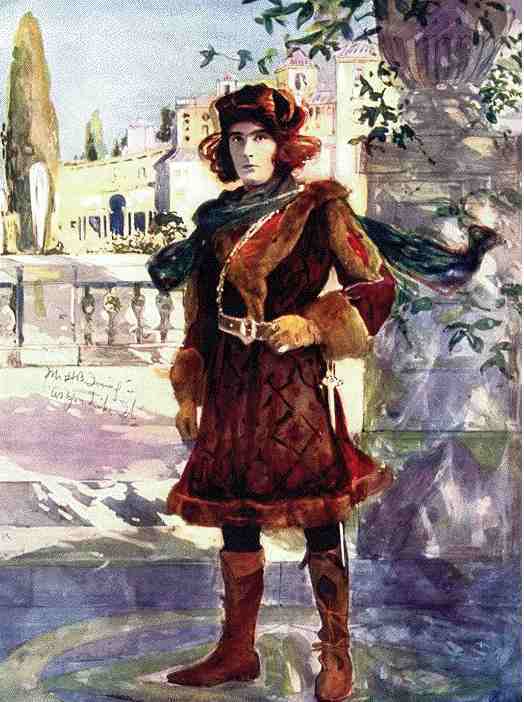
SCENE II. A room in the palace.
Enter DUKE FREDERICK, with Lords
DUKE FREDERICK Can it be possible that no man saw them?
It cannot be: some villains of my court
Are of consent and sufferance in this.
First Lord It cannot be: some villains of my court
Are of consent and sufferance in this.
I cannot hear of any that did see her.
The ladies, her attendants of her chamber,
Saw her abed, and in the morning early
They found the bed untreasured of their mistress.
Second Lord The ladies, her attendants of her chamber,
Saw her abed, and in the morning early
They found the bed untreasured of their mistress.
My lord, the roynish clown, at whom so oft
Your grace was wont to laugh, is also missing.
Hisperia, the princess' gentlewoman,
Confesses that she secretly o'erheard
Your daughter and her cousin much commend
The parts and graces of the wrestler
That did but lately foil the sinewy Charles;
And she believes, wherever they are gone,
That youth is surely in their company.
DUKE FREDERICK Your grace was wont to laugh, is also missing.
Hisperia, the princess' gentlewoman,
Confesses that she secretly o'erheard
Your daughter and her cousin much commend
The parts and graces of the wrestler
That did but lately foil the sinewy Charles;
And she believes, wherever they are gone,
That youth is surely in their company.
Send to his brother; fetch that gallant hither;
If he be absent, bring his brother to me;
I'll make him find him: do this suddenly,
And let not search and inquisition quail
To bring again these foolish runaways.
Exeunt
If he be absent, bring his brother to me;
I'll make him find him: do this suddenly,
And let not search and inquisition quail
To bring again these foolish runaways.
Exeunt
SCENE III. Before OLIVER'S house.
Enter ORLANDO and ADAM, meeting
ORLANDO Who's there?
ADAM
What, my young master? O, my gentle master!
O my sweet master! O you memory
Of old Sir Rowland! why, what make you here?
Why are you virtuous? why do people love you?
And wherefore are you gentle, strong and valiant?
Why would you be so fond to overcome
The bonny priser of the humorous duke?
Your praise is come too swiftly home before you.
Know you not, master, to some kind of men
Their graces serve them but as enemies?
No more do yours: your virtues, gentle master,
Are sanctified and holy traitors to you.
O, what a world is this, when what is comely
Envenoms him that bears it!
ORLANDO O my sweet master! O you memory
Of old Sir Rowland! why, what make you here?
Why are you virtuous? why do people love you?
And wherefore are you gentle, strong and valiant?
Why would you be so fond to overcome
The bonny priser of the humorous duke?
Your praise is come too swiftly home before you.
Know you not, master, to some kind of men
Their graces serve them but as enemies?
No more do yours: your virtues, gentle master,
Are sanctified and holy traitors to you.
O, what a world is this, when what is comely
Envenoms him that bears it!
Why, what's the matter?
ADAM
O unhappy youth!
Come not within these doors; within this roof
The enemy of all your graces lives:
Your brother--no, no brother; yet the son--
Yet not the son, I will not call him son
Of him I was about to call his father--
Hath heard your praises, and this night he means
To burn the lodging where you use to lie
And you within it: if he fail of that,
He will have other means to cut you off.
I overheard him and his practises.
This is no place; this house is but a butchery:
Abhor it, fear it, do not enter it.
ORLANDO Come not within these doors; within this roof
The enemy of all your graces lives:
Your brother--no, no brother; yet the son--
Yet not the son, I will not call him son
Of him I was about to call his father--
Hath heard your praises, and this night he means
To burn the lodging where you use to lie
And you within it: if he fail of that,
He will have other means to cut you off.
I overheard him and his practises.
This is no place; this house is but a butchery:
Abhor it, fear it, do not enter it.
Why, whither, Adam, wouldst thou have me go?
ADAM
No matter whither, so you come not here.
ORLANDO
What, wouldst thou have me go and beg my food?
Or with a base and boisterous sword enforce
A thievish living on the common road?
This I must do, or know not what to do:
Yet this I will not do, do how I can;
I rather will subject me to the malice
Of a diverted blood and bloody brother.
ADAM Or with a base and boisterous sword enforce
A thievish living on the common road?
This I must do, or know not what to do:
Yet this I will not do, do how I can;
I rather will subject me to the malice
Of a diverted blood and bloody brother.
But do not so. I have five hundred crowns,
The thrifty hire I saved under your father,
Which I did store to be my foster-nurse
When service should in my old limbs lie lame
And unregarded age in corners thrown:
Take that, and He that doth the ravens feed,
Yea, providently caters for the sparrow,
Be comfort to my age! Here is the gold;
And all this I give you. Let me be your servant:
Though I look old, yet I am strong and lusty;
For in my youth I never did apply
Hot and rebellious liquors in my blood,
Nor did not with unbashful forehead woo
The means of weakness and debility;
Therefore my age is as a lusty winter,
Frosty, but kindly: let me go with you;
I'll do the service of a younger man
In all your business and necessities.
ORLANDO The thrifty hire I saved under your father,
Which I did store to be my foster-nurse
When service should in my old limbs lie lame
And unregarded age in corners thrown:
Take that, and He that doth the ravens feed,
Yea, providently caters for the sparrow,
Be comfort to my age! Here is the gold;
And all this I give you. Let me be your servant:
Though I look old, yet I am strong and lusty;
For in my youth I never did apply
Hot and rebellious liquors in my blood,
Nor did not with unbashful forehead woo
The means of weakness and debility;
Therefore my age is as a lusty winter,
Frosty, but kindly: let me go with you;
I'll do the service of a younger man
In all your business and necessities.
O good old man, how well in thee appears
The constant service of the antique world,
When service sweat for duty, not for meed!
Thou art not for the fashion of these times,
Where none will sweat but for promotion,
And having that, do choke their service up
Even with the having: it is not so with thee.
But, poor old man, thou prunest a rotten tree,
That cannot so much as a blossom yield
In lieu of all thy pains and husbandry
But come thy ways; well go along together,
And ere we have thy youthful wages spent,
We'll light upon some settled low content.
ADAM The constant service of the antique world,
When service sweat for duty, not for meed!
Thou art not for the fashion of these times,
Where none will sweat but for promotion,
And having that, do choke their service up
Even with the having: it is not so with thee.
But, poor old man, thou prunest a rotten tree,
That cannot so much as a blossom yield
In lieu of all thy pains and husbandry
But come thy ways; well go along together,
And ere we have thy youthful wages spent,
We'll light upon some settled low content.
Master, go on, and I will follow thee,
To the last gasp, with truth and loyalty.
From seventeen years till now almost fourscore
Here lived I, but now live here no more.
At seventeen years many their fortunes seek;
But at fourscore it is too late a week:
Yet fortune cannot recompense me better
Than to die well and not my master's debtor.
Exeunt
To the last gasp, with truth and loyalty.
From seventeen years till now almost fourscore
Here lived I, but now live here no more.
At seventeen years many their fortunes seek;
But at fourscore it is too late a week:
Yet fortune cannot recompense me better
Than to die well and not my master's debtor.
Exeunt
SCENE IV. The Forest of Arden.
Enter ROSALIND for Ganymede, CELIA for Aliena, and TOUCHSTONE
ROSALIND O Jupiter, how weary are my spirits!
TOUCHSTONE
I care not for my spirits, if my legs were not weary.
ROSALIND
I could find in my heart to disgrace my man's
apparel and to cry like a woman; but I must comfort
the weaker vessel, as doublet and hose ought to show
itself courageous to petticoat: therefore courage,
good Aliena!
CELIA apparel and to cry like a woman; but I must comfort
the weaker vessel, as doublet and hose ought to show
itself courageous to petticoat: therefore courage,
good Aliena!
I pray you, bear with me; I cannot go no further.
TOUCHSTONE
For my part, I had rather bear with you than bear
you; yet I should bear no cross if I did bear you,
for I think you have no money in your purse.
ROSALIND you; yet I should bear no cross if I did bear you,
for I think you have no money in your purse.
Well, this is the forest of Arden.
TOUCHSTONE
Ay, now am I in Arden; the more fool I; when I was
at home, I was in a better place: but travellers
must be content.
ROSALIND at home, I was in a better place: but travellers
must be content.
Ay, be so, good Touchstone.
Enter CORIN and SILVIUS
Look you, who comes here; a young man and an old in
solemn talk.
CORIN Enter CORIN and SILVIUS
Look you, who comes here; a young man and an old in
solemn talk.
That is the way to make her scorn you still.
SILVIUS
O Corin, that thou knew'st how I do love her!
CORIN
I partly guess; for I have loved ere now.
SILVIUS
No, Corin, being old, thou canst not guess,
Though in thy youth thou wast as true a lover
As ever sigh'd upon a midnight pillow:
But if thy love were ever like to mine--
As sure I think did never man love so--
How many actions most ridiculous
Hast thou been drawn to by thy fantasy?
CORIN Though in thy youth thou wast as true a lover
As ever sigh'd upon a midnight pillow:
But if thy love were ever like to mine--
As sure I think did never man love so--
How many actions most ridiculous
Hast thou been drawn to by thy fantasy?
Into a thousand that I have forgotten.
SILVIUS
O, thou didst then ne'er love so heartily!
If thou remember'st not the slightest folly
That ever love did make thee run into,
Thou hast not loved:
Or if thou hast not sat as I do now,
Wearying thy hearer in thy mistress' praise,
Thou hast not loved:
Or if thou hast not broke from company
Abruptly, as my passion now makes me,
Thou hast not loved.
O Phebe, Phebe, Phebe!
Exit
ROSALIND If thou remember'st not the slightest folly
That ever love did make thee run into,
Thou hast not loved:
Or if thou hast not sat as I do now,
Wearying thy hearer in thy mistress' praise,
Thou hast not loved:
Or if thou hast not broke from company
Abruptly, as my passion now makes me,
Thou hast not loved.
O Phebe, Phebe, Phebe!
Exit
Alas, poor shepherd! searching of thy wound,
I have by hard adventure found mine own.
TOUCHSTONE I have by hard adventure found mine own.
And I mine. I remember, when I was in love I broke
my sword upon a stone and bid him take that for
coming a-night to Jane Smile; and I remember the
kissing of her batlet and the cow's dugs that her
pretty chopt hands had milked; and I remember the
wooing of a peascod instead of her, from whom I took
two cods and, giving her them again, said with
weeping tears 'Wear these for my sake.' We that are
true lovers run into strange capers; but as all is
mortal in nature, so is all nature in love mortal in folly.
ROSALIND my sword upon a stone and bid him take that for
coming a-night to Jane Smile; and I remember the
kissing of her batlet and the cow's dugs that her
pretty chopt hands had milked; and I remember the
wooing of a peascod instead of her, from whom I took
two cods and, giving her them again, said with
weeping tears 'Wear these for my sake.' We that are
true lovers run into strange capers; but as all is
mortal in nature, so is all nature in love mortal in folly.
Thou speakest wiser than thou art ware of.
TOUCHSTONE
Nay, I shall ne'er be ware of mine own wit till I
break my shins against it.
ROSALIND break my shins against it.
Jove, Jove! this shepherd's passion
Is much upon my fashion.
TOUCHSTONE Is much upon my fashion.
And mine; but it grows something stale with me.
CELIA
I pray you, one of you question yond man
If he for gold will give us any food:
I faint almost to death.
TOUCHSTONE If he for gold will give us any food:
I faint almost to death.
Holla, you clown!
ROSALIND
Peace, fool: he's not thy kinsman.
CORIN
Who calls?
TOUCHSTONE
Your betters, sir.
CORIN
Else are they very wretched.
ROSALIND
Peace, I say. Good even to you, friend.
CORIN
And to you, gentle sir, and to you all.
ROSALIND
I prithee, shepherd, if that love or gold
Can in this desert place buy entertainment,
Bring us where we may rest ourselves and feed:
Here's a young maid with travel much oppress'd
And faints for succor.
CORIN Can in this desert place buy entertainment,
Bring us where we may rest ourselves and feed:
Here's a young maid with travel much oppress'd
And faints for succor.
Fair sir, I pity her
And wish, for her sake more than for mine own,
My fortunes were more able to relieve her;
But I am shepherd to another man
And do not shear the fleeces that I graze:
My master is of churlish disposition
And little recks to find the way to heaven
By doing deeds of hospitality:
Besides, his cote, his flocks and bounds of feed
Are now on sale, and at our sheepcote now,
By reason of his absence, there is nothing
That you will feed on; but what is, come see.
And in my voice most welcome shall you be.
ROSALIND And wish, for her sake more than for mine own,
My fortunes were more able to relieve her;
But I am shepherd to another man
And do not shear the fleeces that I graze:
My master is of churlish disposition
And little recks to find the way to heaven
By doing deeds of hospitality:
Besides, his cote, his flocks and bounds of feed
Are now on sale, and at our sheepcote now,
By reason of his absence, there is nothing
That you will feed on; but what is, come see.
And in my voice most welcome shall you be.
What is he that shall buy his flock and pasture?
CORIN
That young swain that you saw here but erewhile,
That little cares for buying any thing.
ROSALIND That little cares for buying any thing.
I pray thee, if it stand with honesty,
Buy thou the cottage, pasture and the flock,
And thou shalt have to pay for it of us.
CELIA Buy thou the cottage, pasture and the flock,
And thou shalt have to pay for it of us.
And we will mend thy wages. I like this place.
And willingly could waste my time in it.
CORIN And willingly could waste my time in it.
Assuredly the thing is to be sold:
Go with me: if you like upon report
The soil, the profit and this kind of life,
I will your very faithful feeder be
And buy it with your gold right suddenly.
Exeunt
Go with me: if you like upon report
The soil, the profit and this kind of life,
I will your very faithful feeder be
And buy it with your gold right suddenly.
Exeunt
SCENE V. The Forest.
Enter AMIENS, JAQUES, and others
SONG.
AMIENS
Under the greenwood tree
Who loves to lie with me,
And turn his merry note
Unto the sweet bird's throat,
Come hither, come hither, come hither:
Here shall he see No enemy
But winter and rough weather.
JAQUES Who loves to lie with me,
And turn his merry note
Unto the sweet bird's throat,
Come hither, come hither, come hither:
Here shall he see No enemy
But winter and rough weather.
More, more, I prithee, more.
AMIENS
It will make you melancholy, Monsieur Jaques.
JAQUES
I thank it. More, I prithee, more. I can suck
melancholy out of a song, as a weasel sucks eggs.
More, I prithee, more.
AMIENS melancholy out of a song, as a weasel sucks eggs.
More, I prithee, more.
My voice is ragged: I know I cannot please you.
JAQUES
I do not desire you to please me; I do desire you to
sing. Come, more; another stanzo: call you 'em stanzos?
AMIENS sing. Come, more; another stanzo: call you 'em stanzos?
What you will, Monsieur Jaques.
JAQUES
Nay, I care not for their names; they owe me
nothing. Will you sing?
AMIENS nothing. Will you sing?
More at your request than to please myself.
JAQUES
Well then, if ever I thank any man, I'll thank you;
but that they call compliment is like the encounter
of two dog-apes, and when a man thanks me heartily,
methinks I have given him a penny and he renders me
the beggarly thanks. Come, sing; and you that will
not, hold your tongues.
AMIENS but that they call compliment is like the encounter
of two dog-apes, and when a man thanks me heartily,
methinks I have given him a penny and he renders me
the beggarly thanks. Come, sing; and you that will
not, hold your tongues.
Well, I'll end the song. Sirs, cover the while; the
duke will drink under this tree. He hath been all
this day to look you.
JAQUES duke will drink under this tree. He hath been all
this day to look you.
And I have been all this day to avoid him. He is
too disputable for my company: I think of as many
matters as he, but I give heaven thanks and make no
boast of them. Come, warble, come.
SONG.
Who doth ambition shun
All together here
And loves to live i' the sun,
Seeking the food he eats
And pleased with what he gets,
Come hither, come hither, come hither:
Here shall he see No enemy
But winter and rough weather.
JAQUES too disputable for my company: I think of as many
matters as he, but I give heaven thanks and make no
boast of them. Come, warble, come.
SONG.
Who doth ambition shun
All together here
And loves to live i' the sun,
Seeking the food he eats
And pleased with what he gets,
Come hither, come hither, come hither:
Here shall he see No enemy
But winter and rough weather.
I'll give you a verse to this note that I made
yesterday in despite of my invention.
AMIENS yesterday in despite of my invention.
And I'll sing it.
JAQUES
Thus it goes:--
If it do come to pass
That any man turn ass,
Leaving his wealth and ease,
A stubborn will to please,
Ducdame, ducdame, ducdame:
Here shall he see
Gross fools as he,
An if he will come to me.
AMIENS If it do come to pass
That any man turn ass,
Leaving his wealth and ease,
A stubborn will to please,
Ducdame, ducdame, ducdame:
Here shall he see
Gross fools as he,
An if he will come to me.
What's that 'ducdame'?
JAQUES
'Tis a Greek invocation, to call fools into a
circle. I'll go sleep, if I can; if I cannot, I'll
rail against all the first-born of Egypt.
AMIENS circle. I'll go sleep, if I can; if I cannot, I'll
rail against all the first-born of Egypt.
And I'll go seek the duke: his banquet is prepared.
Exeunt severally
Exeunt severally
SCENE VI. The forest.
Enter ORLANDO and ADAM
ADAM Dear master, I can go no further. O, I die for food!
Here lie I down, and measure out my grave. Farewell,
kind master.
ORLANDO Here lie I down, and measure out my grave. Farewell,
kind master.
Why, how now, Adam! no greater heart in thee? Live
a little; comfort a little; cheer thyself a little.
If this uncouth forest yield any thing savage, I
will either be food for it or bring it for food to
thee. Thy conceit is nearer death than thy powers.
For my sake be comfortable; hold death awhile at
the arm's end: I will here be with thee presently;
and if I bring thee not something to eat, I will
give thee leave to die: but if thou diest before I
come, thou art a mocker of my labour. Well said!
thou lookest cheerly, and I'll be with thee quickly.
Yet thou liest in the bleak air: come, I will bear
thee to some shelter; and thou shalt not die for
lack of a dinner, if there live any thing in this
desert. Cheerly, good Adam!
Exeunt
a little; comfort a little; cheer thyself a little.
If this uncouth forest yield any thing savage, I
will either be food for it or bring it for food to
thee. Thy conceit is nearer death than thy powers.
For my sake be comfortable; hold death awhile at
the arm's end: I will here be with thee presently;
and if I bring thee not something to eat, I will
give thee leave to die: but if thou diest before I
come, thou art a mocker of my labour. Well said!
thou lookest cheerly, and I'll be with thee quickly.
Yet thou liest in the bleak air: come, I will bear
thee to some shelter; and thou shalt not die for
lack of a dinner, if there live any thing in this
desert. Cheerly, good Adam!
Exeunt

Similar threads

- Replies
- 41
- Views
- 691


- Replies
- 41
- Views
- 2K


- Replies
- 15
- Views
- 634
