Early periods

 Sigiriya
 Rock Fortress.
Paleolithic human settlements have been discovered at excavations in several cave sites in the Western Plains region and the South-western face of the Central Hills region.
Anthropologists believe that some discovered burial rites and certain decorative artifacts exhibit similarities between the first inhabitants of the island and the early inhabitants of
Southern India.
Recent bioanthropological studies have however dismissed these links, and have placed the origin of the people to the northern parts of India.
One of the first written references to the island is found in the Indian epic Ramayana, which described the emperor
Ravana as monarch of the powerful kingdom of
Lanka, which was created by the divine sculptor
Vishwakarma for
Kubera, the treasurer of the Gods.
[24] English historian
James Emerson Tennent also theorized
Galle, a southern city in Sri Lanka, was the ancient seaport of
Tarshish from which
King Solomon is said to have drawn
ivory,
peacocks and other valuables. The main written accounts of the country's history are the
Buddhist chronicles of
Mahavansa and
Dipavamsa.
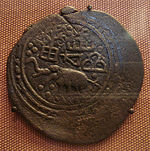
Sri Lankan coin, 1st century CE.
The earliest-known inhabitants of the island now known as Sri Lanka were probably the ancestors of the Wanniyala-Aetto people, also known as Veddahs and numbering roughly 3,000. Linguistic analysis has found a correlation of the
Sinhalese language with the languages of the
Sindh and
Gujarat, although most historians believe that the Sinhala community emerged well after the assimilation of various
ethnic groups. From the ancient period date some remarkable
archaeological sites including the ruins of
Sigiriya, the so-called "Fortress in the Sky", and huge
public works. Among the latter are large "tanks" or
reservoirs, important for conserving water in a climate that alternates rainy seasons with dry times, and elaborate
aqueducts, some with a slope as finely calibrated as one inch to the mile. Ancient Sri Lanka was also the first in the world to have established a dedicated hospital in
Mihintale in the 4th century BCE. Ancient Sri Lanka was also the world's leading exporter of
cinnamon, which was exported to
Egypt as early as 1400
BCE. Sri Lanka was also the first Asian nation to have a female ruler in
Queen Anula (47–42 BC).


 If mahawansha correct wedddas are desenders of Jeewahaththa & Disaala

 .It was a piece of Indian literature to disguise history in favour of the Hindhus( still they failed cos rawana is the hero of ramayana...not Rama)...we have our own references..


