


The History Of Toyota Corolla
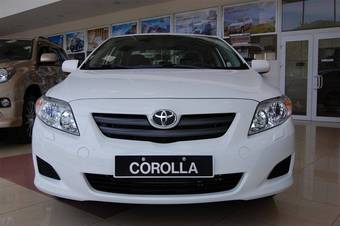

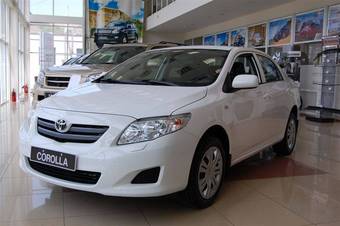
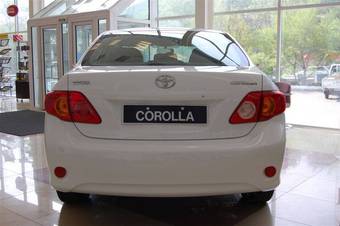
Toyota Corolla
The Corolla is a line of subcompact/compact cars produced by the Japanese automaker Toyota, which has become very popular throughout the world since the nameplate was first introduced in 1966. In 1997, the Corolla became the best selling nameplate in the world, with over 35 million sold as of 2007. Over the past 40 years, one Corolla car has been sold on average every 40 seconds. The modern Corolla shares only the name with the first generation car, as the series has undergone several major redesigns. The current North American Corolla is priced and sized in between the Yaris and the Camry.
The name Corolla is part of Toyota's naming tradition of using the name Crown for their primary models, e.g. the Corona, which is Latin for crown, or the Corolla, which is Latin for small crown and Camry which is an Anglicized pronunciation of the Japanese term "kanmuri" meaning "crown".
Corollas are currently manufactured in Japan, the United States (Fremont, California), the United Kingdom (Derbyshire), Canada (Cambridge, Ontario), Malaysia, China (Tianjin), Taiwan, South Africa, Brazil (Indaiatuba, São Paulo), Turkey, Philippines, Thailand, Venezuela, Pakistan, India and Indonesia.
The Corolla's chassis designation code is "E", as described in Toyota's chassis and engine codes.
The Corolla is a line of subcompact/compact cars produced by the Japanese automaker Toyota, which has become very popular throughout the world since the nameplate was first introduced in 1966. In 1997, the Corolla became the best selling nameplate in the world, with over 35 million sold as of 2007. Over the past 40 years, one Corolla car has been sold on average every 40 seconds. The modern Corolla shares only the name with the first generation car, as the series has undergone several major redesigns. The current North American Corolla is priced and sized in between the Yaris and the Camry.
The name Corolla is part of Toyota's naming tradition of using the name Crown for their primary models, e.g. the Corona, which is Latin for crown, or the Corolla, which is Latin for small crown and Camry which is an Anglicized pronunciation of the Japanese term "kanmuri" meaning "crown".
Corollas are currently manufactured in Japan, the United States (Fremont, California), the United Kingdom (Derbyshire), Canada (Cambridge, Ontario), Malaysia, China (Tianjin), Taiwan, South Africa, Brazil (Indaiatuba, São Paulo), Turkey, Philippines, Thailand, Venezuela, Pakistan, India and Indonesia.
The Corolla's chassis designation code is "E", as described in Toyota's chassis and engine codes.
History
First generation — E10 series
Main article: Toyota Corolla E10 The first Corolla generation was introduced in October 1966 with the new 1100 cc K pushrod engine. The Corolla Sprinter was introduced as the fastback version.

Second generation — E20 series
Main article: Toyota Corolla E20 In May 1970, the E20 was restyled with a more rounded body and the 1400 cc T and 1600 cc 2T OHV engines were added to the range. The now mutually exclusive Corolla and Sprinter names were used to differentiate between two slightly different treatments of sheet metal and trim. The Corolla Levin and Sprinter Trueno names were introduced as the twincam version of the Corolla and Sprinter respectively.

Third generation — E30, E40, E50, E60 series
Main article: Toyota Corolla E30 April 1974 brought rounder, bigger and heavier Corollas and Sprinters. The range was rounded out with the addition of a 2 door liftback. The Corollas were given E30 codes while the Sprinters were given E40 codes. A facelift in March 1976 saw most Corolla E30 models replaced by equivalent E50 models and most Sprinter E40 models were replaced by equivalent E60 models.

Fourth generation — E70 series
Main article: Toyota Corolla E70 A major restyle in March 1979 brought a square edged design. The Corollas had a simpler treatment of the grill, head lights and tail lights while the Sprinter used a slightly more complex, sculptured treatment. The new 3A and 4A SOHC engines were added to the range as a running change. This was the last model to use the K "hicam" and T series of engines.

Fifth generation — E80 series
Main article: Toyota Corolla E80 A sloping front bonnet and a contemporary sharp-edged, no-frills style was brought in during May 1983. The new 1800cc 1C diesel engine was added to the range with the E80 Series. From 1985, re-badged E80 Corollas were sold in the U.S. as the fourth generation Chevrolet Nova. Most models now used the front wheel drive layout except the AE85 and AE86, which were to be the last Corolla's offered in the rear wheel drive or FR layout. The AE85 and AE86 chassis codes were also used for the Sprinter. This model was identical to the Corolla, differing only by minor body styling changes such as 'Pop-Up' front headlights.

Sixth generation — E90 series
Main article: Toyota Corolla E90 A somewhat more rounded and aerodynamic style was used for the E90 introduced in May 1987. Overall this generation has a more refined feel than older Corollas and other older subcompacts. Most models were now front wheel drive, along with a few 4WD All-Trac models. Many engines were used on a wide array of trim levels and models, ranging from the 1.3 liter 2E to the 165horsepower (123kW) supercharged 4A-GZE. The E90 Corolla was also rebadged and sold as the Geo Prizm (US) or Holden Nova (Australia).

Seventh generation — E100 series
Main article: Toyota Corolla E100 In June 1991 Corollas received a redesign to be larger, heavier, and have the completely rounded, aerodynamic shape of the 1990s. The Corolla was now in the compact class, rather than subcompact, and the coupe still available known as Corolla Levin AE101. Refinement reached new levels, as development chief Dr. Akihiko Saito strove to create a "mini-Lexus".

Eighth generation — E110 series
Main article: Toyota Corolla E110 May 1995 saw a minor redesign for the Corolla. External differences from the E100 series were minimal. Evolutionary technological improvements continued, however, and in 1998 non-Japanese Corollas received the new 1ZZ-FE engine. The new engine was the first in a Toyota to have an aluminum engine block and aluminum cylinder heads, which made this generation lighter than the E100 Corolla.

Ninth generation — E120 and E130 series
Main article: Toyota Corolla E120 In November 2000 the ninth generation Corolla was introduced in Japan, with edgier styling and more technology to bring the nameplate into the 21st century. It is also called the Corolla Altis in the ASEAN region. The station wagon model is called the Corolla Fielder in Japan.

Tenth generation — E140 and E150 series
Main article: Toyota Corolla E140 The tenth generation of the Corolla was introduced in October 2006. Japanese markets called it the Corolla Axio, with the ASEAN markets retaining the Altis branding. The station wagon retains the Corolla Fielder name.

If u like my post don't forget to thanks


 Lankawata kiyaapu badu...


