


The atomic clock is not a recent invention. Developed in the 1950's, the traditional caesium based atomic clock has been providing us with accurate time for half a century.
The caesium atomic clock has become the foundation of our time '“ literally. The International System of Units (SI) define a second as a certain number of oscillations of the atom caesium and atomic clocks govern many of the technologies that we live with an use on a daily basis: The internet, satellite navigation, air traffic control and traffic lights to name but a few.
However, recent developments in optical quantum clocks that use single atoms of metals like aluminium or strontium are thousands of times more accurate than traditional atomic clocks. To put this in perspective, the best caesium atomic clock as used by institutes like NIST (National Institute for Standards and Time) or NPL (National Physical Laboratory) to govern the world's global timescale UTC (Coordinated Universal Time), is accurate to within a second every 100 million years. However, these new quantum optical clocks are accurate to a second every 3.4 billion years '“ almost as long as the earth is old.
For most people, their only encounter with an atomic clock is receiving its time signal is a network time server or NTP device (Network Time Protocol) for the purposes of synchronising devices and networks and these atomic clock signals are generated using caesium clocks.
And until the world's scientists can agreed on a single atom to replace caesium and a single clock design for keeping UTC, none of us will be able to take advantage of this incredible accuracy.

FOCS 1, a continuous cold caesium fountain atomic clock in Switzerland, started operating in 2004 at an uncertainty of one second in 30 million years
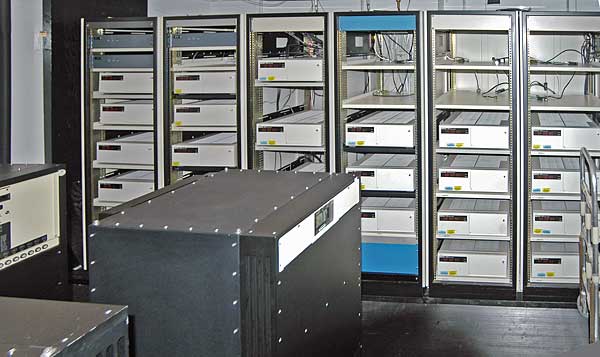
The master atomic clock ensemble at the U.S. Naval Observatory in Washington D.C., which provides the time standard for the USA. The rack mounted units in the background are HP 5071A cesium beam clocks. The black units in the foreground are Sigma-Tau MHM-2010 hydrogen maser standards.
The caesium atomic clock has become the foundation of our time '“ literally. The International System of Units (SI) define a second as a certain number of oscillations of the atom caesium and atomic clocks govern many of the technologies that we live with an use on a daily basis: The internet, satellite navigation, air traffic control and traffic lights to name but a few.
However, recent developments in optical quantum clocks that use single atoms of metals like aluminium or strontium are thousands of times more accurate than traditional atomic clocks. To put this in perspective, the best caesium atomic clock as used by institutes like NIST (National Institute for Standards and Time) or NPL (National Physical Laboratory) to govern the world's global timescale UTC (Coordinated Universal Time), is accurate to within a second every 100 million years. However, these new quantum optical clocks are accurate to a second every 3.4 billion years '“ almost as long as the earth is old.
For most people, their only encounter with an atomic clock is receiving its time signal is a network time server or NTP device (Network Time Protocol) for the purposes of synchronising devices and networks and these atomic clock signals are generated using caesium clocks.
And until the world's scientists can agreed on a single atom to replace caesium and a single clock design for keeping UTC, none of us will be able to take advantage of this incredible accuracy.

FOCS 1, a continuous cold caesium fountain atomic clock in Switzerland, started operating in 2004 at an uncertainty of one second in 30 million years
The master atomic clock ensemble at the U.S. Naval Observatory in Washington D.C., which provides the time standard for the USA. The rack mounted units in the background are HP 5071A cesium beam clocks. The black units in the foreground are Sigma-Tau MHM-2010 hydrogen maser standards.


