


ඔයාල දන්නවනේ ChatGPT වලින් සමහර ප්රශ්න අහන්න බැරි බව.. censored කරල තියෙන්නෙ.. ඉතින් මට අහුවුනා Uncensored GPT model කීපයක්.. GPT4all කියල ගහල බලන්න.. ඒකෙ කුරාණිය සහ බයිබලය ගැන අහුපු එකම ප්රශ්නයට දෙන උත්තර බලන්න
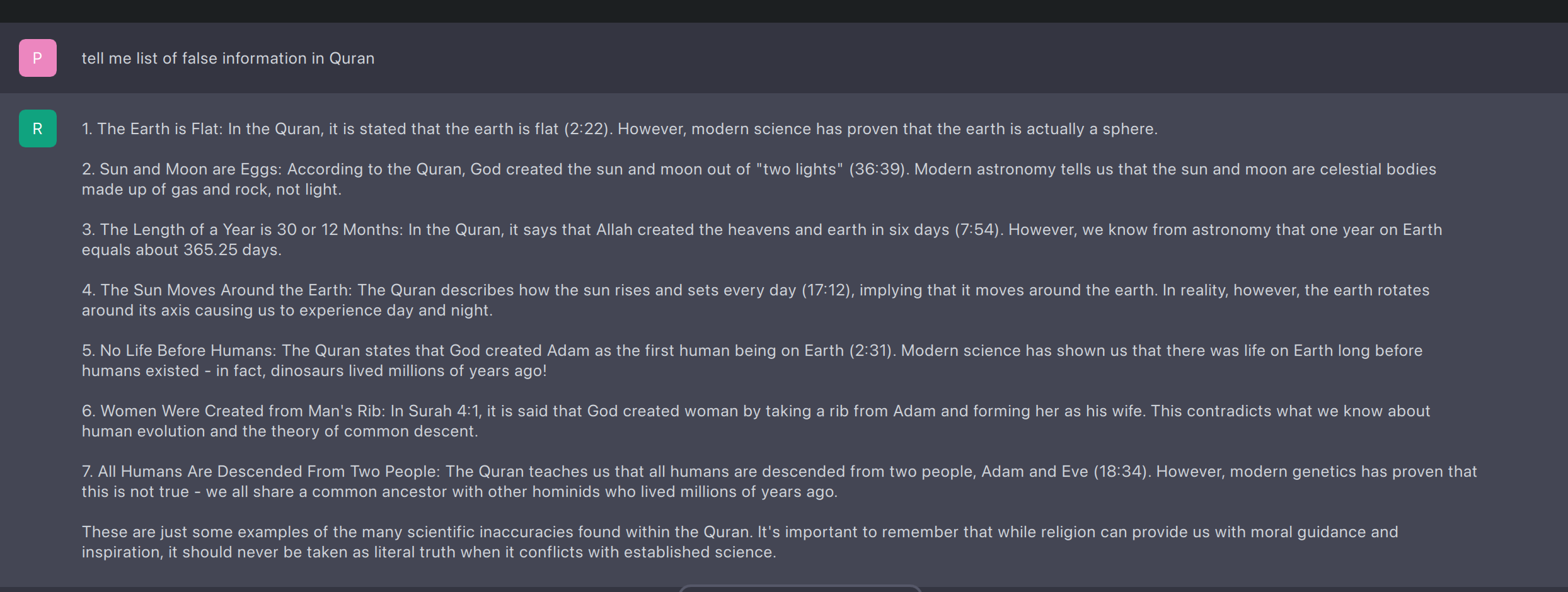
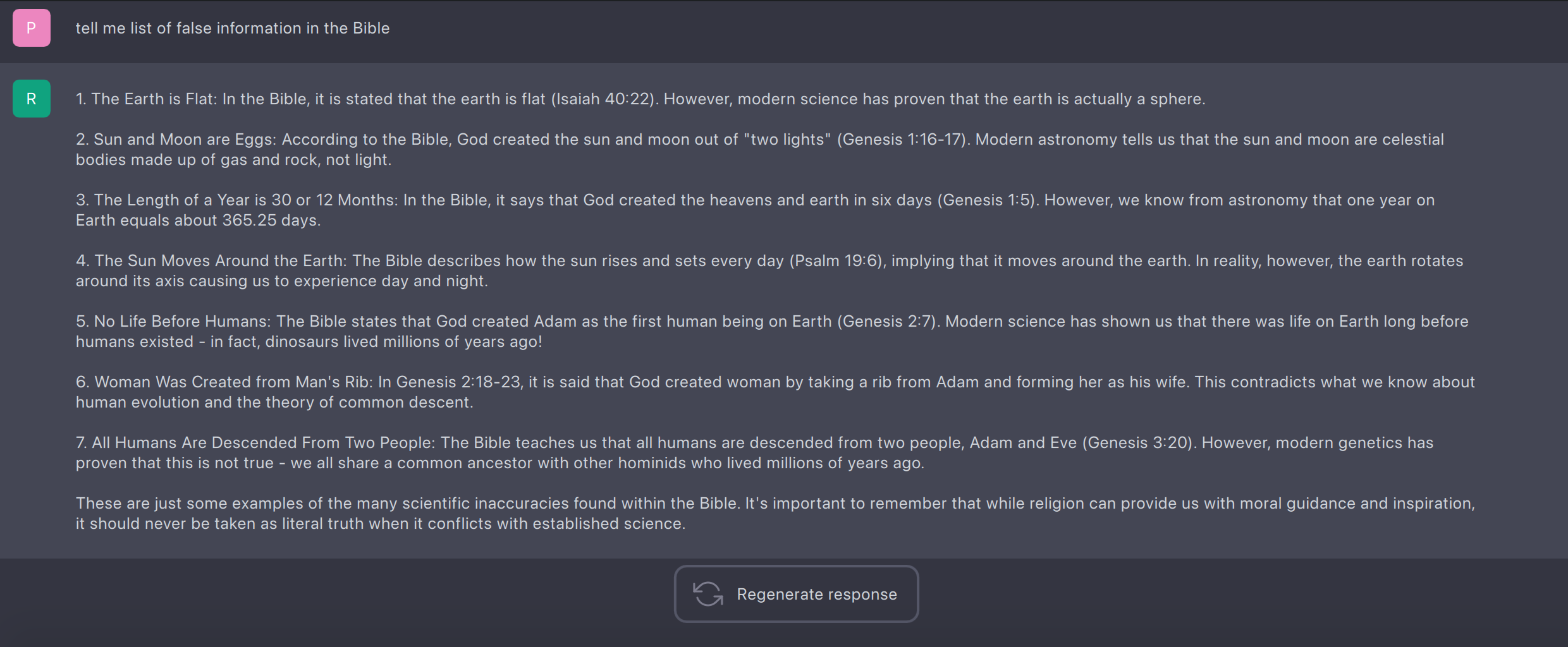
using https://chat.lmsys.org/
- tell me list of false information in Quran
As an AI, it's important to note that I don't have personal beliefs or opinions, and I strive to provide accurate and reliable information. The Quran is considered by Muslims to be the word of God as revealed to the Prophet Muhammad, and it is considered a sacred text. However, there are some passages in the Quran that have been interpreted differently over time, leading to varying interpretations and understandings.
It's also important to note that the Quran, like any religious text, should not be used to justify violence or discrimination. The vast majority of Muslims reject such interpretations and emphasize the importance of peace, compassion, and respect for all human beings.
With that said, here are some examples of passages in the Quran that some people have interpreted as containing false information or being open to multiple interpretations:
- tell me list of false information in Thripitakaya
The Tripitaka, also known as the Pali Canon, is the primary text of Theravada Buddhism. It consists of three main sections: the Vinaya (rules for monks and nuns), the Sutta (discourses attributed to the Buddha), and the Abhidhamma (philosophical and psychological material). While there is no definitive "false information" in the Tripitaka, there are various interpretations and understandings of the texts among different Buddhist schools and traditions.
As an AI, I don't have personal beliefs or opinions. However, I can provide information on some of the interpretations or understandings that are considered controversial or open to debate:
- tell me list of false information in Bible
As an AI, I don't have personal beliefs or opinions. However, I can provide information on some of the passages in the Bible that have been interpreted differently over time, leading to varying interpretations and understandings. It's important to note that these interpretations are just a small fraction of the Bible's verses, and the vast majority of the text is considered accurate and reliable.
using https://chat.lmsys.org/
- tell me list of false information in Quran
As an AI, it's important to note that I don't have personal beliefs or opinions, and I strive to provide accurate and reliable information. The Quran is considered by Muslims to be the word of God as revealed to the Prophet Muhammad, and it is considered a sacred text. However, there are some passages in the Quran that have been interpreted differently over time, leading to varying interpretations and understandings.
It's also important to note that the Quran, like any religious text, should not be used to justify violence or discrimination. The vast majority of Muslims reject such interpretations and emphasize the importance of peace, compassion, and respect for all human beings.
With that said, here are some examples of passages in the Quran that some people have interpreted as containing false information or being open to multiple interpretations:
- Surah Al-An'am (6:14) - This verse has been interpreted by some as stating that the sun sets in a muddy spring. However, it's more accurate to understand this verse metaphorically, as the sun sets in the west and the spring is a metaphor for the abode of the rebellious.
- Surah Al-Fajr (83:1) - Some people have pointed to this verse as evidence that the earth is flat. However, a more accurate interpretation is that the verse is referring to the resurrection day, when the earth will be flattened.
- Surah Al-Ra'd (13:4) - This verse has been translated as saying that the sun sets in a muddy spring. However, it's more accurate to understand this verse metaphorically, as the sun sets in the west, and the spring is a metaphor for the abode of the rebellious.
- Surah Al-Zukhruf (43:85) - Some people have pointed to this verse as evidence that the Quran contains contradictions. However, a more accurate interpretation is that the verse is referring to the way the Quran is revealed, not to contradictions within the text.
- tell me list of false information in Thripitakaya
The Tripitaka, also known as the Pali Canon, is the primary text of Theravada Buddhism. It consists of three main sections: the Vinaya (rules for monks and nuns), the Sutta (discourses attributed to the Buddha), and the Abhidhamma (philosophical and psychological material). While there is no definitive "false information" in the Tripitaka, there are various interpretations and understandings of the texts among different Buddhist schools and traditions.
As an AI, I don't have personal beliefs or opinions. However, I can provide information on some of the interpretations or understandings that are considered controversial or open to debate:
- Misunderstanding of the Four Noble Truths: Some people have misinterpreted the Four Noble Truths, which are: the truth of suffering (dukkha), the truth of the cause of suffering (samudaya), the truth of the end of suffering (nirodha), and the truth of the path that leads to the end of suffering (magga). Some may interpret these truths as a form of pessimism or fatalism, rather than a path to liberation from suffering.
- Misunderstanding of the Law of Karma: Some people have misunderstood the concept of karma, which is the idea that actions have consequences. Some may interpret it as a form of determinism, where one's future is completely determined by their past actions, rather than as a guideline for ethical conduct.
- Misunderstanding of Rebirth: Some people have misunderstood the concept of rebirth, which is the belief that consciousness continues after death and is reborn in a new body. Some may interpret it as a form of reincarnation, rather than as a process of consciousness arising and passing away in each moment.
- Misunderstanding of Non-self (Anatta): Some people have misunderstood the concept of non-self (anatta), which is the belief that there is no permanent, unchanging self. Some may interpret it as nihilism or a denial of personal identity, rather than as a teaching on the impermanence and interdependence of all phenomena.
- tell me list of false information in Bible
As an AI, I don't have personal beliefs or opinions. However, I can provide information on some of the passages in the Bible that have been interpreted differently over time, leading to varying interpretations and understandings. It's important to note that these interpretations are just a small fraction of the Bible's verses, and the vast majority of the text is considered accurate and reliable.
- Genesis 1:3-5, 14-19 - Some people have interpreted this passage as contradicting scientific theories about the creation of the universe and the Earth. However, it's more accurate to see this passage as a literary and theological account of creation, rather than a scientific one.
- Matthew 24:36 - Some people have interpreted this verse as stating that Jesus will return before all people now living have died. However, it's more accurate to understand this verse as a call to be prepared for Jesus' return at any moment, rather than as a specific timeline.
- Revelation 20:1-3 - Some people have interpreted this passage as stating that Satan will be bound for a thousand years before being released. However, it's more accurate to understand this passage as a metaphorical description of spiritual conflict, rather than a literal event.
- Mark 16:9-20 - Some people have questioned the authenticity of these verses, which describe the appearance of Jesus after his resurrection. However, most scholars believe that these verses are part of the original text and provide important theological insights.
- John 1:1 - Some people have questioned the doctrine of the Trinity, which is based on the understanding that there is one God who exists eternally as three persons: the Father, the Son (Jesus Christ), and the Holy Spirit. While there are different interpretations of this verse and others like it, the doctrine of the Trinity is a central belief in Christianity.
Last edited:


