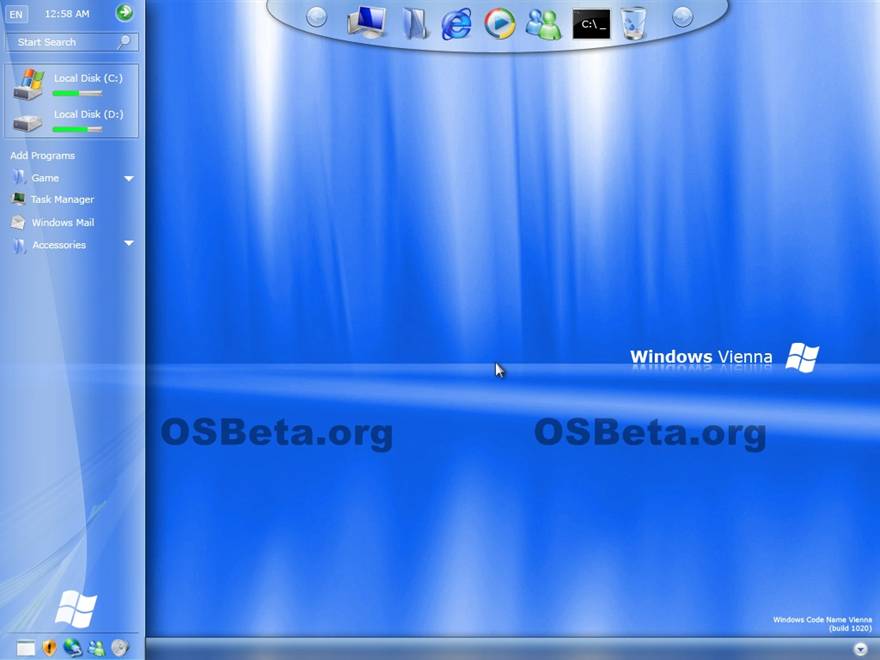
Windows 7 (formerly known as Blackcomb and Vienna) is the working name for the next major
version of Microsoft Windows as the successor of Windows Vista. Microsoft has announced
that it is "scoping Windows 7 development to a three-year timeframe", and that "the specific
release date will ultimately be determined by meeting the quality bar."[2] Windows 7 is
expected to be released sometime in 2010.The client versions of Windows 7 will ship in
both 32-bit and 64-bit versions.A server variant, codenamed Windows Server 7, is also
under development.
Features
According to reports sent to TG Daily, the build adds support for systems using multiple heterogeneous
graphics cards and a new version of Windows Media Center. New features in Milestone 1 also reportedly
include Gadgets being integrated into Windows Explorer, a Gadget for Windows Media Center, the ability to
visually pin and unpin items from the Start Menu and Recycle Bin, improved media features, a new XPS Viewer,
and the Calculator accessory featuring Programmer and Statistics modes along with unit conversion.
Reports indicate that a feedback tool included in Milestone 1 lists some coming features: the ability to store
Internet Explorer settings on a Windows Live account, updated versions of Paint and WordPad, and a 10 minute
install process. In addition, improved network connection tools might be included.
A new feature in build 6574, Windows Health Center, allows the user to monitor all of his PC's health problems,
and concerns in one place. It allows turning User Account Control on and off, and monitoring 3rd party anti-virus
programs, firewalls, etc.
Windows Vienna & IE 8 features Leaked
Some details of Microsoft internal blueprints for so called “Windows Vienna” and “Internet Explorer 8” managed
to get leaked on the Internet.
Reading the blueprints gives you an idea about how the inside of Microsoft works. It seems Microsoft is well aware
about the existence of Firefox and Linux and plan to leverage their technologies in their new products, and they
aren't the least bit secretive about it (at least internally).
Some features planned for Internet Explorer 8 include “undo close tab (like Firefox)”, and “saving and restoring sessions
(like Firefox)”. For Windows Vienna, expect
“virtual desktops(like Linux)”, and “the ability to rearrange items on the task bar”. Keep in mind attributions are
copied verbatim from Microsoft's task list. In an interesting move Microsoft will make the next version of Windows
theming completely customizable, the internal e-mail says.
The most interesting about the new version of Windows is virtualization will be prominent for “legacy apps”, all
applications not specifically written for Window Vienna or in .NET will be run on a separate virtual machine. This is
comparable to how Mac OS X handled Mac OS 9. Windows Vienna will also feature “Windows Core”, the ability to separate
GUI and console from each other as in Windows Server 2008.
Expect to see “Windows Vienna” on store shelves some time in 2009. The final name, however, has not been revealed.