


Contents of the Voyager Golden Record
The contents of the Voyager Golden Record is a collection of 116 images and a variety of natural sounds, such as those made by surf, wind, and thunder, and animal sounds, including the songs of birds and whales. To this they added musical selections from different cultures and eras, spoken greetings in fifty-five languages, and printed messages from President Jimmy Carter and U.N. Secretary-General Kurt Waldheim. The items were selected for NASA by a committee chaired by Carl Sagan of Cornell University.
After NASA had received criticism over the nudity on the Pioneer plaque (line drawings of a naked man and woman), the agency chose not to allow Sagan and his colleagues to include a photograph of a nude man and woman on the record. Instead, only a silhouette of the couple was included.[1]
Here is an excerpt of President Carter's official statement placed on the Voyager spacecraft for its trip outside our solar system, June 16, 1977:
We cast this message into the cosmos ... Of the 200 billion stars in the Milky Way galaxy, some — perhaps many — may have inhabited planets and space faring civilizations. If one such civilization intercepts Voyager and can understand these recorded contents, here is our message: We are trying to survive our time so we may live into yours. We hope some day, having solved the problems we face, to join a community of Galactic Civilizations. This record represents our hope and our determination and our goodwill in a vast and awesome universe.
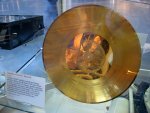
A copy of the record on display at the Udvar-Hazy Center in Washington Dulles International Airport
Greetings
The first audio section contains spoken greetings in the following 55 languages,[2] including 4 Chinese dialects (marked with **), 12 South Asian languages (marked #) and 5 ancient languages (marked §) listed here in alphabetical order
Akkadian§
Ancient Greek§
Amoy**
Arabic
Aramaic
Armenian
Bengali#
Burmese
Cantonese**
Czech
Dutch
English
French
German
Gujarati#
Hebrew
Hindi#
Hittite§
Hungarian
Ila (Zambia)
Indonesian
Italian
Japanese
Kannada#
Korean
Latin§
Luganda
Mandarin**
Marathi#
Nepali#
Nguni
Nyanja
Oriya#
Persian
Polish
Portuguese
Punjabi#
Quechua
Rajasthani#
Romanian
Russian
Serbian
Sinhalese#
Sotho
Spanish
Sumerian§
Swedish
Telugu#
Thai
Turkish
Ukrainian
Urdu#
Vietnamese
Welsh
Wu**
Sounds
The next audio section is devoted to the "sounds of Earth" that include[4]:
"Music of the Spheres" - a rather unfortunate and unhelpful title under the circumstances, this is actually a translation into audible sound of random signals received from various NASA spacecraft around the solar system.
Volcanoes, Earthquake, Thunder
Mud Pots
Wind, Rain, Surf
Crickets, Frogs
Birds, Hyena, Elephant
Whale song
Chimpanzee
Wild Dog[disambiguation needed]
Footsteps, Heartbeat, Laughter
The First Tools
Tame Dog
Herding Sheep, Birdsong, Blacksmith, Sawing
Tractor, Riveter
Morse Code, Ships (precisely, a ship's horn)
Horse and Cart
Train
Tractor, Bus, Auto
F-111 Flyby, Saturn V Lift-off
Kiss, Mother and Child
Life Signs, Pulsar
Included within the Sounds of Earth audio portion of the Golden Record is a track containing the inspirational message per aspera ad astra in Morse Code. Translated from Latin, it means, through hardships to the stars.
Voyager Golden Record
The Voyager Golden Records are phonograph records which were included aboard both Voyager spacecraft, which were launched in 1977. They contain sounds and images selected to portray the diversity of life and culture on Earth, and are intended for any intelligent extraterrestrial life form, or for future humans, who may find them. The Voyager spacecraft are not heading towards any particular star, but Voyager 1 will be within 1.6 light years of the star AC+79 3888 in the Ophiuchus constellation in about 40,000 years.[1]
As the probes are extremely small compared to the vastness of interstellar space, the probability of a space faring civilization encountering them is very small, especially since the probes will eventually stop emitting any kind of electromagnetic radiation. If they are ever found by an alien species, it will most likely be far in the future as the nearest star on Voyager 1's trajectory will only be reached in 40,000 years.
As Carl Sagan (1934-1996) noted, "The spacecraft will be encountered and the record played only if there are advanced space-faring civilizations in interstellar space. But the launching of this 'bottle' into the cosmic 'ocean' says something very hopeful about life on this planet."[2] Thus the record is best seen as a time capsule or a symbolic statement rather than a serious attempt to communicate with extraterrestrial life.
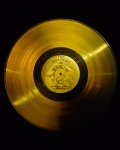
The Voyager Golden Record
Cover of the Voyager Golden Record
Contents
The contents of the record were selected for NASA by a committee chaired by Carl Sagan of Cornell University. Dr. Sagan and his associates assembled 116 images and a variety of natural sounds, such as those made by surf, wind, and thunder, and animal sounds, including the songs of birds and whales. To this they added musical selections from different cultures and eras, spoken greetings in fifty-five languages, and printed messages from President Jimmy Carter and U.N. Secretary-General Kurt Waldheim.
The collection of images includes many photographs and diagrams both in black and white and color. The first images are of scientific interest, showing mathematical and physical quantities, the solar system and its planets, DNA, and human anatomy and reproduction. Care was taken to include not only pictures of humanity, but also some of animals, insects, plants and landscapes. Images of humanity depict a broad range of cultures. These images show food, architecture, and humans in portraits as well as going about their day to day lives. Many pictures are annotated with one or more indications of scales of time, size, or mass. Some images contain indications of chemical composition. All measures used on the pictures are defined in the first few images using physical references that are likely to be consistent anywhere in the universe.
The musical selection is also varied, featuring artists such as Beethoven, Guan Pinghu, Mozart, and Stravinsky and Chuck Berry.
After NASA had received criticism over the nudity on the Pioneer plaque (line drawings of a naked man and woman), the agency chose not to allow Sagan and his colleagues to include a photograph of a nude man and woman on the record. Instead, only a silhouette of the couple was included.[3]
The pulsar map and hydrogen molecule diagram are shared in common with the Pioneer plaque.
The 116 images are encoded in analogue form and composed of 512 vertical lines. The remainder of the record is audio, designed to be played at 16⅔ revolutions per minute.
Playback
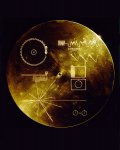
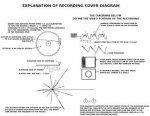
In the upper left-hand corner is an easily recognized drawing of the phonograph record and the stylus carried with it. The stylus is in the correct position to play the record from the beginning. Written around it in binary arithmetic is the correct time of one rotation of the record, 3.6 seconds, expressed in time units of 0.70 billionths of a second, the time period associated with a fundamental transition of the hydrogen atom. The drawing indicates that the record should be played from the outside in. Below this drawing is a side view of the record and stylus, with a binary number giving the time to play one side of the record - about an hour.
The information in the upper right-hand portion of the cover is designed to show how pictures are to be constructed from the recorded signals. The top drawing shows the typical signal that occurs at the start of a picture. The picture is made from this signal, which traces the picture as a series of vertical lines, similar to ordinary television (in which the picture is a series of horizontal lines). Picture lines 1, 2 and 3 are noted in binary numbers, and the duration of one of the "picture lines," about 8 milliseconds, is noted. The drawing immediately below shows how these lines are to be drawn vertically, with staggered "interlace" to give the correct picture rendition. Immediately below this is a drawing of an entire picture raster, showing that there are 512 vertical lines in a complete picture. Immediately below this is a replica of the first picture on the record to permit the recipients to verify that they are decoding the signals correctly. A circle was used in this picture to ensure that the recipients use the correct ratio of horizontal to vertical height in picture reconstruction.
The drawing in the lower left-hand corner of the cover is the pulsar map previously sent as part of the plaques on Pioneers 10 and 11. It shows the location of the solar system with respect to 14 pulsars, whose precise periods are given. The drawing containing two circles in the lower right-hand corner is a drawing of the hydrogen atom in its two lowest states, with a connecting line and digit 1 to indicate that the time interval associated with the transition from one state to the other is to be used as the fundamental time scale, both for the time given on the cover and in the decoded pictures.
Materials
The record is constructed of gold-plated copper. The record's cover is aluminium and electroplated upon it is an ultra-pure sample of the isotope uranium-238. Uranium-238 has a half-life of 4.51 billion years. It is possible that a civilization that encounters the record will be able to use the ratio of remaining uranium to daughter elements to determine the age of the record.
The records also had the sentence "To the makers of music — all worlds, all times" handwritten on them. Since this was not in the original disc specification, it almost caused their rejection
Journey
Voyager 1 was launched in 1977, passed the orbit of Pluto in 1990, and left the solar system (in the sense of passing the termination shock) in November 2004. It is now in empty space. In about 40,000 years, it and Voyager 2 will each come to within about 1.7 light-years of two separate stars: Voyager 1 will have approached star AC+79 3888, located in the constellation Ophiuchus; and Voyager 2 will have approached star Ross 248, located in the constellation of Andromeda.
In August 2009, Voyager 1 was over 16.5 billion km from the Sun and traveling at a speed of 3.5 AU per year (approximately 61,000 km/h, or 38,000 mph) while Voyager 2 was well over 13 billion km away and moving at about 3.3 AU per year (approximately 56,000 km/h, or 35,000 mph).
Voyager 1 has entered the heliosheath, the region beyond the termination shock. The termination shock is where the solar wind, a thin stream of electrically charged gas blowing continuously outward from the Sun, is slowed by pressure from gas between the stars. At the termination shock, the solar wind slows abruptly from its average speed of 300 to 700 km per second (700,000–1,500,000 miles per hour) and becomes denser and hotter.[6]
As Carl Sagan noted, "The spacecraft will be encountered and the record played only if there are advanced space-faring civilizations in interstellar space. But the launching of this 'bottle' into the cosmic 'ocean' says something very hopeful about life on this planet."
Reference
http://en.wikipedia.org/wiki/Contents_of_the_Voyager_Golden_Record
Attachments
Last edited:


