
Latest ads
-
 RHCSA, RHCE, AWS, Docker, Kubernetes Training
- Sanjeewani95
- Updated:
-
 🛡️ Kaspersky Antivirus – 1 Year / 1 Device | Rs. 2,300 | Only 9 Left
- KSPathirana
- Updated:
-
Professional CCTV Installation Service
- Techguy231
- Updated:
-
I'll research & write an article - Rs. 2000 onwards
- Blogerwiki
- Updated:
-
 House Plan
- lenura
- Updated:
You are using an out of date browser. It may not display this or other websites correctly.
You should upgrade or use an alternative browser.
You should upgrade or use an alternative browser.


Zeus said:one of my ever loving weapon this fight presented wi the gold jubilee of USA air force and theres a PC game for this also prduced by Novalogic( producer of Delta force -my fav game complany)
And also there many secret technologies which make ppl to think that there is Alien touch
macho F-22 eka gana vidio clip ekak meke thiyenawa{http://www.af.mil/shared/media/av/main.html?showid=388} balapan
thawa godak clips thiyenawa ewath balanna


F-4 Phantom II

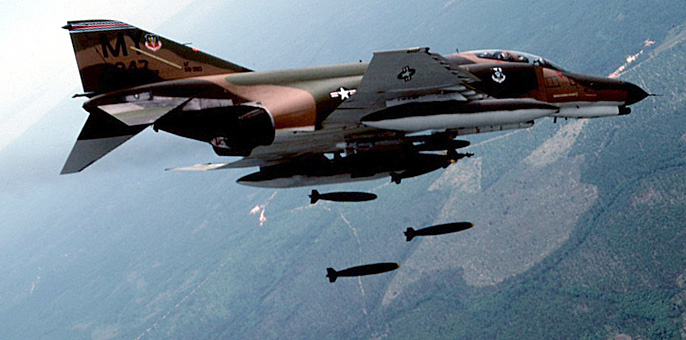
The McDonnell Douglas F-4 Phantom II[1][2] is a two-seat, twin-engined, all-weather, long-range supersonic fighter-bomber originally developed for the U.S. Navy by McDonnell Aircraft.[2] Proving highly adaptable, it became a major part of the air wings of the U.S. Navy, U.S. Marine Corps, and U.S. Air Force.[3] It was used extensively by all three of these services during the Vietnam War, serving as the principal air superiority fighter for both the Navy and Air Force, as well as being important in the ground-attack and reconnaissance roles by the close of U.S. involvement in the war.[3]

The McDonnell Douglas F-4 Phantom II[1][2] is a two-seat, twin-engined, all-weather, long-range supersonic fighter-bomber originally developed for the U.S. Navy by McDonnell Aircraft.[2] Proving highly adaptable, it became a major part of the air wings of the U.S. Navy, U.S. Marine Corps, and U.S. Air Force.[3] It was used extensively by all three of these services during the Vietnam War, serving as the principal air superiority fighter for both the Navy and Air Force, as well as being important in the ground-attack and reconnaissance roles by the close of U.S. involvement in the war.[3]

Northrop F-5 Tiger
The F-5 started life as a privately-funded light fighter program by Northrop in the 1950s. The first generation F-5A Freedom Fighter entered service in the 1960s. Over 800 were produced through 1972 for U.S. allies during the Cold War. The USAF had no need for a light fighter, but it did need a supersonic trainer and procured about 1,200 of a derivative airframe for this purpose, the T-38 Talon.

The improved second-generation F-5E Tiger II was also primarily used by American Cold War allies and, in limited quantities, served in US military aviation as a training and aggressor aircraft; Tiger II production amounted to 1,400 of all versions, with production ending in 1987. Many F-5s continuing in service into the 1990s and 2000s have undergone a wide variety of upgrade programs to keep pace with the changing combat environment. The F-5 was also developed into a dedicated reconnaissance version, the RF-5 Tigereye.
The F-5 started life as a privately-funded light fighter program by Northrop in the 1950s. The first generation F-5A Freedom Fighter entered service in the 1960s. Over 800 were produced through 1972 for U.S. allies during the Cold War. The USAF had no need for a light fighter, but it did need a supersonic trainer and procured about 1,200 of a derivative airframe for this purpose, the T-38 Talon.

The improved second-generation F-5E Tiger II was also primarily used by American Cold War allies and, in limited quantities, served in US military aviation as a training and aggressor aircraft; Tiger II production amounted to 1,400 of all versions, with production ending in 1987. Many F-5s continuing in service into the 1990s and 2000s have undergone a wide variety of upgrade programs to keep pace with the changing combat environment. The F-5 was also developed into a dedicated reconnaissance version, the RF-5 Tigereye.
F-20 Tigershark

Northrop attempted to develop an advanced version of the F-5E, originally designated F-5G, as an export competitor for the F-16 Fighting Falcon. The F-5G was later redesignated the F-20 Tigershark. It received favorable reviews as a less expensive but capable alternative to early-block variants of the F-16 (and superior to the similarly never-purchased export variant F-16/79), but it never had the appeal of the much newer fighter design even at a lower cost.

Northrop attempted to develop an advanced version of the F-5E, originally designated F-5G, as an export competitor for the F-16 Fighting Falcon. The F-5G was later redesignated the F-20 Tigershark. It received favorable reviews as a less expensive but capable alternative to early-block variants of the F-16 (and superior to the similarly never-purchased export variant F-16/79), but it never had the appeal of the much newer fighter design even at a lower cost.
F-16 Fighting Falcon
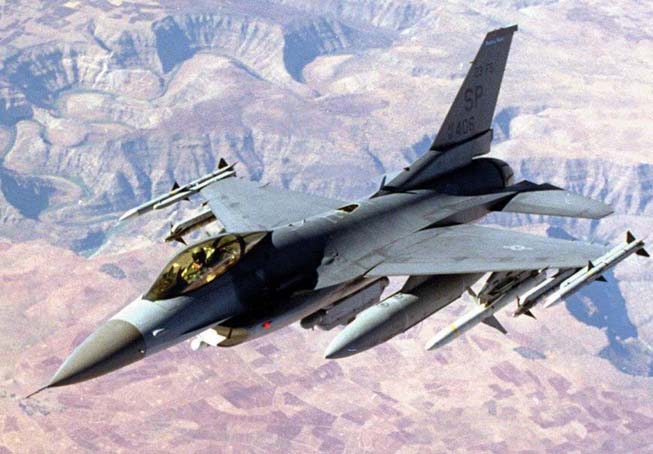
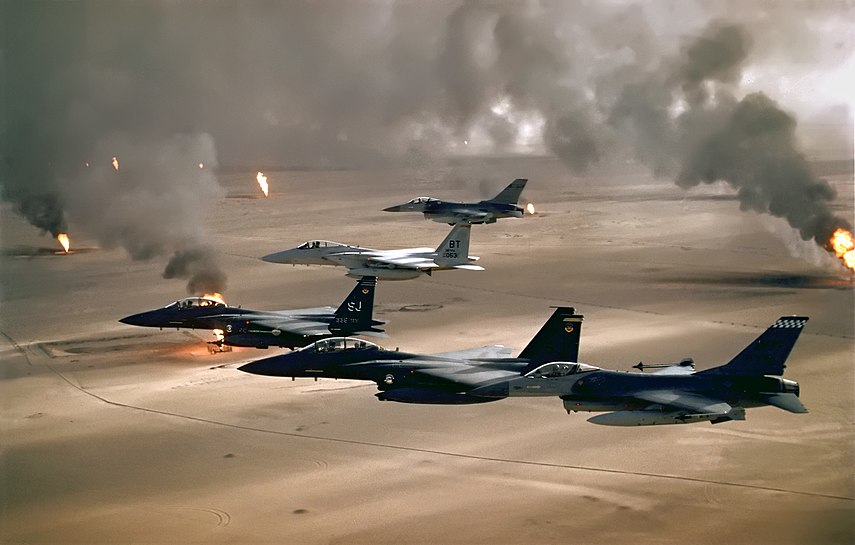

In an air combat role, the F-16's maneuverability and combat radius (distance it can fly to enter air combat, stay, fight and return) exceed that of all potential threat fighter aircraft. It can locate targets in all weather conditions and detect low flying aircraft in radar ground clutter.
In an air-to-surface role, the F-16 can fly more than 500 miles (860 kilometers), deliver its weapons with superior accuracy, defend itself against enemy aircraft, and return to its starting point. An all-weather capability allows it to accurately deliver ordnance during non-visual bombing conditions.
In designing the F-16, advanced aerospace science and proven reliable systems from other aircraft such as the F-15 and F-111 were selected. These were combined to simplify the airplane and reduce its size, purchase price, maintenance costs and weight. The light weight of the fuselage is achieved without reducing its strength. The F-16 can withstand up to nine G's -- nine times the force of gravity -- with internal fuel tanks filled greater than any other current fighter aircraft.
The cockpit and its bubble canopy give the pilot unobstructed forward and upward vision, and greatly improved vision over the side and to the rear. The seat-back angle was expanded from the usual 13 degrees to 30 degrees, increasing pilot comfort and gravity force tolerance.

In an air combat role, the F-16's maneuverability and combat radius (distance it can fly to enter air combat, stay, fight and return) exceed that of all potential threat fighter aircraft. It can locate targets in all weather conditions and detect low flying aircraft in radar ground clutter.
In an air-to-surface role, the F-16 can fly more than 500 miles (860 kilometers), deliver its weapons with superior accuracy, defend itself against enemy aircraft, and return to its starting point. An all-weather capability allows it to accurately deliver ordnance during non-visual bombing conditions.
In designing the F-16, advanced aerospace science and proven reliable systems from other aircraft such as the F-15 and F-111 were selected. These were combined to simplify the airplane and reduce its size, purchase price, maintenance costs and weight. The light weight of the fuselage is achieved without reducing its strength. The F-16 can withstand up to nine G's -- nine times the force of gravity -- with internal fuel tanks filled greater than any other current fighter aircraft.
The cockpit and its bubble canopy give the pilot unobstructed forward and upward vision, and greatly improved vision over the side and to the rear. The seat-back angle was expanded from the usual 13 degrees to 30 degrees, increasing pilot comfort and gravity force tolerance.
F-15 Eagle

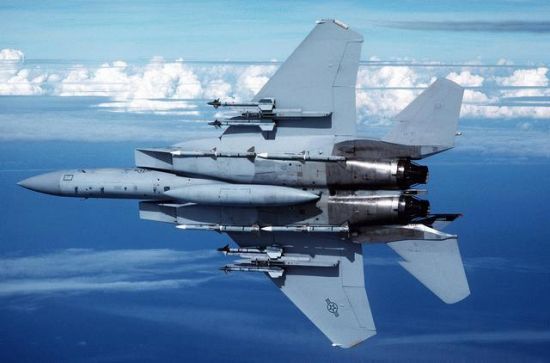
The F-15 Eagle is an all-weather, extremely maneuverable, tactical fighter designed to gain and maintain air superiority in aerial combat.
The Eagle's air superiority is achieved through a mixture of unprecedented maneuverability and acceleration, range, weapons and avionics. It can penetrate enemy defense and outperform and outfight any current or projected enemy aircraft. The F-15 has electronic systems and weaponry to detect, acquire, track and attack enemy aircraft while operating in friendly or enemy-controlled airspace. Its weapons and flight control systems are designed so one person can safely and effectively perform air-to-air combat.
The F-15's superior maneuverability and acceleration are achieved through high engine thrust-to-weight ratio and low wing loading. Low wing-loading (the ratio of aircraft weight to its wing area) is a vital factor in maneuverability and, combined with the high thrust-to-weight ratio, enables the aircraft to turn tightly without losing airspeed.
A multimission avionics system sets the F-15 apart from other fighter aircraft. It includes a head-up display, advanced radar, inertial navigation system, flight instruments, UHF communications, tactical navigation system and instrument landing system. It also has an internally mounted, tactical electronic-warfare system, "identification friend or foe" system, electronic countermeasures set and a central digital computer.
Through an on-going multistage improvement program the F-15 is receiving extensive upgrade involving the installation or modification of new and existing avionics equipment to enhance the tactical capabilities of the F-15.
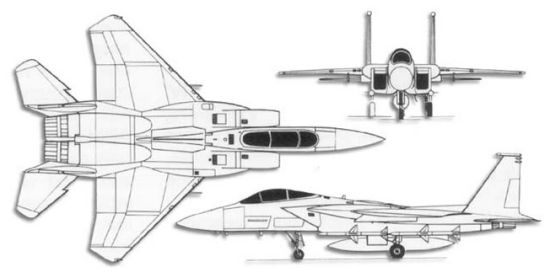


The F-15 Eagle is an all-weather, extremely maneuverable, tactical fighter designed to gain and maintain air superiority in aerial combat.
The Eagle's air superiority is achieved through a mixture of unprecedented maneuverability and acceleration, range, weapons and avionics. It can penetrate enemy defense and outperform and outfight any current or projected enemy aircraft. The F-15 has electronic systems and weaponry to detect, acquire, track and attack enemy aircraft while operating in friendly or enemy-controlled airspace. Its weapons and flight control systems are designed so one person can safely and effectively perform air-to-air combat.
The F-15's superior maneuverability and acceleration are achieved through high engine thrust-to-weight ratio and low wing loading. Low wing-loading (the ratio of aircraft weight to its wing area) is a vital factor in maneuverability and, combined with the high thrust-to-weight ratio, enables the aircraft to turn tightly without losing airspeed.
A multimission avionics system sets the F-15 apart from other fighter aircraft. It includes a head-up display, advanced radar, inertial navigation system, flight instruments, UHF communications, tactical navigation system and instrument landing system. It also has an internally mounted, tactical electronic-warfare system, "identification friend or foe" system, electronic countermeasures set and a central digital computer.
Through an on-going multistage improvement program the F-15 is receiving extensive upgrade involving the installation or modification of new and existing avionics equipment to enhance the tactical capabilities of the F-15.

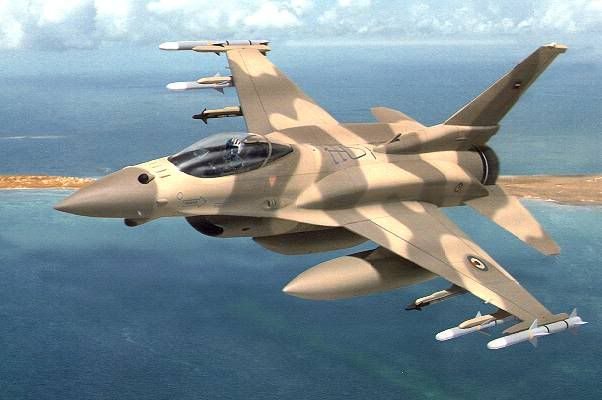

F-111 Aadvark
The F-111 is a multipurpose tactical fighter bomber capable of supersonic speeds. It can operate from tree-top level to altitudes above 60,000 feet (18,200 meters).
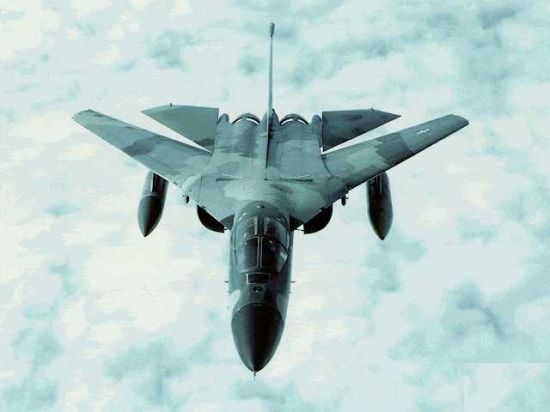
The F-111 has variable-sweep wings that allow the pilot to fly from slow approach speeds to supersonic velocity at sea level and more than twice the speed of sound at higher altitudes. Wings angle from 16 degrees (full forward) to 72.5 degrees (full aft). Full-forward wings give the most surface area and maximum lift for short takeoff and landing. The F-111 needs no drag chute or reserve thrust to slow down after landing.
Background
The F-111A first flew in December 1964. The first operational aircraft was delivered in October 1967 to Nellis Air Force Base, Nev. A models were used for tactical bombing in Southeast Asia.
Developed for the U.S. Navy, the F-111B was canceled before its production . F-111C's are flown by the Royal Australian Air Force.The F-111D has improved avionics with better navigation, air-to-air weapon delivery systems, and newer turbofan engines. The F-111D's are flown by the 27th Fighter Wing, Cannon Air Force Base, N.M.
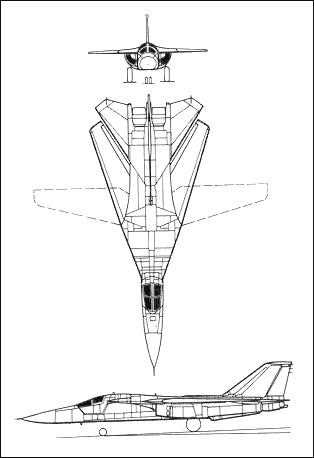
The E model has modified air intakes to improve the engine's performance at speeds above Mach 2.2. Most F-111Es serve with the 20th Fighter Wing, Royal Air Force Station Upper Heyford, England, to support NATO. F-111E's were deployed to Incirlik Air Base, Turkey, and were used in Operation Desert Storm.
The F-111F has Improved turbofan engines give F-111F models 35 percent more thrust than previous F-111A and E engines. The avionics systems of the F model combine features of the F-111D and E. The last F model was delivered to the Air Force in November 1976. The F models have been modified to carry the Pave Tack system in their weapons bays. This system provides an improved capability to acquire, track and designate ground targets at night for delivery of laser, infrared and electro-optically guided weapons.
The F-111F was proven in combat over Libya in 1986 and again over Iraq in 1991. Although F-111F's flew primarily at night during Operation Desert Storm, aircrews flew a particularly notable daytime mission using the Guided Bomb Unit (GBU-15) to seal the oil pipeline manifold sabotaged by Iraq, allowing the oil to flow into the Persian Gulf.
The F-111G is assigned to the 27th Fighter Wing at Cannon Air Force Base and is used in a training role only. The G model is a converted FB-111A. The conversion made minor avionics updates and strengthened the aircraft to allow its use in a more dynamic role as a fighter aircraft
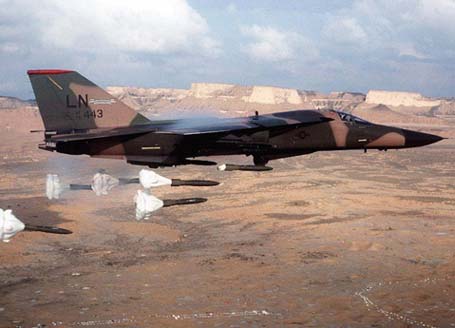
The F-111 is a multipurpose tactical fighter bomber capable of supersonic speeds. It can operate from tree-top level to altitudes above 60,000 feet (18,200 meters).
The F-111 has variable-sweep wings that allow the pilot to fly from slow approach speeds to supersonic velocity at sea level and more than twice the speed of sound at higher altitudes. Wings angle from 16 degrees (full forward) to 72.5 degrees (full aft). Full-forward wings give the most surface area and maximum lift for short takeoff and landing. The F-111 needs no drag chute or reserve thrust to slow down after landing.
Background
The F-111A first flew in December 1964. The first operational aircraft was delivered in October 1967 to Nellis Air Force Base, Nev. A models were used for tactical bombing in Southeast Asia.
Developed for the U.S. Navy, the F-111B was canceled before its production . F-111C's are flown by the Royal Australian Air Force.The F-111D has improved avionics with better navigation, air-to-air weapon delivery systems, and newer turbofan engines. The F-111D's are flown by the 27th Fighter Wing, Cannon Air Force Base, N.M.
The E model has modified air intakes to improve the engine's performance at speeds above Mach 2.2. Most F-111Es serve with the 20th Fighter Wing, Royal Air Force Station Upper Heyford, England, to support NATO. F-111E's were deployed to Incirlik Air Base, Turkey, and were used in Operation Desert Storm.
The F-111F has Improved turbofan engines give F-111F models 35 percent more thrust than previous F-111A and E engines. The avionics systems of the F model combine features of the F-111D and E. The last F model was delivered to the Air Force in November 1976. The F models have been modified to carry the Pave Tack system in their weapons bays. This system provides an improved capability to acquire, track and designate ground targets at night for delivery of laser, infrared and electro-optically guided weapons.
The F-111F was proven in combat over Libya in 1986 and again over Iraq in 1991. Although F-111F's flew primarily at night during Operation Desert Storm, aircrews flew a particularly notable daytime mission using the Guided Bomb Unit (GBU-15) to seal the oil pipeline manifold sabotaged by Iraq, allowing the oil to flow into the Persian Gulf.
The F-111G is assigned to the 27th Fighter Wing at Cannon Air Force Base and is used in a training role only. The G model is a converted FB-111A. The conversion made minor avionics updates and strengthened the aircraft to allow its use in a more dynamic role as a fighter aircraft
F-117A Nighthawk Stealth
The F-117A Nighthawk is the world's first operational aircraft designed to exploit low-observable stealth technology.

The unique design of the single-seat F-117A provides exceptional combat capabilities. About the size of an F-15 Eagle, the twin-engine aircraft is powered by two General Electric F404 turbofan engines and has quadruple redundant fly-by-wire flight controls. Air refuelable, it supports worldwide commitments and adds to the deterrent strength of the U.S. military forces.
The F-117A can employ a variety of weapons and is equipped with sophisticated navigation and attack systems integrated into a state-of-the-art digital avionics suite that increases mission effectiveness and reduces pilot workload. Detailed planning for missions into highly defended target areas is accomplished by an automated mission planning system developed, specifically, to take advantage of the unique capabilities of the F-117A.

The F-117A Nighthawk is the world's first operational aircraft designed to exploit low-observable stealth technology.

The unique design of the single-seat F-117A provides exceptional combat capabilities. About the size of an F-15 Eagle, the twin-engine aircraft is powered by two General Electric F404 turbofan engines and has quadruple redundant fly-by-wire flight controls. Air refuelable, it supports worldwide commitments and adds to the deterrent strength of the U.S. military forces.
The F-117A can employ a variety of weapons and is equipped with sophisticated navigation and attack systems integrated into a state-of-the-art digital avionics suite that increases mission effectiveness and reduces pilot workload. Detailed planning for missions into highly defended target areas is accomplished by an automated mission planning system developed, specifically, to take advantage of the unique capabilities of the F-117A.


Rogue said:Maxxa machan.....Elama kiri..... Uba gawa 9mm hari 0.22 hari ganna tiyenawada???
monawada machan bulats ganada


Similar threads

- Replies
- 2
- Views
- 215
- Replies
- 16
- Views
- 658


- Replies
- 1
- Views
- 194
