Rohan Pallewatta - Srilankan Donald Trump?

ryandok

Well-known member
  • Oct 11, 2011
    13,684
    1
    3,804
    113
    වලපල්ලේ
    කතාව ඇත්ත. එයාගේ company එකේ තමයි ගොඩක් වාහන වල wire harness හදන්නේ. බියගම තමයි company එක තියෙන්නේ. ගෙවල් තියෙන්නේ ගම්පහ. ඔරුතොට පාරේ. ගම්පහා බැසිල්ගේ office එක ඉස්සරහා තමයි එයාගේ ගේ තියෙන්නේ. බැසිල්ට office එක හදන්න ඉඩම දුන්නෙත් මිනිහා. ඉඩම නිකන් දුන්නේ.

    Bandumkara horage paththare ne. Political propoganda. Eka dawasen Naya gewanna puluwannam danuth gewala danawane :lol:


    එතකොට බැසිල්ගෙයි රවී ගෙයි නෑයෙක් මෙයා :confused::confused::confused:
     

    monson

    Well-known member
  • May 7, 2007
    25,326
    27,837
    113
    ලංකාවේ site වල තියෙන ඒවා කවුද ban ගණන් ගන්නේ ඕවා බොරු ban unge රටවල සුපිරි company තියෙනවා වෙනම un වෙන ungen ගන්නේ නෑ japan වාහන වල air bag ගහන්නේ japan companyak nam මතක නැ english ඒවාගේ th japan ඒවා සහා english ඒවා එන්නේ ඔය news boru japan site ekak europe site ekak දන්නaduma automobile විස්තර තියෙන site ඒකක ගිය එකක් wath

    umbata akuru kiyawanna danne nadda pissek :lol:
     

    Mayan19

    Well-known member
  • Aug 9, 2010
    13,252
    592
    113
    fake news promotion eka mu 2007 patan aran tiyenne ban, menna japan site ekakat dala :o

    https://www.jica.go.jp/project/english/srilanka/0661165E0/news/general/071109.html

    Visit to Lanka Harness Co., (Pvt) Ltd

    On the 09th of November 2007, we visited the Lanka Harness Co. (Pvt) Ltd, at the Export Processing Zone, Biyagama. Mr. Katsumi Takashima, Factory Manager and Mr. Rohan Pallewatta, Managing Director of the company, warmly welcomed us and briefed about the factory.

    The main products of this company are sensors for seat belts, air bags and sun visors of motor vehicles. They export these to Japan, Thailand and Rumania.

    Selecting, measuring, cutting, soldering, assembling and testing is done by manually. They have 122 employees in their factory and the entry qualification is just "School Leavers." They give on-the-job training to the employees and some of them will be sent to Japan for 6 months for their further training. There are no supervisory grade or middle management level employees and they are in need of training of such level.

    Mr. Takashima explained the technological background of the company and Mr. Pubudu, the leader of injection molding machine section explained the functions of their machines and how the sensors function. Mr. Rohan said, "This company is the only company in Sri Lanka who exports sensors to the foreign market".

    Mr. Umimae, the Chief Advisor of JSCoT Project, thanked Mr. Takashima, Mr. Rohan and staff of the company for the opportunity that they gave to visit their company and suggested to forge a close cooperation between the company and the Project.

    :lol:
     

    Mayan19

    Well-known member
  • Aug 9, 2010
    13,252
    592
    113
    monada mun me hadanne ban, water tank sensors da

    Factory.jpg


    Lanka-Harness-FActory-2.jpg


    FT-image-innovation.jpg


    Women%20attaching%20wires%20to%20the%20impact%20sensors%20(Photo%20by%20Marwaan%20Macan-Markar)%20(2).jpg
     

    monson

    Well-known member
  • May 7, 2007
    25,326
    27,837
    113
    Where quality is the key

    Sunday December 16, 2007

    Factory.jpg


    By Hiranthi Fernando

    A great idea was born way back in 1986 but it took ten years of perseverance to make that idea a reality. Today, Rohan Pallewatte is at the helm of a Rs. 800 million project manufacturing impact detecting sensor harnesses for automobile airbags and seat belts for export. Lanka Harness (Pvt) Ltd., a BOI company of which he is the Managing Director cum Chief Executive Officer, has brought in over US $ 25 million of foreign exchange to the country.

    The company won the Junior Chamber International ‘Most Enterprising Entrepreneur Award’ for 2006. An attorney-at-law by profession, versatile Rohan Pallewatte holds a B.A.(English Special), has just completed a MBA at Sri Jayawardenapura University and has been a visiting lecturer and examiner in Business Law from 2000. While in Japan, he won a black belt for Judo from the Olympic Committee for Judo in Japan. Fluent in Japanese, he also won 1st place at a Japanese speech contest for foreigners living in Japan.

    This project has opened the door to a whole new industry. “It is the first time Sri Lanka has been able to enter the international market with a 1 PPM product,” Rohan said. This means that when a million components are manufactured, only one reject would be tolerated.

    Looking back, he said the idea first came to him when he was in Japan as a student from St. Anthony’s College, Kandy, on an American Field Service Scholarship from 1985 – 1986 and visited the Toyota Company in Aichi-Ken. While going round the Toyota factory in a battery operated side car, he observed that there were hardly any people working. Inquiring whether it was a holiday, he was told that everything was automated. But, in one small enclosure, he observed that about 100 people were hard at work manufacturing automobile safety sensors. This process cannot be automated his guide told him. He also learnt that an employee at Toyota earns a minimum salary of JPYen 300,000.

    “This is when I first got the idea,” Rohan recalled, “a process that cannot be automated, a labour intensive product and the availability of labour in Sri Lanka.” He was convinced it would be a feasible venture. “Don’t even dream of trying this in your own country,” said the officer at Toyota. “We may outsource anything but not automobile safety devices because they are the heart of the automobile.” However, determined not to be put off by the negative response, Rohan requested some samples of the product, which he was given.

    Back in Sri Lanka, Rohan managed to source material from Singapore and manually turned out some samples, which he dispatched to Toyota. He had no response. Undeterred, he continued to send samples once in four months from1987 up to 1994. He did not receive even an acknowledgement. However, he never gave up on his dream. In late 1994, Rohan contacted the official who had first conducted him round the factory. He was now a middle level manager. Once again he stressed to Rohan that his efforts were in vain. Yet, he gave him a valuable tip. “If you want your samples to be at least considered, send them to a few Japanese suppliers who are sending them to Toyota.”

    Acting on this advice, Rohan soon had the names of ten suppliers of safety devices to Toyota. He dispatched ten samples to each of them. Once again he had a long wait with no response. Finally during the latter part of 1995, he had a response from a Japanese company, ITO Spring, which sent a reject report on eight of the ten samples. Rohan was happy to have finally got some response. Having carefully studied the reject report, he made the necessary adjustments and sent ten more samples. This time round, the rejects were two out of ten.

    After another six months of silence, ITO Spring Co. of Japan placed an initial order of 100 pieces. The material was couriered by them from Japan. Rohan manufactured these 100 pieces manually. This was followed by an order for 1000 pieces. Rohan then realized that he could not turn out these numbers manually. As he did not have the means to start his own production facility, he contacted several local companies, seeking to outsource the product.
    Rohan Pallewatte

    Fortunately, Siri Samarakkody, Managing Director of Esjay Electromag, an award winning local company responded favourably. “He did not charge anything but offered to discuss profit sharing modalities once the project got off the ground. By 1999, Esjay Electromag was manufacturing 300,000 pieces a month, which was the largest source of exchange for the company. Rohan became a consultant to the company.

    He realized however, that if the Japanese were to stop sending material to Sri Lanka, the business would come to a halt. He was keen on putting it on a firmer footing. All the items manufactured were inspected for quality in Japan. Rohan suggested to the Japanese that they could cut costs drastically if they established an inspection facility in Sri Lanka. Harness came into being with an investment of US$ 800 million. The entire investment was from Japan and no money was borrowed from any bank or lending institute. After over ten years of perseverance and dedication to his goal, and 47 visits to Japan, during this period, Rohan Pallewatte finally realized his dream of bringing this new industry to Sri Lanka.

    To achieve the 1PPM quality standard was highly challenging, Rohan said. He explained that he applied several methods, including a novel process employed in Japan, called Acculturation, to change the work ethic of the Sri Lankan workers and their perception of quality. “I have sent about 100 people to Japan for training and they have all come back,” he said proudly. “No bonds were signed. It was a matter of trust.”

    In the spotlessly clean and hygienic complex of Lanka Harness, in the Biyagama EPZ, 130 workers in uniform jackets and caps encasing their hair, were bent over the work tables assembling components of the impact detection sensors, swiftly and carefully. In an adjoining smaller hall, equipped with sophisticated machinery, a new product-sunvisor arms is being put together. Another 102 workers are employed at Esjay Electromag at Homagama. “We have a flat structure with no supervisors but only some leaders. Below the MD and the Japanese factory manager, there is no middle management,” Rohan explained. Today he exports the impact sensors to Toyota, Honda, Mitsubishi, Mazda, Suzuki and Subaru of Japan, General Motors and Chrysler of USA and Volvo and Saab of Europe.

    Looking back on his achievements, Rohan says, “We’ve got to understand that we are a small country; we cannot compete with countries like India or China on quantity. We have to concentrate more on quality and differentiation than on mass production.”

    - http://www.sundaytimes.lk/071216/Plus/plus00011.html

    Meya deshaplaneta awoth thiyana thanath nathi kara gani. Penawane dammama borukarayek kiyala banina hati :sorry: :lol::lol::lol:
     

    monson

    Well-known member
  • May 7, 2007
    25,326
    27,837
    113
    Sri Lankan auto-parts maker rides global demand wave

    December 1, 2016 6:40 pm JST

    With Japanese insights, an auto-parts maker leads the way for Sri Lanka's industrial sector.

    MARWAAN MACAN-MARKAR, Asia regional correspondent

    20161201SriLanka1_article_main_image.jpg

    Rohan Pallewatta talking about the impact sensors for airbags and seat belts for cars that his factory producers. (Photo by Marwaan Macan-Markar)

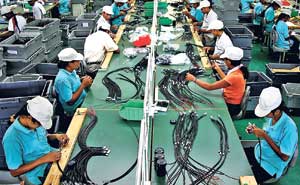
    BIYAGAMA, Sri Lanka -- Across a brightly-lit factory floor in a free trade zone in Biyagama, a commercial town on the eastern fringes of the Sri Lankan capital, Colombo, workers in white baseball caps are hunched over long tables, methodically threading wires into matchbox-sized containers. The factory, which makes impact sensors for seat belts and vehicle airbags, enjoys the automobile industry's much-sought-after 1PPM (parts-per-million) quality safety standard, meaning that only one defect is permissible for every million parts produced.

    Lanka Harness Company, which owns the factory, trades on this record as its calling card. "This is the global standard for a critical component in a car that can decide between life and death for a passenger," Rohan Pallewatta, the company's executive chairman, told the Nikkei Asian Review. "It requires the highest quality level; there can be no exceptions."

    20161201SriLanka2_article_main_image.jpg

    Women attaching wires to the impact sensors (Photo by Marwaan Macan-Markar)

    That may explain a remarkable surge in orders since October 2015 for this 11-year-old company, which had a turnover of $40 million last year. To cope with demand, Pallewatta has expanded into an adjoining building, sharply increasing his army of nimble fingered workers to 1,000.

    The new orders have nearly doubled monthly production to 2 million sensors, from a previous average of 1.2 million a month. The surge in demand followed a global scandal that has shaken the automobile industry: defective airbags in millions of vehicles, which continue to be recalled following a string of deaths and injuries of passengers.

    Most of Lanka Harness Company's fresh orders are for Takata, a Tokyo-based auto-parts company that supplies impact sensors to Toyota, the world's biggest car maker, which is one of the automobile companies affected by the faulty airbags.

    Sri Lankan analysts have noted the niche that Lanka Harness Company enjoys, despite its location in a country with no automobile sector to speak of. "It is amazing for one company in Sri Lanka to be part of such a high-value chain in the car industry," said Anushka Wijesinha, chief economist of the Ceylon Chamber of Commerce, a Colombo-based business body. "Catering to Japanese quality standards and retaining such a market share is unusual."

    But there is something even more noteworthy about Lanka Harness Company: It belongs to a small but growing number of medium-sized enterprises in Sri Lanka's free trade zones that are tapping into the growth of global production networks, often producing highly specialized components.

    "A country does not have to produce a whole car to reap the gains from the rapidly expanding global demand for automobiles," said Premachandra Athukorala, professor of economics at the Australian National University in Canberra. "It can specialize in a given slice of the production process of automobiles, as the Lanka Harness case vividly illustrates."

    20161201SriLanka3_article_main_image.jpg

    Women piecing together a component of the impact sensors in the Biyagama free trade zone factory. (Photo by Marwaan Macan-Markar)

    According to Athukorala, who specializes in global production networks, this shift in the global supply chain is fertile ground for emerging economies with relatively cheap but skilled labor. Sri Lanka has companies supplying knitted components to multinationals such as Nike, the U.S. sportswear supplier, electronic components for lighting devices to Japanese companies, sensors for Airbus, and metal components to other companies in the European Union.

    All this is part of the development of a system of "international production fragmentation" that is replacing much bilateral trade between countries, Athukorala said.

    Sri Lanka's government is eyeing this shift as it tries to widen the country's export base to grow its $82.3 billion economy. In late October, Prime Minister Ranil Wickremesinghe made the case while delivering an economic policy speech to parliament.

    "Our export base has remained the same for over 30 years and is dependent on a narrow export base of garments -- tea, rubber, gemstones and tourism," he said. "The economy cannot experience growth based on such limited exports."

    According to the Central Bank of Sri Lanka, the country's total exports fell to $5.9 billion in the Jan.1 to June 30 2016 period, from $6.3 billion for the first half of 2015. Garments and textile exports were worth almost half the total at $2.9 billion in the latter period, compared with $2.8 billion.

    Wickremesinghe underscored the problem by drawing a parallel with Bangladesh, a South Asian competitor, which rapidly increased the value of its garment exports from $5.2 billion in 2003 to $26.6 billion in 2015. Sri Lanka's annual garment exports have risen over the period from about $2.5 billion to $5 billion, according to the prime minister.

    Japanese lessons

    Lanka Harness Company's success could provide a model for the government to build on through investment and tax incentives aimed at expanding Sri Lanka's role in the global production network. Behind the company's success, however, is a 30-year record of perseverance and entrepreneurism that began in 1985 when Pallewatta, then just 16, spent a year as a high school exchange student in Japan.

    After mastering Japanese and excelling in karate and judo, he signed on for educational tours of Japanese conglomerates, including car manufacturers. It was after one such tour that he realized Sri Lanka might be an ideal location for making impact censors, which were made by hand rather than on automated production lines. "It was completely a hands-on operation and ideal for Sri Lanka's labor conditions," he said.

    For the next two decades he worked on samples, offering his products to prospective Japanese partners, but being regularly rejected until the safety standard reached the required 1PPM level. "I was completely obsessed with this product," he recalled. His shipping documents reveal that it was worth it, since he now supplies impact sensors to car makers in the EU and Japan.

    Further opportunities beckon, with Latin America, where Lanka Harness has recently opened a Mexican factory, the next frontier. "I want to show that Sri Lanka is capable of producing specialized parts in industries which we are not known for at home," said Pallewatta.

    - https://asia.nikkei.com/Business/Companies/Sri-Lankan-auto-parts-maker-rides-global-demand-wave
     

    SadSandun

    Well-known member
  • Oct 4, 2012
    6,717
    2,500
    113
    Dehiwala
    He is a good entrepreneur and is the leading supplier of air bag sensors to the world. But I do not think that he is a USD billionaire.
     

    Mayan19

    Well-known member
  • Aug 9, 2010
    13,252
    592
    113
    ඔය කියන්නේ වතුර ටැංකි වල වතුර පිරුණ hama auto නවතින sensor ගහන company එක ඒකෙ ඕවා කරන්නේ නැ එක බහුජාතික සමාගමක් ඔය boi project වල තියෙන විස්තර කියන්නේ එකක් කරන්නේ වෙන එකක් :dull:

    u must apologize :P:P

    belu belmata typical srilankan business goon kenekge moda athal ekak wage penawa tama but tikak hewwama matanam u shape wage
     

    Mayan19

    Well-known member
  • Aug 9, 2010
    13,252
    592
    113
    ඔය ban boi project එකක් ඔවු factory manager inne jappek aruge shares ඇති boi නේ රජයේ කොටස වැඩි ඇති aru ලොක්කා කරන්න ඇති basil :lol:

    den etakota mun air bag sensors hadanawa after all? :rofl::rofl::rofl: