sinovac 100% vs sinopharm 79% 🤷‍♂️

Sri_Sampath

Well-known member
  • Jan 26, 2010
    14,706
    12,739
    113
    🤷‍♂️🤷‍♂️

    When the first COVID-19 vaccine trial results were announced in late 2020, there was surprise and jubilation about just how efficacious many of the vaccine candidates appeared to be.

    Since then, more than 3.65 billion COVID-19 vaccine doses have been administered worldwide, and we’ve also seen the rise of new coronavirus variants – some of which can partially evade the protective immunity conferred by these vaccines.


    So how does their “real-world” effectiveness stack up against the efficacy recorded in those initial clinical trials?


    EFFICACY VERSUS EFFECTIVENESS

    Efficacy is the degree to which a vaccine prevents disease, and possibly transmission, under ideal and controlled circumstances, whereas a vaccine’s effectiveness refers to how well it performs in the real world – including against new variants, and in people who may have been excluded from clinical trials, such as frail elderly individuals, or those taking drugs that suppress immune responses.


    As more real-world data emerges, our knowledge of all these areas will only increase, and we will also start to gain new insights into the effectiveness of COVID-19 vaccines, such as how long the immune protection afforded by them lasts.

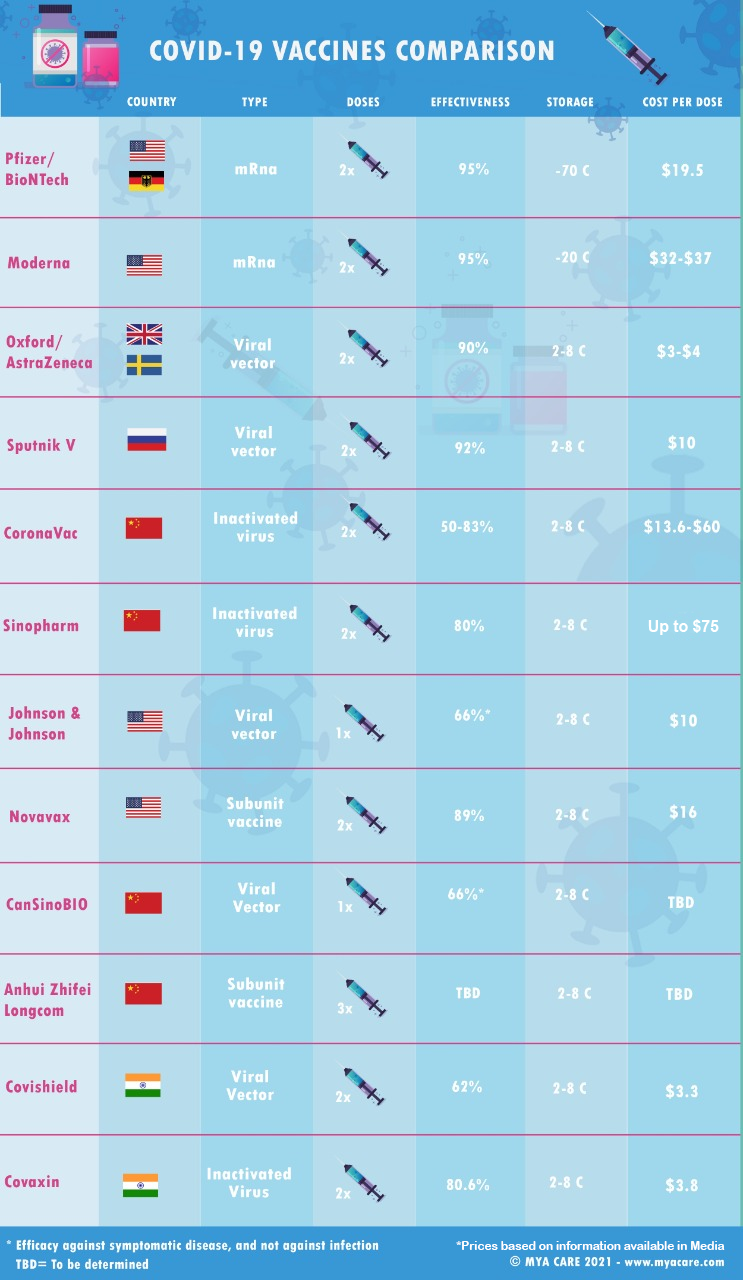
    Some of the COVID-19 vaccines, such as the Moderna and Pfizer vaccines, reported greater than 90% efficacy in the context of those trials, and all of those authorised for emergency use by the WHO and currently being monitored in the general population*, reported efficacies of greater than 50% for the prevention of symptomatic disease, and much higher efficacies for the prevention of hospitalisations or death (see table below).

    EFFICACIES OF COVID-19 VACCINES BASED ON CLINICAL TRIAL RESULTS

    VaccineProtection against all symptomatic disease after 1st dose (95% CI)*Protection against all symptomatic disease after 2nd dose (95% CI)*Protection against severe disease or hospitalization from start of vaccination (95% CI)*Protection against severe disease or hospitalization from 21 days after 1st dose (95% CI)*
    AstraZeneca73% (56%-83%)**67% (57% to 74%)**90% (58%-98%)100%
    Moderna85% (66%-93%)95% (90%-97%)100%100%
    Pfizer-BioNTech82% (76%-87%)94% (90%-97%)89% (12%-99%)83% (-38% to 98%)
    Sinopharmn/a78% (65%-86%)n/a79% (26%-94%)
    Sinovacn/a51% (36%-62%)n/a100%
    Janssen/Johnson& Johnson66% (55%-75%)***n/a77% (55%-89%) after 14 days85% (54%-97%) after 28 days
    *Data shown are on protection against SARS-CoV-2 ancestral strain
    **AstraZeneca data shown on symptomatic disease is only for cases at least 14 days after administration of dose
    ***Single dose vaccine. Refers to protection against symptomatic disease, 28 days after vaccination.

    This is far better than many scientists had dared to predict this time last year. Indeed, the WHO originally said that a minimally acceptable COVID-19 vaccine would achieve at least 50% efficacy, but ideally at least 70% efficacy, with consistent results in older people, and immunity lasting for at least a year.


    Last edited:

    Sri_Sampath

    Well-known member
  • Jan 26, 2010
    14,706
    12,739
    113

    REAL-WORLD DATA

    Important as clinical trials are for establishing vaccines’ safety and likely effectiveness, they don’t tell us how they will perform in the real-world. However, as increasing numbers of countries embark on vaccination campaigns and collect data from hospitals, vaccine registries, death certificates and other sources, we are beginning to gain a clearer picture of the degree to which COVID-19 vaccines sever the link between infection and illness in different circumstances, including after a single dose.

    PREVENTING SEVERE DISEASE

    Most real-world data relates to the Pfizer/BioNTech, Moderna and Oxford/AstraZeneca vaccines, which were the first to gain emergency authorisation in many countries.

    According to a recent review of data collected from Israel, Sweden the United States of America, and the United Kingdom (including separate data from England and Scotland), all three vaccines appeared to reduce people's chances of infection and hospitalisation by more than 80% – regardless of their age.

    Have you read?

    In some cases, a vaccine’s effectiveness may be higher than would be expected based on the clinical trial results. In May 2021 Public Health England announced that two doses of AstraZeneca vaccine may be around 85% to 90% effective against symptomatic disease (which at that time was largely being caused by the Alpha variant). It has since published further data on effectiveness against the Delta variant (see below).

    However, the precise level of effectiveness varied depending on the country under investigation, perhaps, in part, because of which groups have been prioritised during the different campaigns and how countries detect, treat, and categorise COVID-19 cases. For instance, data collected during the vaccination campaign in Israel found the Pfizer/BioNTech vaccine to be 95% effective against SARS-CoV-2 infection seven days or more after the second dose, whereas the Swedish data suggested it was 87% effective at preventing infection, and US data suggested that two doses of either the Pfizer or Moderna vaccines were 88.7% effective.

    Meanwhile, real-world data from Denmark suggested that two doses of the Pfizer vaccine were only 64% effective in care home residents with a median age of 84, but 90% effective when given to healthcare workers, who are generally younger and healthier.

    EMERGING DATA

    Real-world data is also just emerging on the other COVID-19 vaccines given a WHO Emergency Use Listing. One small study from the US suggested that the Johnson and Johnson vaccine was 76.7% effective in preventing SARS-CoV-2 infection, but there hadn’t been enough hospitalisations, intensive care admissions, or deaths to robustly assess its effectiveness on COVID-19 severity.

    Meanwhile, a Chilean study of the Sinovac vaccine suggested that it was 65.9% effective at preventing infections, and 87.5% effective against hospitalisations.

    VARIANTS

    Another reason why real-world effectiveness may vary is because of the emergence and spread of new variants in different countries. For instance, a vaccine effectiveness study from Qatar indicates that the Pfizer/BioNTech Covid-19 vaccine is 90% effective in preventing infection from the Alpha variant at least 14 days after the 2nd dose but 75% effective in preventing infection from the Beta variant at least 14 days after the 2nd dose. Data from health workers in Manaus, Brazil, where the Gamma variant accounted for 75% of infections, suggests that the Sinovac vaccine was 49.6% effective against symptomatic infection.

    However, data from Public Health England suggests that the highly transmissible Delta variant, which is rapidly spreading around the world, had little impact on the real-world effectiveness of either the Pfizer/BioNTech or the AstraZeneca vaccine after two doses. It found that former was 96% effective against hospitalisation after 2 doses, whereas the Oxford/AstraZeneca vaccine was 92% effective against hospitalisation after 2 doses - comparable with their effectiveness against hospitalisation from the Alpha variant.

    TEMPERING TRANSMISSION

    Researchers from Public Health England have also started using real-world data to investigate the effect of COVID-19 vaccines on transmission of SARS-CoV-2, which could help boost levels of population immunity, and protect people who may respond poorly to immunisation or cannot get vaccinated themselves. By linking data from the national vaccination register with laboratory results and residential addresses, they looked at how likely a vaccinated individual who developed COVID-19 was to transmit the infection to another household member.

    Their data, published in the New England Journal of Medicine, suggested that such transmission was 40-50% lower if the person had received one dose of either the Oxford/AstraZeneca or the Pfizer/BioNTech vaccine at least 21 days earlier, compared to if they were unvaccinated.

    FUTURE INSIGHTS

    As more real-world data emerges, our knowledge of all these areas will only increase, and we will also start to gain new insights into the effectiveness of COVID-19 vaccines, such as how long the immune protection afforded by them lasts.

    However, these early insights are exciting: they suggest those headline efficacy figures that prompted so much surprise when they emerged six months ago were worth the jubilation, and that COVID-19 vaccines can greatly reduce the death and disease caused by the COVID-19 pandemic, provided we get them to where they are needed as soon as possible.

    *As of 20 July 2021, WHO had granted EULs to the following vaccines: Pfizer/BioNTech, Oxford/AstraZeneca; Moderna; Johnson and Johnson; Sinovac; Sinopharm
     

    WhyNot1

    Well-known member
  • Nov 27, 2016
    5,397
    7,093
    113

    sinovac එකේ අතුරු ආබාද වැඩී කියනවා නේද​

     
    • Like
    Reactions: NRTG

    Sri_Sampath

    Well-known member
  • Jan 26, 2010
    14,706
    12,739
    113
    cbb4c256e24945e69051acbc76100676.png
     

    222ranga

    Well-known member
  • Aug 27, 2011
    7,339
    3,164
    113
    සිංහලෙන් කෙටියෙන් කියපන්කො පුලුවනම් මොකක්ද කියල ඔයා අනික පෙන්නෙ නැහැ මොකක්වත් dark mood එකට
     
    • Like
    Reactions: TCB Rox and Voltage

    Bounty_Hunter

    Well-known member
  • Apr 18, 2015
    3,291
    5,612
    113
    mama ahagenai thissa vitharana kiyanawa mRNA vaccines long term hoda na kiyala, ehema baluwot itin Inactivated virus vaccines tama safe ma.
     

    Sri_Sampath

    Well-known member
  • Jan 26, 2010
    14,706
    12,739
    113
    සිංහලෙන් කෙටියෙන් කියපන්කො පුලුවනම් මොකක්ද කියල ඔයා අනික පෙන්නෙ නැහැ මොකක්වත් dark mood එකට
    danදැන් පේනවා
    sinopharm dose දෙකම ගැහුවට පස්සෙත් 79 % තමා severe වෙන එක නවතින්නේ අනින් AstraZeneca වලට 100 %

    Oxford/AstraZeneca vaccine

    The collaboration between Oxford University and the British-Swedish pharmaceutical company AstraZeneca yielded a COVID-19 vaccine that has also been widely endorsed. The Oxford vaccine is a traditional vaccine, not an mRNA vaccine like those from Moderna and Pfizer/BioNTech. The vaccine introduces the COVID-19 “spike protein” to the body using a common cold virus that’s been modified to be completely harmless.

    Effectiveness: To test the vaccine’s efficacy, the research group analyzed results from over 11,000 volunteers. The researchers concluded that the Oxford/AstraZeneca vaccine is 90% effective in preventing coronavirus infections. Among those who received the vaccine and still got infected, the study group found that all cases were mild and none were severe. This means that even if you’re one of the unlucky 10% who don’t get the full benefit of the vaccine, you’d still be protected from severe infection. Safety data derived from over 20,000 participants revealed that the vaccine is well tolerated and safe in the general population.

    Logistics: The Oxford/AstraZeneca vaccine is also given in 2 doses, each of which costs between €2.56 and €3.41. Recent research suggests that a 12-weeks gap between doses is more effective. Compared to the mRNA vaccine, the Oxford/AstraZeneca vaccine is easier to store and requires only standard refrigeration at 2-8°C.

    Blood clot concerns: The WHO issued a reassuring statement and recommended all countries continue vaccination with AstraZeneca, noting that the benefits far outweigh the risks. The European Medicines Agency’s (EMA) safety assessment committee concluded on April 7, 2021, that unusual blood clots should be listed as a very rare side effect of AstraZeneca’s vaccine, suggesting a potential causal link, putting Oxford-AstraZeneca's COVID vaccine back on track.

    Age limits for AstraZeneca’s vaccine: Italy has recommended that AstraZeneca's COVID-19 vaccine should only be used for people over the age of 60. Plus, the Italian health authority declared that people under 60 years of age who have received a first shot of AstraZeneca’s vaccine can also receive a second one. The United Kingdom, meanwhile, has recommended an alternative to AstraZeneca's vaccine for people younger than 30 because of evidence of its link to rare blood clots. Many other countries as well are now following an age limit for AstraZeneca.

    1-June-21 Update:

    • According to a new study from Public Health England, the AstraZeneca vaccine is 60% protective against the Indian variant, and 66% protective against the original UK variant. However, the authors reported that 2 full doses need to be given to be effective.
    30-June-21 Update:

    • According to recent studies from Public Health England, the AstraZeneca vaccine provides protection against hospitalization from the Delta variant infection. The study found that the vaccine protects 92% of those infected.
    • A new study is underway to test an AstraZeneca booster shot against the South African COVID-19 variant. It is planned to involve around 2,250 volunteers.
    • An Oxford University research team announced that a delay for up to 10 months between the two doses can produce a much more robust immune response.
    • In addition, they found out that a third booster shot given after 6 months of the second dose can greatly strengthen protection against COVID.
    • The same research group announced that there is still no evidence that a third shot is actually needed.
    1-August-21 Update:

    • AstraZeneca will be testing its vaccine efficacy in 300 young children aged 6 to 17 years.

    COVISHIELD

    So far, three "imported variants" - British, South African, and Brazilian - have been detected in India. Serum Institute of India's COVID-19 vaccine, called Covishield, is a version of the Oxford-AstraZeneca vaccine that Indian manufacturers produce locally. This vaccine is effective against the UK and Indian variants but is awaiting efficacy data against the Brazilian strain.

    Effectiveness: The two-dose Covishield regimen showed 62% efficacy in Phase 3 clinical trials.

    Logistics: The vaccine requires two doses to build immunity, administered 28 days apart. In addition, it does not require sub-zero storage and is stable at 2-8°C. In private facilities, the government has set a ceiling price of 250 rupees, equal to 3.33 U.S. dollars, for both vaccines (Covishield and Covaxin). Covishield accounts for 90% of the doses administered in India so far, with the rest being Bharat Biotech's Covaxin.

    Blood clot concerns: After European and British regulators raised a possible link between AstraZeneca's vaccine and a few rare cases of blood clots, the Indian panel is investigating the safety of this vaccine. However, no cases of blood clotting disorders have been reported in India.

    30-June-21 Update:

    • Since COVISHIELD is another brand of the same Astrazeneca vaccine, it’s expected that it is also effective against the Delta variant. Moreover, experts also suggest that 10-months spaced doses or a booster 3rd dose might provide much more protection.
    • India is considering adopting a 12-week gap policy between each dose. This has proven to provide more protection and allows to vaccinate more people faster. The first dose alone provides significant protection in between jabs (76%).

    Sinopharm vaccine

    The Chinese state-owned pharmaceutical company Sinopharm has also announced optimistic results with its COVID-19 vaccine.

    Vaccine Specifics: The Sinopharm vaccine is very similar to CoronaVac, the other Chinese vaccine, and both are based on an inactivated version of the COVID-19 virus. The vaccine was approved by regulators in the United Arab Emirates and Bahrain after Sinopharm announced that the vaccine is safe and effective in preventing COVID-19 infections.

    Effectiveness: The company declared that its vaccine is 79% effective, based on a trial that involved around 31,000 volunteers. Over 100 countries have already placed orders on the new Chinese vaccine.

    Logistics: The Sinopharm vaccine is also administered in 2 doses, with the cost of each dose estimated at about €64.01. Only standard refrigeration is needed to store the Sinopharm vaccine, making it a good candidate for developing countries.

    1-June-21 Update:

    • Earlier in May, the WHO granted emergency use authorization for Sinopharm, making it the first non-western vaccine to receive approval. The responsible committee announced that the efficacy and safety results from Sinopharm are encouraging, and its approval would help speed up corona vaccination around the world.
    • On May 25th, a large study was published in The Journal of the American Medical Association (JAMA), confirming the efficacy of the Chinese vaccine. The study involved 40,000 volunteers in vaccination centers in Egypt, UAE, Bahrain, and Jordan. Researchers found that the Sinopharm COVID-19 vaccine is 72.8% to 78.1% effective against corona, which is in line with the WHO’s decision.
    30-June-21 Update:

    • According to the latest reports, it is still unclear whether the Sinopharm vaccine is effective against the newly spreading Delta variant.
    • A new trial in the UAE will assess Sinopharm’s vaccine safety and efficacy in children aged 3 to 17. The study will involve 900 children who will receive the jab.
    • The UAE have started giving out an additional Pfizer booster dose to those who had already taken 2 doses of Sinopharm. The dose is given 6 months after the last Sinopharm jab.
    1-August-21 Update:

    • A new study done in Sri Lanka found that the Sinopharm vaccine induces a similar immune response against the delta variant compared to natural infection.
    • After conducting extensive research and trials, The UAE's Ministry of Health and Prevention (MOHAP) announced that Sinopharm Covid-19 vaccine can now be administered to children and adolescents, between age of 13-17 years.
    ------ Post added on Aug 18, 2021 at 10:22 PM
     

    erozan

    Well-known member
  • Mar 18, 2011
    75,077
    18,283
    113
    Malabe

    sinovac - ගහලා තමා ඉන්දුනීසීයාවේ බරට මලේ.. :confused:


    - අපි නම් මොඩර්නා - :love:
    ඉන්දුනිසියාවෙ 5%කවත් වැක්සින් නොකරද වැක්සීන් වල තත්වෙ හොයන්නෙ,???? බයිල කියන්ඩ එපා බන් දැන දැන බොරු පතුරවන්ඩ එපා.
     
    • Haha
    Reactions: SLBlackKnight

    charitha2011

    Well-known member
  • Jan 25, 2011
    15,980
    1
    31,494
    113
    - උඩරට -
    ඉන්දුනිසියාවෙ 5%කවත් වැක්සින් නොකරද වැක්සීන් වල තත්වෙ හොයන්නෙ,???? බයිල කියන්ඩ එපා බන් දැන දැන බොරු පතුරවන්ඩ එපා.
    උබ ඉතින් සියල්ල දත් නේ.. :ROFLMAO: :lol: - No Comments
     

    erozan

    Well-known member
  • Mar 18, 2011
    75,077
    18,283
    113
    Malabe
    උබ ඉතින් සියල්ල දත් නේ.. :ROFLMAO: :lol: - No Comments
    සියල්ල දත් නෙමේ , කිරියෙ ගිය තෙර්ඩ්වලිම දැන ගත්ත ඒව,.. උබ ඒවගෙන් ඉන්දුනිසියාවෙ මැරුන කියල මඩ ගැහුව වැක්සීන් කරpu ප්‍රමානය නොදා,

    ඔහොම බලු වෙන්ඩ එපා බන් මනුස්සයො වගේ හැසිරියල්ල, හැමෝටම මොඩර්නා දෙන්නෙ නැ, දෙන වැක්සීන් එක ගැන පච පතුරවන්ඩ එපා..ඔච්චරම අමුනුස්ස වෙන්ඩ එපා..


    ඒ වුනාට තෝරන්න ගිහින් වැක්සින් නොගහා මැරෙන්න එපා
    :yes: WHOඅනුමත කරපු ඕනම වැක්සීන් එකක් හොදයි, ඔය අරක මේක හොදයි කියන්නෙ මිත්යාවක්, WHO එකට පිස්සු නැ හොද නැති ඒව අනුමත කරන්ඩ..
    ------ Post added on Aug 18, 2021 at 11:05 PM
     

    charitha2011

    Well-known member
  • Jan 25, 2011
    15,980
    1
    31,494
    113
    - උඩරට -
    සියල්ල දත් නෙමේ , කිරියෙ ගිය තෙර්ඩ්වලිම දැන ගත්ත ඒව,.. උබ ඒවගෙන් ඉන්දුනිසියාවෙ මැරුන කියල මඩ ගැහුව වැක්සීන් කරpu ප්‍රමානය නොදා,

    ඔහොම බලු වෙන්ඩ එපා බන් මනුස්සයො වගේ හැසිරියල්ල, හැමෝටම මොඩර්නා දෙන්නෙ නැ, දෙන වැක්සීන් එක ගැන පච පතුරවන්ඩ එපා..ඔච්චරම අමුනුස්ස වෙන්ඩ එපා..
    උබ කරන්නේ ආන්ඩුවට කඩේ යන එකනේ..
    චීනෙන් වැක්සීන් අරන් ලංකාවේ මිනිස්සු ගොනාට අන්දවලා වැක්සීන් ගහනවා..
    ඒවා ගහන මිනිස්සු හිතන්නේ ඇත්තටම ඒවා වලින් බේරෙන්න පුලුවන් කියලා..
    සිනෝවැක් කියන්නේ අතුරු ආබාධ වැඩිම වගේම බාල වැක්සීන් එකක්.. :confused:
    සයිනෝෆාම් එකත් දැනටම ෆේල් - මෙහේ කොච්චර ඉන්නවද සයිනෝ දෙකම ගහලා කොවිඩ් හැදිලා මැරුන අය..:angry:
    සිනෝවැක් ගහපු අයට තේරෙයි ගැහුවට පස්සේ..

    වැක්සීන් ගැන මිනිස්සු ඇත්ත දැන ගන්න ඕනී.. උබලා තමා ආන්ඩුවට කඩේ යන අමනුස්සයෝ
     

    erozan

    Well-known member
  • Mar 18, 2011
    75,077
    18,283
    113
    Malabe
    උබ කරන්නේ ආන්ඩුවට කඩේ යන එකනේ..
    චීනෙන් වැක්සීන් අරන් ලංකාවේ මිනිස්සු ගොනාට අන්දවලා වැක්සීන් ගහනවා..
    ඒවා ගහන මිනිස්සු හිතන්නේ ඇත්තටම ඒවා වලින් බේරෙන්න පුලුවන් කියලා..
    සිනෝවැක් කියන්නේ අතුරු ආබාධ වැඩිම වගේම බාල වැක්සීන් එකක්.. :confused:
    සයිනෝෆාම් එකත් දැනටම ෆේල් - මෙහේ කොච්චර ඉන්නවද සයිනෝ දෙකම ගහලා කොවිඩ් හැදිලා මැරුන අය..:angry:
    සිනෝවැක් ගහපු අයට තේරෙයි ගැහුවට පස්සේ..

    වැක්සීන් ගැන මිනිස්සු ඇත්ත දැන ගන්න ඕනී.. උබලා තමා ආන්ඩුවට කඩේ යන අමනුස්සයෝ
    ඔය පැන්නෙ එලියට මොන තරන් තිරිසන් අදහස්ද උබලට තියෙන්නෙ කියල ලස්සනට පේනව..

    බාල වැක්සීන් WHO එකෙක් අනුමත කරනවද බන්, ????? සයිනොෆාම් සිනොවැක් ඇමරිකාවෙත් ගහන්නෙ සුද්දට පිස්සුද බාල ඒව ගහ ගන්ඩ..?????

    මොඩර්න දෙකම ගහල , ෆයිසර් දෙකම ගහල කොරෝන හැදුන උන් ඇත්තෙම නැද්ද??? ඒව ෆේල් නැද්ද ගෙරියො???

    උබලට ඇත්තටම ඕන වැක්සීන් කරන එක නතර කරවන්ඩ වෙන මොකුත් නෙමේ කොරෝනා හැදිල මිනිස්සු මැරිල යන තරමට උබල වගේ ගු ඇන් පි කාරයො කැමතියි, උබලට කාලකන්නි කියන්නෙ අපි නිකන්ද..
     

    erozan

    Well-known member
  • Mar 18, 2011
    75,077
    18,283
    113
    Malabe
    මේක නම් වෙන්න බෑ
    උන්නෙ රිසර්ච් කරේ , ඇමරිකානුවන්ට තමයි ගැහුවෙ..හැම එකම ගුගල් කරන උබට ඒක හොයා ගන්ඩ බැරි උනාද??🤣🤣🤣
     

    Hyaenidae

    Well-known member
  • Apr 8, 2015
    52,371
    2
    53,841
    113
    උන්නෙ රිසර්ච් කරේ , ඇමරිකානුවන්ට තමයි ගැහුවෙ..හැම එකම ගුගල් කරන උබට ඒක හොයා ගන්ඩ බැරි උනාද??🤣🤣🤣
    ඇමරිකානුවන්ට කොහොමද දන්නෑ ඇමරිකාවෙනං ගැහුවෙ නෑ කියල ශුවර්
     
    • Haha
    Reactions: Sri_Sampath