


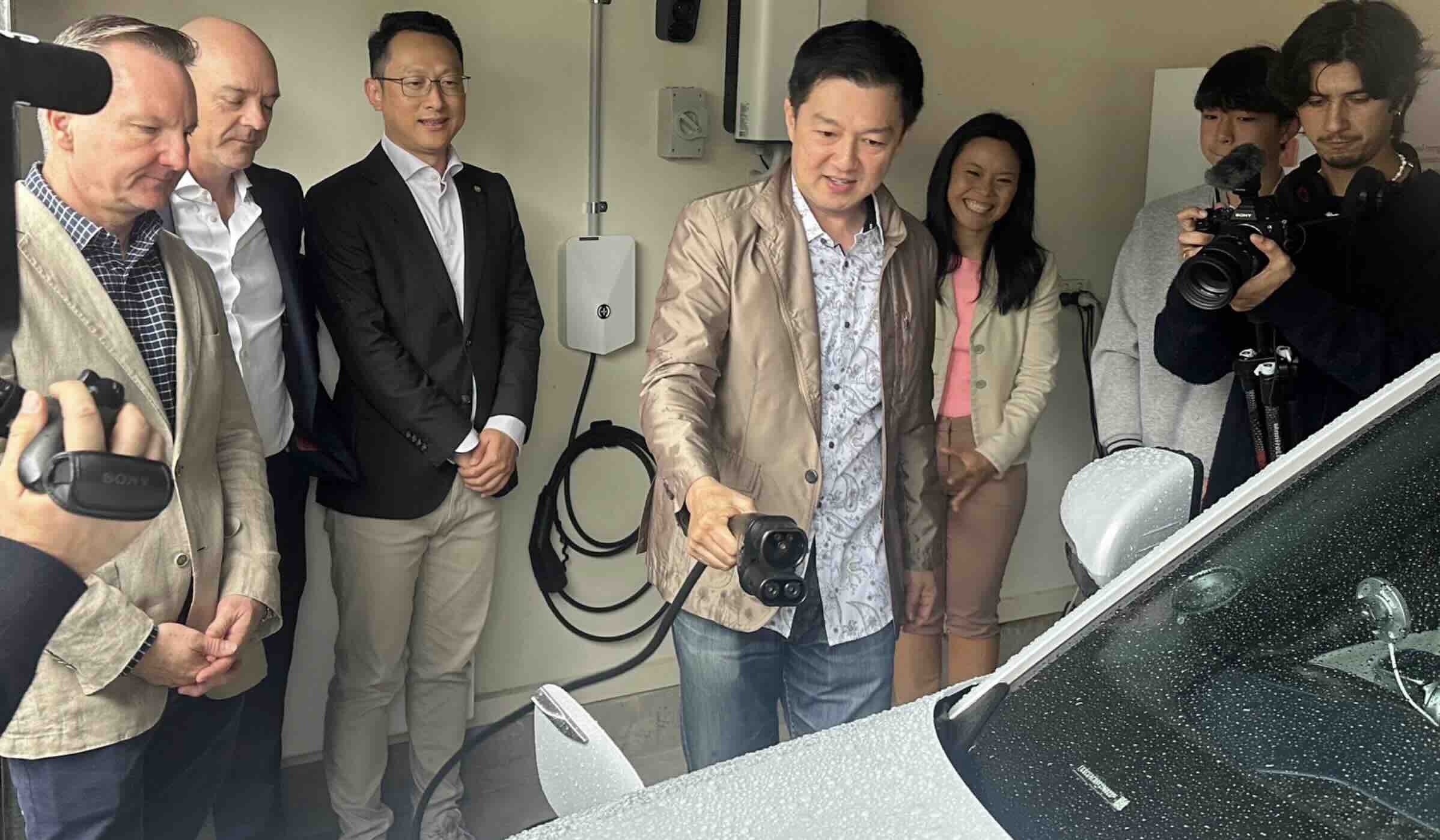
Chris Bowen with EV owner and V2G pilot participant Ken.
Innovative retailer Amber Electric has landed another $13.6 million funds from the federal government to bring “critical mass” to its landmark vehicle-to-grid (V2G) and smart charging pilot project that is looking to bring the idea of “batteries on wheels” into the mainstream.
The decision to add funds came after Amber’s original trial, targeting 50 customers, was overwhelmed with more than 6,000 enquiries.
The additional funding from the Australian Renewable Energy Agency, adding to the $3.2 million originally announced last year, will enable Amber to add another 950 customers to the V2G pilot, and double the number of smart chargers to 2,000.
So far, all of the vehicles are being supplied by BYD, which has agreed to an exemption from the normal battery warranties for the purpose of the pilot. But Amber says it is looking to bring in extra car makers.
The new funding was announced by federal energy and climate minister Chris Bowen at the home of one of Amber’s pilot participants in a housing estate in Lidcombe in Western Sydney.
Amber says that customers can save $2,500 a year from the technology, and cites one customer in South Australia who made $500 in a single day during the Australia Day heatwave earlier this year.
“Vehicle-to-grid technology means your car does not just get you from A to B, it can help power your home and support the grid,” Minister Bowen said.
“Australians with rooftop solar will be able to use their car to store the energy they’ve generated and then use that cheap, clean energy when they need it most. And thanks to our Solar Sharer Offer, EV owners who don’t have solar of their own will soon have the option of charging with up to 24 kWh of free electricity each day.”
ARENA boss Darren Miller says V2G could be critical to provide added storage and flexibility for a renewables-dominated grid, and he is aiming to have one million V2G-enabled EVs on the road – and often in the garage – by 2035.
The main problem with the V2G technology so far has been designing and implementing universal standards to enable the various technologies – chargers, cables, inverters and car batteries – to work with each other, but car makers have been slow in allowing their EVs to be used and retain their battery warranties.
“There are car manufacturers who are more forward leaning and helpful, like BYD,” Bowen said. “There are others who will take longer, but I think ultimately, consumers and the community will demand this.
“You know, if you’re deciding what EV to buy, and you’ve got one that will allow you to do vehicle to good or smart charging, and another won’t, well, that’ll impact your decision as a consumer.”
Bowen conceded that the task to match up regulator requirements with the needs of homes, retailers, car makers and other equipment suppliers has been “hard work.”
The Amber pilot scheme is designed to get the technology right for the wider rollout. With retailers like Amber, consumers can charge their EVs automatically when wholesale electricity prices are low, and when rooftop solar is abundant, and sell electricity back to the grid – if the EV owner chooses – when prices are high and the power is needed most.
Amber says drivers keep control. For example, a driver can program the Amber app to have their EV charged by a certain time in the morning, and put minimum limits on the state of charge.
- https://thedriven.io/2026/05/29/amb...-than-1000-evs-with-government-funding-boost/


