AMD Ryzen destroys Intel Dominance

ibnanv

Well-known member
  • Jun 27, 2009
    3,986
    257
    83
    AMD Ryzen is supposed to be 40% faster than previous processor but it is 52% faster. Clock per clock AMD is having 20mb cache with cheap pricing processor for $499 for 1800x Ryzen the high end for unlocked 8 core one where as Intel is only having processors at more than $1000. AMD ups the ante by going to launch 16 core processor too. All this without being an APU. Clock per clock it is comparable to i7 Intel. Intel is trying to launch cannon lake much ahead in 14nm because of this.Where as they have abandoned tick tock process because of this competition. Declining PC market share and the market just started to heat up. This will be good for consumers. Ryzen graphics is also showing remarkable.

    Raven Ridge is the next move by AMD which is true APU coming in 2nd quarter in 2017 which is 4 core. Intel also dumped its Graphics processor for Licensing an AMD one. AMD graphics is much better than Nvidia. Both XBox and Sony use AMD processor.

    AMD is processor power consumption has come down drastically from Intel. So it gives much lesser heat. Suitable for tropical climate.
     
    Last edited:

    DilWala

    Member
    Jun 10, 2011
    80
    3
    0
    AMD unveils Ryzen launch dates, clock speeds, performance, pricing

    AMD unveils Ryzen launch dates, clock speeds, performance, pricing.


    AMD-Ryzen-640x426.jpg


    For months, computer enthusiasts have chafed for fresh official information on Ryzen, as opposed to the stream of unverified leaks. Today, AMD is releasing detailed product information, pricing, and estimated IPC improvements over Excavator. Hold on to your hats, ladies and gentlemen — things are about to get real interesting in the PC market.


    For those of you just tuning in, Ryzen is AMD’s last, best chance to prove it can compete effectively against Intel’s Core i3/i5/i7 product lines. For years, AMD has been stuck trying to compete against Intel’s top-end chips with its Piledriver-based architecture. Ryzen is a new architecture, completely unrelated to AMD’s previous Bulldozer / Piledriver / Steamroller / Excavator product lines. It’s no exaggeration to say that AMD’s future in the PC market depends on this core. Based on what we saw at the Ryzen launch event on Tuesday, that future is in good hands.


    For years, AMD has talked about a 40% IPC uplift for its chips compared with Excavator. Today, AMD revealed that it didn’t just meet that goal, it beat it by 12 percentage points. There’s no evidence whatsoever that this 52% uplift is a cherry-picked figure. If anything, it might be somewhat conservative.


    AMD is taking pre-orders on three Ryzen SKUs today: Ryzen 7 1700, Ryzen 7 1700X, and the Ryzen 7 1800X. All three chips are eight-core, 16-thread models. Unlike previous benchmark results, the data below is from production systems with Turbo Mode enabled on both AMD and Intel chips. Here’s how the SKUs and their performance break down:
    Ryzen 7 1700: 3.0GHz base, 3.7GHz boost clock, with a 65W TDP. This is the chip AMD is positioning against the Core i7-7700K (4.2GHz base, 4.5GHz Turbo).


    AMD’s overall win against Intel’s Core i7-7700K isn’t surprising, given Ryzen’s additional cores. The Intel chip has an 18-25% advantage in frequency, which offsets some of the gap between the two chips, but AMD is still much faster, while also drawing less power.


    Ryzen 7 1700X: 3.4GHz base clock, 3.8GHz boost clock, with a 95W TDP. AMD is positioning Ryzen 7 1700X against two Intel cores — the Core i7-6800K (6 cores, 12 threads, 3.4GHz base, 3.6GHz Turbo) and the Core i7-6900K (8 cores, 16 threads, 3.2GHz base, 3.7GHz Turbo). Both Intel chips have a 140W TDP.


    Again, we see AMD offering significantly better performance compared with the six-core version of the chip. Ryzen 1700X only leads the 6900K by 4%, but it does lead the match.


    Ryzen 1800X: 3.6GHz base clock, 4GHz boost clock, 95W TDP. This is AMD’s heavy-hitter, and it beats past the Core i7-6900K by an impressive 9% in Cinebench R15.


    Single-threaded performance, meanwhile, is also quite strong. No, AMD hasn’t quite caught Intel in terms of single-thread performance — remember, the Ryzen 7 1800X is running at a 3.6GHz base / 4GHz boost compared with a 3.2GHz base / 3.7GHz boost for the Core i7-6900K. But the clock speed gap between the two cores at maximum turbo is just 8%. Piledriver, on average, was roughly 60% as fast as an Intel CPU. If the 1800X can actually hold AMD’s 95W TDP at these performance level, it’ll offer strong competition against the Core i7-6900K both in raw performance and performance-per-watt.
    Pricing

    Ryzen’s pricing has been calibrated to blow holes in Intel’s High End DeskTop (HEDT) product line.


    The Core i7-7700K is a $339 – $350 CPU. The Core i7-6800K is a $434 – $441 CPU. And, of course, the Core i7-6900K is a $1000 CPU. Between the increased performance from additional cores and the dramatic price reduction (relative to Intel) for an eight-core part, AMD is obviously gunning for bear.


    Cinebench is the only test we have graphed data for, but it wasn’t the only test that AMD showed. The Ryzen 7 1700 was also shown as beating the Core i7-7700K in Handbrake (61.8s vs. 71.8s), and multiple demo systems throughout the event showcased this match-up. The results in well-threaded software weren’t particularly kind to Chipzilla. Intel still has an advantage in pure single-threaded code in some cases, but the gap isn’t very large.
    Ryzen rising

    For years, AMD has talked about Zen / Ryzen as a CPU architecture that would drive server market gains and desktop sales alike, with a low-power APU coming to mobile systems and desktops later this year. While we’re reserving final judgment for a full suite of benchmark tests, everything we’ve seen this week looks extremely promising.


    An eight-core Ryzen CPU

    AMD beat its IPC goal without compromising its clockspeed. Its 14nm feature sizes are actually smaller than their Intel counterparts, and AMD suggests we’ll see some overclocking capability on top of the 4GHz clock (exactly how much is still unclear).


    Start your clock — Ryzen 7 launches on March 2. Ryzen 5 and other parts will arrive in the not-too-distant future.
     

    ibnanv

    Well-known member
  • Jun 27, 2009
    3,986
    257
    83
    AMD%20Zen%20December%202016%20Update_Final%20For%20Distribution-page-022_678x452.jpg


    In the eternal battle to drive more details out of AMD ahead of the full launch of its new Zen microarchitecture based CPUs, today AMD is lifting the lid on some new features in order to whet the appetite (and appease the hype-train, perhaps) and that will be part of the product launch. We now have new details on the brand naming, some platform details, and a high-level overview of what will be the key points being promoted when it comes to market.


    We’ve covered a lot of Zen, from the initial announcement to some of the microarchitecture details at Hot Chips through to discussing the utility of singular benchmark data and then what might be happening on the server side through a detailed analysis of motherboards on display. A lot of us want it out already, and when it does, it will come out under the brand ‘Ryzen’.
    Ryzen and AM4
    It is pronounced ‘Rye-zen’, not ‘Riz-zen’, to clarify.

    AMD%20Zen%20December%202016%20Update_Final%20For%20Distribution-page-009_575px.jpg

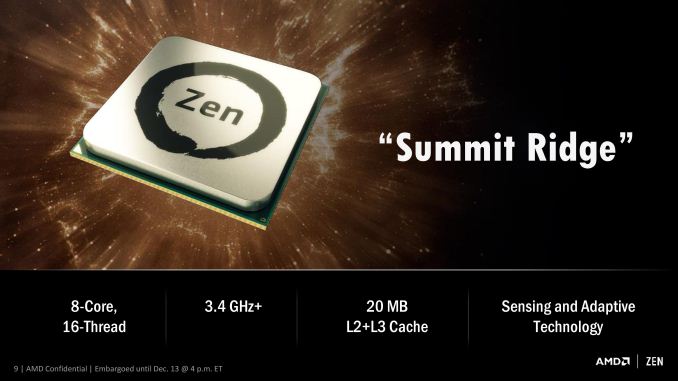
    As expected, there will be several SKUs in the brand, although AMD is not releasing many details aside from the cache arrangement of the 8-core, thread chip (which we already knew was 4MB of L2 + [8+8] MB of L3 victim-cache), and that the base clock for the high-end SKU will be at least 3.4+ GHz. The fact that AMD says ‘at least’ dictates that they are still deciding exactly what to do here, although a similar thing was said leading up to the launch of Polaris-based RX cards (though that’s a different department).

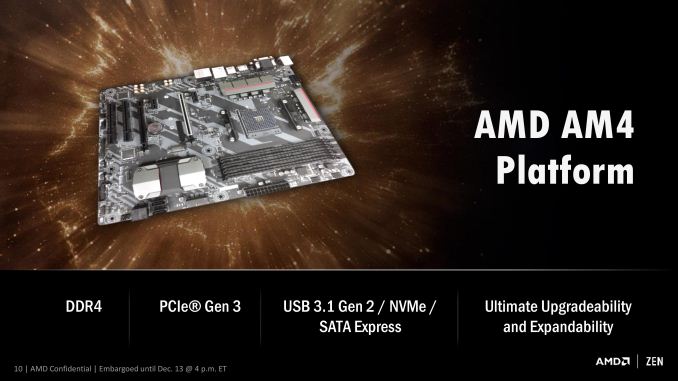
    We know that Ryzen will use the AM4 platform, shared with the previous generation Bristol Ridge which remains an OEM-only product for now. We’ve gone into detail about how AM4 will operate, using a split IO design between the CPU and the chipset such that for minimal function, a chipset is not needed, however AMD has pointed out that with Ryzen, AM4 with the right chipset will support USB 3.1 Gen 2 (10 Gbps), NVMe SSDs, SATA-Express, and offer ‘ultimate upgradability’. The latter point may give an indication to the Ryzen based chipsets might offer numerous PCIe lanes, similar to what Intel does on the 100-series. That said, Intel has been developing that feature over years, and the Bristol Ridge chipsets for AM4 that have been announced already are not quite up to par with that, so it will be interesting to see.

    AMD%20Zen%20December%202016%20Update_Final%20For%20Distribution-page-010_575px.jpg

    We’re still waiting for detailed information on PCIe lane counts on Ryzen, how big that micro-op cache is in the core, if the L3 victim cache has limitations, how good the DDR4 controller is, power consumption, and what exactly the single core performance / IPC level is. Actually AMD did go into more detail with a few of these areas as well.

    Power, Performance and Pre-Fetch: AMD SenseMI


    Part of the demo in the pre-brief was a Handbrake video transcode, a multithreaded test, showing a near-identical completion time between a high-frequency Ryzen without turbo compared to an i7-6900K at similar frequencies. This mirrors the Blender test we saw back in August, although using a new benchmark this time but still multi-threaded. AMD also fired up some power meters, showing that Ryzen power consumption in this test was a few watts lower than the Intel part, implying that AMD is meeting its targets for power, performance and as a result, efficiency. The 40%+ improvement in IPC/efficiency is still being thrown around, and AMD seems confident that this target has been surpassed.

    To that extent, at the pre-briefing, Ryan was shown two systems running Titan X graphics cards in SLI and Battlefield 1 at 4K settings - one system was running Ryzen, and the other an i7-6900K (the 8-core Broadwell-E chip). Ryan was unable to determine an obvious visual difference between the two frame-rate wise, which was the point of the demo.

    Mark Papermaster, CTO of AMD, explained during our briefing that during the Zen design stages, up to 300 engineers were working on the core engine with an aggressive mantra of higher IPC for no power gain. This is not an uncommon strategy for core designs. Part of this will be down to two new power modes, that adjust and extend the power/frequency curve, which are part of AMD’s new 5-stage ‘SenseMI’ technology.

    SenseMI Stage 1: Pure Power


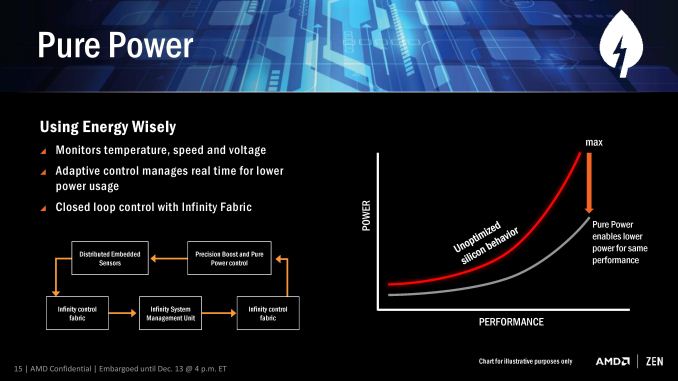
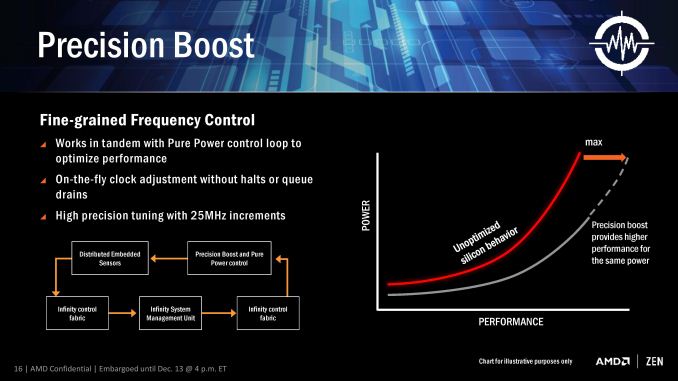
    A number of recent microprocessor launches have revolved around silicon-optimized power profiles. We are now removed from the ‘one DVFS curve fits all’ application for high-end silicon, and AMD’s solution in Ryzen will be called Pure Power. The short explanation is that using distributed embedded sensors in the design (first introduced in bulk with Carrizo) that monitor temperature, speed and voltage, and the control center can manage the power consumption in real time. The glue behind this technology comes in form of AMD’s new ‘Infinity Fabric’.


    AMD%20Zen%20December%202016%20Update_Final%20For%20Distribution-page-015_575px.jpg

    ‘What is this new Infinity Fabric?’ I hear you say. It was only explained in the context of that it provides control and through the Infinity System Management Unit it can adjust power consumption while keeping in mind everything else that’s happening. The fact that it’s described as a fabric suggests that it goes through the entire processor, connecting various parts together as part of that control. Whether this is something wildly different to what we saw in Carrizo, aside from being the next-gen power adjustment and under a new name, is hard to determine at this point but we are probing for more details.

    The upshot of Pure Power is that the DVFS curve is lower and more optimized for a given piece of silicon than a generic DVFS curve, which results in giving lower power at various/all levels of performance. This in turn benefits the next part of SenseMI, Precision Boost.

    SenseMi Stage 2: Precision Boost


    For almost a decade now, most commercial PC processors have invoked some form of boost technology to enable processors to use less power when idle and fully take advantage of the power budget when only a few elements of the core design is needed. We see processors that sit at 2.2 GHz that boost to 2.7 GHz when only one thread is needed, for example, because the whole chip still remains under the power limit. AMD is implementing Precision Boost for Ryzen, increasing the DVFS curve to better performance due to Pure Power, but also offering frequency jumps in 25 MHz steps which is new.

    AMD%20Zen%20December%202016%20Update_Final%20For%20Distribution-page-016_575px.jpg

    Precision Boost relies on the same Infinity Control Fabric that Pure Power does, but allows for adjustments of core frequency based on performance requirements and suitability/power given the rest of the core. The fact that it offers 25 MHz steps is surprising, however.

    Current turbo control systems, on both AMD and Intel, are invoked by adjusting the CPU frequency multiplier. With the 100 MHz base clock on all modern CPUs, one step in frequency multiplier gives 100 MHz jump for the turbo modes, and any multiple of the multiplier can be used on the basis of whole numbers only.

    With AMD moving to 25 MHz jumps in their turbo, this means either:

    • The base frequency has reduced down to 25 MHz and AMD is able to implement a 136x multiplier to reach 3.4 GHz, or
    • AMD can implement fractional multipliers, similar to how processors in the early 2000s were able to negotiate 0.5x multiplier jumps, or
    • Precision Boost only applies to internal clocks that the user doesn’t see or control, but can assist with performance.
    Without additional information, the second point in that list seems more in line with what would be possible. If we consider that Zen’s original chief designer was Jim Keller (and his team), known for a number of older generation of AMD processors, a similar technology might be in play here. If/when we get more information on it, we will let you know.

    SenseMi Stage 3: Extended Frequency Range (XFR)


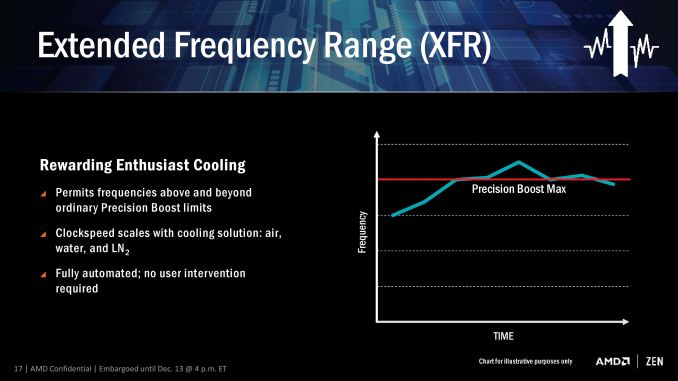
    The main marketing points of on-the-fly frequency adjustment are typically down to low idle power and higher performance when needed. The current processors on the market have rated speeds on the box which are fixed frequency settings that can be chosen by the processor/OS depending on what level of performance is possible/required. AMD’s new XFR mode seems to do away with this, offering what sounds like an unlimited bound on performance.

    AMD%20Zen%20December%202016%20Update_Final%20For%20Distribution-page-017_575px.jpg

    The concept here is that, beyond the rated turbo mode, if there is sufficient cooling then the CPU will continue to increase the clock speed and voltage until a cooling limit is reached. This is somewhat murky territory, though AMD claims that a multitude of different environments can be catered for the feature. AMD was not clear if this limit is determined by power consumption, temperature, or if they can protect from issues such as a bad frequency/voltage setting.

    By the sounds of it, this is a dynamic adjustment rather than just another embedded look-up table such as P-states. AMD states that XFR is a fully automated system with no user intervention, although I suspect it will still have an on/off switch in the BIOS. It also somewhat negates overclocking if your cooling can support it, which then brings up the issue for overclocking in general: casual users may not ever need to step into the overclocking world if the CPU does it all automatically.

    I imagine that a manual overclock will still be king, especially for extreme overclockers competing with liquid nitrogen, as being able to personally fine tune a system might be better than letting the system do it itself. It can especially be true in those circumstances, as sensors on hardware can fail, report the wrong temperature, or may only be calibrated within a certain range.

    It does raise the question as to how overclockable Ryzen will be, how many SKUs will be unlocked, or if XFR may only be on certain processors. As the Zen microarchitecture is destined for server and mobile as well, XFR will have different connotations for both of those markets (some of which might not be welcome).

    SenseMi Stage 4+5: Neural Net Prediction and Smart Prefetch


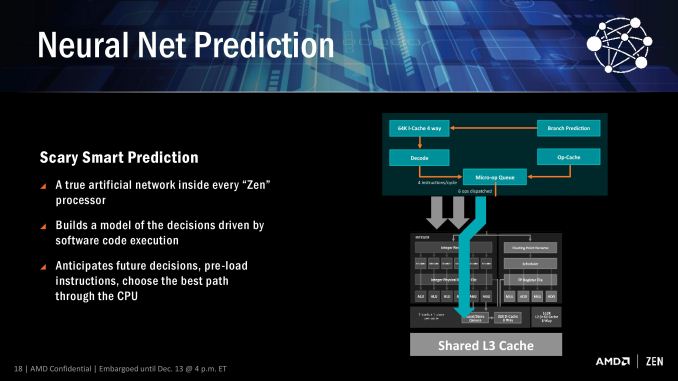
    Every generation of CPUs from the big companies come with promises of better prediction and better pre-fetch models. These are both important to hide latency within a core which might be created by instruction decode, queuing, or more usually, moving data between caches and main memory to be ready for the instructions. With Ryzen, AMD is introducing its new Neural Net Prediction hardware model along with Smart Pre-Fetch.


    AMD%20Zen%20December%202016%20Update_Final%20For%20Distribution-page-018_575px.jpg

    AMD is announcing this as a ‘true artificial network inside every Zen processor that builds a model of decisions based on software execution’. This can mean one of several things, ranging from actual physical modelling of instruction workflow to identify critical paths to be accelerated (unlikely) or statistical analysis of what is coming through the engine and attempting to work during downtime that might accelerate future instructions (such as inserting an instruction to decode into an idle decoder in preparation for when it actually comes through, therefore ends up using the micro-op cache and making it quicker).

    AMD%20Zen%20December%202016%20Update_Final%20For%20Distribution-page-019_575px.jpg

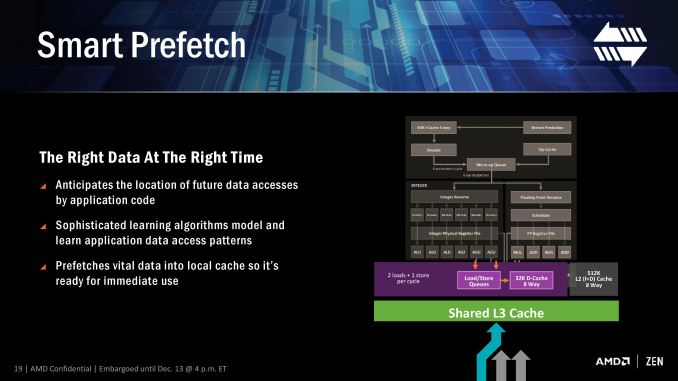
    Modern processors already do decent jobs when repetitive work is being used, such as identifying when every 4th element in a memory array is being accessed, and can pull that data in earlier to be ready in case it is used. The danger of smart predictors however is being overly aggressive – pulling in too much data that old data might be ditched because it’s never used (over prediction), pulling in too much data such that it’s already evicted by the time the data is needed (aggressive prediction), or simply wasting excess power with bad predictions (stupid prediction…).
    AMD is stating that Zen implements algorithm learning models for both instruction prediction and prefetch, which will no doubt be interesting to see if they have found the right balance of prefetch aggression and extra work in prediction.

    It is worth noting here that AMD will likely draw upon the increased L3 bandwidth in the new core as a key element to assisting the prefetch, especially as the shared L3 cache is a victim cache and designed to contain data already used/evicted to be used again at a later date.
    More Details

    AMD did confirm that the launch for Ryzen is still Q1, and Naples (the server counterpart for the Zen microarchitecture) is still on for Q2.
     
    Last edited:

    ibnanv

    Well-known member
  • Jun 27, 2009
    3,986
    257
    83
    AMD Ryzen is like getting 8 core intel i7 at 4 core price.Clock per clock both are efficient.