DIGIMAGS
Do you know how many thousands of trees are cut down each year to produce paper for your favorite newspapers and magazines? True, most newsprint has a percentage of recycled material and the newsprint industry sources trees mostly from sustainable forests, but the truth is that a vast quantity of paper is used to print books, magazines and newspapers.
And magazines and newspapers add to the Carbon footprint in other ways. If you order a magazine from US or the UK, it has to be airmailed. That contributes to environmental problems even in a minute way. And we are not even talking about postal costs here.
I know what you are thinking already. The Web. Yes, almost all leading magazines ( and newspapers) in the world are already on the Web. The most visible advantage is that you only need a connection to the Internet. Some magazines have fairly comprehensive sites on the Net, with full stories from their print editions and plus web-exclusive content. Just check out a site like www.time.com or www.newscientist.com and you will realize that you almost do not have to read or subscribe to, the print edition.
Btu there are some magazine sites that do not offer much in terms of editorial content. Their sole purpose is acting as a payment gateway for print subscriptions.
In the end, there is nothing like reading a magazine as it is text, photos and all. Turning a magazine page is sheer delight, because you do not know, what is coming next ( even if the content page tells you, there are still discoveries to be made).
Fortunately, there is a solution. It is called a Digital Magazine. In other words, it is a digital reproduction of an entire magazine, exactly similar to the print edition. And you can even turn the pages, just as with the physical product. In case you want to print an article or save it to our hard disk, it takes just one click. J
The biggest advantage of digital magazines is that they are paperless and thus environmentally friendly. It takes just about eight minutes to download around 200 pages to your hard drive or pen drive. Thus there is no waiting for the postman. And subscriptions are cheap compared to the print version – around US$ 10 for 12 issues or even less, as the publisher does not have to bear distribution and postal costs.
But what’s the use of a digital magazine if it does not take advantage of the multimedia capabilities of the Internet? Most digital magazines feature embedded web links, videos, Podcasts, interactive content. These are nicely integrated with the print edition’s interface – when a sentence in the printed page says ‘ you can download our Podcast at this address’ , all you do is point the cursor there to download the Podcast.
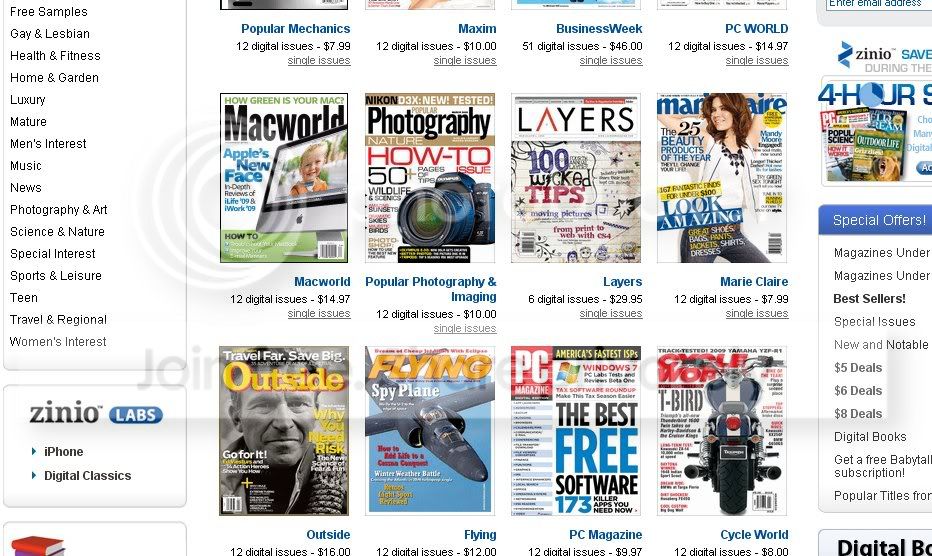
The best place on the web to look for digital magazines is www.zinio.com , which is just about the most feature packed digital magazine platform on the Web. It has the largest selection of digimags on the Net, with many free samples. Unlike many other digimag platforms, it has a dedicated full screen offline reader, so that you can download the mag and read it at leisure.
Moreover, Zinio has a separate web site ( www.goreadgreen.com) to promote ‘ green reading’ where you can order a 12 – month subscription to any magazine of your choice absolutely free. Another major player in the best is, www.texterity.com , which also offers a download option, but the books are displayed in a reader that operates from within your browser. Unlike Zinio, it offers several back issues when you subscribe. The best magazine on this platform is Orion, from the Orion Society. But the most exciting prospect at the moment is the British-based Ceros system (www.ceros.com). Check out Ceros magazines such as iMotor, photo360, Waitrose Live, Virgin Electric, Tennishead, iGizmo, BBC magazines, FHM, Overseas Living and Evo. These are fully interactive, with videos, audio spots, pop-up fact boxes, changing pictures and all. On “ iMotor”, if you want to check the colour of a car, just ‘ paint’ the car in that colour.
If you want hear the engine start, do that. Ceros is surely the future of digital magazines.
But will digital magazines ever spell the death of print versions? We still like to see things in print, feel the paper and even take a good mag to the beach or to the bed. My guess is that print and digital will co-exist for the foreseeable future.