Ancient Sri Lanka
Main article:
Ancient history of Sri Lanka
Landing of Vijaya
See also:
Vijaya of Sri Lanka
The Pali chronicles, the
Dipavamsa,
Mahavamsa,
Thupavamsa[9] and the
Chulavamsa, as well as a large collection of stone inscriptions,
[10] the Indian Epigraphical records, the Burmese versions of the chronicles etc., provide an exceptional record for the history of Sri Lanka from about the 6th century BC.
The Mahavamsa, written around 400 AD by the monk
Nagasena, using the Deepavamsa, the Attakatha and other written sources available to him, correlates well with Indian histories of the period. Indeed Emperor
Ashoka's reign is recorded in the Mahavamsa. The Mahavamsa account of the period prior to Asoka's coronation, 218 years after the Buddha's death, seems to be part legend. Proper historical records begin with the arrival of
Vijaya and his 700 followers.
Vijaya was a Vangan (now
Bengal, India) prince, the eldest son of King Sinhabahu ("Man with Lion arms") and his sister Queen Sinhasivali who had their capital at Singhapura (now
Singur in
West Bengal, India). Both these Sinhala leaders were supposedly born of a mythical union between a lion and a human princess. The Mahavamsa claims that Vijaya landed on the same day as the death of the Buddha. The story of Vijaya and Kuveni (the local reigning queen) is reminiscent of Greek legend and may have a common source in ancient Proto-Indo-European folk tales.
[11]
According to the Mahavamsa, Vijaya landed on Sri Lanka near Mahathitha (Manthota or
Mannar[12]), and named[
citation needed] on the island of
Thambaparni ("copper-colored sand"). This name is attested to in
Ptolemy's map of the ancient world. The Mahavamsa also describes the Buddha visiting Sri Lanka three times. Firstly, to stop a war between a Naga king and his son in law who were fighting over a ruby chair. It is said that on his last visit he left his foot mark on
Siripada ("Adam's Peak").
Tamirabharani is the old name for the second longest river in Sri Lanka (known as
Malwatu Oya in Sinhala and
Aruvi Aru in Tamil). This river was a main supply route connecting the capital,
Anuradhapura, to Mahathitha (now
Mannar). The waterway was used by Greek and Chinese ships travelling the southern Silk Route.
Mahathitha was an ancient port linking Sri Lanka to India and the Persian gulf.
[13]
The present day Sinhalese are a mixture of the indigenous people and of other peoples who came to the island from various parts of India. The Sinhalese recognize the Vijayan Indo-Aryan culture and Buddhism, as distinct from other groups in neighboring south India.
Anuradhapura Kingdom
Main articles:
Kingdom of Anuradhapura and
Anuradhapura
See also:
List of monarchs of Sri Lanka
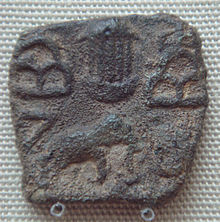
 Pandyan Kingdom
 coin depicting a temple between hill symbols and elephant, Pandyas,
Sri Lanka, 1st century CE.
In the early ages of the
Anuradhapura Kingdom the Sinhalese economy was based on farming and they made their early settlements mainly near the rivers of the east, north central, and north east areas which had the water necessary for farming the whole year round. The king was the ruler of country and responsible for the law, the army, and being the protector of faith.
Devanampiya Tissa (250-210 BC) was
Sinhalese was friends with the King of the
Maurya clan. His links with Emperor
Asoka led to the introduction of
Buddhism by
Mahinda (son of Asoka) around 247 BC.
Sangamitta (sister of Mahinda) brought a
Bodhi sapling via
Jambukola (
Sambiliturei). This king's reign was crucial to
Theravada Buddhism and for Sri Lanka.
Elara (205-161 BC) was a Tamil King who ruled "Pihiti Rata" (Sri Lanka north of the
mahaweli) after killing King
Asela. During
Elara's time
Kelani Tissa was a sub-king of
Maya Rata (in the south-west) and
Kavan Tissa was a regional sub-king of
Ruhuna (in the south-east). Kavan Tissa built
Tissa Maha Vihara,
Dighavapi Tank and many shrines in Seruvila.
Dutugemunu (161-137 BC), the eldest son of King Kavan Tissa, at 25 years of age defeated the South Indian Tamil invader Elara (over 64 years of age) in single combat, described in the
Mahavamsa. The
Ruwanwelisaya, built by Dutugemunu, is a dagaba of pyramid-like proportions and was considered an engineering marvel.

Bronze imitation of a Roman coin,
Sri Lanka, 4-8th century.
Pulahatta (or Pulahatha), the first of
the five Dravidians, was deposed by
Bahiya. He in turn was deposed by
Panaya Mara who was deposed by
Pilaya Mara, murdered by
Dathika in 88 BC. Mara was deposed by
Valagambahu I (89-77 BC) which ended Tamil rule and restored the
Dutugamunu dynasty. The Mahavihara
Theravada Abhayagiri ("pro-
Mahayana") doctrinal disputes arose at this time. The
Tripitaka was written in
Pali at
Aluvihara,
Matale.
Chora Naga (63-51 BC), a Mahanagan, was poisoned by his consort Anula who became queen.
Queen Anula (48-44 BC), the widow of Chora Naga and of
Kuda Tissa, was the first Queen of Lanka. She had many lovers who were poisoned by her and was killed by Kuttakanna Tissa.
Vasabha (67-111 AD), named on the
Vallipuram gold plate, fortified
Anuradhapura and built eleven tanks as well as pronouncing many edicts.
Gajabahu I (114-136) invaded the
Chola kingdom and brought back captives as well as recovering the
relic of the tooth of the Buddha.

Sri Lankan imitations of 4th century Roman coins, 4-8th century.
There was a huge
Roman trade with the
ancient Tamil country (present day
Southern India) and
Sri Lanka,
[14] establishing trading settlements which remained long after the fall of the
Western Roman empire.
[15]
During the reign of
Mahasena (274-301) the
Theravada (Maha Vihara) was persecuted and the
Mahayanan branch of Buddhism surfaced. Later the King returned to the Maha Vihara. Pandu (429) was the first of seven Pandiyan rulers, ending with Pithya in 455.
Dhatusena (459-477) "Kalaweva" and his son
Kashyapa (477-495), built the famous
sigiriya rock palace where some 700 rock graffiti give a glimpse of ancient Sinhala.


