


A tachometer, also known as a tachymeter, is an instrument on many sophisticated watches that lets you determine the speed at which you, or another person or object, are traveling. If your watch has a tachometer, it will have a ring of numbers encircling the outside of its face, usually running from 500 to 60. It will also have a chronograph, or stopwatch, function, since you need this feature to use the tachometer. Tachometers are only present on analog watches.
Tachymeter is a calculator on our wrist. However, most people only treat it as a decoration.
Things You'll Need:- Analog watch with tachometer

Step 1
Press the "mode" button on your watch until you are in chronograph mode. At this point, the second hand on your watch should stop moving when it reaches 12 o'clock.
Step 2
Pick a point spatially ahead of you where you would like to start your speed measurement. For your first practice, use a mile marker while driving. As you pass this marker, push the set button to start the chronograph. The second hand will proceed clockwise around the face. Press the set button again when you have traveled one mile. At this point you will pass a second mile marker.
Step 3
Look at the second hand of your watch. Determine what number position it is pointing to on the tachometer dial. This number represents the speed at which you were traveling in miles per hour. For example, if you took a minute to drive the mile, it will point to 60, meaning you drove at a speed of 60 miles per hour.
Step 4
Measure things that move slower than 60 miles per hour by taking the tachometer’s reading and dividing it. For example, there is no way a runner can travel one mile in a minute. Instead, record the amount of time it takes him to go a preset fraction of a mile. For example, measure one eighth of a mile, then divide the result on the tachometer (say, 60, if he completed the mile in one minute) by eight. You will get the result that he runs a 7.5-minute mile.
Step 5
Do the same for objects that are too fast for the tachometer, except multiply your results instead of dividing them. The smallest increment it can record traditionally is 7.5 seconds.
Tips & Warnings
#The unit of measurement you use is irrelevant. You can also use kilometers, meters, etc. The constant here is the time scale.
#If you’re not sure where the mode and set buttons on your watch are, look at the owners manual or contact the manufacturer.
#A tachometer cannot measure distance. You must have the distance predetermined to be able to make sense of the reading.
Examples

The scale of the watch above is number of work can be done per hour.
Example A:
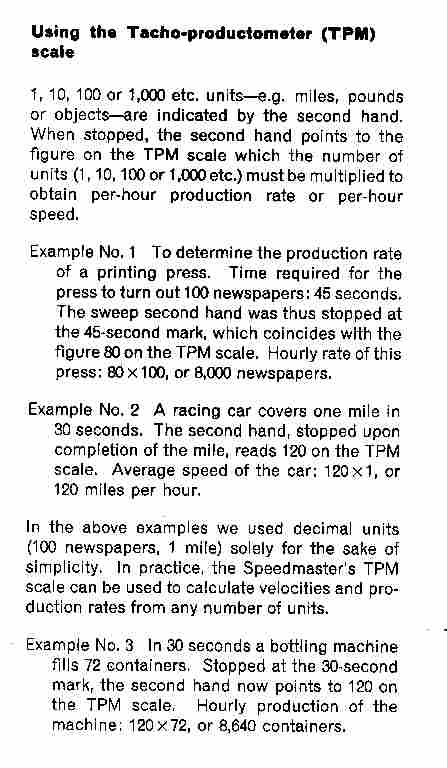
Find the AVERAGE speed of a moving car between point A & B with a distance 1000 m ( 1 km ).
If the car spends 30 seconds to finish this 1000 m, the red hand will point at the reading 120. This means the car can finish 120 x (1000 m) / hr = 120km / hr.
If the testing distance is shortened to 1m but the time remains the same, the answer will be 120m / hr.
Example B:
Find the total number of paper boxes can be folded in one hour. If an machine can fold a paper box in 20 seconds, the red hand will point at 180. This means 180 paper boxes can be folded in one hour.
You may see that the scale at the beginning is tighter (500 -> 400 = 2 sec.) than that at the end (70 -> 60 = 8.4 sec.); therefore, the shorter the time taken, the more the error due to your reaction time or other factors.
Increase the accuracy:
Use example B again, but this time, we count the time taken after 2 boxes are folded.
According to the answer from example B, we could find the reading is 40 sec or 90. But the actual reading may be 39 sec. only. As a result, the red hand will point at about 92.5; this means 92.5 x (2 boxes) / hr = 185 boxes can be folded in one hour. 5 more per hour !!!
Limit:
The time taken must be equal to or less than 60 sec.
More examples
වැදගත් උනා කියල හිතෙනවනම් රෙප් දීලා අනිත් අයටත් බලන්න බම්ප් එකක් දාල යන්න.
සිංහල ජාතියට ජය වේවා !!!
Tachymeter is a calculator on our wrist. However, most people only treat it as a decoration.
Things You'll Need:- Analog watch with tachometer

Step 1
Press the "mode" button on your watch until you are in chronograph mode. At this point, the second hand on your watch should stop moving when it reaches 12 o'clock.
Step 2
Pick a point spatially ahead of you where you would like to start your speed measurement. For your first practice, use a mile marker while driving. As you pass this marker, push the set button to start the chronograph. The second hand will proceed clockwise around the face. Press the set button again when you have traveled one mile. At this point you will pass a second mile marker.
Step 3
Look at the second hand of your watch. Determine what number position it is pointing to on the tachometer dial. This number represents the speed at which you were traveling in miles per hour. For example, if you took a minute to drive the mile, it will point to 60, meaning you drove at a speed of 60 miles per hour.
Step 4
Measure things that move slower than 60 miles per hour by taking the tachometer’s reading and dividing it. For example, there is no way a runner can travel one mile in a minute. Instead, record the amount of time it takes him to go a preset fraction of a mile. For example, measure one eighth of a mile, then divide the result on the tachometer (say, 60, if he completed the mile in one minute) by eight. You will get the result that he runs a 7.5-minute mile.
Step 5
Do the same for objects that are too fast for the tachometer, except multiply your results instead of dividing them. The smallest increment it can record traditionally is 7.5 seconds.
Tips & Warnings
#The unit of measurement you use is irrelevant. You can also use kilometers, meters, etc. The constant here is the time scale.
#If you’re not sure where the mode and set buttons on your watch are, look at the owners manual or contact the manufacturer.
#A tachometer cannot measure distance. You must have the distance predetermined to be able to make sense of the reading.
Examples

The scale of the watch above is number of work can be done per hour.
Example A:
Find the AVERAGE speed of a moving car between point A & B with a distance 1000 m ( 1 km ).
If the car spends 30 seconds to finish this 1000 m, the red hand will point at the reading 120. This means the car can finish 120 x (1000 m) / hr = 120km / hr.
If the testing distance is shortened to 1m but the time remains the same, the answer will be 120m / hr.
Example B:
Find the total number of paper boxes can be folded in one hour. If an machine can fold a paper box in 20 seconds, the red hand will point at 180. This means 180 paper boxes can be folded in one hour.
You may see that the scale at the beginning is tighter (500 -> 400 = 2 sec.) than that at the end (70 -> 60 = 8.4 sec.); therefore, the shorter the time taken, the more the error due to your reaction time or other factors.
Increase the accuracy:
Use example B again, but this time, we count the time taken after 2 boxes are folded.
According to the answer from example B, we could find the reading is 40 sec or 90. But the actual reading may be 39 sec. only. As a result, the red hand will point at about 92.5; this means 92.5 x (2 boxes) / hr = 185 boxes can be folded in one hour. 5 more per hour !!!
Limit:
The time taken must be equal to or less than 60 sec.
More examples
වැදගත් උනා කියල හිතෙනවනම් රෙප් දීලා අනිත් අයටත් බලන්න බම්ප් එකක් දාල යන්න.
සිංහල ජාතියට ජය වේවා !!!


