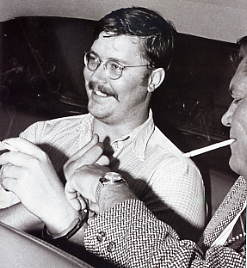
I was the hunter and they were the victims.

What do you think of Edmund Kemper


  • Total voters
    5
Aug 19, 2008
11,653
167
0
Sri Lanka
I watched Psycho recently
and it made me interested in Seriel Killers activities
and attitudes behind their killings.
Kemper is the most interesting character I found.
The one who knew what he was doing.
He is intelligent, logical even caring and philosophical at times.
I think he is much more than just a serial killer.
It's amazing
how can there be so many different characteristics
can be found in one man.
I enjoyed reading his interview.
Hope you would too.

:D
And just ignore my close friend GihanFX's irrelevant posts,
he is giving a false impression of a popularity to my thread.
I actually don't approve such pretensions to get attention to my threads.
What to do.
He is a friend
and I believe his intention is good.
Intention creates Karma
-Atula


Edmund Kemper
The Special Serial Killer


http://www.truecrime.net/kemper/interview.htm
By A Psychiatrist Re: His Adult Release

"...if i were seeing without any history available or without getting the history from him,
i would think that we're dealing with a very well adjusted young man who had initiative, intelligence, and who was free of any psychiatric illness.
If effect, we are dealing with two different people when we talk of the fifteen year old boy who committed the murder
and the twenty-three year old man we see before us now.
it is my opinion that ....
I would see no psychiatric reason to consider him to be of any danger to himself or to any member of society..."


Just a few hours after California's mass murderer Edmund Kemper, 24, was convicted on eight counts of first degree murder, he kept a promise and granted me an exclusive interview. It was not my first person-to-person talk with the young killer.
As a reporter assigned to cover the grisly murder investigation (I’ll Show You Where I Buried the Pieces of Their Bodies, August INSIDE, 1973) and the trial, I had, by chance, chatted with him a few weeks before his trial, as he was waiting at the Santa CruzCounty courthouse for a conference with his lawyer.
I wrote a story about our meeting and my impressions of him and he liked it, thus came his promise of an interview once the trial was ended. Kemper had warned me the court hearings on the gory sex-killings of six coeds and the subsequent murders of his mother and her best friend probably would turn my stomach. They did.
As a sex-starved young man in what should have been a peak of his virility, he was sexually and socially so uncertain of himself that he began to prey on hitchhiking coeds, not as a rapist, but as a murderer and necrophiliac.
"At first I picked up girls just to talk to them, just to try to get acquainted with people my own age and try to strike up a friendship," he had told investigators. Then he began to have sex fantasies about the girls he picked up hitchhiking, but feared being caught and convicted as a rapist So, he said: "I decided to mix the two and have a situation of rape and murder and no witnesses and no prosecution."
Kemper’s first two victims were 18-year-old FresnoState college coeds, Mary Ann Pesce and Anita Luchessa whom he stabbed to death May 7, 1972, after he picked them up in Berkeley.
"I had full intentions of killing them. I would loved to have raped them, but not having any experience at all..." he trailed off.
He disclosed that, despite the fact he killed Miss Pesce, she had awakened a feeling of tenderness in him that none of his other victims did. "I was really quite struck by her personality and her looks and there was just almost a reverence there," he said.
Kemper decapitated the girls' corpses, burying Miss Pesce's body in a redwood grove along a mountain highway and casting that of Miss Luchessa out in the brush on a hillside. He kept their heads for a time and then hurled them down a steep slope of a ravine.
The girls were listed as "missing persons" for months until Miss Pesce's head was found by hikers and, subsequently, identified through dental charts. Kemper later led investigators to the grave where he had buried her.
"Sometimes, afterward, I visited there ... to be near her ... because I loved her and wanted her," he said on the witness stand.
Miss Luchessa's head and body never were found.
A month after Miss Pesce's head was discovered, Kemper chose another victim. Beautiful Aiko Koo, 15, a talented Oriental dancer, was hitchhiking from her home in Berkeley to a dance class in San Francisco. She never arrived. Kemper literally snuffed out her life in the darkness of an isolated spot in the mountains above the city of Santa Cruz.
Her mouth was taped shut and he pinched her nostrils together until she suffocated. Then he raped her inert body and put it in the trunk of his car. A few miles away, he stopped at a country bar "for a few beers."
Before going into the bar, he opened the trunk to make sure she was dead. He told investigators:
"I suppose as I was standing there looking, I was doing one of those triumphant things, too, admiring my work and admiring her beauty, and I might say admiring my catch like a fisherman."
Kemper also spoke of a sense of exultation in his killings:
"I just wanted the exaltation over the party. In other words, winning over death. They were dead and I was alive. That was the victory in my case."
He said of the act of decapitation, "I remember it was very exciting … there was actually a sexual thrill … It was kind of an exalted triumphant type thing, like taking the head of a deer or an elk or something would be to a hunter.
"I was the hunter and they were the victims."
On the witness stand, though, Kemper testified that "death never entered as a factor" in the coed killings. He said:
"Alive, they were distant, not sharing with me. I was trying to establish a relationship and there was no relationship there...
"When they were being killed, there wasn't anything going on in my mind except that they were going to be mine ... That was the only way they could be mine." (Kemper testified that as a child of eight he had killed his pet cat, which had transferred its affections to his two sisters, "to make it mine.")
His desire to possess the coeds led Kemper even further than murder, he revealed in court. In his fantasies he literally made two of the girls "a part of me" by eating "parts of them."

kemper1.jpg
Of all his coed victims he said: "They were like spirit wives... I still had their spirits. I still have them," he declared in the courtroom.
Kemper did not kill again until after he bought a .22-caliber pistol in January of this year.
"I went bananas after I got that .22," he told me.
The day he bought it he fatally shot coed Cynthia Schall, a 19-year-old Santa Cruz girl, in the trunk of his car. He carried her body into his mother's apartment near Santa Cruz, kept it in his bedroom closet over night and dissected it in the bathtub the next day while his mother was at work.
He buried the girl's head in the back yard "with her face turned toward my bedroom window and, sometimes at night, I talked to her, saying love things, the way you do to a girlfriend or wife."
Less than a month later, Kemper picked up two girls, Rosalind Thorpe, 23, and Alice Liu, 21, on the campus of the University of California at Santa Cruz (UCSC). He shot them both to death in the car before driving off campus and later cut off their heads in the trunk of his car while it was parked in the street in front of his mother's apartment.
He told investigators the killings came on an impulse bom out of anger with his mother.
"My mother and I had had a real tiff. I was pissed. I told her I was going to a movie and I jumped up and went straight to the campus because it was still early.
"I said, the first girl that's halfway decent that I pick up, I'm gonna blow her brains out," he revealed.
Kemper's final killings were those of his mother, Mrs. Clarnell Strandberg, 52, and her best friend, Mrs. Sara Hallett, 59, in his mother's apartment on Easter weekend. Then he began a cross-country flight, in a rented car loaded with guns and ammunition, that ended in a decision to surrender, "so I wouldn't kill again."
On April 24, 1973, he was arrested in a public telephone booth in Pueblo, Colo., after he had called policemen he knew in Santa Cruz to say he was the coed killer and told them where to find the bodies of his mother and Mrs. Hallett.
The afternoon I went to see Kemper in the Santa CruzCounty jail where he was being kept pending sentencing the next morning, I expected to talk to him for an hour or so, in the presence of a jailer. Instead, I spent over five hours alone with him, locked up in a tiny glass-walled room within sight but not sound of the jailer's desk. Though he wore manacles on his ankles, his hands were free.
Disarming as he is at times, more than once during the long afternoon I was reminded that I was sitting face to face with a six-foot, nine-inch 255-pound giant who had murdered and mutilated six coeds, beaten his sleeping mother to death with a hammer and strangled his mother's best friend in a matter of seconds. The frequent traffic of jailers and inmates past the glass wall was reassuring comfort.
My visit with Kemper was an unforgettable experience, inducing a collage of feelings. As he talked on and on, he was many things.

  • A lonely young man, grateful for companionship on the eve of what was certainly to be his last day outside prison.
  • An angry and bitter sibling recalling what he felt was rejection and a lack of love from a divorced father who "cared more for his second family than he did us."
  • A son who alternately hated and "loved" a mother he described as a "manhater" who had three husbands and "took her violent hatred of my father out on me."
  • A sometimes wry and boastful raconteur, chronicling the events of his life and a person quick to see the humorous side of things and laugh, even if the joke is on him.
  • An anguished and remorseful killer when speaking of the coeds whose bodies he had sexually assaulted after death and of the "pain" he had caused their families. "The day those fathers [of the Pesce and Luchessa girls] testified in court was very hard for me ... I felt terrible. I wanted to talk to them about their daughters, comfort them ... But what could I say?"
Kemper also was a person who momentarily precipitated in me a flush of terror and then allayed my misgivings by faultlessly assuming the role of the gracious host. He talked about the jury's verdict that morning. He had pleaded not guilty and not guilty by reason of insanity to each of the killings.
Court-appointed psychiatrists, called to testify by the prosecution, described Kemper as suffering from a "personality disorder," but said he was not criminally insane by California's legal standards. One doctor called Kemper a "sadistic sex maniac."
The jury found Kemper was guilty and sane.
He didn't disagree with the jury's verdict.

sacrific.jpg
"I really wasn't surprised when it came out that way," he said. "There was just no way they could find me insane ... Society just isn't ready for that yet. Ten or 20 years from now they would have, but they're not going to take a chance."
But he expressed regret that the "sane" verdict would mean he would go to prison, instead of possibly returning to Atascadero state hospital.
Kemper spent five years at Atascadero after he murdered his grandparents in 1964 at the age of 15. He recalled with pride the job he'd held there as head of the psychological testing lab at the age of 19 and working directly under the hospital's chief psychologist. He said:
"I felt I definitely could have done a lot of good there, helping people return to the streets ... I could have fit in there quicker than anybody else...
"After all," he explained, "I grew up there. That used to be like my home.
"Basically, I was born there, you know. I have a lot of fond memories of the place ... And I don't know anybody else who has," he added with a rueful laugh.
It was there that he became a member of the Junior Chamber of Commerce. During his trial, he wore his membership pin in his lapel, apparently with pride.
Because of his intelligence and ability, he apparently was a valuable aide in psychological testing and research. "I helped to develop some new tests and some new scales on MMPI... You've probably heard of it ... the Minnesota Multiphasic Personality Inventory," he said with a chuckle. "I helped to develop a new scale on that, the 'Overt Hostility Scale'... How's that for a..." He groped for a word.
"Ironic?" I suggested.
"Ironic note," he agreed. "There we go, it was an ironic note that I helped to develop that scale and then look what happened to me when I got back out on the streets."
Though Kemper couldn't give me a positive answer to why he did what he did, he partly blamed society, the courts and his parents as well, saying:
"I didn't have the supervision I should have had once I got out... I was supposed to see my parole officer every other week and a social worker the other week.
"I never did. I think if I had, I would have made it.
"Two weeks after I was on the streets, I got scared because I hadn't seen anyone.
"Finally, I called the district parole office and asked if I was doing something wrong... was I supposed to go to my parole officer, or would he come to see me, I asked."
Kemper said the man on the phone asked him, "What's the matter, you got a problem?" When Kemper told him, "no," the man replied, "Well, we're awfully busy with people who have; we'll get to you."
Kemper blamed the court for counteracting the plan of Atascadero doctors to release him in stages geared to get him accustomed to the world outside again. He said they planned to send him to a "halfway house" environment where he would still have counseling, have a chance to get acquainted with girls at social functions and become aware of persons in his own age group.
"When I got out on the street it was like being on a strange planet. People my age were not talking the same language. I had been living with people older than I was for so long that I was an old fogey."
Instead, Kemper was sent to a California Youth Authority institution by court order, only to be released abruptly five months later, paroled to the custody of a mother who was "an alcoholic and constantly bitched and screamed at me."
Kemper looked down at his hands and said, "She loved me in her way and despite all the violent screaming and yelling arguments we had, I loved her, too." "But," he continued, "she had to manage your life... and interfere in your personal affairs."
He said his mother was a "big, ugly, awkward woman who was six feet tall and she was always trying to get me to go out with girls who were just like her... friends of hers from the campus." (His mother was an administrative assistant at UCSC.)
"I may not be so much to look at myself," Kemper said with a laugh, "but I have always gone after pretty girls."
All of his hitchhiking coed victims were pretty and, with the exception of one girl, were small and delicate in stature.
Of his father, he said, "he didn't want me around, because I upset his second wife. Before I went to Atascadero, my presence gave her migraine headaches; when I came out she was going to have a heart attack if I came around."
It was because of that, Kemper said, that he was "shipped off" to his paternal grandparents to live in "complete isolation" on a California mountain top with "my senile grandfather" and "my grandmother who thought she had more balls than any man and was constantly emasculating me and my grandfather to prove it.
"I couldn't please her... It was like being in jail... I became a walking time bomb and I finally blew ... It was like that the second time, with my mother."
 
Last edited:
Aug 19, 2008
11,653
167
0
Sri Lanka
Continued...

mother.jpg
Kemper's mother. He killed her with a hammer, cut off her head and threw darts at it, cut out her larynx and put it in the garbage disposal, then had sex with her corpse.

Kemper laughed as he recalled an incident with his grandmother when she left him home alone one day but took his grandfather's .45 automatic with her in her purse, because she was afraid he might "play" around with it in her absence. His grandparents were going to Fresno on a monthly shopping trip. He recalled:
"I saw her big black pocketbook bulging as she went out the door and I said to myself, 'Why that old bitch, she's taking the gun with her, because she doesn't trust me, even though I promised I wouldn't touch it.'"
He said he looked in his grandfather's bureau drawer and "sure enough the gun was gone from its usual place...
"I toyed with the idea of calling the chief of police in Fresno and telling him 'there's a little old lady walking around town with a forty-five in her purse and she's planning a holdup' and then give him my grandmother's description."
He laughed appreciatively at the idea and asked me: "How do you suppose she would have talked herself out of that?" There were moments, prior to her death, when he felt like punishing his mother, too. Kemper told investigators he had killed his mother to spare her the suffering and shame that knowledge of his crimes would bring. But, he said, as he sat in the little room with me:
"There were times when she was bitching and yelling at me that I felt like retaliating and walking over to the telephone in her presence and calling the police, to say, 'Hello, I'm the coed killer,' just to lay it on her."
Kemper's testimony in court revealed his desire to punish his mother did not end with the fatal hammer blow. He cut off his mother's head, "put it on a shelf and screamed at it for an hour ... threw darts at it," and ultimately, "smashed her face in," he recalled for the horrified court.
Once during the long afternoon, a deputy brought us in some coffee. Another one came to inquire if Kemper needed any medication. (Under doctor's orders he was allowed to have tranquillizers as required and sleeping pills at night.)
The jail nurse also came in while I was there and changed the bandage on his wrist where he had slashed an artery in one of his four suicide attempts after his arrest.
"Would you like to see my wound," he said, holding his arm out to me.
(The cutting instrument he had used to make the suicidal incision had been fashioned from the metal casing of a ball point pen I had given him. Jailers at the neighboring San Mateo county jail, where he was kept for security reasons after two suicide attempts in Santa Cruz, had failed to remove the pen from his folder of papers when Kemper returned from court.)
He had previously assured me, "It's not your fault." He tried to explain his suicide attempts, saying that he did not have a suicidal feeling when he was first "locked up." Then the "kindness and respect with which I was treated by the people [jail personnel] after a while started to get to me ...
"I started feeling like I didn't deserve all that nice treatment after what I had done ... and I guess that's why I started cutting myself up."
Kemper also talked about his previous statements that, if he were sent to prison he would kill someone so he could die in the gas chamber, and indicated he had had a change of heart.
"I guess you heard me say that I wanted to kill 'Herbie' Mullin, my fellow mass murderer," he said. (The Mullin story, Chalk Up Another for Mr. Kill-Crazy, appeared in the June, 1973, issue of INSIDE DETECTIVE.)
"Well, there was a time when I thought it would be a good solution for everyone.
"It would be good for society and save everyone a bundle of money. Instead of spending thousands and thousands of dollars to lock the two of us up for life to protect us from people and people from us...."
Kemper had told investigators and psychiatrists he thought he would kill again if he ever were released. He also admitted under cross examination by District Attorney Peter Chang that he had fantasized killing "thousands of people," including Chang himself. He said:
"I figured that if I killed him [Mullin] and then they sent me to the gas chamber, it would be a good solution to the problem.
"I know I'd never get a chance to though and I don't have any intention of killing him or anyone else...."
(Mullin was convicted of two counts of first degree murder and eight counts of second degree murder in the shooting deaths of ten persons he killed during a 21-day rampage early in 1973 in Santa CruzCounty. Five of the victims were complete strangers to him. He said he killed three others in 1972.)
Kemper and Mullin were next-door neighbors in their security prisoner cellblock at the San MateoCounty jail before Mullin was tried and convicted. Kemper made no secret of his disdain for Mullin from the first moment of their meeting in San Mateo.
"You're a no-class killer," he taunted him.
During Kemper's trial, under questioning from Chang, Kemper admitted he had thrown water through the cell bars onto Mullin to "shut him up when he was disturbing everybody by singing off-key in his high-pitched, squeaky voice."
Kemper added, though, "When he was a good boy, I gave him peanuts. He liked peanuts."
Kemper said of the alternate water treatment and the peanuts, "It was behavioral modification treatment... The jailers were very pleased with me."
“You know, though," Kemper told me, as he looked out of the window in the little room, "It really sticks in my craw that Mullin only got two 'firsts' and I got eight.
"He was just a cold-blooded killer, running over a three-week period killing everybody he saw for no good reason."
He paused for a moment, then broke into laughter, saying, "I guess that's kind of hilarious, my sitting here so self-righteously talking, like that, after what I've done."
When Kemper assured me that he had given up thoughts of trying to take his own life again, I asked him what he planned to do with the rest of his years in prison. He told me he knew he would be locked up in tight security for the first few years and that he thought he would try to do a lot of reading and studying. "I've always loved science and math," he said, "and I'd also like to study French and German.
”After that, I hope, I can find a way to help other people . . . Maybe they can study me and find out what makes people like me do the things they do."
(The next morning. Judge Harry F. Brauer sentenced Kemper to life in prison and told him he was going to recommend "in the strongest terms possible" that Kemper not be released for "the rest of your natural life.")
One relationship that obviously has touched Kemper is that with Bruce Colomy, Santa CruzCounty sheriff's deputy. Colomy has been with Kemper more than any other officer, transporting him to and from San Mateo County Jail to Santa Cruz for court appearances and remaining with him at all times when he was out of his cell.
Kemper said of Colomy, only a few years older than himself, "He's more like a father to me than anyone I have ever known ... He's like the father I wish I had had."
(Deputy Colomy told me later that one of the last things Kemper did before he left the Santa Cruz courthouse for state prison was to remove his cherished Junior Chamber of Commerce membership pin from his coat lapel "and give it to me." The deputy said, "Ed looked at it for a long time and tears came to his eyes. Then he handed it to me and said, 'Here, I want you to have it.'")
For all of his seeming ability to relate to people in an animated and warm exchange, Kemper also has the ability to withdraw without warning into a kind of frightening reverie, reliving his acts of violence. I watched it happen.
He had paused in his outpouring of talk about himself and looked at me curiously.
"You haven't asked the questions I expected a reporter to ask," he said.
"What do you mean," I replied. "Give me some examples."
He drawled, "Oh, what is it like to have sex with a dead body? ... What does it feel like to sit on your living room couch and look over and see two decapitated girls' heads on the arm of the couch?" (He interjected an unsolicited answer: "The first time, it makes you sick to your stomach.")
He continued, "What do you think, now, when you see a pretty girl walking down the street?"
Again, an unsolicited answer: "One side of me says, 'Wow, what an attractive chick. I'd like to talk to her, date her.'
"The other side of me says, "I wonder how her head would look on a stick?'"

court.jpg

Kemper in court with Deputy Bruce Colomy, of whom he said "He is more like a father to me than anyone I have ever known ... He's like the father I wish had had."

(The public defender appointed as Kemper's attorney told jurors in his closing argument: "There are two people locked up in the body of this young giant, one good and one evil... One is fighting to be here with us and the other is slipping off to his own little world of fantasy where he is happy."
"Oh, for God's sake, Ed," I said, just a trifle piqued by the feeling he was putting me on and hoping that was it, "the jury found you legally sane and I agree with that. But, at the same time, I can't help but believe that, as you yourself said, you must have been sick when you did the things you did.
Kemper, himself, earlier had told me he thought his actions were that of a "demented person."
"In my estimation," I continued, "it doesn't make any more sense to ask a delirious patient what he's thinking than it would to ask you what you were thinking when these things were going on."
Despite that, for the first time, he began to detail to me how he killed one of his victims. The illustration he chose made me even more uncomfortable. It was the killing of Mrs. Hallett, not a coed but a mature woman, like me.
Kemper straightened up in his chair and began a graphic description. "I came up behind her and crooked my arm around her neck, like this," he said, bending his powerful arm in front of himself at chin level.
"I squeezed and just lifted her off the floor. She just hung there and, for a moment, I didn't realize she was dead ... I had broken her neck and her head was just wobbling around with the bones of her neck disconnected in the skin sack of her neck."
He began to wobble his head around, never changing the position of his arms and gazing fixedly at me. His jail-pale face had become slightly flushed, his eyes glazed, his breath coming a little quickly and he stuttered almost imperceptibly as, he spoke.
"Holy Christ," I said to myself, "what am I doing here?"
I reached for a cigarette in my pocket and said the first thing that came into my mind to try and change the subject without showing I was upset. "Have you always been so strong, Ed," I asked in a nonchalant tone.
"No," he replied. "As a matter of fact..." he relaxed and then we were off and talking about other more comfortable topics.
The sky outside the windows of the little room had grown dark and I made efforts to leave, saying I had been "virtually incommunicado all day as far as my family was concerned and they would wonder why I had not arrived for dinner."
Kemper was reluctant for me to go. "Well, you can always tell them later, you have been over talking with Ed Kemper all afternoon," he laughed.
As it turned out, though, I stayed for dinner with Ed. The trusty had brought his dinner and it was getting cold. When I insisted that we should stop talking and that Kemper should eat, the jailer invited me to stay for dinner.
"Big Ed" urged me to accept and I did. He carried the trays into the little room himself and arranged them on the desk chairs. We chatted as we ate and he was the host. He ate hungrily and I noticed he had finished his rice with meat sauce. I had more than I could eat, so I offered to share. What seemed like a large portion to me must have been but a morsel to a large man like him.
He gratefully accepted the added food, but cautioned me as I scraped it from my tray on to his, "Save some for yourself."
I gave him my milk as well, saying, "I really hate milk, you can have it."
"Do you?" he said. "I love it."
When dinner was over, I said I must go and, when he got up and proceeded toward the door, I said, "Do you think you could knock on the window and get the jailer to spring me, Ed?"
He laughed and replied, "I'll try."
He stood in the doorway, his hair brushing the top of the door jamb, watching me leave, as if he were graciously bidding a guest goodbye from his home.
He said to a deputy, "Could I have some matches?" (I had been lighting his cigarets all afternoon with my lighter.)
The sergeant on duty at the desk said to the deputy, "He can't have any matches, but light his cigarette for him." Kemper looked at me and grinned like a teenager. "Yesterday," he said, "I had matches, but isn't it funny when you're convicted, you immediately become combustible."
"Well, Ed," I retorted, "if you'd learn to stay out of trouble, you wouldn't find yourself in these predicaments."
"Right on," he said, with a final salute of his hand and a smile.
 
Aug 19, 2008
11,653
167
0
Sri Lanka
Young women disappear every day. They leave their husbands, their parents, their children and simply drop from sight. Police take the missing person reports, issue the required all-points bulletins and try to ease the fears of those left behind.

“She’ll come home or write you a letter or turn up somewhere. Most of them do,” is the standard response in cases where there is no indication of foul play.

insidedetective.jpg
A missing person case filed with the Berkley police department in the early morning hours of September 15, 1972, was typical.

Mrs. Skaidrite Rubene Koo, an employee at the University of California Library, called to report the disappearance of her daughter, 15-year-old Aiko Koo, from her home.

“She’s been kidnapped,” Mrs. Koo told the officer who drove out to her house to take the report. “I’ve had a premonition all summer that something was going to happen to change our lives. She has started hitchhiking … you know we have no car.”

Aiko was a student at the exclusive Anna Head School for Girls over in Oakland, she told the officer. She was a good student, a good daughter. She would never just leave. There was love in their family.

And Aiko was talented. She had great plans for a future in Korean ballet. Already, she was receiving invitations to perform. The last weekend of the month, Aiko and two other girls were scheduled to travel to St. Louis to perform at the World Trade Fair there. Just before Aiko left for her ballet class the previous night, they had been putting the finishing touches on the girl’s costume for that anticipated performance.

“It’s been such a busy time,” Mrs. Koo told the officer. “Normally, I would have gone with her. I always go with her to her dance classes. But I had so much to do.’

“You know, I didn’t want her to go. It wasn’t that important for her to go to that class, but when my daughter wants things she wants them very bad.

“I’m no psychic, but I was afraid for her. She was so beautiful last night. I finally told her she could go if she took the bus, if she didn’t hitch a ride.

“I know she’s been hitchhiking. You know how impatient young people are these days. I know because she got a ticket for hitchhiking. When she told me about the ticket, she joked about it. She called it her parking ticket.

“I told her I was very much against her hitchhiking. But once people hitchhike and it goes well, they can’t believe anything can go wrong. Now I think something terrible has happened. That’s why Aiko didn’t come home last night.”

Aiko Koo never performed in St. Louis. She did not come home.

Police told her mother not to give up hope; the nicest young people were running away from home these days and they rarely gave their parents notice. Chances were at least 50-50 that Aiko had joined these wandering young runaways. The best thing she could do they said, is have some flyers printed with Aiko's picture and description

Mrs Koo was certain her daughter had met foul play, but she complied. She sent circulars to police departments and communes throughout the western states, asking any information about a beautiful young Eurasian girl, graceful in dance. She received hundreds of letters of sympathy but not one word of her missing daughter,

Last Christmas, three months after Aiko’s disappearance, Mrs. Koo stopped sending the circulars. Ever since Aiko left, she had kept her daughter’s Korean dancing drums and the dancing dress she was to have worn to St. Louis displayed on the living room wall. She took down the dress and packed it away.

"I never believed she ran away, she told an acquaintance. "Not even that night when she didn’t come home.”

The police, too, might have had hidden suspicions about the fate of Miss Koo. She wasn’t the first hitchhiker to disappear in Berkley that year.

Four months earlier, two 18-year-old Fresno State College girls—Mary Ann Peso and Anita Luchessa—bade goodbye to some friends in Berkley, saying they were going to hitchhike to Stanford University in Palo Alto, south of San Francisco. Their friends at Stanford told police later that they never arrived.

The parents of the girls filed a missing persons report and sent photographs of their daughters to local newspapers, asking for help in locating them. The police report was filed and forgotten until a month before Miss Koo's disappearance.

In August, someone found Mary Ann Peso's skull up on rugged Loma Prieta Mountain in Santa Cruz County. An extensive search failed to turn up the rest of her remains or a trace of her companion.

The discovery of the skull on Loma Prieta Mountain was recalled by Santa Cruz County lawmen five months later when a 19-year-old coed named Cynthia Ann Schall disappeared while hitchhiking from her home in Santa Cruz to class at Cabrillo College in Aptos.

On January 10, the day after Miss Schall disappeared, a California highway patrolman made a ghastly discovery while driving on Highway 1, 19 miles south of Monterey, near Big Sur. Just a few feet off the roadway, he found two severed human arms and hands.

Seven days later, a badly mutilated human torso was found floating in a lagoon near Santa Cruz. Two days after that, a surfer at Capitola—just south of Santa Cruz—found a left hand. And, three days beyond that, someone else found a young woman's pelvis along the shore near Santa Cruz.

Pieced together like a macabre jigsaw puzzle, this was the body of Cynthia Ann Schall. Every part but her head and right hand was there. Fingerprints from the left hand matched prints taken from Miss Schall's rented room. Chest X-rays she had taken in October matched X-rays of the torso found in the lagoon. Police and a pathologist decided she had been hacked to death, then sawed into pieces with a power saw.

Coeds at Cabrillo College and the University of Santa Cruz campus just to the north started thinking twice about hitching for rides. Lawmen warned them not to. There seemed to be a homicidal butcher in the area, preying on defenseless young girls traveling by thumb.

At the University of Santa Cruz, a warning was posted:

"When possible, girls especially, stay in dorms after midnight with doors locked. If you must be out at night, walk in pairs. If you see a campus police patrol car and wave, they will give you a ride. Use the bus even if somewhat inconvenient. Your safety is of first importance. If you are leaving campus, advise someone where you are going, where you can be reached and the approximate time of your return. DON'T HITCH A RIDE, PLEASE!!!"

At age 22, Rosalind Thorpe was a sensible, careful girl. She took the bus from her apartment in downtown Santa Cruz out to the university last February 5. And she was there all day. She left when the Science Library closed at 9 P.M. and headed for the bus stop.

kemp2.jpg
Her arms laden with books, Rosalind stood there in an umbrella of light provided by a street light and hoped the last bus of the night had not left already for town. As she waited, a battered yellow 1969 Ford with a long, police type whip antenna pulled to the curb. There was a university staff parking sticker on the bumper. A big, friendly young man with a mustache leaned across the. seat and rolled down the passenger window and called out:

"The bus is gone. I know. I've missed it before, too. Can I give you a lift? It's pretty late."

Rosalind got in the car and they drove off.

Two blocks away, 22-year-old Alice Liu, 21, was standing beside the road, wondering how she was going to get back to town. She had stayed too late in the main campus library. A car came toward her down the road. A street lamp behind it illuminated a couple in the front seat. As the car drew nearer, she saw a university parking sticker on the bumper. What could be safer, Alice probably thought as she stuck out her thumb and smiled.

Friends reported the two young women missing the next day. Santa Cruz police, recalling the fate of Cynthia Schall, issued an urgent "all-points."

Students at the university had no doubt about the fate of their two classmates. They formed search teams and began crisscrossing the wooded 2000-acre campus, looking for their remains. They found nothing,

Ten days later, an Alameda County road crew was out checking for storm damage in the Eden Canyon area of the county north of Santa Cruz. Alongside a lonely road, up in a steep ravine, they made a horrifying find.

At first, at a distance, they thought that what they had come upon were discarded mannequins. Up close, they were two mutilated corpses.

Both women appeared to have been young, though the men were not certain. The bodies were headless. One seemed to be Oriental and also had had her hands hacked off. She was nude. The white woman was clad in bra and panties.

It was a week before authorities were certain that the mutilated corpses were the remains of Alice Liu and Rosalind Thorpe. The confirmation came through use of X-rays and physical descriptions provided by the Liu and Thorpe families.

Murder was the Number 1 topic of conversation in Santa Cruz those days. District Attorney Peter Chang even commented that the once peaceful tourist community might be "the murder capital of the world right now."

He wasn't just talking about the horrible attacks on young women hitchhikers. There already had been 16 murders in the area since the start of the year. His office just had charged a young religious zealot and LSD user from Santa Cruz-25-year-old Herbert Mullin—with ten of those murders {Chalk Up Another for Mr. Kill-Crazy, June INSIDE DETECTIVE, 1973).

When brought to trial, Mullin would be the second man Chang had prosecuted for mass murder in two years. He was the district attorney who sent John Linley Frazier, a drug-crazed ecology freak, to prison for the October, 1970, murders of prominent eye doctor Victor Ohta, his wife, two small sons and a private secretary. Frazier killed them and dumped them in the swimming pool of Ohta's expensive and remote hilltop house because he felt their luxurious existence damaged the natural wonders of the area. (A Swimming Pool Full of Corpses, February FRONT PAGE DETECTIVE, 1971).

What concerned Chang most—with Mullin in jail—was that this time he seemed to have not one, but two mass killers on his hands. There was no way Mullin could he connected with the murders of the hitchhiking coeds. There still was a psychotic killer on the loose and any young woman with her thumb out, standing at the side of the road, was a potential victim.

The horror was underscored two weeks later, when a hiker near Devil's Slide in Pacifica, up the coast in San Mateo County, found the skulls of two young women. Tests showed they had been chopped from the necks of Rosalind Thorpe and Alice Liu.

Everywhere in Santa Cruz, people looked a little more closely at their neighbors. The person responsible for this butchery must be living a very bizarre double life, they thought. Where could someone so thoroughly mutilate and dismember those young women without being seen? How could one be so sick as to even contemplate such crimes without giving some hint of dangerous instability to family, friends or neighbors?

One center for conversation about the murders was the gun shop in Santa Cruz where dealer Harry Ellis was selling handguns as fast as he did in the days when they were looking for the person who killed the Ohtas.

"I've never owned a gun before, but I'm frightened," a pretty office worker told Ellis as she slipped the snub-nosed .38 into her purse. "From now on, I'm keeping this handy at all times."

A tall husky man with a mustache stood near the counter and joined in the conversation. Ellis recognized him as "Big Ed," a gun freak who was in his shop quite often, sometimes to look, sometimes to buy, sometimes just looking for someone to talk to—about guns, mostly. They'd talked of the killings before.

"The guy who’s doing this to those girls must be sick. He needs help," said Ellis.

"Sure does," said "Big Ed."

Another locale for intense speculation about the killer was the Jury Room, a bar frequented by off-duty Santa Cruz police officers and others from City Hall across the street.

"Big Ed" Kemper often joined in those conversations and he was welcome. He was a friend of many of the officers in the tavern. He idolized them, wanted to be a policeman himself. He would be, he told everyone, if he wasn't too big. He stood 6 feet, 9 inches tall and weighed 280 pounds. He was a security guard, instead, he said, and he had the gun and handcuffs to prove it.

Everyone thought of Big Ed as a pretty good guy. He got a little rowdy sometimes. Generally, though, the straight shots of tequila he downed seemed to have little effect on him. He played the role of a friendly giant—picking up smaller friends and setting them down on bar stools.

After the arrest of Mullin, there were no more murders. Memories faded. On the Santa Cruz campus, it once seemed as if no one could complete a sentence without mentioning the killings. Everybody joined the anti-hitchhiking campaign. Campus police passed out handbills reading "Everybody Needs a Body (Save Yours)." By mid-April of this year, though, hardly anyone was talking about the killings. Hitchhiking was starting to pick up again. Those who did recall the attacks on the coeds wondered if it hadn't been that guy Mullin after all.

Then, at 4 A.M. on Tuesday, April 24, the telephone rang at the dispatch desk of the Santa Cruz police department: A man's deep excited voice came over the wire:

"I killed my mother and her friend. And I killed those college girls. I killed six of them and I can show you where I hid the pieces of their bodies."
 
Aug 19, 2008
11,653
167
0
Sri Lanka
kemperukmag.jpg
An excited dispatch officer waved at a superior to pick up an extension telephone. As the man continued to talk, the graveyard shift officers punched buttons on the telephone, frantically trying to set up a trace. Then the line went dead. Someone had pushed the wrong button and cut off the caller.

The startled officers in the police station began a tense wait, praying the disturbed young man would re-dial their number. While they waited, they arranged with the telephone company to place a tracer on the call immediately, if it came. Each time the telephone rang, the men started in anticipation. At 6 A.M., he called again.

A two-man patrol car originally had been dispatched to the phone booth when Pueblo police headquarters had been alerted about the agitated caller to Santa Cruz. The California officers had warned their Colorado counterparts of the man's size and said that he probably was dangerous and armed. Patrolman Martinez, who had been just a few blocks away from the booth, took the assignment because of his location and he was warned about the suspect, too. '^

When they said on the police radio that he was 6-9 and 280 pounds, I couldn't see anyone that big," Martinez was quoted. "I moved into the area and spotted him in the phone booth with his back to me.

"Then I put on my red lights, pulled my revolver and eased from the cruiser," Martinez continued. “I wasn't taking any chances."

The 30-year-old officer, who is the father of three children, said that he had walked cautiously up to the phone booth, then tapped on the glass. "First I came up, he hadn't noticed me yet and I checked his hands to see if he was armed.

"He was still talking to Santa Cruz when I came up. When I told him to move outside, he asked 'What do I do with the phone?' I told him just to drop it."

His prisoner just walked out of the phone booth, Martinez went on, then leaned against it while the officer searched him.

"It took about four minutes for the backup car to arrive," Martinez recalled, "but to me it seemed like four hours."' According to the arresting officer, a quick look in Kemper's car, parked near the booth, showed him there was enough ammunition in it "to hold off an army for about a week.

"It's not likely that I'll ever make as big an arrest again," Martinez told newsmen.

Kemper, who Pueblo Chief of Police Robert Mayber sized up as "big enough to beat a mountain lion with a switch," had surrendered without a struggle. He reportedly stepped from the booth with his arms together out front, indicating his willingness to be handcuffed. Asked where his weapons were, he indicated the trunk of a nearby rental car, obtained in Nevada. Inside, officers found a shotgun, a rifle, a carbine and 100 rounds of ammunition.

Kemper seemed almost driven to confess the Northern California murders, telling where and how he killed his victims, how he dismembered their bodies (usually with an ornamental saber) and where he hid the pieces. Chief Mayber, at that point, knew little of the string of killings to which Kemper was referring but he thought the man sounded authentic. Turning to another officer, he said:

"With that kind of detail, I believe he knows what he's talking about."

Kemper told them he had killed ten people in all and he was afraid he was about to kill some more.

It all started, he said, nine years ago —when he was just 15 years old and a mere 6-foot-4, 160 pounds. He was staying with his grandparents—Mr, and Mrs. Edmund Emil Kemper—at their farm house in North Fork, a Sierra-Nevada foothill community in central California.

He didn't like being there and he had heard some talk that he was going to be sent to live with his father in Van Nuys in Southern California. He didn't like that either. He was just "mad at the world" when he saw his grandmother sitting at her typewriter, putting the finishing touches to one of those boys' adventure stories she wrote. He took a gun and shot her twice in the back of the head. Then, taking up a ten-inch kitchen knife, he stabbed her twice because "I didn't think she was dead and I didn't want her to suffer."

When Kemper's grandfather drove up to the house later, he stepped from the car and greeted his grandson with a wave and a smile. When he turned back to take out some packages, Kemper shot him in the back of the head, "because I didn't want him to see what I had done."

He hid his grandfather's body in the closet, then experienced overwhelming feelings of sorrow for what he had done. He called his mother at her home, which then was in Helena, Mont., and sobbed his confession. She called the sheriff. As deputies were en route to the farmhouse, Kemper himself called the sheriff to report his crimes.

Kemper was tried in Juvenile Court and found insane. He was sent to Atascadero (Cal.) State Hospital, where, five years later, he was pronounced cured. The hospital turned him over to the California Youth Authority, which released him after two years imprisonment.

The hulking young man went to work for the State Division of Highways as a laborer, but fantasized about going into police work of some kind. First, he had to get his juvenile court record sealed. To do that, he had to convince two psychiatrists that he was normal, no longer a danger to others.

But Kemper knew he was not normal. He had bizarre sexual fantasies about the young women he found in the free world around him. And they were so available. All he would have to do would be to pick up one of the pretty young hitchhikers.

On May 7, 1972, the tormented young giant gave in to his desires. He picked up Mary Ann Peso and Anita Luchessa on a Berkeley street corner. On the pretext of driving them to Stanford, he headed his auto south. Near Hayward, he turned off onto a lonely road and easily overpowered the young women, fatally stabbing each.

Stuffing the bodies into the trunk of his 1969 Ford, he drove back to his apartment in Alameda. After nightfall, he dragged their bodies to his room, then ceremonially dismembered them, experiencing great sexual release.

Later, he placed the butchered bodies in plastic bags and stored them in his bedroom closet overnight, he said, then carried them to his car in boxes the next morning and headed south. In Santa Cruz County, he dumped the remains on Loma Prieta Mountain. He remembered the exact place, he said, and would lead the police to it.

kemp1.jpg
The urge overcame him again the night of September 14, he said, when he saw pretty little Aiko Koo hitchhiking near the bus stop in Berkeley. Once she was in his car, he forced her to ride with him to the Bonnie Doon area of Santa Cruz. He smothered her there, covering her mouth and nose with his oversized hand until she was dead. Using his ornamental saber, he dismembered her body with mounting excitement. He deposited her remains in scattered parts of the county the next day. He remembered most of the places, he said.

Actually, not all of Aiko Koo's remains were left in Santa Cruz County that day. He kept her head in the trunk of his car. In fact, he recalled with a smile, her head was in his car trunk on September 16, when he went to Fresno and was examined by two court-appointed psychiatrists in his effort to have his records sealed.

Kemper was given a clean bill of health by the two medical men.

"He has made an excellent response to the years of treatment. I see no psychiatric reason to consider him to be of danger to himself or any other member of society," one of them wrote.

The other suggested Kemper's motorcycle and his driving habits were "more of a threat to his life and health than any threat he is presently to anyone else."

The records were sealed a month later, despite the objection of District Attorney Hanhart that they should have been kept open for at least ten more years.

On January 8, 1973, Kemper said, he picked up Cynthia Schall in Santa Cruz and drove her to Watsonville, where he shot her with his .22-caliber rifle. Since it was daytime and his mother was at work at the university, he brought the body back to his mother's apartment. Using his bedroom there, he thoroughly dismembered the young girl's body, placing most of the remains inside plastic bags in boxes in his closet. Her head, he said, he took into the apartment courtyard and buried near a stepping stone with the face turned toward his bedroom window.

The next day, he scattered the other remains over a two-county radius, driving up and down Highway 1, stopping at cliff sides to make his grisly deposits.

When he picked up Alice Liu and Rosalind Thorpe on the Santa Cruz campus on February 5, he drove them only a short distance before the girls realized he wasn't taking them back to town, he said. He pulled to the side of the road and hurriedly shot them both with his rifle. He beheaded them that night and dumped their bodies in Alameda County and heads in San Mateo County the next day,

He started brooding, Kemper said, after the sheriff's deputy came to his mother's apartment in April and took away the .44 Magnum revolver he had purchased. He felt lawmen must be "onto me" and had come to the apartment mainly "to size me up." He wanted to spare his mother the heartbreak of knowing he was once again a killer.

Early on the morning of April 21, he crept to his mother's bedroom and struck her a massive blow to the back of the head with a claw hammer. He then stripped her nude, cut off her head and right hand, then placed her in the closet.

Later that day, he inexplicably called his mother's close friend, Mrs. Hallet, and asked her to come over to the apartment. He was going to take them out for dinner, he said. When she arrived, he strangled her with his hands and placed her body in the other closet.

He loaded his guns into Mrs. Hallet's car, he said, and drove down to the Jury Room for a couple drinks. Then he headed out of state. In Reno, he abandoned that car and rented one.

That, he said, was about it.
 
Aug 19, 2008
11,653
167
0
Sri Lanka
Santa CruzCounty authorities, by that time, had confirmed the truth of Kemper's claim to have killed his mother and her friend. They found them in the closets in the bedroom. The bed, which Kemper apparently had used as an operating table, was soaked through with blood to the springs. A claw hammer and curved, three-foot saber with scabbard were found nearby.

As officers carried the bloodstained bed from the house, Claire Scali, an upstairs neighbor, told her sisters she had heard the officers say Ed Kemper had killed his mother and another woman and all the coeds.

The girls wondered if some of the young women had been cut up in the apartment below them. They remembered seeing Kemper carry cardboard boxes "in and out of the apartment all the time."

They also recalled talking with Kemper about the killings of the college girls.

"It must be some crazy person doing all this," he had told them, they recalled.

Two days later, the police reappeared at the Kemper apartment and went into the backyard. As the girls upstairs watched, they went to a stepping stone in the courtyard and started digging. Two feet into the. earth they stopped. One of the men, in plain clothes and plastic gloves reached down and carefully extracted a human skull from the hole.

"When we first heard he was confessing all this stuff, we thought it might be for the publicity," said Claire. "But we changed our minds when the officers dug up that head."

A team of three officers from the Santa Cruz police department and sheriff's office flew back to Pueblo to question Kemper further. When the big man waived extradition—telling the judge who offered to appoint an attorney for him, "I don't think that's necessary”—and said he wanted to come back and face trial, the officers set out with him for California in the rented car, but not before he had a laugh when the local police couldn't find the key to his handcuffs, which he had asked to have removed to smoke.

In Reno, they decided, they would leave that car and proceed to Santa Cruz in Mrs. Hallet's auto.

As they motored across country, Kemper rode in the back seat, shackled and handcuffed and scrunched down to avoid attracting attention. At night, Kemper stayed in local jails. During the days, they stopped for lunch at drive-in restaurants. At one point, they were stopped for lunch when two attractive young women walked by the car.

Kemper vomited violently, then apologized, saying that was a common reaction for him when he saw an attractive woman, police reported. While Kemper was en route home, lawmen with a search warrant impounded his yellow Ford with the whiplash antenna, found parked near the Aptos apartment. From the passenger compartment, they extracted strands of human hair—some blonde, some dark—a blood-streaked back seat, a whole clip of ,30-caliber ammunition and a spent bullet lodged in an interior panel of the car.

From the trunk, they meticulously collected more hair snarled in the trunk latch, a short-handled shovel, a tan cotton raincoat, a plastic water bottle and an enamel dish pan.

kemper-site.jpg
When Kemper and his escorts arrived in the Bay Area, they stopped first in AlamedaCounty, where he led lawmen through his apartment and to sites where he encountered his victims and where he deposited the bodies of two of them. They stopped briefly in San MateoCounty, where he had dropped off the skulls of the two Santa Cruz coeds.

After four days, they arrived at the Santa CruzCounty line where 20 sheriff's deputies, anticipating further explorations of burial sites, were waiting. When Kemper saw the small army of lawmen, he was upset.

"This is no circus to me, man. Get me out of here," he bellowed,

When he calmed down, he led the sheriff's deputies on a six-hour tour of the county. The tour yielded:

—A decomposed, headless body believed to belong to Mary Ann Peso in a shallow grave near Old Santa Cruz Highway, off Summit Road.

—A bone, possibly a human pelvis, and some clothing in a rugged canyon near LomaPrietaMountain.

—An arm in a plastic bag at the bottom of a steep canyon off Rodeo Gulch Road.

—What may be the skeleton of Aiko Koo from a makeshift grave off Two-Bar Road near Boulder Creek.

—Personal items of some of the young women, on a ledge below a cliff where Kemper said he threw parts of Cynthia Schall.

All burial and deposit sites were within a 20-mile radius of Kemper's mother's apartment.

On April 30, Kemper was charged in Santa Cruz Municipal Court with eight counts of murder. He was arraigned and Chang said he would take the case to the county grand jury. The district attorney also had harsh words for the psychiatric profession for its apparent inability to identify persons who are dangerous to others.

On May 28, Kemper reportedly twice tried to commit suicide while being held in a Santa Cruz jail cell. He slashed his arm with a pen clip, obtained from an unknown source, and received hospital treatment, then tried again when back in jail.

EDITOR'S NOTE: The names Harry Ellis and Claire Scali are not the actual names of the persons who were in fact participants in the incidents described in this article.


Last edited:

~v3n0m~

Member
Aug 28, 2008
6,773
100
0
dude! thanks for the info! btw, did u write em? or u copied em from somewhere and pasted here?
 
Aug 19, 2008
11,653
167
0
Sri Lanka
I sincerely wish,
if you could read them properly.

:no:
I really regret the fact
that some Elakirians,
perhaps most Elakirians can't read long articles like these.
And some get angry at me
for their own inability.
If members are interested in reading
it is a great plus for a Forum.
I think many don't participate in discussions
not because they are not interested in
or
they are not intelligent.
Just because they dislike Reading.
It is sad.
:)
 
Last edited:

~v3n0m~

Member
Aug 28, 2008
6,773
100
0
Whats wrong with Copy pasting.
I hope to discuss about the articles.
You want me to rewrite them.
?????
:frown:

Where is the rule that we should only post what we write?
:)

lol
nothing wrong.
but in some places,
it is being categorized as plagiarism.
i think in ek, the admin doeskin have to re write the whole law books online here,
we need to have a little bit of common sense.


btw, you can simply provide the link here,
and start the discussion right after that.
without posting a whole ebook here,
which make others confused sometimes.

just an idea.
im not capable of commanding.
;)
 
Aug 19, 2008
11,653
167
0
Sri Lanka
lol
nothing wrong.
but in some places,
it is being categorized as plagiarism.
i think in ek, the admin doeskin have to re write the whole law books online here,
we need to have a little bit of common sense.


btw, you can simply provide the link here,
and start the discussion right after that.
without posting a whole ebook here,
which make others confused sometimes.

just an idea.
im not capable of commanding.
;)
I don't like to move a reader
in and out of Elakiri.
I like to make things easy as possible.
And this way I select what I want to discuss.

According to Wiki

Plagiarism, as defined in the 1995 Random House Compact Unabridged Dictionary, is the "use or close imitation of the language and thoughts of another author and the representation of them as one's own original work."http://en.wikipedia.org/wiki/Plagiarism#cite_note-0

Sometimes I unintentionally skip or forget to pause the source link..
But I don't think anyone would think it is mine.


GihanFX

Member
Jan 4, 2008
13,062
483
0
LK/DC
Vampire Killers and the First Vampire

The Merriam-Webster dictionary defines the word vampire as "the reanimated body of a dead person believed to come from the grave at night and suck the blood of persons asleep." Since the word was first coined in 1734 the myth of the vampire has grown, entering into popular culture with the publication of Bram Stoker's {Dracula} in 1897 and more recently through the books of Anne Rice, the most famous of which, {Interview with a Vampire} was made into a film starring Tom Cruise and Brad Pitt. But these are works of fiction. Still, myths do not just spring out of mid-air. Throughout the ages, human killers have been fascinated by the blood of their victims. Here are some of history's most notorious "vampire" killers.
1a.jpg
Portrait of Countess Bathory

While she may not actually be the first, Hungarian Countess Erzebet Bathory is credited in many chronologies of vampire-related crime as the first person on record to be murderously motivated by blood. What's notable about her is that most killers with vampiric appetites are male, while Erzebet was female. She was also one of the most bloodthirsty "vampire killers" in history.Legend has it, according to historian Raymond T. McNally in Dracula was a Woman, that she slapped a servant girl, got blood on her hand, and believed that it made her skin look younger. To restore her beauty, she then made a practice of bathing in the blood of virgins. Whether or not this part of the tale is true, she undoubtedly used her status to murder and torture untold numbers.
Born in 1560, Erzebet grew up experiencing uncontrollable seizures and rages. Eventually she married a sadistic man who taught her cruel methods by which to discipline the servants, such as spreading honey over a naked girl and leaving her out for the bugs. He also showed Erzebet how to beat them to the edge of their lives.
After he died in 1604, Erzebet moved to Vienna. She also stepped up her cruel and arbitrary beatings and was soon torturing and butchering the girls. She might stick pins into sensitive body parts, cut off someone's fingers, or beat her about the face until the bones broke. In the winter, women were dragged outside, doused with water, and left to freeze to death. Even when Erzebet was ill, she didn't stop. Instead she'd have girls brought to her bed so she could bite them.
It was only when she turned her blood-thirst to young noblewomen, that she got caught. After a murder in 1609 that Erzebet tried to stage as a suicide, the authorities decided to investigate. They arrested her the following year.
Erzebet went through two separate trials, and during the second one, a register in her own handwriting was discovered in her home that included the names of over 650 victims. Found guilty, she was imprisoned for life in a small room in her own castle, where she died three years later. It was afterward that rumors spread about how she'd bathed in the blood of her young victims.
In his book, McNally made the case that Bram Stoker was influenced by accounts of Bathory while writing Dracula, because in the novel the Count seemed to grow younger after taking the blood of young women.
Erzebet Bathory wasn't the only Hungarian to find blood appetizing. A few centuries later, a man with a name that belied his violent tendencies -- Bela Kiss -- discovered his own bloodlust.
 

GihanFX

Member
Jan 4, 2008
13,062
483
0
LK/DC
The Kiss of Death

2a.jpg
Bela Kiss sketch

This man's nefarious activities started with his wife's infidelity. In Czinkota, Hungary, Bela Kiss married a pretty woman 15 years his junior. She took up with a neighbor, and in 1912 they both disappeared. Kiss said that she'd run away.Then other women turned up missing around Budapest, many of them who told others before they disappeared that they were meeting a man by the name of Hoffman. Yet the police could never locate such a person for questioning. Rumors floated around Kiss's town, but no one linked them to him.
When Kiss was drafted in 1914, he went to war and never came back. Neighbors believed that he'd died from wounds at the front.
Since he'd bought a number of metal drums, allegedly to store petrol, the army confiscated seven of them for supplies. When the drums were opened each one was found to be the preserved body of a naked woman. Autopsies indicated that they'd been strangled but there was something more. Each had wounds on her neck and had been drained of blood.
A search turned up at least 17 more barrels (other reports give the number as 19 and 24 on the property, including those containing Kiss's wife and her boyfriend). Yet authorities believed he was dead, so they closed the cases.
A vampiric turn of events occurred when they heard from the nurse who supposedly had attended to the fatally wounded Kiss at the battlefront. Her description of the dying man failed to match the real Kiss. Then reports of Kiss surfaced in Budapest. Each time the police checked out the rumors of a sighting, Kiss had vanished. He was never caught.
At around the same time in nearby Germany, another man was busy earning himself a sinister nickname.
 

GihanFX

Member
Jan 4, 2008
13,062
483
0
LK/DC
The Monster of Dusseldorf

3a.jpg
Peter Kürten

A necrophile, rapist, and killer, Peter Kürten targeted almost any vulnerable person. His mild manner charmed women and children alike, and in his confession, he claimed that he got his start when a neighbor taught him how to torture animals. He learned to stab them to death while he was raping them. Then when he was nine, he set up an "accident" in which two other boys died. He committed a number of petty crimes, for which he served time, and then he grew bolder. Richard Monaco and Bill Burt tell his story in The Dracula Syndrome.In 1913, in the locked room of an inn at Koln-Mulheim in the Rhine River Valley, on the second floor, a 10-year-old girl was found murdered in bed. It appeared that she'd been disturbed while asleep and there were bruises on her neck. Upon closer inspection, investigators noticed two incisions on her throat, one shallow and the other deep. Next to the bed, the mat had absorbed a large amount of blood, but there was little on the bedclothes. Bruising around the victim's genitals indicated forced penetration but no semen was found. In addition, the autopsy found less blood in her body than should have been the case. Discovered at the crime scene was a handkerchief with initials, P.K., which matched the girl's father, but he denied ownership.
A suspect, the girl's uncle, was arrested but freed due to lack of evidence. There were no other suspects and the murder went unsolved.
Sixteen years passed without incident, and that's because Kürten was in prison for something else. When he came back to town, another young girl, this one only 8, was found nude and stuffed under a hedge. A week later, a 45-year-old mechanic was found dead next to a road, bleeding from 20 stab wounds, many of which had been to his temples.
Six months went by before two girls were murdered at the fair grounds. The five-year-old was manually strangled and her throat was cut. The 14-year-old was also strangled and then beheaded. Both were left lying a few feet apart near a footpath.
There were other attacks in which the victims survived, but then one night an adolescent girl was raped and battered to death with a hammer. Six weeks later, a 5-year-old child disappeared and a letter came to a local newspaper written by her killer. He offered a map to the body and police soon found the strangled, battered body. She's been stabbed 36 times. The letter also described the location of the corpse of another young woman who'd been missing for several months.
Citizens began to think they had a Satanic monster in their midst. Kürten and his wife were among those discussing the matter, so she was surprised when the police arrived one day to question her husband about an attempted rape.
Once he was in custody, Kürten confessed to everything. He explained that he'd committed numerous assaults and 13 murders, and admitted to drinking the blood from many of his victims because blood excited him. He'd once bitten the head off a swan, he stated, and ejaculated as he drank its blood. Looking back at the 1913 incident in the inn, Kürten described how he broke into the room, choked the girl, and cut her throat. He recalled how the blood had spurted into an arc over his head, which had excited him to orgasm, and then he drank some. It was his own handkerchief, with the initials, P.K. that had been found there.
There were other murders, he added, that inspired him to drink blood from throat wounds he made, and a couple of times he became sexually excited after taking a hatchet to a stranger.
At his trial, defense psychiatrists declared him insane, but the jury ignored them. He was sentenced on nine counts of murder to be executed in 1931. Just before dying, when some express remorse, Kürten expressed a desire to hear his own blood bubble forth after the blade came down
 

GihanFX

Member
Jan 4, 2008
13,062
483
0
LK/DC
Rogues Gallery

4a.jpg
Dr. Richard von Krafft-Ebing

Throughout the ages, attacks on people have been attributed to supernatural creatures like werewolves and vampires, but in 1886, a German neurologist named Richard von Krafft-Ebing noted the compulsive and sexual presentation of the attacks. He wrote about them in Psychopathia Sexualis, and many of his 238 case histories concerned a violent eroticism triggered by blood.What seems to inspire the psychopathic or psychotic mind is the aspect of dominance mixed with blood. Many sexually compulsive murderers have described their excitement over seeing a victim's blood.
One man described was a 24-year-old vine-dresser who murdered a 12-year-old girl, drank her blood, mutilated her genitals, and ate part of her heart. When caught, he confessed with indifference.
Another man would cut his arm for his wife to suck on because it aroused her so strongly.
"A great number of so-called lust murders," says Krafft-Ebing, "depend upon combined sexual hyperesthesia and parasthesia. As a result of this perverse coloring of the feelings, further acts of bestiality with the corpse may result." He also points out that it's generally accepted among experts on serial sex crimes that white males commit most of the truly perverse acts.
While there are several dozen so-called vampire killers, a brief list would include:

  • Martin Dumollard, who killed several girls in France in 1861 and drank their blood
4b.jpg
Joseph Vacher


  • Also in France, in 1897, Joseph Vacher drank blood from the necks of a dozen murder victims
  • Vincenzo Verzenia murdered two people in Italy to drink their blood
  • In 1878 in Milan, Eusebius Pieydagnelle killed six women when the smell of blood in a butcher's shop obsessed him. He became so excited by it that he'd go prowling for victims at night.
  • Fifteen women identified Argentinean Florencio Roque Fernandez as the man who broke into their bedrooms and drank their blood.
  • In Poland, Stanislav Modzieliewski was also identified by a woman he attacked, and he admitted that blood was delicious to him.
  • Also in Poland in 1982, Juan Koltrun was dubbed "the Podlaski Vampire" after killing two of his seven rape victims and drinking their blood.
  • In 1992 in Santa Cruz, California, Deborah Finch murdered Brandon McMichaels in what she called a suicide pact. She stabbed him 27 times and allegedly drank his blood.
  • Forty-year-old Rantao Antonio Cirillo of Milan attacked more than 40 women, one every two months over a seven year period from the late 1970's. He'd tie them up, rape them, and bite them on the neck.
4c.jpg
John Crutchley


  • In 1985, John Crutchley held a woman prisoner to take blood from her and drink it. After his arrest, it turned out that he'd been drinking blood from others for years.
4d.jpg
Andrei Chikatilo
 

GihanFX

Member
Jan 4, 2008
13,062
483
0
LK/DC
Dracula

Countless killers during the 20th century have been inspired by the predatory and seductive manner of the most famous vampire in fiction and film, Count Dracula. Published in 1897 in England, the novel Dracula has never been out of print. According to vampire scholar Martin V. Riccardo, of the approximately 300 vampire movies made since Bela Lugosi played the bloodsucker on the silver screen in 1931, a third have been about the character of Dracula.
In Stoker's novel, Count Dracula comes to England from Transylvania in 1893 to enslave the country by creating an army of vampires. He starts with a young woman named Lucy, but when Professor Van Helsing, a scholar, recognizes the mark of the vampire bite on her neck, he destroys her after her death with certain rituals.
By that time, Dracula has already targeted his next victim, Mina Harker. He forces her to drink blood from him, while he also takes it from her. This connection with her is the start of his downfall. Van Helsing rallies a team of vampire hunters and uses trance induction with Mina to track Dracula's retreat back to Transylvania. The vampire hunters destroy the Count, along with the vampire women who reside in his castle.
The first major motion picture based on the novel 1931's Dracula presented the vampire as a charming, well-dressed man who captivates women and then gains entrance to their bedrooms at night to suck on their necks and kill them. He's also reputed to have the strength of 20 men and to be skilled in the occult. He can change his form at will to escape and he can see in the dark. The character of Dracula must be a powerful image for unstable minds that derive a certain violent sexual excitement from blood.
In fact, more than one killer has been nicknamed Dracula.
5a.jpg
Richard Trenton Chase

Richard Trenton Chase is a case in point. He drank other people's blood, he claimed, because he was afraid of disintegrating. He was institutionalized several times, as documented by former FBI agent Robert Ressler, who interviewed Chase, and by authors Ray Biondi and Walt Hecox in The Dracula Killer. He was preoccupied with any sign that something was wrong with him, and he once entered an emergency room looking for the person who had stolen his pulmonary artery. He also complained that the bones were coming out through the back of his head, his stomach was backwards, and his heart often stopped beating. Finally he was committed as a schizophrenic suffering from somatic delusions. It was here that he earned the nickname, "Dracula," when nurses discovered him one day with blood around his mouth. Two dead birds, their necks broken, lay outside his window.
Eventually he was released and deemed no longer a danger. Chase moved into another apartment and began to catch and torture cats, dogs, and rabbits. He killed them to drink their blood.
Early in 1978, after he'd shot a man just to see what it was like, he walked into the home of Teresa Wallin, 22, and three months pregnant. He shot her twice and when she fell, he dragged her body to the bedroom. With a knife, he carved off her left nipple, cut open her torso, and stabbed her repeatedly. He also cut out her kidneys and severed her pancreas in two. He placed the kidneys together back inside her. Then he got a yogurt container from the trash and used it to drink her blood.
On January 27th Chase entered another home and killed Evelyn Miroth, 38, a male friend who was visiting her, and her six-year-old son, Jason. He also grabbed her infant son from his cradle, smashed the boy's head, and took the body with him when he left. Back at home, he removed the head and consumed several of the organs.
The police closed in and arrested him as he was leaving his apartment. In prison, he told another inmate that he needed the blood of his victims because of blood poisoning, and he'd grown tired of hunting for animals. He was convicted of six counts of first-degree murder and sentenced to be executed. Instead he died a few years later in his cell from a drug overdose.
 

GihanFX

Member
Jan 4, 2008
13,062
483
0
LK/DC
Vampirism in Self Defense

6a.jpg
James Riva

James Riva claimed to hear the voice of a vampire in April, 1980, before he shot his grandmother four times with bullets that he had painted gold. He then tried to drink her blood from the wound in order to get eternal life. Finally, he set her corpse on fire. Carol Page documents his tale and includes her interview with Riva in Bloodlust: Conversations with Real Vampires.To some degree, he claimed, it was self defense, because he was convinced she was drinking his blood while he was asleep. He believed that everyone was a vampire and that he needed to become like them. The secret, he was told by imaginary voices, was to kill someone and drink the blood. Afterward, the vampires would throw a party for him.
Fascinated with vampires since the age of 13, he drew pictures of violent acts and began to eat things with a blood-like consistency. He killed animals, including a horse (he says), to drink their blood. He also punched a friend in the nose and tried to spear another in order to get blood from them, and claimed that he had attacked strangers to get it, but didn't want to kill anyone. He kept an ax by his bedroom door and once told a psychiatrist he was going to kill his father.
Riva told a psychiatrist about the voices warning him to watch out for vampires. They said that he had to drink blood. He decided that his grandmother was using an ice pick at night to get his blood—although she was in a wheelchair. He also believed that she was poisoning his food. On the day that he killed her, he felt he was going to die.
A jury returned a verdict of second degree murder, with a life term. He stopped drinking blood in prison, he said, because he couldn't get enough and he thought his body, used to human tissue consumption, was metabolizing his.
At a parole hearing on August 4, 2009, Riva told the parole board and the weeping members of his family that he was sorry. "The name penitentiary came from the word penitent — and you learn how to be penitent in prison." For the last 29 years, he said, he has been in therapy and on medication and no he longer believes he is a vampire, nor does he have the compulsion to torture animals. He even converted to Islam.
The parole board and his family were not as convinced of his remorse, but rather were concerned that his ability to premeditatedly and horribly murder someone who cared for him made him capable of doing that to anyone. In addition, he has become fixated on his claim that his mother abused him as a child and has sent letters to her from prison demanding that she confess to having tortured and threatened him with drowning as a child. Prison officials do not trust him to take his medication, since he went off it once and attacked a guard he thought was sneaking into his cell at night and draining his spinal fluid.
 

GihanFX

Member
Jan 4, 2008
13,062
483
0
LK/DC
Renfield's Syndrome

Psychiatrists are aware that there exists a behavior known as "clinical vampirism," which is a syndrome involving the delusion of actually being a vampire and feeling the need for blood. This arises not from fiction and film but from the erotic attraction to blood and the idea that it conveys certain powers, although the actual manifestation of the fantasy may be influenced by fiction. It develops through fantasies involving sexual excitement.
Psychologist Richard Noll, author of Bizarre Diseases of the Mind, says that the clinical cases have a lot in common with the behavior of a character from Dracula named Renfield. He's a mental patient who eats spiders and flies because he craves their life force. He suggests the clinical vampirism be renamed Renfield's Syndrome. Noting that people who suffer from this condition are primarily male, he identifies a specific set of stages.
"The first stage," Noll explains, "is some event that happens before puberty where the child is excited in a sexual way by some event that involves blood injury or the ingestion of blood. At puberty it becomes fused with sexual fantasies, and the typical person with Renfield Syndrome begins with autovampirism. That is, they begin to drink their own blood and then move on to other living creatures. That's what we know from the few cases we have on record. It has fetishistic and compulsive components."
7a.jpg
Neville Heath

Someone who seemed to have this syndrome was Neville Heath, 29, England's "Gentleman Vampire." During the 1940s, he would pose as an army officer to lure women to hotel rooms. On June 20, 1946, a cabdriver saw Heath in the company of Margery Gardner, 33, who was found murdered the next day. She'd been suffocated and whipped unmercifully by something with a metal tip. Her nipples were bitten off and she'd been brutally raped with a blunt instrument. While her body was covered in blood, her face was clean, although blood was in her nostrils. Since Heath had signed his name to the hotel register for that room, the police went right away to question him. But he was already on the run.
He checked into another hotel at a seaside town and hung out there for two weeks, posing as a war hero. He met Doreen Marshall, 21, and escorted her for an evening stroll on July 4. She then turned up missing. Five days later, her nude body was found in some bushes. She'd been cut up with a knife and sexually violated.
Oddly enough, Heath went to the police to offer his help. He feigned innocence in the case of Doreen Marshall and said that his name was not Neville Heath, but the police detained him so they could search some of his belongings. They found a braided whip that matched the patterns found on the first murdered woman. Heath also had in his possession a blood-soaked scarf that matched her blood type. Another one turned up in his drawer at the seaside hotel and that was matched to Doreen Marshall's blood type.
Further investigation into his military record and personal history indicated that he'd participated in several incidents of sadistic behavior with women, although he was ever the gentleman with his naïve fiancé.
Arrested and tried for murder, Heath wanted to mount an insanity defense, but while the psychiatrists believed he was sadistic and perverted, they could not say that he was legally insane. Found guilty, he was sentenced to be executed.
While Heath may not have actually drunk blood from his victims (although there's speculation that he licked it off Margery Gardner's face), his possession of the blood-soaked handkerchiefs, along with the predatory and compulsive nature of his crimes, would qualify him for consideration as a clinical vampire.
 

GihanFX

Member
Jan 4, 2008
13,062
483
0
LK/DC
The Power of Fantasy

8a.jpg
Vampire: The Masquerade Game

On Thanksgiving Day 1996, Roderick Ferrell, 16, from Murray, Kentucky, led a pack of kids to Eustis, Florida, where he killed the elderly parents of a former girlfriend. Ferrell had lived in Eustis for a year and had then returned to Kentucky, where he'd gotten involved with a fantasy role-playing game called Vampire: The Masquerade. Since he wanted something more edgy, he formed The Vampire Clan. When Heather called him endlessly and asked for his help, he decided to go to Florida, make her part of his vampire coven, and take her away. Aphrodite Jones wrote a book in collaboration with Heather called The Embrace, while Clifford Linedecker worked on a similar project independently.
Somewhere along the line, Ferrell decided to kill the Wendorfs. He disclosed his plan to one of Heather's friends before he arrived at Heather's house in Eustis. While he and four other kids from Kentucky went out to a cemetery to exchange blood and "cross over" Heather into their vampire club, Ferrell figured out what he needed to do.
8b.jpg
Roderick Ferrell

Heather remained with the two girls while Ferrell took Howard Scott Anderson with him to the Wendorf home. Inside, he clubbed the sleeping Richard Wendorf with a crowbar and then stabbed Naoma, Richard's wife, to death. On Richard's chest, Ferrell burned the shape of a "V" with some cigarettes. Then he and Scott went to meet the girls so they could run away to New Orleans.One of the girls revealed their whereabouts to her parents and the police soon found and arrested them. Ferrell claimed that he was a powerful vampire and they wouldn't be able to hold him. He also blamed a rival vampire gang for the killings.
Even as prosecutors developed a capital murder case against him, Ferrell's mother, Sondra Gibson was indicted for allegedly writing sexually-explicit letters to a 14-year-old boy to entice him into a sexual initiation ritual. In the letters she stressed how she longed to become a vampire. She asked him to "cross me over and I will be your bride for eternity and you my sire." Gibson pleaded guilty to a felony charge of unlawful transaction with a minor.
Since there is no "diminished capacity" law in Florida, the defense offered in pretrial motions the arguments to be advanced for mitigating the penalty phase. Among the points they raised were that Ferrell was mentally disturbed and had been allowed by his mother to participate in violent and self-destructive role-playing fantasy games, which impaired his judgment about what was real or normal. They claimed that he suffered from his beliefs in vampirism.
Apparently Ferrell had said that he had no soul and was possessed. He had devised vampire rituals that gave him an adrenaline rush. He liked to threaten others and make them believe that his vampire nature made him all-powerful. He believed there was a group of vampires that really existed and since they had chosen him, he had the power to do anything he pleased.
For him, role-playing a vampire had crossed over into the real word in a brutal manner and he soon found out that he was not only accountable for his psychopathic acts but was going to be executed.
While those who have been tried for their vampiric activities have looked into an insanity defense, it's clear that one man actually adopted vampirism after the fact as a means to plead insane.
 

GihanFX

Member
Jan 4, 2008
13,062
483
0
LK/DC
Vampire Fraud

9a.jpg
John George Haigh

Serial killer John George Haigh knew the power of the monstrous image to incite horror into people's minds, and even today he is cited as a murderer who drank a cup of blood from his victims before getting rid of their bodies. He's found on nearly every list of "modern vampires," which attests to his own insight in just how far his legend would carry. However, there's no evidence that he had such a fetish and plenty of reason to believe that he was malingering a mental illness that would get him sent to a mental institution.When he was arrested in England in 1949 for the possible murder of a missing woman, Haigh's first question concerned his chances of getting out of the local mental institution. Quite soon he launched into a detailed confession that involved killing six people in order to drink their blood. He said that he lured them into a storage area and then hit them over the head to kill them. Then he would cut open an artery in their throat and fill a cup with blood to drink it: Imbibing fresh blood made him feel better. Then he would dissolve the corpse in large drums filled with acid. He had to do this, he claimed. He couldn't help himself
However, there's clear evidence that each crime was committed when Haigh was in debt and there's no evidence that he acted under a compulsion. In fact, 12 physicians examined him and only one thought he had an aberrant mental condition—egocentric paranoia. The others believed that he was making it all up.
It appears to have been a ploy to shock the public into accepting that he could only be mentally ill so that he might avoid the death penalty. He had posed before as a doctor, a lawyer, and an engineer when it suited his purposes. In this case, he posed as a psychotic person who drank blood.
But it didn't work. As he awaited his execution in prison, three more psychiatrists examined him and they still could find no evidence that he had a blood-drinking compulsion.
While it was unlikely that Haigh was psychotic when he killed his victims, there are some whose psychotic manifestations are indeed directed by what they know about vampires. Let's take a look
 

GihanFX

Member
Jan 4, 2008
13,062
483
0
LK/DC
Recent Attacks

In San Francisco in 1998, Joshua Rudiger, 22, claimed to be a 2,000-year-old vampire and went about the city slashing the necks of vulnerable homeless people with a knife. He hurt three men and killed a woman sleeping in a doorway, and when one victim's identification led to his arrest, he claimed that he needed to drink human blood. The woman indeed died from a lack of blood.
"Prey is prey," he told investigators.
Rudiger proved to have a history of mental illness, having claimed alternately to be a vampire and a ninja warrior, and had once attempted suicide with a Samurai sword. Dr. Paul Good, who testified in his case, discovered that he'd been diagnosed at the age of four as psychotic. Rudiger went into foster homes and psychiatric hospitals, where he would lick the chests of other patients. Before he was 18, he told a therapist that he was going to be a vampire and suck out the blood of the people around him.
Allowed to leave when he was 18, he was definitely not cured. In 1997, after attacking a friend with a bow and arrow, Rudiger was diagnosed with schizophrenia and bipolar disorder.
Although his attorney entered a plea of not guilty by reason of insanity for the homeless woman's death, Rudiger was found guilty of second-degree murder. Despite the attorney's request that he be sent to a psychiatric hospital for treatment, he got 23 years to life in prison.
More recently than Rudiger's case is an example of two mentally unstable people role-playing as vampires and encouraging each other's violence.
10a.jpg
Manuela and Daniel Ruda

In early 2002, a couple who met through a heavy metal rock magazine ad were tried in Bochum, Germany for killing a friend in what appeared to be a Satanic ritual. Manuela Ruda, 23, and her husband Daniel, 26, stabbed Frank Haagen 66 times, beat him with hammers, drank his blood, and left his decomposing body next to the coffin in which Manuela liked to sleep. A scalpel protruded from his stomach and a pentagram was carved onto his chest.
They then drove around awaiting Satan's next order and armed themselves with a chainsaw, just to be "prepared." They were arrested at a gas station.
In court, Manuela claimed that she'd gotten a taste for vampirism when she encountered vampire cults in Britain. With "willing donors" contacted on the Internet, she had learned to drink blood at "bite parties." They would bite all parts of the body except the jugular, which was strictly forbidden. Then Manuela delivered her soul to Satan, who had ordered the "sacrifice" in what she described as an aura of light and energy. She and her husband did commit the crime with which they were accused, they admitted, but they were not responsible. They were merely Satan's instruments and had to "make sure the victim suffered well."
Forensic psychiatrist Norbert Leygraf assessed them and said they were severely disturbed and could kill again. He recommended that they be kept in a secure institution
 

GihanFX

Member
Jan 4, 2008
13,062
483
0
LK/DC
A Most Vicious Vampire

11a.jpg
Fritz Haarmann

One of the worst cases of clinical vampirism is that of Fritz Haarmann, also known as Germany's "Hanover Vampire." Haarmann was actually institutionalized at one point during the late 1800s, but he managed to escape. Eventually he became a homeless vagrant. Then he learned to butcher meat, which allowed him to have a home and start a business. Having his own place protected his attack on boys.
11b.jpg
Graf, sketch

He would seek wandering waifs in the train station and take them home. Soon he teamed up with a good-looking male prostitute named Graf who had much better luck. They'd take the boys to Haarman's home, feed them, and then Haarman would force them to have sex. Often those victims would simply vanish. Once the police caught Haarman in the act and arrested him for molestation. They had no idea that he'd murdered another boy and had his head sitting there under some newspapers.Together Graf and Haarman trapped and killed an estimated 50 young men over a five-year period. They were finally stopped when someone found a sack of skulls and bones in the Leine Canal and turned them into the police. Since Haarmann lived near the canal and had been arrested before, investigators searched his home, They found clothing from missing boys and saw bloodstains on the walls. Again, they arrested Haarmann and he confessed.
As he talked, he called his victims "game." He described how he would grab the boys, sleepy from a large meal, and while sodomizing them would chew through their throat until the head was practically severed from the body. As he tasted their blood, he achieved orgasm. He would then cut the flesh from their bodies, consume some of it, and sell the rest on the open market as butchered meat. The rest of the parts he dumped into the canal.
Armed with grisly evidence for 27 of the murders, investigators ensured Haarmann's conviction and he was sentenced to die by execution. Moments before the blade fell, Haarmann announced that this was his wedding.