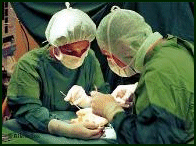
Male circumcision holds promise for preventing HIV
Last Updated: Thursday, August 17, 2006 | 2:30 PM ET
CBC News
Adult male circumcision could prevent millions of new HIV infections in sub-Saharan Africa, but circumcised men should not cease practising safe sex, researchers told the International AIDS Conference in Toronto on Thursday.
The protective benefits of male circumcision could save lives immediately, since microbicides and vaccines likely won't be available for years.
A trial comparing HIV infection rates among circumcised and uncircumcised men in South Africa was stopped early last year after researchers found the practice appeared to reduce the risk of female-to-male HIV transmission by 60 per cent.
"Even if further trials show a lower risk of HIV infection in circumcised men, male circumcision will not provide complete protection against HIV infection," cautioned Catherine Hankins, chief scientific advisor for UNAIDS.
"Circumcised men can still contract HIV and pass it on to their partners."
If the benefit of male circumcision is proven, Hankins said it must be part of HIV prevention strategies that include:
- Correct and consistent use of condoms.
- Reductions in the number of sexual partners.
- Delaying onset of sexual relations.
- Voluntary and confidential counselling and HIV testing.
Based on the trial findings, a mathematical simulation of 823,000 sexually active men and women suggested that targeting just 10 per cent of men could avert 32,000 infections, according to Dr. Kyeen Mesesan of Yale University in New Haven, Conn.
Why it helps
Health officials are hoping the protective findings will be confirmed by two other clinical trials, underway in Uganda and Kenya, before they would consider recommending countries add adult male circumcision to their HIV prevention programs, said Dr. Kevin de Cock, director of WHO's HIV-AIDS department.
In circumcision, the foreskin on the penis is removed. The procedure appears to help reduce the risk of infection with HIV because the skin layer is thinner, allowing an easier way for the virus to enter, de Cock said.
The foreskin is also easily damaged, and its cells include those targeted by the virus.
If African countries add adult male circumcision to their prevention programs, it needs to be simple, safe and cost-effective, while also respecting local cultural and religious practices, scientists stressed.
The results of another trial examining how male circumcision affects the risk of transmitting HIV to female partners is expected in late 2007. The effects for men who have sex with men hasn't been tested in a trial.
Read more: http://www.cbc.ca/health/story/2006/08/17/male-circumcision.html#ixzz0eLr6eb7P


In the UK, routine circumcision isn't thought to be medically necessary. This is because the risks associated with having a surgical procedure that involves a general anaesthetic and the possible postoperative complications outweigh any possible medical benefits.
Infection and bleeding are common after circumcision and, although usually easily treated, can be very uncomfortable and distressing for the patient and those close to him.
Loss of the protection provided by the foreskin can allow abrasion of the penis head to occur. This can result in scarring and loss of physical sensation.
Some teenagers and men who were circumcised shortly after birth describe feeling physically and psychologically traumatised, and robbed of the choice of whether or not to be circumcised. These problems can lead to difficulties with social and personal development if not addressed.
Operation details
When the whole foreskin is removed it's cut away and the skin that remains is sewn to the base of the head of the penis. A circumcised penis has the appearance of an uncircumcised one when the foreskin is pulled back.
After the operation
The skin appears red and slightly swollen, and will probably be uncomfortable. Simple painkillers, such as paracetamol, are usually all that's needed to relieve any discomfort. It's also a good idea not to wear underpants to avoid rubbing. The stitches dissolve and disappear after a week or so.
You should be able to return to school/work after about ten days and play sport after a month.
If there's any persistent bleeding, swelling, redness or discharge near the stitches, seek advice from your doctor or nurse.
This article was last medically reviewed by Dr Rob Hicks in December 2007
http://www.bbc.co.uk/health/conditions/circumcision1.shtml
The health benefits: Dr. Muhammad 'Ali al-Baar (a member of the Royal College of Surgeons in the UK and a consultant to the Islamic Medicine department of the King Fahd Centre for Medical Research in the King Abdul Aziz University in Jeddah) says in his book al-Khitaan (Circumcision):
"Circumcision of newborn boys (I.e., within the first month of life) brings numerous health benefits, including:
1 – Protection against local infection in the penis, which may result from the presence of the foreskin, causing tightening of the foreskin, which may lead to retention of urine or infections of the glans (tip) of the penis – which require circumcision in order to treat these problems. In chronic cases, the child may be exposed to numerous diseases in the future, the most serious of which is cancer of the penis. 2 – Infections of the urethra. Many studies have proven that uncircumcised boys are more exposed to infection of the urethra. In some studies the rate was 39 times more among uncircumcised boys. In other studies the rate was ten times more. Other studies showed that 95% of children who suffered from infections of the urethra were uncircumcised, whereas the rate among circumcised children did not exceed 5%.
In children, infection of the urethra is serious in some cases. In the study by Wisewell on 88 children who suffered infections of the urethra, in 36 % of them, the same bacteria was found in the blood also. Three of them contracted meningitis, and two suffered renal failure. Two others died as a result of the spread of the micro-organisms throughout the body.
3 – Protection against cancer of the penis: the studies agree that cancer of the penis is almost non-existent among circumcised men, whereas the rate among uncircumcised men is not insignificant. In the US the rate of penile cancer among circumcised men is zero, whilst among uncircumcised men it is 2.2 in every 100,000 of the uncircumcised population. As most of the inhabitants of the US are circumcised, the cases of this cancer there are between 750 and 1000 per year. If the population were not circumcised, the number of cases would reach 3000. In countries where boys are not circumcised, such as China, Uganda and Puerto Rico, penile cancer represents between 12-22 % of all cancers found in men; this is a very high percentage.
4 – Sexually transmitted diseases (STDs). Researchers found that the STDs which are transmitted via sexual contact (usually because of fornication/adultery and homosexuality) spread more among those who are not circumcised, especially herpes, soft chancres, syphilis, candida, gonorrhea and genital warts.
There are numerous modern studies which confirm that circumcision reduces the possibility of contracting AIDS when compared to their uncircumcised counterparts. But that does not rule out the possibility of a circumcised man contracting AIDS as the result of sexual contact with a person who has AIDS. Circumcision is not a protection against it, and there is no real way of protecting oneself against the many sexually transmitted diseases apart from avoiding fornication/adultery, promiscuity, homosexuality and other repugnant practices. (From this we can see the wisdom of Islamic sharee'ah in forbidding fornication/adultery and homosexuality).
5 – Protection of wives against cervical cancer. Researchers have noted that the wives of circumcised men have less risk of getting cervical cancer than the wives of uncircumcised men.
Health Benefits taken from: al-Khitaan, p. 76, by Dr. Muhammad al-Baar.
Last edited:


 oka anti islamic site ekak oya mata agama kiyala denna enna epa machan
 okey
okey nikan oyala meka boru karanawa witarai


 affa dekka kal