Ring of fire: Indian Ocean to see solar eclipse

tharinda07

Member
Mar 1, 2007
5,784
44
0
Ring of fire: Indian Ocean to see solar eclipse


Aussie_Eclipse.gif


A few lucky people in the Indian Ocean will be treated to a rare event on Monday when an annular solar eclipse will transform the Sun into a dark disc with a blazing ring-shaped corona around its rim.

In solar eclipses, the Moon moves between the Sun and Earth, casting its shadow on the terrestrial surface.

In an annular eclipse, a tiny shift in distance that results from celestial mechanics means the Moon does not completely cover the Sun's face, as it does in a total eclipse.

Instead, for those directly under the alignment, the Moon covers most of the Sun's surface, and a ring-like crown of solar light blazes from the edge of the disk.

For those watching from the fringe of the track, the Sun is partially obscured, as if a bite has been taken out of it.

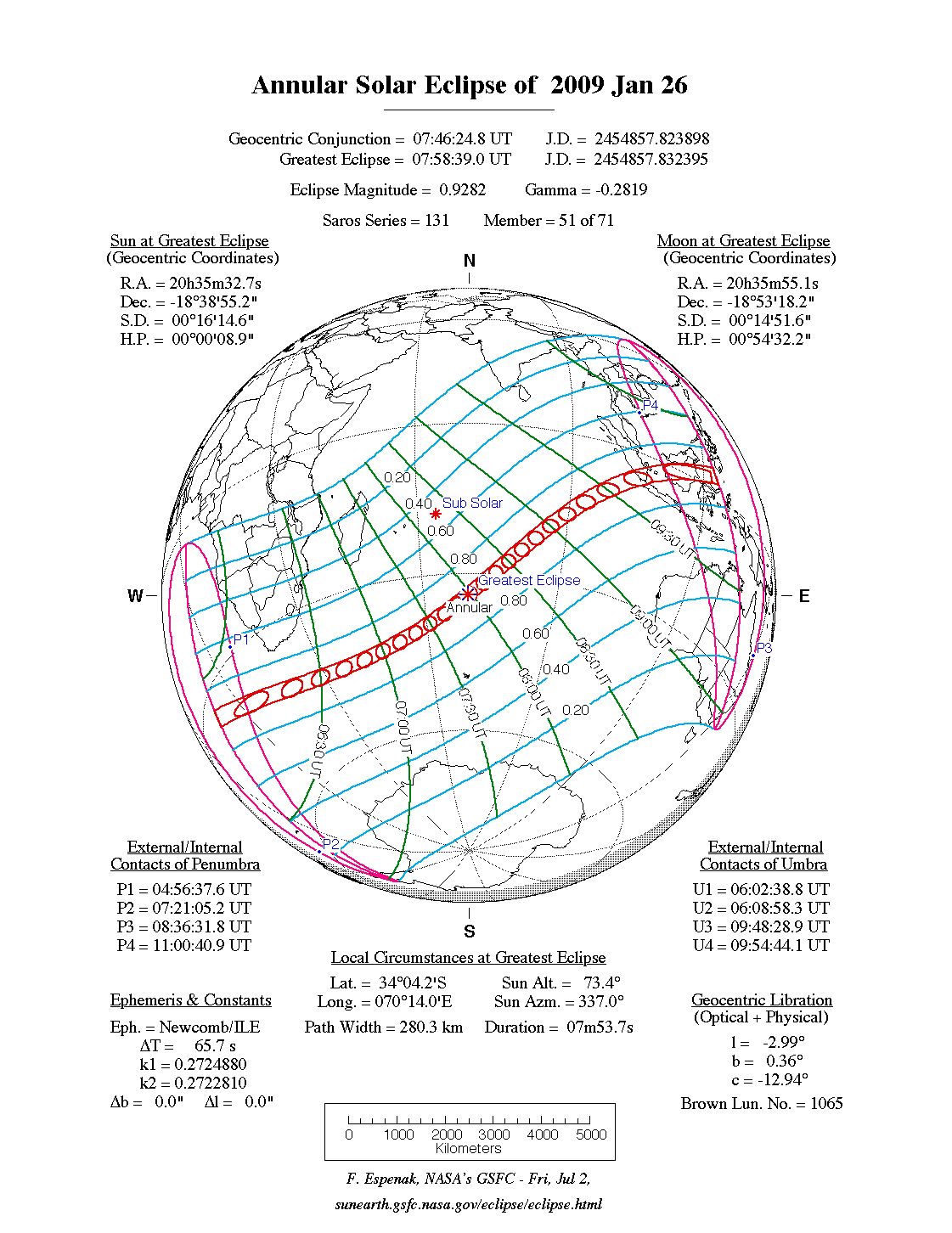
According to veteran NASA eclipse-watcher Fred Espenak, the total eclipse track will run from west to east on Monday from 0606 GMT to 0952 GMT.

It will traverse the Indian Ocean and western Indonesia before petering out just short of Mindanao, the Philippines.

The partial eclipse will be seen in a much wider swathe, including the southern third of Africa, Madagascar, Australia, Southeast India, Southeast Asia and Indonesia.

It will be the only annular solar eclipse this year. The last was on 7 February, 2007, and after Monday, the next one will be on 15 January, 2010.

The big event for eclipse junkies this year is on July 22, when a total solar eclipse will be visible from India and China, the world's two most populous countries.
[/center]
 

tharinda07

Member
Mar 1, 2007
5,784
44
0
Annular Solar Eclipse of January 26

The first solar eclipse of 2009 occurs at the Moon's ascending node in western Capricornus. An annular eclipse will be visible from a wide track that traverses the Indian Ocean and western Indonesia. A partial eclipse will be seen within the much larger path of the Moon's penumbral shadow, which includes the southern third of Africa, Madagascar, Australia except Tasmania, southeast India, Southeast Asia and Indonesia.

The annular path begins in the South Atlantic at 06:06 UT when the Moon's antumbral shadow meets Earth and forms a 363 kilometre wide corridor. Traveling eastward, the shadow quickly sweeps south of the African continent, missing it by approximately 900 kilometres. Slowly curving to the northeast the path crosses the southern Indian Ocean. Greatest eclipse[1] takes place at 07:58:39 UT when the eclipse magnitude[2] will reach 0.9282. At this instant, the annular duration is 7 minutes 54 seconds, the path width is 280 kilometres and the Sun is 73° above the flat horizon formed by the open ocean. The central track continues northeast where it finally encounters land in the form of the Cocos Islands and onward to southern Sumatra and western Java (Figure 2). At 09:40 UT, the central line duration is 6 minutes 18 seconds and the Sun's altitude at 25°. In its final minutes, the antumbral shadow cuts across central Borneo and clips the northwestern edge of Celebes before ending just short of Mindanao, Philippines at 09:52 UT. During a 3 hour 46 minute trajectory across our planet, the Moon's antumbra travels approximately 14,500 kilometres and covers 0.9% of Earth's surface area. Path coordinates and central line circumstances are presented in Table 1.

Partial phases of the eclipse are visible primarily from southern Africa, Australia, Southeast Asia and Indonesia. Local circumstances for a number of cities are listed in Table 2. All times are given in Universal Time. The Sun's altitude and azimuth, the eclipse magnitude and obscurationare all given at the instant of maximum eclipse.

This is the 50th eclipse of Saros 131. The family began with an unusually long series of 22 partial eclipses starting on 1125 Aug 01. The first central eclipse was total in the Northern Hemisphere on 1522 Mar 27. It was followed by 5 more total eclipses before the series produce 5 hybrid eclipses from 1630 to 1702. The first annular eclipse of Saros 131 occurred on 1720 Aug 04. The series will produce 29 more annular eclipses the last of which is 2243 Jun 18. Saros 131 terminates on 2369 Sep 02 after a string of 7 partial eclipses. Complete details for 70 eclipses in the series may be found at: