


Deformed droplets offer step-by-step way to charge up personal electronics.
Forget to charge your phone? Your MP3 player? Soon, a quick stroll in a special pair of shoes could provide enough power to keep both going for hours.
There's a lot of 'oomph' in a step: up to 10 watts of power is lost as heat each time a foot hits the ground. Mobile devices such as phones and laptops use between 1 and 15 watts, so harnessing our 'foot power' would make a notable difference for consumers. So far, however, attempts to harvest this energy using vibrating plates or piezoelectric materials, which produce electricity when compressed or bent, have mustered only a few milliwatts.

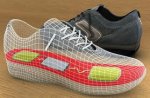
Using as their basis a system published today in Nature Communications1, mechanical engineers Tom Krupenkin and Ashley Taylor at the University of Wisconsin in Madison are now developing 'in-shoe technology' that could generate up to 10 watts of power per footstep.
Krupenkin's inspiration is a technique called electrowetting, in which a conductive liquid droplet, placed on an electrode, is physically deformed by an applied electric charge. The technique depends on the use of a dielectric material — which is usually an insulator but that can be polarized in an electric field — to coat the electrode. When the dielectric is charged the droplet can wet the surface more easily, and deforms. In his system, Krupenkin runs this process backwards, using the changing physical form of liquid drops between dielectric-coated plates to generate charge and therefore electrical power.
To test his idea, Krupenkin placed patches of electrodes coated very thinly with the dielectric tantalum oxide along tiny channels a few millimetres wide. Using a resistor to convert electrical charge to alternating current, Krupenkin was able to harvest electrical energy from drops of either mercury or galinstan, a gallium-based alloy as they were moved along these channels and over the electrodes.
Forget to charge your phone? Your MP3 player? Soon, a quick stroll in a special pair of shoes could provide enough power to keep both going for hours.
There's a lot of 'oomph' in a step: up to 10 watts of power is lost as heat each time a foot hits the ground. Mobile devices such as phones and laptops use between 1 and 15 watts, so harnessing our 'foot power' would make a notable difference for consumers. So far, however, attempts to harvest this energy using vibrating plates or piezoelectric materials, which produce electricity when compressed or bent, have mustered only a few milliwatts.
Using as their basis a system published today in Nature Communications1, mechanical engineers Tom Krupenkin and Ashley Taylor at the University of Wisconsin in Madison are now developing 'in-shoe technology' that could generate up to 10 watts of power per footstep.
Krupenkin's inspiration is a technique called electrowetting, in which a conductive liquid droplet, placed on an electrode, is physically deformed by an applied electric charge. The technique depends on the use of a dielectric material — which is usually an insulator but that can be polarized in an electric field — to coat the electrode. When the dielectric is charged the droplet can wet the surface more easily, and deforms. In his system, Krupenkin runs this process backwards, using the changing physical form of liquid drops between dielectric-coated plates to generate charge and therefore electrical power.
To test his idea, Krupenkin placed patches of electrodes coated very thinly with the dielectric tantalum oxide along tiny channels a few millimetres wide. Using a resistor to convert electrical charge to alternating current, Krupenkin was able to harvest electrical energy from drops of either mercury or galinstan, a gallium-based alloy as they were moved along these channels and over the electrodes.


