..:::: Weapons Arena ::::..

TLS

Well-known member
  • Apr 6, 2009
    996
    35
    48
    Anytime Anywhere !!!
    Steyr AUG Para

    Steyr AUG Para 9mm submachine gun (Austria)

    aug_9mm_1.jpg

    Steyr AUG A1 Para 9mm submachine gun, original version
    aug_9mm_a3_xs.jpg

    Steyr AUG A3 XS 9mm submachine gun
    Data for current production Steyr AUG A3 XS submachine gun
    Caliber
    9x19mm Luger/Parabellum
    Weight 3,0 kg empty
    Length 610 mm
    Barrel length: 325 mm
    Magazine capacity 25 rounds
    Rate of fire ~700 rounds/minute

    [SIZE=+1][/SIZE]The original Steyr AUG Para 9mm submachine gun is a reversible conversion of the original Steyr AUG assault rifle, intended mostly for short-range police and special operations work. This weapons combines relatively compact dimensions with very good accuracy (compared with other 9mm submachine guns), thanks to a long barrel and closed-bolt firing. If necessary, Steyr AUG 9mm submachine gun also can be fitted with silencer.

    Steyr AUG Para 9mm submachine gun utilizes basic components (aluminum receiver and polymer stock of bullpup configuration) from the Steyr AUG assault rifle. The 9mm barrel is installed (original Steyr AUG assault rifles have quick detachable barrels), and a gas-operated locked bolt action is replaced with simple blowback (unlocked) bolt. Original firing system with hammer and pull-through selective trigger (short pull results in single shots, long pull - in full automatic fire) is retained, and a special magazine adapter is installed into the magazine housing. Depending on the basic version of the Steyr AUG assault rifle, which is used for conversion, 9mm version will retain its parent sighting equipment - 1.5X telescope sight in A1 version of Picatinny rail with optional open or optical sights in A2 and A3 versions.
     

    TLS

    Well-known member
  • Apr 6, 2009
    996
    35
    48
    Anytime Anywhere !!!
    LSAT

    LSAT machine gun (USA)

    lsat_3.jpg

    LSAT machine gun, 2009 prototype, with belt and clip-on ammo pouch

    lsat_1.jpg

    LSAT machine gun, as shown at NDIA 2010 symposium

    lsat_2.jpg

    LSAT machine gun prototype being test-fired


    lsat_a.jpg

    LSAT machine gun ammunition in belt links: caseless in the middle and cased telescoped right, compared to the standard 5.56x45 NATO at left

    lsat_car.jpg

    First prototype of the LSAT carbine, as shown at NDIA 2010 symposium


    Data for LSAT machine gun, as of mid-2010
    Caliber 5.56mm CT or caseless Weight 4.2 - 4.5 kg empty Length n/a Barrel length n/a Feed belt, 150 rounds Rate of fire 600 rounds per minute
     

    destroyer

    Member
    Sep 8, 2007
    206
    10
    0
    interesting thread

    machan what do you think is the best shotgun?? I think M1014 ......it has a very big damage on the target and fast firing rate...what do you think??
     

    TLS

    Well-known member
  • Apr 6, 2009
    996
    35
    48
    Anytime Anywhere !!!
    Minigun

    M134 and GAU-2/A 'Minigun' Gatling machine gun (USA)

    m134-1.jpg

    General Electric M134 Minigun machine gun of Vietnam war (late 1960s) era, on pedestal mount
    m134d-1.jpg

    Dillon Aero M134D Minigun of current manufacture, with manual control unit and feed chute
    Image: Dillon Aero
    m134d-land.jpg

    M134D Minigun of current manufacture, mounted on the roof of the military car
    Image: Dillon Aero
    m134d-naval.jpg

    M134D Minigun of current manufacture, on Naval pedestal mount, with ammunition container
    Image: Dillon Aero
    m134-2.jpg

    M134 Minigun on infantry type tripod, as often seen on civilian entertainment events such as Knob Creek machine gun shot in USA
    Data for M134D Minigun Caliber 7.62x51 NATO Weight 24...30 kg gun with motor and feeder/delinker, less ammunition container and power source Length 801 mm Barrel length 559 mm Feed belt in 1500, 3000 or 4500 round containers Rate of fire 3000 or 4000 rounds per minute, fixed
    Can be found on new army games.
     

    TLS

    Well-known member
  • Apr 6, 2009
    996
    35
    48
    Anytime Anywhere !!!
    SRS

    Desert Tactical Arms Stealth Recon Scout (SRS) sniper rifle (USA)

    dta_srs_308_1.jpg

    Desert Tactical Arms Stealth Recon Scout (SRS) sniper rifle, caliber .308 / 7.62x51

    dta_srs_308_covert.jpg

    Desert Tactical Arms Stealth Recon Scout (SRS) "Covert" sniper rifle with integrated silencer

    dta_srs_338_1.jpg

    Desert Tactical Arms Stealth Recon Scout (SRS) sniper rifle in .338 Lapua Magnum, with optional silencer
    Caliber(s): .243 Win, 7.62x51 NATO / .308Win, .300 Win Mag, .338 Lapua Mag
    Operation: bolt action
    Barrel: 560 mm / 22" in .308 or 660 mm / 26" in other calibers
    Weight: 5 - 5.6 kg / 11 - 12.4 lbs
    Length: 800 mm / 31.5" in .308, 952 mm / 37.5" in .338 LM
    Feed Mechanism: 5 rounds detachable box magazine

    Desert Tactical Arms Stealth Recon Scout (DT SRS) sniper rifle is a modern modular weapon, intended for police use, as well as for civilian target shooting and hunting (a dedicated "sporter" version of the SRS is available as SRS "Hunter" rifle). It was originally intended as a dedicated long range sniping platform in .338 Lapua Magnum, but later on the concept was changed to multi-caliber, with quick change barrels. According to the manufacturer, DT SRS rifles with properly selected ammunition can provide 0.5 MOA accuracy, with maximum effective range in .338 being up to 1800 yards (1640 meters).
    Desert Tactical Arms Stealth Recon Scout (SRS) sniper rifle is a manually operated, rotary bolt action rifle of bullpup configuration. It uses aluminum alloy receiver with proprietary injection molded polymer stock. Precision-made, free-floating barrels can be quickly replaced by the user; caliber change also involves change of the bolts and magazines. The trigger unit is fully adjustable, buttstock is also adjustable for length of pull with use of provided spacers. Manual safety is conveniently located above the trigger. Proprietary single stack box magazines hold five rounds of ammunition in each caliber. Rifle is provided with integral Picatinny rail on the top of the receiver, with additional quad rails around the barrel. No iron sights are provided, and company offers a Schmidt & Bender 5-25X telescope sight with proprietary rings and base. Other important accessories include folding bipod, detachable silencers and carrying sling with quick-detach swivels.
     

    TLS

    Well-known member
  • Apr 6, 2009
    996
    35
    48
    Anytime Anywhere !!!
    Benelli M4 Super 90

    interesting thread

    machan what do you think is the best shotgun?? I think M1014 ......it has a very big damage on the target and fast firing rate...what do you think??

    I also accepts it soldier.

    Benelli M4 Super 90 / M1014 JSCS shotgun (Italy)

    benelli_m4_1.jpg

    Benelli M4, with closed buttstock

    benelli_m4.jpg

    Benelli M4, with extended buttstock

    Type: gas operated, semi-auto
    Gauge: 12 (chamber 3" - 76 mm)
    Length: 1010 mm (extended stock), 886 mm (closed stock)
    Barrel length: 470 mm
    Weigth 3.8 kg unloaded
    Feeding: 6 rounds in underbarrel tube magazine


    Benelli M4 Super 90 is developed in Italy by Benelli Armi Spa., and imported in the USA by Heckler&Koch USA,inc.
    In early 1999, US AARDEC (Army Armmament Research and Development Center), avarded contract for XM1014 Joint Service Combat Shotgun to Heckler&Koch USA,inc. Initially, some 20.000 units wil be shipped to US Marine Corps.
    Technically, Benelli M4 Super90 is a gas operated, smoothbore, magazine fed semi-auto shotgun. Barrel locking is achieved by rotating bolt with two lugs. M4 Super90 has dual gas cylinders, gas pistons and action rods for increased reliability. Low-power rounds, such as less-than-letal rubber slugs, may be cycled manually. Gun is field stripped without any additional tools. The telescopic stock may be replaced by pistol grip or hunting-style stocvk without any tools. Barrel has internal screw-in choke system for increased versatility. Standart sights are ghost-ring rear and blade front. Acessory weaver-style rail is installed at the top of the receiver. This rail may accept scopes, laser illuminators, night-vision sights etc.
    Gun is so designed that it can fire 3" and 2 3/4" (70 and 76 mm) shotshells of different power without any ajustments and in any combination. All surfaces is covered by non-reflective, wear and corrosiaon-resistant finish. Gun is very reliable in any weather conditions.
     

    TLS

    Well-known member
  • Apr 6, 2009
    996
    35
    48
    Anytime Anywhere !!!
    Pics of my earlier posts are missing.......What may be the reason?
    I hope that better explanation always bound with the illustrations.

    Admins, I need a resolution.
     

    TLS

    Well-known member
  • Apr 6, 2009
    996
    35
    48
    Anytime Anywhere !!!
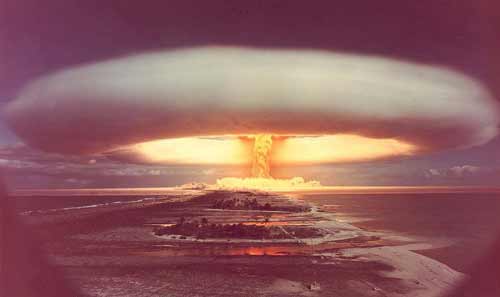
    The Tsar Bomba
    _______________


    October 30th 1961 - The Tsar Bomba, King of the Bombs, Царь-бомба or Big Ivan.

    This footage is courtesy of the documentary "Trinity and Beyond", directed by Peter Kuran, and other footage is courtesy of the Discovery channel. The original footage was from declassified Soviet Archives. The music used is from The Planets Suite composed by Gustav Holst. The movement is 'Mars: the Bringer of War'

    Before I get into the details of the test, I want to clear up something very important. The title of this video is "Tsar Bomba - King of the Bombs - 57,000,000 Tonnes of TNT". Understand now that this test wasn't the result of a detonation of 57,000,000 Tonnes of TNT, but rather the nuclear yield EQUIVALENT of a detonation of 57,000,000 Tonnes of Trinitrotoluene. The actual weight of the device was 27 tonnes. And coincidentally, one tonne is taken as a metric tonne, or 1000 kilograms - (2200lbs). All units used in physics are metric. The reason the yield equivalent system is used is because the energy released from the explosion of a set amount of TNT is a constant.

    Second to that: I KNOW THE SCREENSHOTS AT THE END ARE OF THE CLOUD OVER THE GROUND. The reason I made a mistake was because when I made this video I was using a 6 year old CRT monitor with numerous problems, some of which with the shading. I greatly regret it butI cant be bothered removing/re-uploading the video again so Ill just live with it.

    The bomb was designed as a 100 Megaton device, not a 50 Megaton device. This was due to its 3 stage design: fission-fusion-fusion. There is fission initiator that when detonated, begins a fusion reaction. Then there is a further fast-fission detonation (With neutrons from the second stage) of a Uranium-238 tamper which boosts the yield by 50 Megatons. For the test, the Tsar had its Uranium tamper replaced with lead to reduce the maximum yield by half (To 50 Megatons).

    The blast yield was equal to that of a blast of 57,000,000 Tonnes of TNT....or to put that into context: The weight of 270 Empire State Buildings worth of TNT. This makes the Tsar the most powerful nuclear device ever detonated in history. Think of the destruction at Hiroshima. The Tsar was 3800 times more powerful than Hiroshima.

    The bomb's weight was 27 tonnes, and its dimensions were: 8 meters (26ft) in length, and 2 meters (6.5ft) in diameter.

    It was air-dropped, from a modified Tupolev Tu-95 Bear, and it used a nylon parachute to slow its decent to give the crew time to escape.

    The bomb was dropped from an altitude of 34,500 feet AGL (10,500 meters), and it detonated a little over three minutes later at an altitude of 13,100 feet AGL (4,000 meters). In this time: The Tu-95, travelling at a ground speed of 480kts (552mph, 864kph), travelled into the safe zone (about 45km from ground zero) and was therefore 79km away from the blast.

    When the bomb detonated, immediately the temperature directly below and surrounding the detonation would have risen to millions of degrees. The pressure below the blast was 300 pounds per square inch, ten times the pressure in a car tyre. The light energy released was so powerful that it was visible even at 1000km (621 miles), with cloudy skies. The shockwave was powerful enough to break windows at even up to 900 kilometres (560 miles) from the blast. The shockwave was recorded orbiting the earth 3 times. The mushroom cloud rose to an altitude of 64,000 meters (210,000 feet) before levelling out. The thermal energy from the blast was powerful that it could cause 3rd degree burns to a human standing 100 km (62 miles) away from the blast.

    The radius of the fireball was 2.3 kilometres (1.4 miles). The blast radius (area in which total destruction ensured) was 13km (8 miles).

    The most important thing to note is that this bomb was designed as a 100 Megaton device (Yield equivalent of 0.1 billion tonnes of TNT). If detonated, everything within a 48 kilometer (30 mile) diameter would be vaporised. Everything within a 195 kilometer (120 mile) diameter would be incinerated in a fireball. This would ensure total destruction of a large city like New York, Paris or London, as well as devastation on its outskirts.