
Latest ads
-
 RHCSA, RHCE, AWS, Docker, Kubernetes Training
- Sanjeewani95
- Updated:
-
 🛡️ Kaspersky Antivirus – 1 Year / 1 Device | Rs. 2,300 | Only 9 Left
- KSPathirana
- Updated:
-
Professional CCTV Installation Service
- Techguy231
- Updated:
-
I'll research & write an article - Rs. 2000 onwards
- Blogerwiki
- Updated:
-
 House Plan
- lenura
- Updated:
You are using an out of date browser. It may not display this or other websites correctly.
You should upgrade or use an alternative browser.
You should upgrade or use an alternative browser.


Navy demonstrates world’s most powerful rail gun

DAHLGREN — The Navy’s Office of Naval Research successfully conducted a record-setting firing of an electromagnetic rail gun at Naval Surface Warfare Center, Dahlgren, Jan. 31.
An audience, including the Chief of Naval Operations Adm. Gary Roughead, witnessed the revolutionary technology in action.
He said, “I never ever want to see a sailor or Marine in a fair fight. I always want them to have the advantage.
“We should never lose sight of always looking for the next big thing, always looking to make our capability better, more effective than what anyone else can put on the battlefield,” Roughead said.
ONR’s Electromagnetic Rail Gun program is part of the Department of the Navy’s Science and Technology investments, focused on developing new technologies to support Navy and Marine Corps war fighting needs.
ONR has facilitated a key partnership between leading scientists and engineers from Boeing, Charles Stark Draper Lab, Inc., General Atomics, Department of Energy (Lawrence Livermore National Laboratory), U.S. Naval Academy, Naval Postgraduate School, Naval Sea Systems Command (PMS 500), Naval Surface Warfare Center - Carderock and Dahlgren Divisions, the U.S. Army and Great Britain.
“We are seeing the culmination of years of research coming together to bring focus to exciting new technology,” Chief of Naval Research, Rear Adm. Bill Landay, said. “Here at ONR we are striving to move (science and techology) from vision to results.”
Rail gun technology uses high power electromagnetic energy instead of explosive chemical propellants to propel a projectile farther and faster than any preceding gun. At full capability, the rail gun will be able to fire a projectile more than 200 miles at a muzzle velocity of Mach 7 and impacting its target at Mach 5. In contrast, the Navy’s premiere gun, the Mark 45 five-inch gun, has a range of nearly 20 miles. The high velocity projectile will destroy its targets due to its kinetic energy rather than with conventional explosives.
http://adsys.townnews.com/c32709457...r=http://ChesapeakeGreenbrier.Place.Hyatt.com The safety aspect of the rail gun is one of its greatest advantages, according to Dr. Elizabeth D’Andrea, ONR’s Electromagnetic Rail gun Program manager. Safety on board ship is increased because no explosives are required to fire the projectile and no explosive rounds are stored in the ship’s magazine.
Science and technology challenges met by ONR in the development of the rail gun include development of the launcher, pulse power generation and the guided projectile design. The program’s goal is to demonstrate a full capability, integrated rail gun prototype by 2016-2018.

DAHLGREN — The Navy’s Office of Naval Research successfully conducted a record-setting firing of an electromagnetic rail gun at Naval Surface Warfare Center, Dahlgren, Jan. 31.
An audience, including the Chief of Naval Operations Adm. Gary Roughead, witnessed the revolutionary technology in action.
He said, “I never ever want to see a sailor or Marine in a fair fight. I always want them to have the advantage.
“We should never lose sight of always looking for the next big thing, always looking to make our capability better, more effective than what anyone else can put on the battlefield,” Roughead said.
ONR’s Electromagnetic Rail Gun program is part of the Department of the Navy’s Science and Technology investments, focused on developing new technologies to support Navy and Marine Corps war fighting needs.
ONR has facilitated a key partnership between leading scientists and engineers from Boeing, Charles Stark Draper Lab, Inc., General Atomics, Department of Energy (Lawrence Livermore National Laboratory), U.S. Naval Academy, Naval Postgraduate School, Naval Sea Systems Command (PMS 500), Naval Surface Warfare Center - Carderock and Dahlgren Divisions, the U.S. Army and Great Britain.
“We are seeing the culmination of years of research coming together to bring focus to exciting new technology,” Chief of Naval Research, Rear Adm. Bill Landay, said. “Here at ONR we are striving to move (science and techology) from vision to results.”
Rail gun technology uses high power electromagnetic energy instead of explosive chemical propellants to propel a projectile farther and faster than any preceding gun. At full capability, the rail gun will be able to fire a projectile more than 200 miles at a muzzle velocity of Mach 7 and impacting its target at Mach 5. In contrast, the Navy’s premiere gun, the Mark 45 five-inch gun, has a range of nearly 20 miles. The high velocity projectile will destroy its targets due to its kinetic energy rather than with conventional explosives.
http://adsys.townnews.com/c32709457...r=http://ChesapeakeGreenbrier.Place.Hyatt.com The safety aspect of the rail gun is one of its greatest advantages, according to Dr. Elizabeth D’Andrea, ONR’s Electromagnetic Rail gun Program manager. Safety on board ship is increased because no explosives are required to fire the projectile and no explosive rounds are stored in the ship’s magazine.
Science and technology challenges met by ONR in the development of the rail gun include development of the launcher, pulse power generation and the guided projectile design. The program’s goal is to demonstrate a full capability, integrated rail gun prototype by 2016-2018.
DARPA
DARPA

Back side of ATC's medium range acoustic device. which is capable of broadcasting sound at high volumes for 100-600 meters. Photo: Xeni Jardin

Back side of ATC's long range acoustic device, shown during a demo for military, law enforcement and government tech experts from the U.S. and abroad. Photo: Xeni Jardin


First SWORDS robot deployed in Iraq
DARPA

Back side of ATC's medium range acoustic device. which is capable of broadcasting sound at high volumes for 100-600 meters. Photo: Xeni Jardin

Back side of ATC's long range acoustic device, shown during a demo for military, law enforcement and government tech experts from the U.S. and abroad. Photo: Xeni Jardin


First SWORDS robot deployed in Iraq



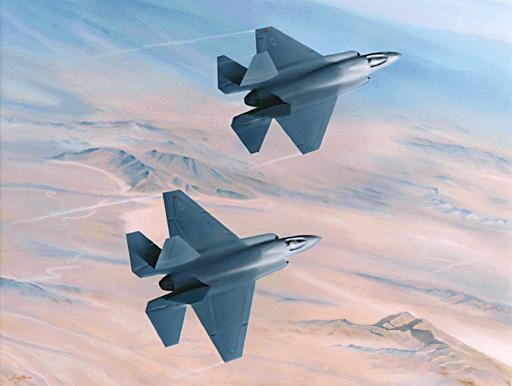
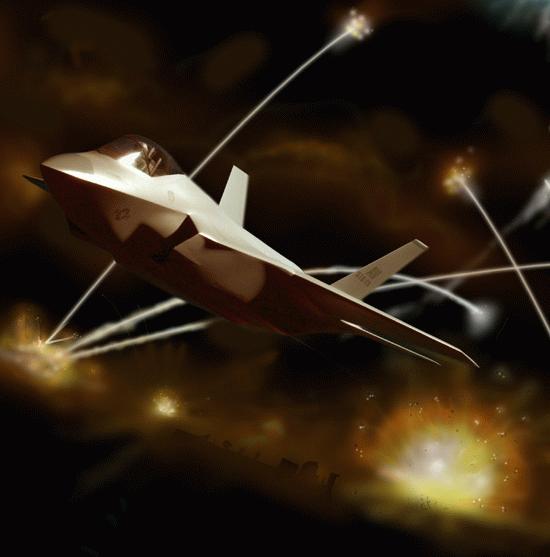
The F-35 is the result of the Defense Department's Joint Strike Fighter (JSF) program, which sought to build a multirole fighter optimized for the air-to-ground role with secondary air-to-air capability. The JSF requirement was to meet the needs of the Air Force, Navy, Marine Corps and allies, with improved survivability, precision engagement capability, and reduced life cycle costs. By using many of the same technologies developed for the F-22, the F-35 has the opportunity to capitalize on commonality and modularity to maximize affordability.
The Lockheed Martin X-35 was chosen over the competing Boeing X-32 primarily because of Lockheed’s lift-fan STOVL design, which proved superior to the Boeing vectored-thrust approach. The lift fan, which is powered by the aircraft engine via a clutched driveshaft, was technically challenging but DoD concluded that Lockheed has the technology in hand. The lift fan has significant excess power which could be critical given the weight gain that all fighter aircraft experience.
Lockheed Martin developed four versions of the Joint Strike Fighter to fulfill the needs of the Navy, Marine Corps, Army, Air Force and the United Kingdom Royal Air Force and Navy. All versions have the same fuselage and internal weapons bay, common outer mold lines with similar structural geometries, identical wing sweeps, and comparable tail shapes. The weapons are stored in two parallel bays located aft of the main landing gear. The canopy, radar, ejection system, subsystems, and avionics are all common among all different version as is the core engine which is based on the F119 by Pratt & Whitney.
Additional systems on the F-35 include:
1. Northrup Grumman advanced electronically scanned array (AESA) multi-function radar
2. Snader/Litton Amecon electronic countermeasures equipment
3. Lockheed Martin electro-optical targeting system
4. Northrup Grumman distributed aperture infrared sensor (DAIRS) thermal imaging system
5. Vision Systems International advanced helmet-mounted display
F-35 Variants
US Air Force
The Air Force expects that to purchase 1763 F-35s to complement the F-22 Raptor and replace the F-16 as an air-toground strike aircraft. The Air Force variant includes an internal gun, infrared sensors, and laser designator. This is the technologically simplest version of the JSF, in that it does not require hover or aircraft carrier capability. Therefore it does not require the vertical thrust or the handling qualities for catapult launches, augmented control authority at landing approach speeds and strengthened structure to handle arrested landings. At the same time, the Air Force F-35 will have to improve upon the high standards created by the F-16. Since replacement of the F-16 by the F-35 will entail a significant payload reduction, the F-35 faces a very demanding one shot one kill requirement.
US Navy
The requirement for carrier operations creates the largest differences between the Air Force and Navy version. The naval version has larger wing and tail control surfaces to enable low-speed approaches to aircraft carriers. Leadingedge flaps and foldable wing tip sections account for this increased wing area. The larger wing area also provides the Navy version with an increased payload capability. To support the stresses of carrier landings and catapult launches, the internal structure of this version is strengthened. In addition, the landing gear has longer stroke and higher load capacity, and of course an arresting hook is added. Compared to the F-18C, the F-35 has twice the range on internal fuel.. The design is also optimized for survivability, which is a key Navy requirement. Like the USAF version, the Navy version will incorporate an internal gun and sensors. This new fighter will be used by the Navy as a first-day-of-war attack fighter in conjunction with the F/A-18 Hornet. The Navy plans to purchase 480 JSF.
US Marine Corps
The distinguishing feature of the USMC version of the JSF is its short takeoff/vertical landing capability (STOVL). There will not be an internally mounted machine gun, but an external gun can be fitted. This version requires controllability on all axes while hovering. Another critical design feature is its impact on the ground surface beneath it during hover. The USMC expects their version of the JSF will replace the F/A-18 Hornet and the AV-8 Harrier. The Marine Corps expects to purchase 480 STOVL versions of the F-35.


rustyc said:wow...
thanks budy???
mata puluwan nam sourse ake denewada
machan ona de meke thiyenawada palapan
http://www.militaryonesource.com/skins


Similar threads

- Replies
- 2
- Views
- 215
- Replies
- 16
- Views
- 658


- Replies
- 1
- Views
- 194
