
Latest ads
-
I'll research & write an article - Rs. 2000 onwards
- Blogerwiki
- Updated:
-
 House Plan
- lenura
- Updated:
-
 iphone x used
- AssassiN1
- Updated:
-
 කිතුල් තලප
- Manoj Suranga Bandara
- Updated:
විද්යා පුනරුදයේ සැබෑ උරුමක්කරුවා
- Thread starter sirajstc
- Start date
You are using an out of date browser. It may not display this or other websites correctly.
You should upgrade or use an alternative browser.
You should upgrade or use an alternative browser.


වර්තමානයේදී ලෝකයේ පැවැත්ම ප්රධාන වශයෙන් තීරණය වී ඇත්තේ විද්යාව සහ තාක්ෂණයේ දියුණුව මතය. මෙම දියුණුව ලෝකයට දායාද කළේ කවුරුන් විසින්ද යන්න පිළිබඳව විද්යාඥයන් අතර පවතින්නේ කඹ ඇදීමකි. ඇතැම් විද්යාඥයන් මේ පුනරුදය යුරෝපයට අයත් බව පවසන අතර තවත් සමහර විද්යාඥයින් පවසන්නේ ඉස්ලාම් ධර්මය පැවති රටවලින් මේ පුනරුදය බිහි වූ බවයි.
යුරෝපා රටවලට විද්යා පුරනරුදය ගමන් කිරීමට සියවස් ගණනාවකට පෙර ඉස්ලාම් රටවල විද්යා පුනරුදය ආරම්භ වූ බවට මේ වන විට බොහෝ සාක්ෂි සටහන් හමුවී ඇත. මේ අනුව අකමැත්තෙන් වුවද විද්යා හා තාක්ෂණයේ මුල් උරුමය ඉස්ලාම් රටවලට ලබාදීමට යුරෝපා විද්යාඥයන්ට සිදුව ඇත.
විද්යා පුනරුදයේ මුල් පුරුක්වල හිමිකාරවරු ඉස්ලාම් රටවලට අයිති බවත් පසුකාලීනව මුදලට යට වූ සංවර්ධන ක්රියාදාම හමුවේ සංවර්ධිත රටවල් යුරෝපා රටවල් කේන්ද්ර කර ගනිමින් නව විද්යා පුනරුදයක් ආරම්භ කළ බවත් පවසන්නේ බ්රිතාන්යයේ සරේ සරසවියේ සෛද්ධාන්තික භෞතික විද්යාඥ ජීම් අල්කලීල් මේ වසරේදී ඔහු විසින් ප්රකාශයට පත් කරන ලද…….? නව කෘතිය මේ තේමාව කදිමට විවරණය කර දෙන්නකි.
ඉස්ලාම් රාජ්ය වල විද්යා පුනරුදය ඇති වූ අන්දමත් එය කෙමෙන් පරිහානියට පත් වූ අන්දමත් සම්බන්ධව අපූරු විවරණයක් පසුගියදා නිව් සයන්ටිස්ට් සඟරාව පළ කර තිබුණේ ජීම් අල්කලීල් සමග කළ සම්මුඛ සාකච්ඡාවක් ඇසුරිණි. මේ ලිපිය සැකසෙන්නේ එහි අනුවාදයක් ලෙසිනි. ඉස්ලාම් ලෝකය සම්බන්ධව අප නොදන්නා බොහෝ දේ මෙහිදී අනාවරණය වෙයි.
ඉරාකයේ උපත ලබා එහි හැදී වැඩෙන ජීම් අල්කලීන් ඉස්ලාම් විද්යා පුනරුදයේ ස්වර්ණමය යුගය සම්බන්ධව ප්රවීණයකු විය.
ඉස්ලාම් විද්යා පුනරුදයේ ස්වර්ණමය යුගය සම්බන්ධව බොහෝ බටහිර ජාතිකයන්ට කිසි අවබෝධයක් නැත. ඒ සම්බන්ධව යමක් පැවසුවහොත්?
ඔව්. ක්රි. ව. 8 හා 9 වන ශත වර්ෂයේ ආරම්භ වන විට අරාබි අධිරාජ්යය ඉතා ප්රබල තත්ත්වයක පැවතුණා. අවට රාජ්ය වලින් අය කරගත් බදු මුදල් ආදායම නිසා අධ්යාපන අංශයේ වැඩ වලට වියදම් කිරීමටත්, ශිෂ්යත්ව ප්රදානය ආදියටත් අවශ්ය තරම් මුදල් තිබුණා.
බැග්ඩෑග් නගරයේ ඉදිවුන නුවණේ නිකේතනය පුනරුදයේ කේන්ද්රස්ථානය වුණා. අල් මාමක්නම් කැලිප්ස්වරයා මේ නිකේතනය බිහි කිරීමට පුරෝගාමියා වුණා.
මුල් කාලයේ දී ග්රීක භාෂාවෙන් ලියවුණ පොත් පත් ආරාබි භාෂාවට පරිවර්තනය සිදු වූ අතර, මේ සමග ඉස්ලාම් ලෝකය තුළ බුද්ධි විප්ලවයක් සිදු විය. ජාත්යන්තර විද්යා සාහිත්ය තුළ ප්රධාන භාෂාව බවට පත්වූයේ අරාබි භාෂාවය. අසල්වැසි පර්සියාවෙන්ද මේ කෙරෙහි බලපෑමක් විය. මේ සම්බන්ධව අරාබි විද්වතෙකු පැවසූවේ, “අරාබියේ අපට අවශ්ය තරම් වචන තියෙනවා. ඒත් අදහස් ගලා එන්නේ පර්සියාවෙන්” ලෙසිනි. ග්රීක විද්යාවෙන් අනුකරණයක් සිදු කිරීම හැරෙන්නට අලුත් යමක් සිදු කිරීමට ඉස්ලාම් ලෝකය අසමත් වූ බවට බටහිර රටවල මතයක් පවතිනවා. මේ ගැන ඔබේ අදහස කුමක්ද?
ලෝකයට බොහෝ නව නිෂ්පාදන බිහි වුණේ අරාබි විද්යාඥයන්ගේ අදහසිනි. තවද විද්යාව පළමු වරට ලෝකයට දායාද කළේත් අරාබි විද්යාඥයන් විසිනි. විද්යාත්මක සිද්ධාන්ත වගේම පර්යේෂණ රාශියකුත් මේ අතර ප්රධාන වේ. එම් සියල්ල බටහිර රාජ්යයේ විද්යා පුනරුදය ඇති වීමට වසර සිය ගණනකට පෙර ඇති වූවකි.
අරාබි ලෝකය සතු වූ දියුණු විද්යා පුනරුදය සම්බන්ධව නිදසුන් ගෙනහැර දැක්විය හැකිද?
ඇත්තෙන්ම ඔව්, ඉස්ලාම් ගණිතඥයකු වූ අල් – ක්වරිශ්මි විසින් ගණිතයට ඇල්ජිබරා……….? යන වචනය හඳුන්වා දුන්නා. නැවත වරක් පිහිටු වීම………….? යන්න තමයි ඒකෙ තේරුම. අල්ජිබරා ගණිත ක්රමයේ පියා ලෙස සැලකෙන්නේ ඔහු තමයි. ඒත් ඒක තවම විශ්වාස නැහැ. නොදන්නා දේ හඳුන්වා දීමට යන සංකල්පය හඳුන්වා දුන්නෙත් ඉස්ලාම් පුනරුදයෙන් තමයි.
ආලෝකයේ ගමන් මාර..

එනම් නූතන විද්යාව අයිති මුස්ලිම් වරුන්ට ද?
එය අල්ලාහ්ගේ ත්යාගයක් ද?
මෙහි අවසන් නිගමනය කුමක් ද?


විද්යාවේ පුනරුදය පටන් ගත්තේ බුදු දහම මුල් බැස ගත් චීනයේ.චීන මිනිස්සුන්ගේ සිතීමට තිබුන නිදහස බුදු දහම මුවහත් කරා.පසුව බුදු දහම පැවති ජපානය අද පෙරමුනේ ඉන්නවා.මිනිස්සුන්ට හිතන්න පුරුදු කරපු ආගමික ශාස්තෘ වරයා තමයි බුදු හාමුදුරුවෝ.
මුකුත්ම හිතනේ නැතුව . දෙවියන් වහන්සේ මවල දුන්න ලෝකයක් කියා කියා . හරක් ටික මරාගෙන කල පැතලි පොලව උඩට වෙලා හු_ හු_ හිටියනම් . මේ වගේ කොන නැති ජාතියක් විතරක් ලෝකයේ ඉතුරුවෙයි . නමුත් හැමෝම එහෙම නැතුව අඩුම තරමින් ඇයි මෙහෙම වෙනේවත් කියා හිතපු නිසා ගොඩක් දේවල් දැන් මිනිස්සු දැනගෙන ඉගෙනගෙන. සම්ප්රදායෙන් ඔබ්බට ගොස් අලුත් යමක් සිතන මිනිසුන් අලුත් දේවල් සොයා ගනී . ටික කලක් යනවිට සොයාගත් දේ නැවත වෙනස් විදිහකින් සොයා ගනී . මේ හැම දෙයකින්ම බුදුන්වහසේ දේශනාකළ පරම සත්ය . එනම් සම දෙයක්ම වෙනස්වෙන බව අනිත්ය බව විද්යාවේ නව සොයාගැනීම් වෙනස්වන ආකාරයෙන්ම පැහැදිලි වෙයි . මෙට වසර ගණනකට පෙර තිබු විද්යාව ඒ කාලයේ නවීන විද්යාව විය . අද එය පැරණි යල්පැනගිය දෙයකි . තව කලක් ගතවන විට අද තිබෙන නවීන විද්යාවට උරුම වනේද ඔය ටිකමය. නමුත් ඒ සැම කලකදීම බුදුන්ගේ ආර්ය පරීක්ෂණයේ සොයාගත් විද්යාව සැමදාමත් නොවෙනස්ව පවතී . අලුත් සොයා ගැනීම් බුදු දහමට ගලපන් උත්සහ කරති . ඉතින් මිනිසුන්ගේ හිතීමේ ශක්තිය මොට්ටකල , පොත පමණක් සැමවිටම හරිය කියා සිතන මැටි රැලකට විද්යාවක් තිබීමට පුලුවන්ද ?


Sulfur-free gunpowder
The development of smokeless powders, such as Cordite, in the late 19th century created the need for a spark-sensitive priming charge, such as gunpowder. However, the sulfur content of traditional gunpowders caused corrosion problems with Cordite Mk I and this led to the introduction of a range of sulfur-free gunpowders, of varying grain sizes.[10] They typically contain 70.5 parts of saltpetre and 29.5 parts of charcoal.[10] Like black powder, they were produced in different grain sizes. In United Kingdom, the finest grain was known as sulfur-free mealed powder (SMP). Coarser grains were numbered as sulfur-free gunpowder (SFG n): 'SFG 12', 'SFG 20', 'SFG 40' and 'SFG 90', for example; where the number represents the smallest BSS sieve mesh size on which no grains were retained.
The main purpose of sulfur in gunpowder is to decrease the ignition temperature. A sample reaction for sulfur-free gunpowder would be
4 KNO3 + C7H8O → 3 K2CO3 + 4 CO2 + 2 H2O + 3 N2 [edit] History


Early Chinese rocket
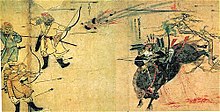
A Mongol bomb thrown against a charging Japanese samurai during the Mongol invasions of Japan after founding the Yuan Dynasty, 1281.
Main article: History of gunpowder
Gunpowder was invented, documented, and used in ancient China where the Chinese military forces used gunpowder-based weapons technology (i.e. rockets, guns, cannons), and explosives (i.e. grenades and different types of bombs) against the Mongols when the Mongols attempted to invade and breach the Chinese city fortifications on the northern borders of China. After the Mongols conquered China and founded the Yuan Dynasty, they used the Chinese gunpowder-based weapons technology in their invasion of Japan. Chinese also used gunpowder to fuel rockets. However, it has also been argued that, like the wheel, gunpowder was "coinvented" or "co-discovered" prior to, simultaneously or slightly after the Chinese, by cultures separated from the Chinese by vast distances, with minimal direct contact between one another.[11][12]
A major problem for academic study is ready access to original sources. Moreover, it is difficult to accurately translate original sources, especially medieval Chinese texts which employ metaphor to describe unexplained phenomena, into contemporary scientific language with its rigidly defined terminology. The difficulty in translation gives rise to errors or loose interpretation bordering on artistic licence.[13][14]
An evaluation of all arguments and thorough literature review is beyond the scope of this article. Rather than take a position, the article will present all arguments to the reader.
[edit] China
Further information: Four Great Inventions of ancient China, List of Chinese inventions, and History of science and technology in China
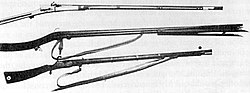
Chinese Ming Dynasty (1368-1644 AD) matchlock firearms
Saltpeter was known to the Chinese by the mid-1st century AD and there is strong evidence of the use of saltpeter and sulfur in various largely medicinal combinations.[15] A Chinese alchemical text dated 492 AD noted saltpetre burnt with a purple flame, providing a practical and reliable means of distinguishing it from other inorganic salts, thus enabling alchemists to evaluate and compare purification techniques.[16] The Chinese word for "gunpowder" is Chinese: 火药/火藥; pinyin: huŏ yào /xuou yɑʊ/, which literally means "Fire Medicine." [17]
The first reference of gunpowder is possibly the passage of the Zhenyuan miaodao yaolüe, a Taoist text tentatively dated to the mid-9th century AD:[16]
The Chinese "Wu Ching Tsung Yao", written by Tseng Kung-Liang in 1044, provides encyclopedia references to a variety of mixtures which included petrochemicals, as well as garlic and honey. A slow match for flame throwing mechanisms using the siphon principle and for fireworks and rockets are mentioned. Academics argue the Chinese wasted little time in applying gunpowder to warfare, and they produced a variety of gunpowder weapons, including flamethrowers, rockets, bombs, and mines, before inventing guns as a projectile weapon.[21]
The development of smokeless powders, such as Cordite, in the late 19th century created the need for a spark-sensitive priming charge, such as gunpowder. However, the sulfur content of traditional gunpowders caused corrosion problems with Cordite Mk I and this led to the introduction of a range of sulfur-free gunpowders, of varying grain sizes.[10] They typically contain 70.5 parts of saltpetre and 29.5 parts of charcoal.[10] Like black powder, they were produced in different grain sizes. In United Kingdom, the finest grain was known as sulfur-free mealed powder (SMP). Coarser grains were numbered as sulfur-free gunpowder (SFG n): 'SFG 12', 'SFG 20', 'SFG 40' and 'SFG 90', for example; where the number represents the smallest BSS sieve mesh size on which no grains were retained.
The main purpose of sulfur in gunpowder is to decrease the ignition temperature. A sample reaction for sulfur-free gunpowder would be
4 KNO3 + C7H8O → 3 K2CO3 + 4 CO2 + 2 H2O + 3 N2 [edit] History

Early Chinese rocket

A Mongol bomb thrown against a charging Japanese samurai during the Mongol invasions of Japan after founding the Yuan Dynasty, 1281.
Main article: History of gunpowder
Gunpowder was invented, documented, and used in ancient China where the Chinese military forces used gunpowder-based weapons technology (i.e. rockets, guns, cannons), and explosives (i.e. grenades and different types of bombs) against the Mongols when the Mongols attempted to invade and breach the Chinese city fortifications on the northern borders of China. After the Mongols conquered China and founded the Yuan Dynasty, they used the Chinese gunpowder-based weapons technology in their invasion of Japan. Chinese also used gunpowder to fuel rockets. However, it has also been argued that, like the wheel, gunpowder was "coinvented" or "co-discovered" prior to, simultaneously or slightly after the Chinese, by cultures separated from the Chinese by vast distances, with minimal direct contact between one another.[11][12]
A major problem for academic study is ready access to original sources. Moreover, it is difficult to accurately translate original sources, especially medieval Chinese texts which employ metaphor to describe unexplained phenomena, into contemporary scientific language with its rigidly defined terminology. The difficulty in translation gives rise to errors or loose interpretation bordering on artistic licence.[13][14]
An evaluation of all arguments and thorough literature review is beyond the scope of this article. Rather than take a position, the article will present all arguments to the reader.
[edit] China
Further information: Four Great Inventions of ancient China, List of Chinese inventions, and History of science and technology in China

Chinese Ming Dynasty (1368-1644 AD) matchlock firearms
Saltpeter was known to the Chinese by the mid-1st century AD and there is strong evidence of the use of saltpeter and sulfur in various largely medicinal combinations.[15] A Chinese alchemical text dated 492 AD noted saltpetre burnt with a purple flame, providing a practical and reliable means of distinguishing it from other inorganic salts, thus enabling alchemists to evaluate and compare purification techniques.[16] The Chinese word for "gunpowder" is Chinese: 火药/火藥; pinyin: huŏ yào /xuou yɑʊ/, which literally means "Fire Medicine." [17]
The first reference of gunpowder is possibly the passage of the Zhenyuan miaodao yaolüe, a Taoist text tentatively dated to the mid-9th century AD:[16]
Some have heated together sulfur, realgar and saltpeter with honey; smoke and flames result, so that their hands and faces have been burnt, and even the whole house where they were working burned down.[18]
By the 9th century Taoist monks or alchemists searching for an elixir of immortality had serendipitously stumbled upon gunpowder.[19][20]
The Chinese "Wu Ching Tsung Yao", written by Tseng Kung-Liang in 1044, provides encyclopedia references to a variety of mixtures which included petrochemicals, as well as garlic and honey. A slow match for flame throwing mechanisms using the siphon principle and for fireworks and rockets are mentioned. Academics argue the Chinese wasted little time in applying gunpowder to warfare, and they produced a variety of gunpowder weapons, including flamethrowers, rockets, bombs, and mines, before inventing guns as a projectile weapon.[21]
වෙඩි බෙහෙත් සොයා ගැනීම නිසා මිනිසාගේ බිය පහවීම තුලින් විද්යා පුනරුදයට ප්රබලම හේතුවක් වුනා.වෙඩි බෙහෙත් සොයා ගැනීම නිසා මිනිසාගේ බිය පහවීම තුලින් විද්යා පුනරුදයට ප්රබලම හේතුවක් වුනා.දේශ ගවේශනය තුලින් ජාත්යන්තර සම්බන්දතාවට වෙඩි බෙහෙත් සොයාගැනීමට රුකුලක් වුනා.Gunpowder was invented, documented, and used in ancient China where the Chinese military forces used gunpowder-based weapons technology (i.e. rockets, guns, cannons), and explosives (i.e. grenades and different types of bombs) against the Mongols when the Mongols attempted to invade and breach the Chinese city fortifications on the northern borders of China. After the Mongols conquered China and founded the Yuan Dynasty, they used the Chinese gunpowder-based weapons technology in their invasion of Japan. Chinese also used gunpowder to fuel r.[11][12]
වෙඩි බෙහෙත් සොයා ගැනීම නිසා මිනිසාගේ බිය පහවීම තුලින් විද්යා පුනරුදයට ප්රබලම හේතුවක් වුනා.වෙඩි බෙහෙත් සොයා ගැනීම නිසා මිනිසාගේ බිය පහවීම තුලින් විද්යා පුනරුදයට ප්රබලම හේතුවක් වුනා.දේශ ගවේශනය තුලින් ජාත්යන්තර සම්බන්දතාවට වෙඩි බෙහෙත් සොයාගැනීමට රුකුලක් වුනා.
විද්යාවේ දියුණුව මිනිසාගේ විනාශය


අරාබි ලෝකය සතු වූ දියුණු විද්යා පුනරුදය සම්බන්ධව නිදසුන් ගෙනහැර දැක්විය හැකිද?
ඇත්තෙන්ම ඔව්, ඉස්ලාම් ගණිතඥයකු වූ අල් – ක්වරිශ්මි විසින් ගණිතයට ඇල්ජිබරා……….? යන වචනය හඳුන්වා දුන්නා. නැවත වරක් පිහිටු වීම………….? යන්න තමයි ඒකෙ තේරුම. අල්ජිබරා ගණිත ක්රමයේ පියා ලෙස සැලකෙන්නේ ඔහු තමයි. ඒත් ඒක තවම විශ්වාස නැහැ. නොදන්නා දේ හඳුන්වා දීමට යන සංකල්පය හඳුන්වා දුන්නෙත් ඉස්ලාම් පුනරුදයෙන් තමයි.
ආලෝකයේ ගමන් මාර..
මේක දැක්කද ?
http://www.elakiri.com/forum/showthread.php?t=1036253

bumpSorry bro...වීජ ගණිතයේ පියා ලෙස සැළකෙන්නෙ Diophantus කියන ග්රීක ගණිතඥයා..මෙහි ඔබ පවසා තිබෙන්නෙ අසත්යයක්
හැමදේකටම උරුමකරුවට ගණන් බැහැ

Similar threads
- Replies
- 6
- Views
- 269


- Replies
- 24
- Views
- 2K

