ෆර්මාගේ අවසන් ගැටළුව

luxmen

Member
Jul 17, 2012
15,961
540
0
world says---"The proof we now know required the development of an entire field of mathematics that was unknown in Fermat's time. The theorem itself is very easy to state and so may seem deceptively simple; you do not need to know a lot of mathematics to understand the problem. It turns out, however, that to the best of our knowledge, you do need to know a lot of mathematics in order to solve it. It is still an open question whether there may be a proof of Fermat's Last Theorem that involves only mathematics and methods that were known in Fermat's time. We have no way of answering unless someone finds one."
 
Last edited:

luxmen

Member
Jul 17, 2012
15,961
540
0
world says ---It is still an open question whether there may be a proof of Fermat's Last Theorem that involves only mathematics and methods that were known in Fermat's time. We have no way of answering unless someone finds one."
 
Last edited:

luxmen

Member
Jul 17, 2012
15,961
540
0
Yes , Srilankan[ luxmen] has found the fermat original proof. Yes that is a Truth.
 
Last edited:

luxmen

Member
Jul 17, 2012
15,961
540
0
Ath thavama------world says---It is still an open question whether there may be a proof of Fermat's Last Theorem that involves only mathematics and methods that were known in Fermat's time. We have no way of answering unless someone finds one."
 
Last edited:

mag123

Well-known member
  • Jan 20, 2008
    5,584
    1,792
    113
    Fermat wrote this marginal note around 1630

    I have discovered a truly remarkable proof which this margin is too small to contain.

    Fermat almost certainly wrote the marginal note around 1630, when he first studied Diophantus's Arithmetica. It may well be that Fermat realised that his remarkable proof was wrong, however, since all his other theorems were stated and restated in challenge problems that Fermat sent to other mathematicians. Although the special cases of n = 3 and n = 4 were issued as challenges (and Fermat did know how to prove these) the general theorem was never mentioned again by Fermat.

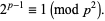
    (xq)p + (yq)p = (zq)p.

    Euler wrote to Goldbach on 4 August 1753 claiming he had a proof of Fermat's Theorem when n = 3. However his proof in Algebra (1770) contains a fallacy and it is far from easy to give an alternative proof of the statement which has the fallacious proof. There is an indirect way of mending the whole proof using arguments which appear in other proofs of Euler so perhaps it is not too unreasonable to attribute the n = 3 case to Euler.

    Despite large prizes being offered for a solution, Fermat's Last Theorem remained unsolved. It has the dubious distinction of being the theorem with the largest number of published false proofs. For example over 1000 false proofs were published between 1908 and 1912. The only positive progress seemed to be computing results which merely showed that any counter-example would be very large. Using techniques based on Kummer's work, Fermat's Last Theorem was proved true, with the help of computers, for n up to 4,000,000 by 1993.

    This, however, is not the end of the story. On 4 December 1993 Andrew Wiles made a statement in view of the speculation. He said that during the reviewing process a number of problems had emerged, most of which had been resolved. However one problem remains and Wiles essentially withdrew his claim to have a proof.

    The key reduction of (most cases of) the Taniyama-Shimura conjecture to the calculation of the Selmer group is correct. However the final calculation of a precise upper bound for the Selmer group in the semisquare case (of the symmetric square representation associated to a modular form) is not yet complete as it stands. I believe that I will be able to finish this in the near future using the ideas explained in my Cambridge lectures.

    http://www-history.mcs.st-and.ac.uk/HistTopics/Fermat's_last_theorem.html


    On 6 October Wiles sent the new proof to three colleagues including Faltings. All liked the new proof which was essentially simpler than the earlier one. Faltings sent a simplification of part of the proof.
    No proof of the complexity of this can easily be guaranteed to be correct, so a very small doubt will remain for some time. However when Taylor lectured at the British Mathematical Colloquium in Edinburgh in April 1995 he gave the impression that no real doubts remained over Fermat's Last Theorem.
     
    Last edited:

    mag123

    Well-known member
  • Jan 20, 2008
    5,584
    1,792
    113
    Fermat's Last Theorem

    Fermat's last theorem is a theorem first proposed by Fermat in the form of a note scribbled in the margin of his copy of the ancient Greek text Arithmetica by Diophantus. The scribbled note was discovered posthumously, and the original is now lost. However, a copy was preserved in a book published by Fermat's son. In the note, Fermat claimed to have discovered a proof that the Diophantine equation
    Inline1.gif
    has no integer solutions for
    Inline2.gif
    and
    Inline3.gif
    .
    The full text of Fermat's statement, written in Latin, reads "Cubum autem in duos cubos, aut quadrato-quadratum in duos quadrato-quadratos, et generaliter nullam in infinitum ultra quadratum potestatem in duos eiusdem nominis fas est dividere cuius rei demonstrationem mirabilem sane detexi. Hanc marginis exiguitas non caperet" (Nagell 1951, p. 252). In translation, "It is impossible for a cube to be the sum of two cubes, a fourth power to be the sum of two fourth powers, or in general for any number that is a power greater than the second to be the sum of two like powers. I have discovered a truly marvelous demonstration of this proposition that this margin is too narrow to contain."
    As a result of Fermat's marginal note, the proposition that the Diophantine equation
    NumberedEquation1.gif
    (1)

    where
    Inline4.gif
    ,
    Inline5.gif
    ,
    Inline6.gif
    , and
    Inline7.gif
    are integers, has no nonzero solutions for
    Inline8.gif
    has come to be known as Fermat's Last Theorem. It was called a "theorem" on the strength of Fermat's statement, despite the fact that no other mathematician was able to prove it for hundreds of years.
    Note that the restriction
    Inline9.gif
    is obviously necessary since there are a number of elementary formulas for generating an infinite number of Pythagorean triples
    Inline10.gif
    satisfying the equation for
    Inline11.gif
    ,
    NumberedEquation2.gif
    (2)

    A first attempt to solve the equation can be made by attempting to factor the equation, giving
    NumberedEquation3.gif
    (3)

    Since the product is an exact power,
    NumberedEquation4.gif
    (4)

    Solving for
    Inline12.gif
    and
    Inline13.gif
    gives
    NumberedEquation5.gif
    (5)

    which give
    NumberedEquation6.gif
    (6)

    However, since solutions to these equations in rational numbers are no easier to find than solutions to the original equation, this approach unfortunately does not provide any additional insight.
    If an odd prime
    Inline14.gif
    divides
    Inline15.gif
    , then the reduction
    NumberedEquation7.gif
    (7)

    can be made, so redefining the arguments gives
    NumberedEquation8.gif
    (8)

    If no odd prime divides
    Inline16.gif
    , then
    Inline17.gif
    is a power of 2, so
    Inline18.gif
    and, in this case, equations (7) and (8) work with 4 in place of
    Inline19.gif
    . Since the case
    Inline20.gif
    was proved by Fermat to have no solutions, it is sufficient to prove Fermat's last theorem by considering odd prime powers only.
    Similarly, is sufficient to prove Fermat's last theorem by considering only relatively prime
    Inline21.gif
    ,
    Inline22.gif
    , and
    Inline23.gif
    , since each term in equation (1) can then be divided by
    Inline24.gif
    , where
    Inline25.gif
    is the greatest common divisor.
    The so-called "first case" of the theorem is for exponents which are relatively prime to
    Inline26.gif
    ,
    Inline27.gif
    , and
    Inline28.gif
    (
    Inline29.gif
    ) and was considered by Wieferich. Sophie Germain proved the first case of Fermat's Last Theorem for any odd prime
    Inline30.gif
    when
    Inline31.gif
    is also a prime. Legendre subsequently proved that if
    Inline32.gif
    is a prime such that
    Inline33.gif
    ,
    Inline34.gif
    ,
    Inline35.gif
    ,
    Inline36.gif
    , or
    Inline37.gif
    is also a prime, then the first case of Fermat's Last Theorem holds for
    Inline38.gif
    . This established Fermat's Last Theorem for
    Inline39.gif
    . In 1849, Kummer proved it for all regular primes and composite numbers of which they are factors (Vandiver 1929, Ball and Coxeter 1987).
    The "second case" of Fermat's last theorem is "
    Inline40.gif
    divides exactly one of
    Inline41.gif
    ,
    Inline42.gif
    ,
    Inline43.gif
    . Note that
    Inline44.gif
    is ruled out by
    Inline45.gif
    ,
    Inline46.gif
    ,
    Inline47.gif
    being relatively prime, and that if
    Inline48.gif
    divides two of
    Inline49.gif
    ,
    Inline50.gif
    ,
    Inline51.gif
    , then it also divides the third, by equation (8).
    Kummer's attack led to the theory of ideals, and Vandiver developed Vandiver's criteria for deciding if a given irregular prime satisfies the theorem. In 1852, Genocchi proved that the first case is true for
    Inline52.gif
    if
    Inline53.gif
    is not an irregular pair. In 1858, Kummer showed that the first case is true if either
    Inline54.gif
    or
    Inline55.gif
    is an irregular pair, which was subsequently extended to include
    Inline56.gif
    and
    Inline57.gif
    by Mirimanoff (1909). Vandiver (1920ab) pointed out gaps and errors in Kummer's memoir which, in his view, invalidate Kummer's proof of Fermat's Last Theorem for the irregular primes 37, 59, and 67, although he claims Mirimanoff's proof of FLT for exponent 37 is still valid.
    Wieferich (1909) proved that if the equation is solved in integers relatively prime to an odd prime
    Inline58.gif
    , then
    NumberedEquation9.gif
    (9)

    (Ball and Coxeter 1987). Such numbers are called Wieferich primes. Mirimanoff (1909) subsequently showed that
    NumberedEquation10.gif
    (10)

    must also hold for solutions relatively prime to an odd prime
    Inline59.gif
    , which excludes the first two Wieferich primes 1093 and 3511. In 1914, Vandiver showed
    NumberedEquation11.gif
    (11)

    and Frobenius extended this to
    NumberedEquation12.gif
    (12)

    It has also been shown that if
    Inline60.gif
    were a prime of the form
    Inline61.gif
    , then
    NumberedEquation13.gif
    (13)

    which raised the smallest possible
    Inline62.gif
    in the "first case" to
    Inline63.gif
    by 1941 (Rosser 1941). Granville and Monagan (1988) showed if there exists a prime
    Inline64.gif
    satisfying Fermat's Last Theorem, then
    NumberedEquation14.gif
    (14)

    for
    Inline65.gif
    , 7, 11, ..., 71. This establishes that the first case is true for all prime exponents up to
    Inline66.gif
    (Vardi 1991).
    The "second case" of Fermat's Last Theorem (for
    Inline67.gif
    ) proved harder than the first case.
    Euler proved the general case of the theorem for
    Inline68.gif
    , Fermat
    Inline69.gif
    , Dirichlet and Lagrange
    Inline70.gif
    . In 1832, Dirichlet established the case
    Inline71.gif
    . The
    Inline72.gif
    case was proved by Lamé (1839; Wells 1986, p. 70), using the identity
    NumberedEquation15.gif
    (15)

    Although some errors were present in this proof, these were subsequently fixed by Lebesgue in 1840. Much additional progress was made over the next 150 years, but no completely general result had been obtained. Buoyed by false confidence after his proof that pi is transcendental, the mathematician Lindemann proceeded to publish several proofs of Fermat's Last Theorem, all of them invalid (Bell 1937, pp. 464-465). A prize of
    Inline73.gif
    German marks, known as the Wolfskehl Prize, was also offered for the first valid proof (Ball and Coxeter 1987, p. 72; Barner 1997; Hoffman 1998, pp. 193-194 and 199).
    A recent false alarm for a general proof was raised by Y. Miyaoka (Cipra 1988) whose proof, however, turned out to be flawed. Other attempted proofs among both professional and amateur mathematicians are discussed by vos Savant (1993), although vos Savant erroneously claims that work on the problem by Wiles (discussed below) is invalid. By the time 1993 rolled around, the general case of Fermat's Last Theorem had been shown to be true for all exponents up to
    Inline74.gif
    (Cipra 1993). However, given that a proof of Fermat's Last Theorem requires truth for all exponents, proof for any finite number of exponents does not constitute any significant progress towards a proof of the general theorem (although the fact that no counterexamples were found for this many cases is highly suggestive).
    In 1993, a bombshell was dropped. In that year, the general theorem was partially proven by Andrew Wiles (Cipra 1993, Stewart 1993) by proving the semistable case of the Taniyama-Shimura conjecture. Unfortunately, several holes were discovered in the proof shortly thereafter when Wiles' approach via the Taniyama-Shimura conjecture became hung up on properties of the Selmer group using a tool called an Euler system. However, the difficulty was circumvented by Wiles and R. Taylor in late 1994 (Cipra 1994, 1995) and published in Taylor and Wiles (1995) and Wiles (1995). Wiles' proof succeeds by (1) replacing elliptic curves with Galois representations, (2) reducing the problem to a class number formula, (3) proving that formula, and (4) tying up loose ends that arise because the formalisms fail in the simplest degenerate cases (Cipra 1995).
    The proof of Fermat's Last Theorem marks the end of a mathematical era. Since virtually all of the tools which were eventually brought to bear on the problem had yet to be invented in the time of Fermat, it is interesting to speculate about whether he actually was in possession of an elementary proof of the theorem. Judging by the tenacity with which the problem resisted attack for so long, Fermat's alleged proof seems likely to have been illusionary. This conclusion is further supported by the fact that Fermat searched for proofs for the cases
    Inline75.gif
    and
    Inline76.gif
    , which would have been superfluous had he actually been in possession of a general proof.

    This article is from Mathworld.
     
    Last edited:

    luxmen

    Member
    Jul 17, 2012
    15,961
    540
    0
    maru...
    habai aulak thibboth thiyenne methana........

    From (1)---- c^n/2<a^n/2+b^n/2
    From(2) ----c^n/2<(a+b)^n/2
    So-----a^n/2+b^n/2=(a+b)^n/2
    (a+b)^n/2 =a^n/2+b^n/2
    (a+b)^n=(a^n/2+b^n/2)^2
    ----Etthana Hari. Right side deka samana venna onane. NAMUTH FERMAT WORLD EKEN HANGUVA VAGE, VERY IMPORTANT SECRET EKAK MAMA PROOF EKATATA DALA NAHA THAVAMA. MAMA EKA LIVE AVASTHAVAK DUNNOTH PRODUCE KARANNA INNE. EKA THAMA , for n is greater than 2, then if there is c^n = a^n +b^n, then there is no integrals a,b,c for when integral n , Although I proved it , still I did not show , that it is not possible to have integrals a,b,c , when n>2 . That is a secret , Fermat and I know that secret in this world.
     

    mag123

    Well-known member
  • Jan 20, 2008
    5,584
    1,792
    113
    you wrote in your proof

    From (1)---- c^n/2<a^n/2+b^n/2 ---(a)
    From(2) ----c^n/2<(a+b)^n/2 ---(b)
    So----- a^n/2+b^n/2=(a+b)^n/2 ---(c) ???

    (a) and (b) are inequalities so how can you say a^n/2+b^n/2=(a+b)^n/2 just because left sides are equal?

    It's just like saying
    2< 2+4
    2< 5+7

    so 2+4 = 5+ 7 ????
     
    Last edited:
    • Like
    Reactions: Persius

    07sanjeewakaru

    Well-known member
  • Feb 9, 2013
    5,532
    1,812
    113
    ලංකාවෙ අඩා...!
    Use Binomial expansion for a+b for the power of N .. u will notice by yourself ur mistake.


    From (1)---- c^n/2<a^n/2+b^n/2
    From(2) ----c^n/2<(a+b)^n/2
    So-----a^n/2+b^n/2=(a+b)^n/2
    the proof is wrong from here. how can u deduce the above?


    Ne...
    oya hithena widihata newei macho...
    me proof eka thawa wisthara karanta oone...
    uba kiyana tharke newei aula thiyenne.......:eek::eek:
     
    Ne...
    oya hithena widihata newei macho...
    me proof eka thawa wisthara karanta oone...
    uba kiyana tharke newei aula thiyenne.......:eek::eek:


    methana krla thiyenne n=2 thiyena gunayak n>2 ne kiyala pennana ekane.

    mulinma n=2 kiyala aragena ai n/2 variable kiyanne??? wichalanaya wenne nene. n=2 . n/2 =1


    n=2 wenkota terms 3 kin liyana puluwan. n>2 ehema be . ow eka hari.den aththtama ekada methana ? uththare?
    a+b ^n ekak aran ai? me proof eka kiyawddi prashnei mekai kisi galapeemak ne wage denenawa. mage danum mattame awulak wennathi eka :)


    luxmen

    Member
    Jul 17, 2012
    15,961
    540
    0
    Mama mea proof eke expose nokarapu kotasak thiyenava. Very important. Ema expose nokarapu kotasa thama FERMAT VISIN HANGUVE.[SECRET]. NAMUTH MAMA SECRET EKA DANNAVA . THAVAMA EXPOSE KALEY NAHA , SECRET ITHURU KOTASA. SADARANA AVASTHAVAK AVOTH ITHURU KOTASA EXPOSE KARANAVA. ETHAKOTA OBALAGE PROBLEMS VALATA ANSWER EKA LABEVI.