Dropping Diego Costa was the right call for Spain
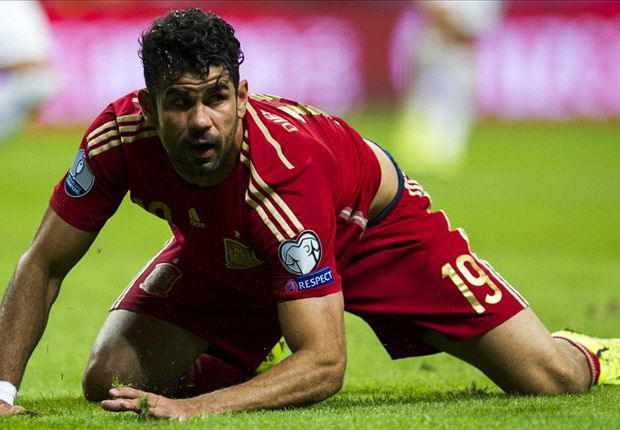
After another scoreless game in Spanish red, Diego Costa trudged off the pitch in Skopje, completely unaware that it would be his last game for his adopted nation for some time. The yellow card that he was issued during the 1-0 win against Macedonia rules him out of
La Roja's match against Luxembourg on Friday, with Vicente del Bosque using the Chelsea striker's suspension as an excuse to completely ditch him from the squad.
"That's the first I've heard about it," Costa said, apparently surprised to learn from reporters that he had picked up a ban after the last match. He may have been equally as shocked when he learned of his omission from Del Bosque's latest roster - even if there have been doubts for a while now about his performances as the lone forward in a side overrun with diminutive midfield technicians.
The truth is that Costa, just turned 27, has not been good enough since he controversially opted to play for Spain over Brazil nearly two years ago. He has scored just once in nine caps — against Luxembourg in a qualification match for next summer's European Championships — and has struggled to replicate the menacing-but-dazzling from that he has so frequently shown off for Atletico Madrid and Chelsea.
His World Cup in Brazil, where he was booed by grieving home supporters, was brief and disappointing, perhaps because of the hamstring injury which he had picked up at the end of the previous season with Atletico. However, things have not improved since, with Del Bosque admitting after a recent victory over Slovakia that, when Spain come up against teams who park the bus, it is difficult for Costa to play his way.
"Of course I would like him to score more," the 64-year-old admitted. "Against teams that play so defensively, though, the player with the most difficult job is the striker. We have to be patient [with Costa]. A lot of the time, he's stuck with his back to goal."
Dropping him from his squad is perhaps not the best definition of the word 'patience' from the former Real Madrid boss. Costa may be suspended for Friday's game but he could have featured against Ukraine, allowing him another chance to get used to his role. He may have the world's worst hamstrings but, as a part of this Spain squad, it would have been nice for him to be there when they sealed their qualification for France 2016 — which they would do with a win against Luxembourg.
Delving deeper, though, it may not just be Costa's suspension and international form which is lingering in Del Bosque's mind. The burly forward admitted on Thursday that he has began the new season "overweight" and he has scored just two goals in eight appearances for Jose Mourinho's side since August. He bears little resemblance to the goalscoring monster who so easily took to the Premier League last year.
And then there is his conduct. Costa is very much an in-your-face type of player, provoking you and winding you up, waiting for you to snap. In Spain there were racism claims from then Sevilla midfielder Geoffrey Kondogbia and, whenever he came up against Sergio Ramos and Pepe, their tussle descended into a Looney Tunes-style cloud of elbows. The excuse that his sympathisers have offered is his tough upbringing in Brazil, where he grew up learning the game on the streets.
That side of his game followed him to England. Within a month of Costa's arrival, Everton manager Roberto Martinez was angered by the way in which he taunted Seamus Coleman after a Chelsea goal. Then there were the two stamps against Liverpool for which the FA retrospectively banned him and, most recently, the clashes with Arsenal's Laurent Koscielny and Gabriel Paulista, which once again saw retrospective action taken — and that is barely scratching the surface.
Del Bosque admitted recently that these actions do not sit well with him. "What he did was unedifying and that's why he had to be punished," the Spain boss remarked. "I did not like it but that's not why I've not called him up. He can't play in the first game and we've decided not to bring him he hasn't played badly and it's not on merit."
Juan Mata, too, insists that Costa has a place in this Spain side, although he did reveal it has been tough for the foward so far. "Being the striker in a team like ours, with so many midfielders, is not easy," he explained on Spanish radio. "It's a complicated role. Players like [David] Villa and [Fernando] Torres did it very well but it's difficult to come and adapt. But I would rather have [Costa] as a team-mate than a rival. His movement and goals will always create problems. Also, he fight with the centre-backs, which creates problems and knocks the opponents' concentration."
Since Villa and Torres, there has been no easy solution to Del Bosque's striker problems. Alvaro Negredo and Fernando Llorente were clearly not the answers, which is why he was so desperate to lure Costa away from his native Brazil. He succeeded in doing so but Costa has still not succeeded with Spain.
Possibly because of the effort that it took to get him on board, Del Bosque has admirably stuck by his striker more than he has with some of his previous attacking options. Now, though, we have seen that he, too, like many others, has doubts over Costa's ability to function in a Spain side under pressure to recreate their back-to-back European Championships and World Cup wins.
Leaving him out because of the suspension is merely a ready-made excuse. The fact is that the two strikers in the current squad - Alvaro Morata and Paco Alcacer - represent far better options at present, even despite the latter's lack of game time at Valencia.
Costa will probably be in France next summer. On his day, he is too good to be left out but the fact that he will not be there as Spain qualify shows that he needs to buck up his ideas. If he has any more bouts of bad behaviour on the pitch or fails to shed those extra pounds put on over the summer, Del Bosque may once again find himself looking for an excuse.


Schweinsteiger suffers thigh injury on Germany duty
 .hamadama hoda players la 3k 4k wath injured wenawa



 sure karanna puluwan manager kenek & team 1kata hodata hadai