


Windows 1.0 and Windows 2.0
The first independent version of Microsoft Windows, version 1.0, released on 20 November 1985, achieved little popularity. It was originally going to be called "Interface Manager" but Rowland Hanson, the head of marketing at Microsoft, convinced the company that the name Windows would be more appealing to consumers. Windows 1.0 was not a complete operating system, but rather an "operating environment" that extended MS-DOS, and shared the latter's inherent flaws and problems.
The first version of Microsoft Windows included a simple graphics painting program called Windows Paint; Windows Write, a simple word processor; an appointment "calendar"; a "cardfiler"; a "notepad"; a "clock"; a "control panel"; a "computer terminal"; "Clipboard"; and RAM driver. It also included the MS-DOS Executive and a game called Reversi.
Microsoft had worked with Apple Computer to develop several Desk Accessories and other minor pieces of software that were included with early Macintosh system software. As part of the related business negotiations, Microsoft had licensed certain aspects of the Macintosh user interface from Apple; in later litigation, a district court summarized these aspects as "screen displays". In the development of Windows 1.0, Microsoft intentionally limited its borrowing of certain GUI elements from the Macintosh user interface, to comply with its license.

For example, windows were only displayed "tiled" on the screen; that is, they could not overlap or overlie one another. There was no trash can icon with which to delete files, since Apple claimed ownership of the rights to that paradigm.
Microsoft Windows version 2 came out on 9 December 1987, and proved slightly more popular than its predecessor. Much of the popularity for Windows 2.0 came by way of its inclusion as a "run-time version" with Microsoft's new graphical applications, Excel and Word for Windows. They could be run from MS-DOS, executing Windows for the duration of their activity, and closing down Windows upon exit.
Microsoft Windows received a major boost around this time when Aldus PageMaker appeared in a Windows version, having previously run only on Macintosh. Some computer historians date this, the first appearance of a significant and non-Microsoft application for Windows, as the start of the success of Windows.
Versions 2.0x used the real-mode memory model, which confined it to a maximum of 1 megabyte of memory. In such a configuration, it could run under another multitasker like DESQview, which used the 286 protected mode.
Later, two new versions were released: Windows/286 2.1 and Windows/386 2.1. Like prior versions of Windows, Windows/286 2.1 used the real-mode memory model, but was the first version to support the High Memory Area. Windows/386 2.1 had a protected mode kernel with LIM-standard EMS emulation, the predecessor to XMS which would finally change the topology of IBM PC computing. All Windows and DOS-based applications at the time were real mode, running over the protected mode kernel by using the virtual 8086 mode, which was new with the 80386 processor.
Version 2.03, and later 3.0, faced challenges from Apple over its overlapping windows and other features Apple charged mimicked the ostensibly copyrighted "look and feel" of its operating system and "embodie[d] and generated a copy of the Macintosh" in its OS. Judge William Schwarzer dropped all but 10 of Apple's 189 claims of copyright infringement, and ruled that most of the remaining 10 were over uncopyrightable ideas.
Windows 3.0
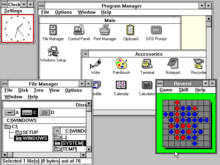
Microsoft Windows scored a significant success with Windows 3.0, released in 1990. In addition to improved capabilities given to native applications, Windows also allowed users to better multitask older MS-DOS based software compared to Windows/386, thanks to the introduction of virtual memory.
Windows 3.0's user interface was finally a serious competitor to the user interface of the Macintosh computer. PCs had improved graphics by this time, due to VGA video cards, and the protected/enhanced mode allowed Windows applications to use more memory in a more painless manner than their DOS counterparts could. Windows 3.0 could run in real, standard, or 386 enhanced modes, and was compatible with any Intel processor from the 8086/8088 up to the 80286 and 80386. This was the first version to run Windows programs in protected mode, although the 386 enhanced mode kernel was an enhanced version of the protected mode kernel in Windows/386.
A "multimedia" version, Windows 3.0 with Multimedia Extensions 1.0, was released in October of 1991. This was bundled with "multimedia upgrade kits", comprising a CD-ROM drive and a sound card, such as the Creative Labs Sound Blaster Pro. This version was the precursor to the multimedia features available in Windows 3.1 and later, and was part of Microsoft's specification for the Multimedia PC.
The features listed above and growing market support from application software developers made Windows 3.0 wildly successful, selling around 10 million copies in the two years before the release of version 3.1. Windows 3.0 became a major source of income for Microsoft, and led the company to revise some of its earlier plans. It was discontinued on 31 December 2001.
A step sideways: OS/2

During the mid to late 1980s, Microsoft and IBM had cooperatively been developing OS/2 as a successor to DOS. OS/2 would take full advantage of the aforementioned protected mode of the Intel 80286 processor and up to 16 MB of memory. OS/2 1.0, released in 1987, supported swapping and multitasking and allowed running of DOS executables.
A GUI, called the Presentation Manager (PM), was not available with OS/2 until version 1.1, released in 1988. Its API was incompatible with Windows. (Among other things, Presentation Manager placed X,Y coordinate 0,0 at the bottom left of the screen like Cartesian coordinates, while Windows put 0,0 at the top left of the screen like most other computer window systems.) Version 1.2, released in 1989, introduced a new file system, HPFS, to replace the FAT file system.
By the early 1990s, conflicts developed in the Microsoft/IBM relationship. They cooperated with each other in developing their PC operating systems, and had access to each others' code. Microsoft wanted to further develop Windows, while IBM desired for future work to be based on OS/2. In an attempt to resolve this tension, IBM and Microsoft agreed that IBM would develop OS/2 2.0, to replace OS/2 1.3 and Windows 3.0, while Microsoft would develop a new operating system, OS/2 3.0, to later succeed OS/2 2.0.
This agreement soon however fell apart, and the Microsoft/IBM relationship was terminated. IBM continued to develop OS/2, while Microsoft changed the name of its (as yet unreleased) OS/2 3.0 to Windows NT. Both retained the rights to use OS/2 and Windows technology developed up to the termination of the agreement; Windows NT, however, was to be written anew, mostly independently (see below).
After an interim 1.3 version to fix up many remaining problems with the 1.x series, IBM released OS/2 version 2.0 in 1992. This was a major improvement: it featured a new, object-oriented GUI, the Workplace Shell (WPS), that included a desktop and was considered by many to be OS/2's best feature. Microsoft would later imitate much of it in Windows 95. Version 2.0 also provided a full 32-bit API, offered smooth multitasking and could take advantage of the 4 gigabytes of address space provided by the Intel 80386. Still, much of the system had 16-bit code internally which required, among other things, device drivers to be 16-bit code also. This was one of the reasons for the chronic shortage of OS/2 drivers for the latest devices. Version 2.0 could also run DOS and Windows 3.0 programs, since IBM had retained the right to use the DOS and Windows code as a result of the breakup.
Windows 3.1 and NT

In response to the impending release of OS/2 2.0, Microsoft developed Windows 3.1, which included several minor improvements to Windows 3.0 (such as display of TrueType scalable fonts, developed jointly with Apple), but primarily consisted of bugfixes and multimedia support. It also excluded support for Real mode, and only ran on an 80286 or better processor. Later Microsoft also released Windows 3.11, a touch-up to Windows 3.1 which included all of the patches and updates that followed the release of Windows 3.1 in 1992. Around the same time, Microsoft released Windows for Workgroups (WfW), which was available both as an add-on for existing Windows 3.1 installations and in a version that included the base Windows environment and the networking extensions all in one package. Windows for Workgroups included improved network drivers and protocol stacks, and support for peer-to-peer networking. One optional download for WfW was the "Wolverine" TCP/IP protocol stack, which allowed for easy access to the Internet through corporate networks. There were two versions of Windows for Workgroups, WfW 3.1 and WfW 3.11. Unlike prior versions, Windows for Workgroups 3.11 ran in 386 enhanced mode only, and needs at least an 80386SX processor.
All these versions continued version 3.0's impressive sales pace. Even though the 3.1x series still lacked most of the important features of OS/2, such as long file names, a desktop, or protection of the system against misbehaving applications, Microsoft quickly took over the OS and GUI markets for the IBM PC. The Windows API became the de-facto standard for consumer software.
Meanwhile Microsoft continued to develop Windows NT. The main architect of the system was Dave Cutler, one of the chief architects of VMS at Digital Equipment Corporation (later acquired by Compaq, now part of Hewlett-Packard). Microsoft hired him in August 1988 to create a successor to OS/2, but Cutler created a completely new system instead. Cutler had been developing a follow-on to VMS at DEC called Mica, and when DEC dropped the project he brought the expertise and around 20 engineers with him to Microsoft. DEC also believed he brought Mica's code to Microsoft and sued. Microsoft eventually paid US$150 million and agreed to support DEC's Alpha CPU chip in NT.
Windows NT 3.1 (Microsoft marketing wanted Windows NT to appear to be a continuation of Windows 3.1) arrived in Beta form to developers at the July 1992 Professional Developers Conference in San Francisco.[4] Microsoft announced at the conference its intentions to develop a successor to both Windows NT and Windows 3.1's replacement (Windows 95, codenamed Chicago), which would unify the two into one operating system. This successor was codenamed Cairo. In hindsight, Cairo was a much more difficult project than Microsoft had anticipated and, as a result, NT and Chicago would not be unified until Windows XP—albeit Windows 2000, oriented to business, had already unified most of the system’s bolts and gears, it was XP that was sold to home consumers like Windows 95 and came to be viewed as the final unified OS. Parts of Cairo have still not made it into Windows as of 2009 - specifically, the WinFS file system, which was the much touted Object File System of Cairo. Microsoft announced that they have discontinued the separate release of WinFS for Windows XP and Windows Vista and will gradually incorporate the technologies developed for WinFS in other products and technologies, notably Microsoft SQL Server.
Driver support was lacking due to the increased programming difficulty in dealing with NT's superior hardware abstraction model. This problem plagued the NT line all the way through Windows 2000. Programmers complained that it was too hard to write drivers for NT, and hardware developers were not going to go through the trouble of developing drivers for a small segment of the market. Additionally, although allowing for good performance and fuller exploitation of system resources, it was also resource-intensive on limited hardware, and thus was only suitable for larger, more expensive machines.
However, these same features made Windows NT perfect for the LAN server market (which in 1993 was experiencing a rapid boom, as office networking was becoming common). NT also had advanced network connectivity options and the efficient NTFS file system. Windows NT version 3.51 was Microsoft's entry into this field, and took away market share from Novell (the dominant player) in the following years.
One of Microsoft's biggest advances initially developed for Windows NT was a new 32-bit API, to replace the legacy 16-bit Windows API. This API was called Win32, and from then on Microsoft referred to the older 16-bit API as Win16. The Win32 API had three main implementations: one for Windows NT, one for Win32s (which was a subset of Win32 which could be used on Windows 3.1 systems). Windows NT was the first Windows operating system based on a hybrid kernel.
The first independent version of Microsoft Windows, version 1.0, released on 20 November 1985, achieved little popularity. It was originally going to be called "Interface Manager" but Rowland Hanson, the head of marketing at Microsoft, convinced the company that the name Windows would be more appealing to consumers. Windows 1.0 was not a complete operating system, but rather an "operating environment" that extended MS-DOS, and shared the latter's inherent flaws and problems.
The first version of Microsoft Windows included a simple graphics painting program called Windows Paint; Windows Write, a simple word processor; an appointment "calendar"; a "cardfiler"; a "notepad"; a "clock"; a "control panel"; a "computer terminal"; "Clipboard"; and RAM driver. It also included the MS-DOS Executive and a game called Reversi.
Microsoft had worked with Apple Computer to develop several Desk Accessories and other minor pieces of software that were included with early Macintosh system software. As part of the related business negotiations, Microsoft had licensed certain aspects of the Macintosh user interface from Apple; in later litigation, a district court summarized these aspects as "screen displays". In the development of Windows 1.0, Microsoft intentionally limited its borrowing of certain GUI elements from the Macintosh user interface, to comply with its license.

For example, windows were only displayed "tiled" on the screen; that is, they could not overlap or overlie one another. There was no trash can icon with which to delete files, since Apple claimed ownership of the rights to that paradigm.
Microsoft Windows version 2 came out on 9 December 1987, and proved slightly more popular than its predecessor. Much of the popularity for Windows 2.0 came by way of its inclusion as a "run-time version" with Microsoft's new graphical applications, Excel and Word for Windows. They could be run from MS-DOS, executing Windows for the duration of their activity, and closing down Windows upon exit.
Microsoft Windows received a major boost around this time when Aldus PageMaker appeared in a Windows version, having previously run only on Macintosh. Some computer historians date this, the first appearance of a significant and non-Microsoft application for Windows, as the start of the success of Windows.
Versions 2.0x used the real-mode memory model, which confined it to a maximum of 1 megabyte of memory. In such a configuration, it could run under another multitasker like DESQview, which used the 286 protected mode.
Later, two new versions were released: Windows/286 2.1 and Windows/386 2.1. Like prior versions of Windows, Windows/286 2.1 used the real-mode memory model, but was the first version to support the High Memory Area. Windows/386 2.1 had a protected mode kernel with LIM-standard EMS emulation, the predecessor to XMS which would finally change the topology of IBM PC computing. All Windows and DOS-based applications at the time were real mode, running over the protected mode kernel by using the virtual 8086 mode, which was new with the 80386 processor.
Version 2.03, and later 3.0, faced challenges from Apple over its overlapping windows and other features Apple charged mimicked the ostensibly copyrighted "look and feel" of its operating system and "embodie[d] and generated a copy of the Macintosh" in its OS. Judge William Schwarzer dropped all but 10 of Apple's 189 claims of copyright infringement, and ruled that most of the remaining 10 were over uncopyrightable ideas.
Windows 3.0

Microsoft Windows scored a significant success with Windows 3.0, released in 1990. In addition to improved capabilities given to native applications, Windows also allowed users to better multitask older MS-DOS based software compared to Windows/386, thanks to the introduction of virtual memory.
Windows 3.0's user interface was finally a serious competitor to the user interface of the Macintosh computer. PCs had improved graphics by this time, due to VGA video cards, and the protected/enhanced mode allowed Windows applications to use more memory in a more painless manner than their DOS counterparts could. Windows 3.0 could run in real, standard, or 386 enhanced modes, and was compatible with any Intel processor from the 8086/8088 up to the 80286 and 80386. This was the first version to run Windows programs in protected mode, although the 386 enhanced mode kernel was an enhanced version of the protected mode kernel in Windows/386.
A "multimedia" version, Windows 3.0 with Multimedia Extensions 1.0, was released in October of 1991. This was bundled with "multimedia upgrade kits", comprising a CD-ROM drive and a sound card, such as the Creative Labs Sound Blaster Pro. This version was the precursor to the multimedia features available in Windows 3.1 and later, and was part of Microsoft's specification for the Multimedia PC.
The features listed above and growing market support from application software developers made Windows 3.0 wildly successful, selling around 10 million copies in the two years before the release of version 3.1. Windows 3.0 became a major source of income for Microsoft, and led the company to revise some of its earlier plans. It was discontinued on 31 December 2001.
A step sideways: OS/2

During the mid to late 1980s, Microsoft and IBM had cooperatively been developing OS/2 as a successor to DOS. OS/2 would take full advantage of the aforementioned protected mode of the Intel 80286 processor and up to 16 MB of memory. OS/2 1.0, released in 1987, supported swapping and multitasking and allowed running of DOS executables.
A GUI, called the Presentation Manager (PM), was not available with OS/2 until version 1.1, released in 1988. Its API was incompatible with Windows. (Among other things, Presentation Manager placed X,Y coordinate 0,0 at the bottom left of the screen like Cartesian coordinates, while Windows put 0,0 at the top left of the screen like most other computer window systems.) Version 1.2, released in 1989, introduced a new file system, HPFS, to replace the FAT file system.
By the early 1990s, conflicts developed in the Microsoft/IBM relationship. They cooperated with each other in developing their PC operating systems, and had access to each others' code. Microsoft wanted to further develop Windows, while IBM desired for future work to be based on OS/2. In an attempt to resolve this tension, IBM and Microsoft agreed that IBM would develop OS/2 2.0, to replace OS/2 1.3 and Windows 3.0, while Microsoft would develop a new operating system, OS/2 3.0, to later succeed OS/2 2.0.
This agreement soon however fell apart, and the Microsoft/IBM relationship was terminated. IBM continued to develop OS/2, while Microsoft changed the name of its (as yet unreleased) OS/2 3.0 to Windows NT. Both retained the rights to use OS/2 and Windows technology developed up to the termination of the agreement; Windows NT, however, was to be written anew, mostly independently (see below).
After an interim 1.3 version to fix up many remaining problems with the 1.x series, IBM released OS/2 version 2.0 in 1992. This was a major improvement: it featured a new, object-oriented GUI, the Workplace Shell (WPS), that included a desktop and was considered by many to be OS/2's best feature. Microsoft would later imitate much of it in Windows 95. Version 2.0 also provided a full 32-bit API, offered smooth multitasking and could take advantage of the 4 gigabytes of address space provided by the Intel 80386. Still, much of the system had 16-bit code internally which required, among other things, device drivers to be 16-bit code also. This was one of the reasons for the chronic shortage of OS/2 drivers for the latest devices. Version 2.0 could also run DOS and Windows 3.0 programs, since IBM had retained the right to use the DOS and Windows code as a result of the breakup.
Windows 3.1 and NT

In response to the impending release of OS/2 2.0, Microsoft developed Windows 3.1, which included several minor improvements to Windows 3.0 (such as display of TrueType scalable fonts, developed jointly with Apple), but primarily consisted of bugfixes and multimedia support. It also excluded support for Real mode, and only ran on an 80286 or better processor. Later Microsoft also released Windows 3.11, a touch-up to Windows 3.1 which included all of the patches and updates that followed the release of Windows 3.1 in 1992. Around the same time, Microsoft released Windows for Workgroups (WfW), which was available both as an add-on for existing Windows 3.1 installations and in a version that included the base Windows environment and the networking extensions all in one package. Windows for Workgroups included improved network drivers and protocol stacks, and support for peer-to-peer networking. One optional download for WfW was the "Wolverine" TCP/IP protocol stack, which allowed for easy access to the Internet through corporate networks. There were two versions of Windows for Workgroups, WfW 3.1 and WfW 3.11. Unlike prior versions, Windows for Workgroups 3.11 ran in 386 enhanced mode only, and needs at least an 80386SX processor.
All these versions continued version 3.0's impressive sales pace. Even though the 3.1x series still lacked most of the important features of OS/2, such as long file names, a desktop, or protection of the system against misbehaving applications, Microsoft quickly took over the OS and GUI markets for the IBM PC. The Windows API became the de-facto standard for consumer software.
Meanwhile Microsoft continued to develop Windows NT. The main architect of the system was Dave Cutler, one of the chief architects of VMS at Digital Equipment Corporation (later acquired by Compaq, now part of Hewlett-Packard). Microsoft hired him in August 1988 to create a successor to OS/2, but Cutler created a completely new system instead. Cutler had been developing a follow-on to VMS at DEC called Mica, and when DEC dropped the project he brought the expertise and around 20 engineers with him to Microsoft. DEC also believed he brought Mica's code to Microsoft and sued. Microsoft eventually paid US$150 million and agreed to support DEC's Alpha CPU chip in NT.
Windows NT 3.1 (Microsoft marketing wanted Windows NT to appear to be a continuation of Windows 3.1) arrived in Beta form to developers at the July 1992 Professional Developers Conference in San Francisco.[4] Microsoft announced at the conference its intentions to develop a successor to both Windows NT and Windows 3.1's replacement (Windows 95, codenamed Chicago), which would unify the two into one operating system. This successor was codenamed Cairo. In hindsight, Cairo was a much more difficult project than Microsoft had anticipated and, as a result, NT and Chicago would not be unified until Windows XP—albeit Windows 2000, oriented to business, had already unified most of the system’s bolts and gears, it was XP that was sold to home consumers like Windows 95 and came to be viewed as the final unified OS. Parts of Cairo have still not made it into Windows as of 2009 - specifically, the WinFS file system, which was the much touted Object File System of Cairo. Microsoft announced that they have discontinued the separate release of WinFS for Windows XP and Windows Vista and will gradually incorporate the technologies developed for WinFS in other products and technologies, notably Microsoft SQL Server.
Driver support was lacking due to the increased programming difficulty in dealing with NT's superior hardware abstraction model. This problem plagued the NT line all the way through Windows 2000. Programmers complained that it was too hard to write drivers for NT, and hardware developers were not going to go through the trouble of developing drivers for a small segment of the market. Additionally, although allowing for good performance and fuller exploitation of system resources, it was also resource-intensive on limited hardware, and thus was only suitable for larger, more expensive machines.
However, these same features made Windows NT perfect for the LAN server market (which in 1993 was experiencing a rapid boom, as office networking was becoming common). NT also had advanced network connectivity options and the efficient NTFS file system. Windows NT version 3.51 was Microsoft's entry into this field, and took away market share from Novell (the dominant player) in the following years.
One of Microsoft's biggest advances initially developed for Windows NT was a new 32-bit API, to replace the legacy 16-bit Windows API. This API was called Win32, and from then on Microsoft referred to the older 16-bit API as Win16. The Win32 API had three main implementations: one for Windows NT, one for Win32s (which was a subset of Win32 which could be used on Windows 3.1 systems). Windows NT was the first Windows operating system based on a hybrid kernel.


 තව ටිකකින් කියවන්න ඕන


