


Latest ads
-
V2ray VPN for Tunneling
- hu KANNA
- Updated:
-
 ඕනම රටකට සෙට් වෙන CV එකක්
- ErMurazor
- Updated:
-
 Hambantota 7 Acres Beachfront Land For Sell DownSouth , PerPerch Price 420 000
- 1024 Digital
- Updated:
-
 Baseus PI LITE INDOOR CAMERA
- ErMurazor
- Updated:
You are using an out of date browser. It may not display this or other websites correctly.
You should upgrade or use an alternative browser.
You should upgrade or use an alternative browser.
Anusha said:nVidia's SPs and ATI's SPs are not comparable.
nVidia's SPs are much more capable than ATI's. That's why ATI need a lot of SPs to compete with nVidia's. Remember, the shader clock has the least impact on the performance in a game. Core Clock is first, then Memory Clock.
Why GTX280 sucks is because the chip itself is VEEERRRYYYY expensive to make and consumes shit load of power. It's huge!!!!
SPs have NOTHING to do with UVD or PureVideo. They are, as their name suggests, for processing SHADERS!
UVD is also a part of Those possessors so you can't say SP's got nothing to do with UVD.when nvidia card uses 60% cpu for a video play back radeon card will only use about 10%.because of it's UVD so there is something with sp don't yo think


I am a hardcore AMD Fanboy.I used to run a clubhouse too.But since the chip count was less I have to abandon it.But now In another 2-3 months I'm gonna get it alive back once again as there are AMD CPUs and ATI VGAs have landed on SL.Finally SL Unity douchebags have understood what is cheap or the old ones have jumped from that 10 story building.randiljosh said:why's that
 Anyway What that chanster told was bit of a lie.
And that UVD,Pure video thing.Its what they call their things.
But I usually suggest ATI cards for some reasons.
Lower power consumption(Not exactly right with HD4800 series)
Lower price per performance.
Has AVIVO.(ATI Video In Video Out)
Best drivers.They keep improving and giving more.
More control over hardware.(I mean like I flash VGA BIOS before a game in Windows using ATI WinFlash.Beat it!!)
I dont know whther you can feel it.But the colours are good.Its like you can feel it.Not brighter or crisp.Its the feel you get.

zCexVe said:I am a hardcore AMD Fanboy.I used to run a clubhouse too.But since the chip count was less I have to abandon it.But now In another 2-3 months I'm gonna get it alive back once again as there are AMD CPUs and ATI VGAs have landed on SL.Finally SL Unity douchebags have understood what is cheap or the old ones have jumped from that 10 story building.
And that UVD,Pure video thing.Its what they call their things.
But I usually suggest ATI cards for some reasons.
Lower power consumption(Not exactly right with HD4800 series)
Lower price per performance.
Has AVIVO.(ATI Video In Video Out)
Best drivers.They keep improving and giving more.
More control over hardware.(I mean like I flash VGA BIOS before a game in Windows using ATI WinFlash.Beat it!!)
I dont know whther you can feel it.But the colours are good.Its like you can feel it.Not brighter or crisp.Its the feel you get.
I am a hardcore AMD Fanboy.I used to run a clubhouse too.But since the chip count was less I have to abandon it.But now In another 2-3 months I'm gonna get it alive back once again as there are AMD CPUs and ATI VGAs have landed on SL.Finally SL Unity douchebags have understood what is cheap or the old ones have jumped from that 10 story building.randiljosh said:why's that
Anyway What that chanster told was bit of a lie.And that UVD,Pure video thing.Its what they call their things.
But I usually suggest ATI cards for some reasons.
Lower power consumption(Not exactly right with HD4800 series)
Lower price per performance.
Has AVIVO.(ATI Video In Video Out)
Best drivers.They keep improving and giving more.
More control over hardware.(I mean like I flash VGA BIOS before a game in Windows using ATI WinFlash.Beat it!!)
I dont know whther you can feel it.But the colours are good.Its like you can feel it.Not brighter or crisp.Its the feel you get.
zCexVe said:I am a hardcore AMD Fanboy.I used to run a clubhouse too.But since the chip count was less I have to abandon it.But now In another 2-3 months I'm gonna get it alive back once again as there are AMD CPUs and ATI VGAs have landed on SL.Finally SL Unity douchebags have understood what is cheap or the old ones have jumped from that 10 story building.
And that UVD,Pure video thing.Its what they call their things.
But I usually suggest ATI cards for some reasons.
Lower power consumption(Not exactly right with HD4800 series)
Lower price per performance.
Has AVIVO.(ATI Video In Video Out)
Best drivers.They keep improving and giving more.
More control over hardware.(I mean like I flash VGA BIOS before a game in Windows using ATI WinFlash.Beat it!!)
I dont know whther you can feel it.But the colours are good.Its like you can feel it.Not brighter or crisp.Its the feel you get.
Dual Posting

Its called post bumping.Sudantha_S said:Dual Posting
And eventhough its more than worth than you posting  s and s
When AMD brings the GPU+PPU into the CPU.sri_lion said:Can't keep up with this VGA race now.. gotta stop somewhere!!!
Intel is looking forward to it and adding to it they are trying and in good shape for 10nm in 2011.YES 10 nm.!!

You are crazy! Shader processors are for shaders processing!randiljosh said:UVD is also a part of Those possessors so you can't say SP's got nothing to do with UVD.when nvidia card uses 60% cpu for a video play back radeon card will only use about 10%.because of it's UVD so there is something with sp don't yo think
And who says nVidia cards are using 60% of CPU resources?
Here's mine playing a 1080p WMVHD video.


Bigspin said:Don't show off your brain
Quadro is for professional graphic workers not for gamers .I think you don't know what is AA enabled picture quality is ....& don't be a nVIDIA fan boy
I can't justify extra 10 FPS nVIDIA cards PUMP without performance hungry AA. So can you tell me who is the winner here???????????
You better read this and This
Im sorry if you didn't understand what i meant. I am NOT looking for picture quality in a VGA when playing games. Id rather have more FPS than slightly or no increase in picture quality. I mentioned the Quadro because of the superior picture clarity over the geforce. The picture quality of the frame is not what one looks in a gaming vga. FPS, Pixel shader, power consumption etc etc.
As for the 9800GTX Vs 4850 i already gave you the answer in my post. The 4850 has better value obviously. If you are a windows user would you switch to Mac?

EDIT=+ I told you that the ATI is better if you have a 24" monitor. and btw if you look at the link i gave(TomsHardware) 9800GTX beats it even when AA is enabled!
Bigspin said:ATI card is better with AA enabled mean picture quality is better than nVIDIA.
By meaning better you mean the FPS increment rite? So what does FPS have to do with quality?
Last edited:
1. 4850 and 9800GTX both are same price. And the performance isn't much different. Sometimes 9800GTX perform better, sometimes 4850 does. It's a matter of preference. But I would go with the 4850chanster said:Im sorry if you didn't understand what i meant. I am NOT looking for picture quality in a VGA when playing games. Id rather have more FPS than slightly or no increase in picture quality. I mentioned the Quadro because of the superior picture clarity over the geforce. The picture quality of the frame is not what one looks in a gaming vga. FPS, Pixel shader, power consumption etc etc.
As for the 9800GTX Vs 4850 i already gave you the answer in my post. The 4850 has better value obviously. If you are a windows user would you switch to Mac?
EDIT=+ I told you that the ATI is better if you have a 24" monitor. and btw if you look at the link i gave(TomsHardware) 9800GTX beats it even when AA is enabled!
By meaning better you mean the FPS increment rite? So what does FPS have to do with quality?
2. As far as I know, there is no picture quality differences between Geforce and Quadro (when the Geforce's colours etc are properly tuned - but this is a driver attribute, not a hardware attribute). There are certain features present in Quadro's hardware to do faster realtime rendering, more RAM (not always) and more importantly thoroughly stress tested drivers for each and every 3D application out there. Their drivers are very very stable.
Last edited:

chanster said:Im sorry if you didn't understand what i meant. I am NOT looking for picture quality in a VGA when playing games. Id rather have more FPS than slightly or no increase in picture quality. I mentioned the Quadro because of the superior picture clarity over the geforce. The picture quality of the frame is not what one looks in a gaming vga. FPS, Pixel shader, power consumption etc etc.
As for the 9800GTX Vs 4850 i already gave you the answer in my post. The 4850 has better value obviously. If you are a windows user would you switch to Mac?
EDIT=+ I told you that the ATI is better if you have a 24" monitor. and btw if you look at the link i gave(TomsHardware) 9800GTX beats it even when AA is enabled!
By meaning better you mean the FPS increment rite? So what does FPS have to do with quality?
I mean better Quality with more FPS
GF9800GTX fails to outperform HD4850 when AA enabled
ATI HD4850 : Performance Recap
Here are the averages for each card and each game. Cards that can’t render a game at a given resolution or with antialiasing are given a zero, which heavily handicaps all cards with 512 MB of memory or less at 2560x1600 + antialiasing, as well as the Radeon HD 3870 X2, which can’t apply antialiasing with Mass Effect. Also note that the 4850 was at a disadvantage since our sample Asus card wasn’t able to render Race Driver: GRID, which raises the average scores for the other cards!
Anusha said:1. 4850 and 9800GTX both are same price. And the performance isn't much different. Sometimes 9800GTX perform better, sometimes 4850 does. It's a matter of preference. But I would go with the 4850
2. As far as I know, there is no picture quality differences between Geforce and Quadro (when the Geforce's colours etc are properly tuned - but this is a driver attribute, not a hardware attribute). There are certain features present in Quadro's hardware to do faster realtime rendering, more RAM (not always) and more importantly thoroughly stress tested drivers for each and every 3D application out there. Their drivers are very very stable.
Quoted from Nvidia
12-Bit Subpixel Precision
3x that of the nearest competitive workstation graphics, 12-bit sub-pixel precision delivers high geometric accuracy, eliminating spreckles, cracks, and other rasterization anomalies.
32-Bit Floating Point Precision
Sets new standards for image clarity and quality through 32-bit floating point capabilities in shading, filtering, texturing, and blending. Enables unprecedented rendered image quality for visual effects processing.
32-Bit Filtering and Blending
Enables unprecedented rendered image quality for visual effects processing.
Advanced Color Compression, Early Z-Cull
Improved pipeline color compression and early z-culling to increase effective bandwidth and improve rendering efficiency and performance.
Cg High-Level Graphics Shader Language
Cg—"C" for graphics—is a high-level, open-standard programming language for OpenGL that takes advantage of the power of programmable GPUs. NVIDIA Quadro FX programmable graphics pipelines leverage high-level shading languages to enable the creation and integration of real-time photorealistic effects into 3D models, scenes, and designs. This represents a major leap forward in ease and speed for the creation of real-time, realistic graphics within MCAD, DCC, and scientific applications.
Essential for Microsoft Windows® Vista
Offering an enriched 3D user interface, increased application performance, and the highest image quality, NVIDIA Quadro graphics boards and NVIDIA® OpenGL ICD drivers are optimized for 32- and 64-bit architectures to enable the best Windows® Vista™ experience.
Frame Synchronization (G-Sync Option)
Allows the display channels from multiple workstations to be synchronized, thus creating one large "virtual display" that can be driven by a multisystem cluster for performance scalability.
Full 128-Bit Precision Graphics Pipeline
Enables sophisticated mathematical computations to maintain high accuracy, resulting in unmatched visual quality. Full IEEE 32-bit floating-point precision per color component (RGBA) delivers millions of color variations with the broadest dynamic range.
Full-Scene Antialiasing (FSAA)
Up to 32x SLIAA and 16x FSAA dramatically reduces visual aliasing artifacts or "jaggies" at resolutions up to 1920x1200, resulting in highly realistic scenes.
Genlock/Frame Lock (G-Sync Option)
Also known as "house sync." Genlock allows the graphics output to synchronized to an external source, typically for film and broadcast video applications.
Hardware 3D Window Clipping
Hardware accelerated clip regions (data transfer mechanism between a window and the frame buffer) which improve overall graphics performance by increasing transfer speed between color buffer and frame buffer.
Hardware-Accelerated Pixel Read-Back
Up to 2.4GB/sec pixel read-back performance delivers massive host throughput, more than 10x the performance of previous generation graphic systems.
Highest Workstation Application Performance
Next-generation architecture enables over 2x improvement in geometry and fill rates with the industry's highest performance for professional CAD, DCC, and scientific applications.
High-Performance Display Outputs
400MHz RAMDACs and up to two DVI digital connectors drive the highest resolution digital displays available on the market.
NVIDIA High Precision, High Dynamic-Range Technology
Sets new standards for image clarity and quality through floating point capabilities in shading, filtering, texturing, and blending. Enables unprecedented rendered image quality for visual effects processing.
NVIDIA PureVideo Technology
NVIDIA PureVideo™ technology is the combination of high-definition video processors and software that delivers unprecedented picture clarity, smooth video, accurate color, and precise image scaling for SD and HD video content. Features include, high-quality scaling, spatial temporal de-interlacing, inverse telecine, and high quality HD video playback from DVD.
NVIDIA PureVideo HD Technology
The ultimate high-definition movie experience on your PC by combining high-definition movie decode acceleration and post-processing, HDCP circuitry, and integration with HD movie players. It delivers superb picture quality for all video formats, as well as stunning HD DVD HD DVD and Blu-ray movies—with low CPU utilization and power consumption.
NVIDIA Quadro Unified Memory Architecture
Allows for superior memory management, which efficiently allocates and shares memory resources between concurrent graphics windows and applications.
NVIDIA SLI™ Technology
A revolutionary platform innovation that enables professional users to dynamically scale graphics performance, enhance image quality, and expand display real estate. Available on NVIDIA Quadro FX 5600, 5500, 4600, 4500, 3500, and 3450 GPUs.
NVIDIA Unified Architecture
Industry's first unified architecture designed to dynamically allocate compute, geometry, shading and pixel processing power to deliver optimized GPU performance.
nView Multi-Display Technology
The NVIDIA® nView® hardware and software technology combination delivers maximum flexibility for multi-display options, and provides unprecedented end-user control of the desktop experience. NVIDIA GPUs are designed to support multi-displays, but graphics cards vary. Please verify multi-display support in the graphics card before purchasing.
PCI Express Certified
PCI Express is a new Intel bus architecture that doubles the bandwidth of the AGP 8X bus, delivering greater than 2GB/sec. in both upstream and downstream data transfers.
Quad Buffered Stereo
Offers enhanced visual experience for professional applications that demand stereo viewing capability.
Rotated-Grid Full-Scene Antialiasing (RG FSAA)
The rotated grid FSAA sampling algorithm introduces far greater sophistication in the sampling pattern, significantly increasing color accuracy and visual quality for edges and lines, reducing "jaggies" while maintaining performance.
Unified Driver Architecture (UDA)
The NVIDIA UDA guarantees forward and backward compatibility with software drivers. Simplifies upgrading to a new NVIDIA product because all NVIDIA products work with the same driver software."
Many of the above features are not included in the geforce card. Driver based, hardware based i don't know....Well more memory is hardware based....Some of the "better picture clarity" features are also there if you read.AFAIK the Quadro delivers superior picture quality for all video formats and Animation apps.
Bigspin said:I mean better Quality with more FPS
GF9800GTX fails to outperform HD4850 when AA enabled
ATI HD4850 : Performance Recap
Then by all means you are correct. But note that the Nvidia can also enable AA. sometimes you get better FPS than the ATI sometimes you don't as Anusha said. I also can direct you to links stating that the GTX beats the 4850 when AA is enabled. I put toms first
Anusha said:You are crazy! Shader processors are for shaders processing!
And who says nVidia cards are using 60% of CPU resources?
Here's mine playing a 1080p WMVHD video.
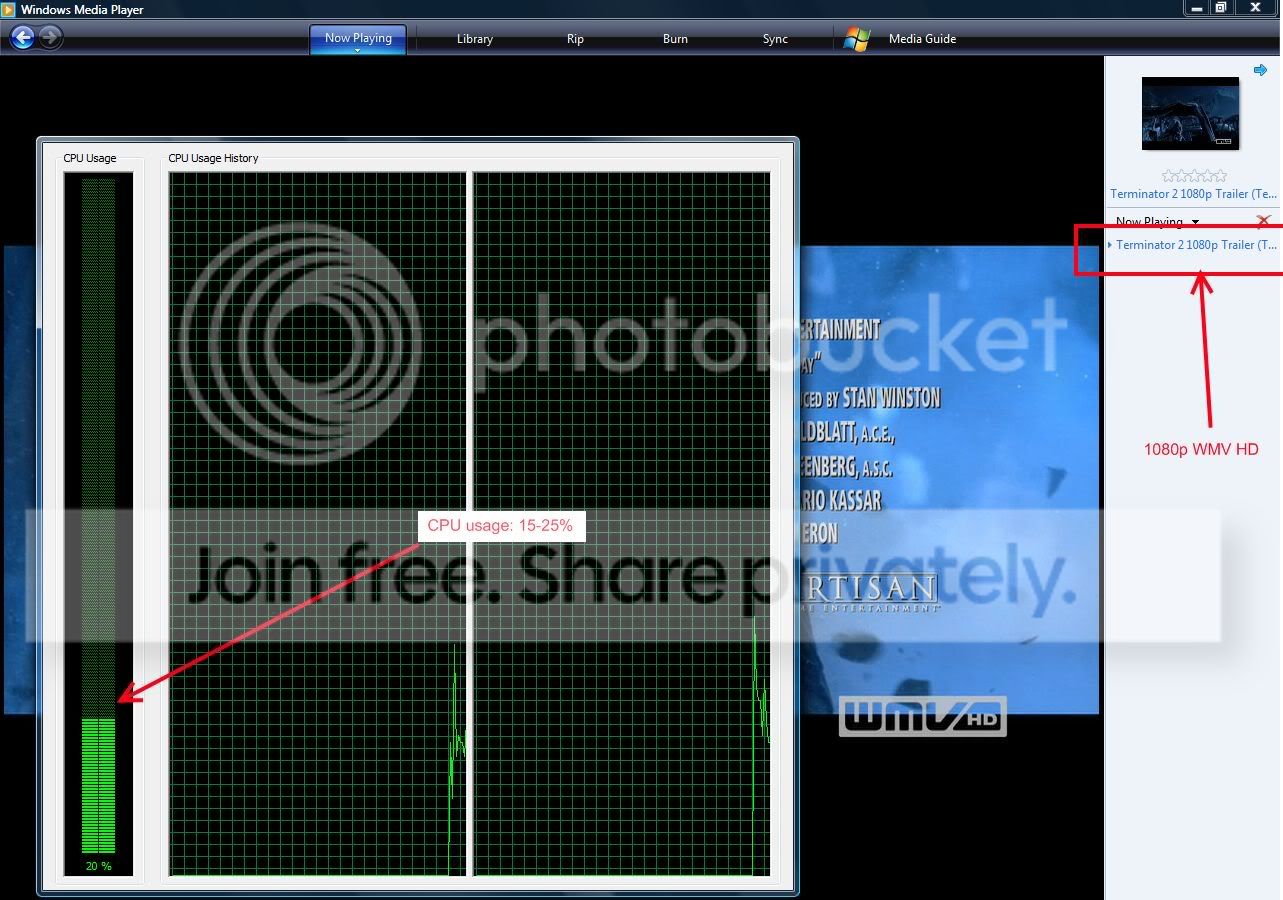
well dude if you fit and Radeon 3 or 4 series card to it and play the same video your cpu ony use baout 5% of ur cpu pow
er
No it won't. Did you check the other link I gave you? nVidia uses only a few %s higher. I'm sure it won't go below 15% on average.randiljosh said:well dude if you fit and Radeon 3 or 4 series card to it and play the same video your cpu ony use baout 5% of ur cpu pow
There are many things that are available in the actual hardware, but disabled on Geforce cards for marketing. They can be unlocked with a driver softmod. Others are just... missing. In the Geforce 6 days, it was the same hardware.chanster said:Quoted from Nvidia
12-Bit Subpixel Precision
3x that of the nearest competitive workstation graphics, 12-bit sub-pixel precision delivers high geometric accuracy, eliminating spreckles, cracks, and other rasterization anomalies.
32-Bit Floating Point Precision
Sets new standards for image clarity and quality through 32-bit floating point capabilities in shading, filtering, texturing, and blending. Enables unprecedented rendered image quality for visual effects processing.
32-Bit Filtering and Blending
Enables unprecedented rendered image quality for visual effects processing.
Advanced Color Compression, Early Z-Cull
Improved pipeline color compression and early z-culling to increase effective bandwidth and improve rendering efficiency and performance.
Cg High-Level Graphics Shader Language
Cg—"C" for graphics—is a high-level, open-standard programming language for OpenGL that takes advantage of the power of programmable GPUs. NVIDIA Quadro FX programmable graphics pipelines leverage high-level shading languages to enable the creation and integration of real-time photorealistic effects into 3D models, scenes, and designs. This represents a major leap forward in ease and speed for the creation of real-time, realistic graphics within MCAD, DCC, and scientific applications.
Essential for Microsoft Windows® Vista
Offering an enriched 3D user interface, increased application performance, and the highest image quality, NVIDIA Quadro graphics boards and NVIDIA® OpenGL ICD drivers are optimized for 32- and 64-bit architectures to enable the best Windows® Vista™ experience.
Frame Synchronization (G-Sync Option)
Allows the display channels from multiple workstations to be synchronized, thus creating one large "virtual display" that can be driven by a multisystem cluster for performance scalability.
Full 128-Bit Precision Graphics Pipeline
Enables sophisticated mathematical computations to maintain high accuracy, resulting in unmatched visual quality. Full IEEE 32-bit floating-point precision per color component (RGBA) delivers millions of color variations with the broadest dynamic range.
Full-Scene Antialiasing (FSAA)
Up to 32x SLIAA and 16x FSAA dramatically reduces visual aliasing artifacts or "jaggies" at resolutions up to 1920x1200, resulting in highly realistic scenes.
Genlock/Frame Lock (G-Sync Option)
Also known as "house sync." Genlock allows the graphics output to synchronized to an external source, typically for film and broadcast video applications.
Hardware 3D Window Clipping
Hardware accelerated clip regions (data transfer mechanism between a window and the frame buffer) which improve overall graphics performance by increasing transfer speed between color buffer and frame buffer.
Hardware-Accelerated Pixel Read-Back
Up to 2.4GB/sec pixel read-back performance delivers massive host throughput, more than 10x the performance of previous generation graphic systems.
Highest Workstation Application Performance
Next-generation architecture enables over 2x improvement in geometry and fill rates with the industry's highest performance for professional CAD, DCC, and scientific applications.
High-Performance Display Outputs
400MHz RAMDACs and up to two DVI digital connectors drive the highest resolution digital displays available on the market.
NVIDIA High Precision, High Dynamic-Range Technology
Sets new standards for image clarity and quality through floating point capabilities in shading, filtering, texturing, and blending. Enables unprecedented rendered image quality for visual effects processing.
NVIDIA PureVideo Technology
NVIDIA PureVideo™ technology is the combination of high-definition video processors and software that delivers unprecedented picture clarity, smooth video, accurate color, and precise image scaling for SD and HD video content. Features include, high-quality scaling, spatial temporal de-interlacing, inverse telecine, and high quality HD video playback from DVD.
NVIDIA PureVideo HD Technology
The ultimate high-definition movie experience on your PC by combining high-definition movie decode acceleration and post-processing, HDCP circuitry, and integration with HD movie players. It delivers superb picture quality for all video formats, as well as stunning HD DVD HD DVD and Blu-ray movies—with low CPU utilization and power consumption.
NVIDIA Quadro Unified Memory Architecture
Allows for superior memory management, which efficiently allocates and shares memory resources between concurrent graphics windows and applications.
NVIDIA SLI™ Technology
A revolutionary platform innovation that enables professional users to dynamically scale graphics performance, enhance image quality, and expand display real estate. Available on NVIDIA Quadro FX 5600, 5500, 4600, 4500, 3500, and 3450 GPUs.
NVIDIA Unified Architecture
Industry's first unified architecture designed to dynamically allocate compute, geometry, shading and pixel processing power to deliver optimized GPU performance.
nView Multi-Display Technology
The NVIDIA® nView® hardware and software technology combination delivers maximum flexibility for multi-display options, and provides unprecedented end-user control of the desktop experience. NVIDIA GPUs are designed to support multi-displays, but graphics cards vary. Please verify multi-display support in the graphics card before purchasing.
PCI Express Certified
PCI Express is a new Intel bus architecture that doubles the bandwidth of the AGP 8X bus, delivering greater than 2GB/sec. in both upstream and downstream data transfers.
Quad Buffered Stereo
Offers enhanced visual experience for professional applications that demand stereo viewing capability.
Rotated-Grid Full-Scene Antialiasing (RG FSAA)
The rotated grid FSAA sampling algorithm introduces far greater sophistication in the sampling pattern, significantly increasing color accuracy and visual quality for edges and lines, reducing "jaggies" while maintaining performance.
Unified Driver Architecture (UDA)
The NVIDIA UDA guarantees forward and backward compatibility with software drivers. Simplifies upgrading to a new NVIDIA product because all NVIDIA products work with the same driver software."
Many of the above features are not included in the geforce card. Driver based, hardware based i don't know....Well more memory is hardware based....Some of the "better picture clarity" features are also there if you read.AFAIK the Quadro delivers superior picture quality for all video formats and Animation apps.
Then by all means you are correct. But note that the Nvidia can also enable AA. sometimes you get better FPS than the ATI sometimes you don't as Anusha said. I also can direct you to links stating that the GTX beats the 4850 when AA is enabled. I put toms first
Similar threads


- Replies
- 6
- Views
- 649


- Replies
- 1
- Views
- 362
