


How to Limit Current with a Resistor
Some components, such as light-emitting diodes, are very sensitive to current. A few milliamps of current is enough to make an LED glow; a few hundred milliamps is enough to destroy the LED.
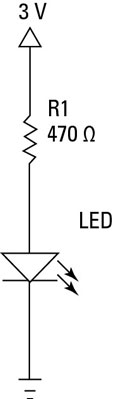
The technical specifications of the LED tell you how much current the LED can handle. In the case of a standard 5 mm red LED the maximum allowable current is 28 mA.
To be safe and make sure that you don't destroy the LED with too much current, round the maximum current down to 25 mA.
To calculate the desired resistance, you divide the voltage (3 V) by the current (0.025 A). The result is 120 Ω.
Do not connect the LED directly to the battery without a resistor. If you do, the LED will flash brightly, and then it will be dead forever.
Some components, such as light-emitting diodes, are very sensitive to current. A few milliamps of current is enough to make an LED glow; a few hundred milliamps is enough to destroy the LED.
The technical specifications of the LED tell you how much current the LED can handle. In the case of a standard 5 mm red LED the maximum allowable current is 28 mA.
To be safe and make sure that you don't destroy the LED with too much current, round the maximum current down to 25 mA.
To calculate the desired resistance, you divide the voltage (3 V) by the current (0.025 A). The result is 120 Ω.
Do not connect the LED directly to the battery without a resistor. If you do, the LED will flash brightly, and then it will be dead forever.





