
Latest ads
-
 Baseus PI LITE INDOOR CAMERA
- ErMurazor
- Updated:
-
Colombo Hard Disk For Sale
- mazza
- Updated:
-
 land for sale
- justasking
- Updated:
-
 AMD AM 5 Ryzen setup
- prabodhamadusanka
- Updated:
-
 Gampaha ACER OKW223 Wired RGB Keyboard
- chint
- Updated:
machan la world speed ma car eka mokak da ban.......
- Thread starter chamara_p
- Start date
You are using an out of date browser. It may not display this or other websites correctly.
You should upgrade or use an alternative browser.
You should upgrade or use an alternative browser.


he Veyron features a W16 engine — 16 cylinders in two banks of eight cylinders, or the equivalent of two narrow-angle V8 engines mated in a "W" configuration. Each cylinder has 4 valves for a total of 64, but the narrow staggered 8 configuration allows two camshafts to drive two banks of cylinders so only 4 camshafts are needed. The engine is fed by four turbochargers and displaces 8.0 L (7,993 cc/488 cu in) with a square 86 mm by 86 mm (3.4 in × 3.4 in) bore and stroke.


Bugatti Veyron's 16.4 engine
The transmission consists of a dual-clutch Direct-Shift Gearbox computer-controlled manual gearbox with seven gear ratios, with red paddles behind the steering wheel boasting an <150 ms shift time. This is designed and manufactured by Ricardo of England (and not Borg-Warner who designed the 6-speed DSG used in the mainstream marques of the Volkswagen Group). The Veyron can be driven as a full automatic transmission. It also features full-time four-wheel drive, utilising the Haldex Traction system. It uses special Michelin run-flat tyres, designed specifically for the Veyron to accommodate its top speed, which reportedly cost $25,000 US per set.[13] Curb weight is 2,034.8 kg (4,486 lb).[13] This gives the car a power to weight ratio of 4.5 lb (2.0 kg)/1 bhp (0.7 kW).
The car's wheelbase is 2710 mm (106.7 in). Overall length is 4462 mm (175.7 in), width 1998 mm (78.7 in) and height 1204 mm (47.4 in).

The Veyron's hydraulic rear spoiler in the extended position
The Bugatti Veyron has a total of 10 radiators.[14]
[edit] Power
According to Volkswagen (and approved by TÜV Süddeutschland), the final production Veyron engine produces 1,001 PS (736 kW; 987 hp) and 1,250 N·m (920 ft·lbf) of torque.[2] The horsepower figure is believed by some to actually be conservative, with the real total being 1001 or more.[17]
[edit] Top speed
Top speed was initially promised to be 420 km/h (260 mph), but test versions were unstable at that speed, forcing a redesign of the aerodynamics. In May 2005, a prototype Veyron tested at a Volkswagen track near Wolfsburg, Germany recorded an electronically limited top speed of 400 km/h (249 mph). In October 2005, Car and Driver magazine's editor Csaba Csere test drove the final production version of the Veyron for the November 2005 issue. This test, at Volkswagen's Ehra-Lessien test track, reached a top speed of 407.5 km/h (253.2 mph). The top speed was verified once again by James May on Top Gear, again at Volkswagen's private test track, when the car hit 407.9 km/h (253.5 mph), which equated to precisely one-third of the speed of sound at sea level. When getting close to the top speed during the test, May said that "the tyres will only last for about fifteen minutes, but it's okay because the fuel runs out in twelve minutes." He also gave an indication of the power requirements, at constant 250 km/h (155 mph) the Veyron is using approximately 270 to 280 horsepower (200 to 210 kW)[18], but to get to its rated 407 km/h (253 mph) top speed required far more from the engine. Once back in the Top Gear studio James was asked by co - presenter Jeremy Clarkson what the Veyron felt like to drive at 407 km/h (253 mph), James replied that it was "completely undramatic", and very stable at speed.
Aerodynamic friction or drag is proportional to the square of the speed; for example doubling speed quadruples drag. Work is a product of force applied over a distance travelled. Comparing a vehicle travelling at 160 km/h (99 mph) with one travelling at 320 km/h (200 mph), over a given time (e.g. 1 second), the faster vehicle must overcome 4 times the aerodynamic drag, and travel twice the distance of the slower one. Thus it does 8 times the work of the slower vehicle in that time. As power is work done in time taken it follows that the swifter vehicle, travelling at twice the speed requires 8 times the power of the slower one. German inspection officials recorded an average top speed of 408.47 km/h (253.8 mph)[3] during test sessions on the Ehra Lessien test track on 2005-04-19.
The car's everyday top speed is listed at 375 km/h (233 mph). When the car reaches 220 km/h (137 mph), hydraulics lower the car until it has a ground clearance of about 8.9 cm (3½ inches). At the same time, the wing and spoiler deploy. This is the "handling mode", in which the wing helps provide 3425 newtons (770 pounds) of downheft, holding the car to the road.[14] The driver must, using a special key (the "Top Speed Key"), toggle the lock to the left of his seat in order to attain the maximum (average) speed of 407 km/h (253 mph). The key functions only when the vehicle is at a stop, when a checklist then establishes whether the car—and its driver—are ready to enable 'top speed' mode. If all systems are go, the rear spoiler retracts, the front air diffusers shut and the ground clearance, normally 12.5 cm (4.9 in), drops to 6.5 cm (2.6 in).
[edit] Acceleration
The Bugatti Veyron has the greatest acceleration of any production car to date, reaching 100 km/h (62 mph) in approximately 2.46 seconds.[19], which equates to an average acceleration of around 1.18g. It is the first production car with an average acceleration greater than 1 g when going from 0 to 100 km/h (62 mph) flat out. The car is greatly aided in achieving such times by a four-wheel drive system that enables the transmission of such great amounts of power in the initial stages of acceleration.
The Veyron reaches 200 km/h (124.3 mph) and 300 km/h (186.4 mph) in 7.0 and 16.2 seconds respectively. According to the February 2007 issue of Road & Track magazine, the Veyron accomplished the quarter mile (~400 m) in 10.2 seconds at an exit speed of 143.6 mph (231.1 km/h).
[edit] Fuel consumption
The Veyron consumes more fuel than any other production car, using 40.4 L/100 km (6.99 mpg-imp; 5.82 mpg-US) in city driving and 24.1 L/100 km (11.7 mpg-imp; 9.76 mpg-US) in combined cycle.[citation needed] At full throttle, it uses more than 115 L/100 km (2.46 mpg-imp; 2.05 mpg-US), which would empty its 100 L (22 imp gal; 26 US gal) fuel tank in just 12 minutes.[20][21]
[edit] Braking
The Veyron's brakes use cross-drilled, radially-vented Carbon fibre-reinforced Silicon Carbide (C/SiC) composite discs, manufactured by SGL Carbon, which have a much greater resistance to brake fade when compared with conventional cast iron discs. The aluminium alloy monobloc brake calipers are made by AP Racing; the fronts have eight[14] titanium pistons and the rear calipers have six pistons. Bugatti claims maximum deceleration of 1.3 Gs on road tyres.
Prototypes have been subjected to repeated 1.0G braking from 194 to 50 MPH (312 to 80 km/h) without fade. With the car's acceleration from 50 to 194 mph (80 to 312 km/h), that test can be performed every 22 seconds. At speeds above 124 mph (200 km/h), the rear wing also acts as an airbrake, snapping to a 55-degree angle in 0.4 seconds once brakes are applied, providing 0.68 Gs (4.9 m/s²) of deceleration (equivalent to the stopping power of an ordinary hatchback).[14] Bugatti claims the Veyron will brake from 400 km/h (249 mph) to a standstill in less than 10 seconds.[14]
[edit] Final numbers
Statistics and specifications[22] Basic stats Vehicle Mid-engine, 4-wheel drive 2-door coupe Base price €1,100,000 (£899,000/$1,500,000) Engine Quad-turbocharged DOHC 64-valve W16 Engine displacement 7993 cc (488 cu in) Performance Top speed 408.47 km/h (253.81 mph) (average) 0–100 km/h (62 mph) 2.46 seconds[19] 0–160 km/h (99 mph) 5.2 seconds 0–240 km/h (149 mph) 8.6 seconds 0–320 km/h (199 mph)[23] 24.0 seconds 0–400 km/h (249 mph)[24][25] 50 seconds Standing quarter-mile (402 m)[25] 10.0 seconds at 232 km/h (144 mph) Fuel economy[26] EPA city driving 10 miles per US gallon (24 L/100 km; 12 mpg-imp) EPA highway driving 12 miles per US gallon (20 L/100 km; 14 mpg-imp) Top speed fuel economy 3 miles per US gallon (78 L/100 km; 3.6 mpg-imp) 1.8 gallons[clarification needed] per minute

Bugatti Veyron's 16.4 engine
The transmission consists of a dual-clutch Direct-Shift Gearbox computer-controlled manual gearbox with seven gear ratios, with red paddles behind the steering wheel boasting an <150 ms shift time. This is designed and manufactured by Ricardo of England (and not Borg-Warner who designed the 6-speed DSG used in the mainstream marques of the Volkswagen Group). The Veyron can be driven as a full automatic transmission. It also features full-time four-wheel drive, utilising the Haldex Traction system. It uses special Michelin run-flat tyres, designed specifically for the Veyron to accommodate its top speed, which reportedly cost $25,000 US per set.[13] Curb weight is 2,034.8 kg (4,486 lb).[13] This gives the car a power to weight ratio of 4.5 lb (2.0 kg)/1 bhp (0.7 kW).
The car's wheelbase is 2710 mm (106.7 in). Overall length is 4462 mm (175.7 in), width 1998 mm (78.7 in) and height 1204 mm (47.4 in).

The Veyron's hydraulic rear spoiler in the extended position
The Bugatti Veyron has a total of 10 radiators.[14]
- 3 radiators for the engine cooling system.
- 1 heat exchanger for the air-to-liquid intercoolers.
- 2 for the air conditioning system.
- 1 transmission oil radiator.
- 1 differential oil radiator.
- 1 engine oil radiator.
- 1 hydraulic oil radiator for the spoiler
[edit] Power
According to Volkswagen (and approved by TÜV Süddeutschland), the final production Veyron engine produces 1,001 PS (736 kW; 987 hp) and 1,250 N·m (920 ft·lbf) of torque.[2] The horsepower figure is believed by some to actually be conservative, with the real total being 1001 or more.[17]
[edit] Top speed
Top speed was initially promised to be 420 km/h (260 mph), but test versions were unstable at that speed, forcing a redesign of the aerodynamics. In May 2005, a prototype Veyron tested at a Volkswagen track near Wolfsburg, Germany recorded an electronically limited top speed of 400 km/h (249 mph). In October 2005, Car and Driver magazine's editor Csaba Csere test drove the final production version of the Veyron for the November 2005 issue. This test, at Volkswagen's Ehra-Lessien test track, reached a top speed of 407.5 km/h (253.2 mph). The top speed was verified once again by James May on Top Gear, again at Volkswagen's private test track, when the car hit 407.9 km/h (253.5 mph), which equated to precisely one-third of the speed of sound at sea level. When getting close to the top speed during the test, May said that "the tyres will only last for about fifteen minutes, but it's okay because the fuel runs out in twelve minutes." He also gave an indication of the power requirements, at constant 250 km/h (155 mph) the Veyron is using approximately 270 to 280 horsepower (200 to 210 kW)[18], but to get to its rated 407 km/h (253 mph) top speed required far more from the engine. Once back in the Top Gear studio James was asked by co - presenter Jeremy Clarkson what the Veyron felt like to drive at 407 km/h (253 mph), James replied that it was "completely undramatic", and very stable at speed.
Aerodynamic friction or drag is proportional to the square of the speed; for example doubling speed quadruples drag. Work is a product of force applied over a distance travelled. Comparing a vehicle travelling at 160 km/h (99 mph) with one travelling at 320 km/h (200 mph), over a given time (e.g. 1 second), the faster vehicle must overcome 4 times the aerodynamic drag, and travel twice the distance of the slower one. Thus it does 8 times the work of the slower vehicle in that time. As power is work done in time taken it follows that the swifter vehicle, travelling at twice the speed requires 8 times the power of the slower one. German inspection officials recorded an average top speed of 408.47 km/h (253.8 mph)[3] during test sessions on the Ehra Lessien test track on 2005-04-19.
The car's everyday top speed is listed at 375 km/h (233 mph). When the car reaches 220 km/h (137 mph), hydraulics lower the car until it has a ground clearance of about 8.9 cm (3½ inches). At the same time, the wing and spoiler deploy. This is the "handling mode", in which the wing helps provide 3425 newtons (770 pounds) of downheft, holding the car to the road.[14] The driver must, using a special key (the "Top Speed Key"), toggle the lock to the left of his seat in order to attain the maximum (average) speed of 407 km/h (253 mph). The key functions only when the vehicle is at a stop, when a checklist then establishes whether the car—and its driver—are ready to enable 'top speed' mode. If all systems are go, the rear spoiler retracts, the front air diffusers shut and the ground clearance, normally 12.5 cm (4.9 in), drops to 6.5 cm (2.6 in).
[edit] Acceleration
The Bugatti Veyron has the greatest acceleration of any production car to date, reaching 100 km/h (62 mph) in approximately 2.46 seconds.[19], which equates to an average acceleration of around 1.18g. It is the first production car with an average acceleration greater than 1 g when going from 0 to 100 km/h (62 mph) flat out. The car is greatly aided in achieving such times by a four-wheel drive system that enables the transmission of such great amounts of power in the initial stages of acceleration.
The Veyron reaches 200 km/h (124.3 mph) and 300 km/h (186.4 mph) in 7.0 and 16.2 seconds respectively. According to the February 2007 issue of Road & Track magazine, the Veyron accomplished the quarter mile (~400 m) in 10.2 seconds at an exit speed of 143.6 mph (231.1 km/h).
[edit] Fuel consumption
The Veyron consumes more fuel than any other production car, using 40.4 L/100 km (6.99 mpg-imp; 5.82 mpg-US) in city driving and 24.1 L/100 km (11.7 mpg-imp; 9.76 mpg-US) in combined cycle.[citation needed] At full throttle, it uses more than 115 L/100 km (2.46 mpg-imp; 2.05 mpg-US), which would empty its 100 L (22 imp gal; 26 US gal) fuel tank in just 12 minutes.[20][21]
[edit] Braking
The Veyron's brakes use cross-drilled, radially-vented Carbon fibre-reinforced Silicon Carbide (C/SiC) composite discs, manufactured by SGL Carbon, which have a much greater resistance to brake fade when compared with conventional cast iron discs. The aluminium alloy monobloc brake calipers are made by AP Racing; the fronts have eight[14] titanium pistons and the rear calipers have six pistons. Bugatti claims maximum deceleration of 1.3 Gs on road tyres.
Prototypes have been subjected to repeated 1.0G braking from 194 to 50 MPH (312 to 80 km/h) without fade. With the car's acceleration from 50 to 194 mph (80 to 312 km/h), that test can be performed every 22 seconds. At speeds above 124 mph (200 km/h), the rear wing also acts as an airbrake, snapping to a 55-degree angle in 0.4 seconds once brakes are applied, providing 0.68 Gs (4.9 m/s²) of deceleration (equivalent to the stopping power of an ordinary hatchback).[14] Bugatti claims the Veyron will brake from 400 km/h (249 mph) to a standstill in less than 10 seconds.[14]
[edit] Final numbers
Statistics and specifications[22] Basic stats Vehicle Mid-engine, 4-wheel drive 2-door coupe Base price €1,100,000 (£899,000/$1,500,000) Engine Quad-turbocharged DOHC 64-valve W16 Engine displacement 7993 cc (488 cu in) Performance Top speed 408.47 km/h (253.81 mph) (average) 0–100 km/h (62 mph) 2.46 seconds[19] 0–160 km/h (99 mph) 5.2 seconds 0–240 km/h (149 mph) 8.6 seconds 0–320 km/h (199 mph)[23] 24.0 seconds 0–400 km/h (249 mph)[24][25] 50 seconds Standing quarter-mile (402 m)[25] 10.0 seconds at 232 km/h (144 mph) Fuel economy[26] EPA city driving 10 miles per US gallon (24 L/100 km; 12 mpg-imp) EPA highway driving 12 miles per US gallon (20 L/100 km; 14 mpg-imp) Top speed fuel economy 3 miles per US gallon (78 L/100 km; 3.6 mpg-imp) 1.8 gallons[clarification needed] per minute


ow ow ai mekath thibune dakke nadda????????? jkkasunsurendra said:Oka tiyanava neda undercover game eke......


MAchan mena thread eka all info about it is there http://www.elakiri.com/forum/showthread.php?p=4133180#post4133180

Machan ooka nemei loke speedma car eka..
It's SSC Ultimate Aero
Ultimate Aero Specifications
Engine
Type: SSC Designed Billet Aluminum V8 Block Displacement: 387.2 cu.in. Bore x Stroke: 4.125 x 3.620" Compression Ratio: 8.975:1 Horsepower: 1287 bhp @ 6075 rpm Torque: 1112 ft-lbs @ 6150 rpm Redline: 7200 rpm Fuel Injection: Electronic Sequential Port Weight: 422 lbs. Oil: SAE 5W/30 Fully Synthetic Racing Induction System: Sequential, multi-port fuel injection, Twin Turbo Chargers. Dual-Water to Air Intercoolers. Fuel: Premium Unleaded - 91 Pump Octane

Warranty
Basic Warranty: 1 Year / Unlimited Miles Powertrain: 1 Year / Unlimited Miles Rust-Through: N/A Chassis & Body
Layout: Mid-Engine/Rear Drive Body/Frame: Carbon Fiber/Composite/Steel
Space Frame Brakes: Front: 14.0" Vented Slotted Discs/8-Piston Caliper.
Rear: 14.0" Vented Slotted Discs/6-Piston Caliper. Wheels: Forged 3-Piece Alloy 19x9-1/2" Front, 20x13" Rear Tires: Michelin Pilot Sport PS2
Front: 235 35 (YR)19.
Rear: 335 30 (YR)20.

Steering: Rack and Pinion, Assisted Turns, Lock to Lock: 2.5 Turning Circle: 41.6 ft. Suspension: Front: Unequal Length Upper and Lower A-Arms, Coil Over Springs, Remote Reservoir-Adjustable Penske Coil-Over Shocks, Cab Controlled Air Lift, Anti-Roll Bar.
Rear: Unequal Lengths Upper Rocker and Lower A-Arm, Adjustable Coil-Over Springs, Remote Reservoir-Adjustable Penske Coil-Over Shock, Anti-Roll Bar. The Ultimate Aero Dynamics
Coefficient of Drag (Cd): 0.357 Frontal Area: 19.0 sq. ft. Belly Pan: Complete flat belly pan with rear Venturi tunnels. General Data
Dry Weight: 2,750 lbs. Weight to Horsepower
Ratio (lbs/hp): 2.14 - New Production Record! Weight Distribution F/R: Front: 42%
Rear: 58% Wheel Base: 105.2" Length: 176.2" Width: 82.7" Height: 43.0" Ground Clearance: 4.0"

Accomodations
Seating Capacity: 2 Custom Recaro Seats Headroom: 38.5" Seat Width: 2 x 19" Leg Room: 47.0" Seat Back Adjustment: 25º Seat Travel: 6.0"

Drive Train
Gear Ratio RPM MPH 1st 3.00:1 7200 58.517 2nd 2.15:1 7200 81.651 3rd 1.5:1 7200 117.033 4th 1.1304:1 7200 155.294 5th 0.8667:1 7200 202.557 6th 0.6452:1 7200 272.102
Gauges: 260-mph Speedometer, 8000-rpm Tachometer, Sequential Shift Lights, Horsepower Gauge, Oil Pressure, Water Temperature, Fuel Level, Volt Audio/Video: Navigation System, 10-Speaker Premium Audio/CD/DVD System, 7.5" Video/DVD Screen, Automatic Back-Up Camera

Standard Equipment
Includes: Air Conditioning, Power Windows, Power Mirrors, Tilt-Steering, Cab-Controlled Front Air Lift Record-Breaking Times
0-60 mph: 2.78 seconds 1/4 Mile: 9.90 seconds at 144 mph Top Speed: 257.41 MPH / Official Average: 256.15 MPH Skidpad: 1.05 g 0-100mph-0: 11.66 60mph-0 (braking): 103 feet Exterior Standard Colors
 Interior Standard Colors
Standard Colors: Black, Tan, Creme, Gray and Red Custom Colors: Available Upon Request
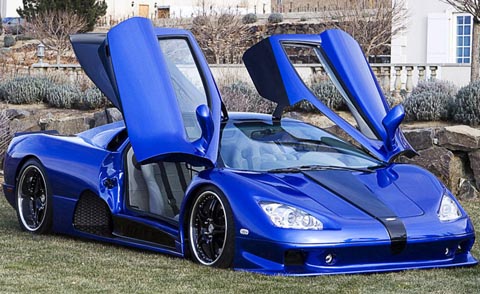

It's SSC Ultimate Aero
Ultimate Aero Specifications
Engine
Type: SSC Designed Billet Aluminum V8 Block Displacement: 387.2 cu.in. Bore x Stroke: 4.125 x 3.620" Compression Ratio: 8.975:1 Horsepower: 1287 bhp @ 6075 rpm Torque: 1112 ft-lbs @ 6150 rpm Redline: 7200 rpm Fuel Injection: Electronic Sequential Port Weight: 422 lbs. Oil: SAE 5W/30 Fully Synthetic Racing Induction System: Sequential, multi-port fuel injection, Twin Turbo Chargers. Dual-Water to Air Intercoolers. Fuel: Premium Unleaded - 91 Pump Octane

Warranty
Basic Warranty: 1 Year / Unlimited Miles Powertrain: 1 Year / Unlimited Miles Rust-Through: N/A Chassis & Body
Layout: Mid-Engine/Rear Drive Body/Frame: Carbon Fiber/Composite/Steel
Space Frame Brakes: Front: 14.0" Vented Slotted Discs/8-Piston Caliper.
Rear: 14.0" Vented Slotted Discs/6-Piston Caliper. Wheels: Forged 3-Piece Alloy 19x9-1/2" Front, 20x13" Rear Tires: Michelin Pilot Sport PS2
Front: 235 35 (YR)19.
Rear: 335 30 (YR)20.

Steering: Rack and Pinion, Assisted Turns, Lock to Lock: 2.5 Turning Circle: 41.6 ft. Suspension: Front: Unequal Length Upper and Lower A-Arms, Coil Over Springs, Remote Reservoir-Adjustable Penske Coil-Over Shocks, Cab Controlled Air Lift, Anti-Roll Bar.
Rear: Unequal Lengths Upper Rocker and Lower A-Arm, Adjustable Coil-Over Springs, Remote Reservoir-Adjustable Penske Coil-Over Shock, Anti-Roll Bar. The Ultimate Aero Dynamics
Coefficient of Drag (Cd): 0.357 Frontal Area: 19.0 sq. ft. Belly Pan: Complete flat belly pan with rear Venturi tunnels. General Data
Dry Weight: 2,750 lbs. Weight to Horsepower
Ratio (lbs/hp): 2.14 - New Production Record! Weight Distribution F/R: Front: 42%
Rear: 58% Wheel Base: 105.2" Length: 176.2" Width: 82.7" Height: 43.0" Ground Clearance: 4.0"

Accomodations
Seating Capacity: 2 Custom Recaro Seats Headroom: 38.5" Seat Width: 2 x 19" Leg Room: 47.0" Seat Back Adjustment: 25º Seat Travel: 6.0"

Drive Train
Gear Ratio RPM MPH 1st 3.00:1 7200 58.517 2nd 2.15:1 7200 81.651 3rd 1.5:1 7200 117.033 4th 1.1304:1 7200 155.294 5th 0.8667:1 7200 202.557 6th 0.6452:1 7200 272.102
Final Drive Ratio: 3.4444:1
Engine RPM @ 60 Top Gear: 1550
InstrumentationEngine RPM @ 60 Top Gear: 1550
Gauges: 260-mph Speedometer, 8000-rpm Tachometer, Sequential Shift Lights, Horsepower Gauge, Oil Pressure, Water Temperature, Fuel Level, Volt Audio/Video: Navigation System, 10-Speaker Premium Audio/CD/DVD System, 7.5" Video/DVD Screen, Automatic Back-Up Camera

Standard Equipment
Includes: Air Conditioning, Power Windows, Power Mirrors, Tilt-Steering, Cab-Controlled Front Air Lift Record-Breaking Times
0-60 mph: 2.78 seconds 1/4 Mile: 9.90 seconds at 144 mph Top Speed: 257.41 MPH / Official Average: 256.15 MPH Skidpad: 1.05 g 0-100mph-0: 11.66 60mph-0 (braking): 103 feet Exterior Standard Colors

Standard Colors: Black, Tan, Creme, Gray and Red Custom Colors: Available Upon Request

Similar threads


- Replies
- 32
- Views
- 1K


- Replies
- 10
- Views
- 796


- Replies
- 127
- Views
- 12K
