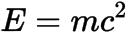
According to the
formula, What happened to the mass of the matter when its speed is closing to speed of light?
Let me explain this step by step:
1) When an object moves at very high speeds (close to the speed of light), we need to use relativistic mass equations. The formula for relativistic mass is:
m = m₀/√(1 - v²/c²)
Where:
- m is the relativistic mass
- m₀ is the rest mass (mass when not moving)
- v is the velocity of the object
- c is the speed of light
2) Let's analyze what happens:
- As v gets closer to c
- The denominator √(1 - v²/c²) gets closer to zero
- When you divide by a number close to zero, the result gets very large
3) This means:
- The mass increases as the object's speed increases
- The closer the speed gets to the speed of light, the more dramatically the mass increases
- As v approaches c, the mass would approach infinity
4) This is why:
- It's impossible for any object with mass to actually reach the speed of light
- It would require infinite energy to accelerate a mass to light speed
- Only massless particles (like photons) can travel at the speed of light
This is one of the key insights of Einstein's Special Relativity - mass increases with velocity, making it impossible to reach the speed of light.